April 11, 2025
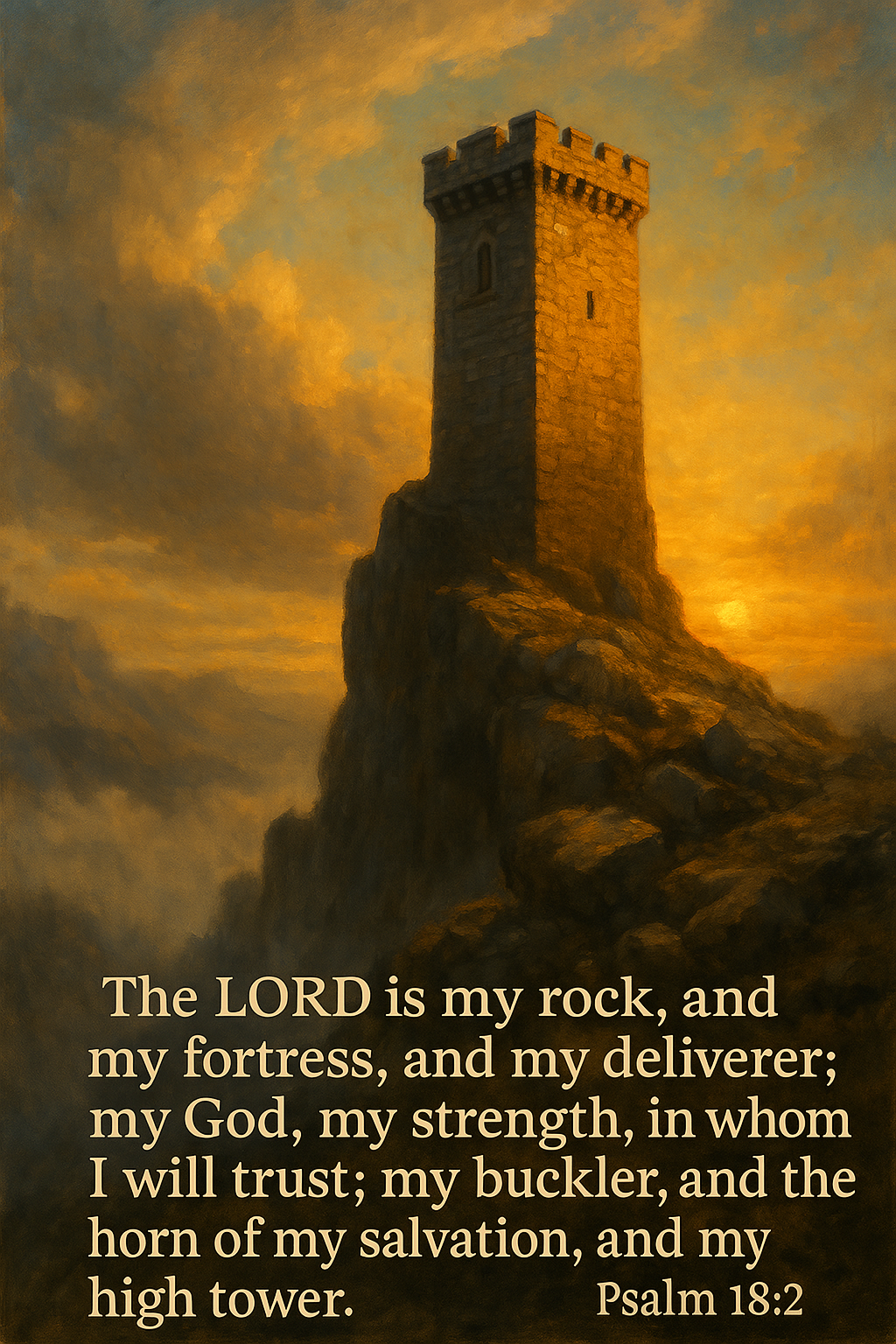
Psalm chapter 18 verse 2: “The LORD is my rock, and my fortress, and my deliverer; my God, my strength, in whom I will trust; my buckler, and the horn of my salvation, and my high tower.”
VERSE CONTEXT
This verse was written by David, the second king of Israel, who was both a warrior and a worshiper. Psalm 18, where this verse is found, is a personal song of praise that David wrote to the LORD on the day when he was delivered “from the hand of all his enemies, and from the hand of Saul” (Psalm 18, title). It’s a deeply intimate, autobiographical testimony of divine rescue and sustaining power.
David had spent years on the run from King Saul, hiding in caves, living among enemies, and narrowly escaping death more than once. The pressure of being God’s anointed while being hunted like a criminal would have been immense. Yet throughout it all, David maintained his relationship with the LORD and trusted in Him completely.
Psalm 18 is therefore not a theoretical psalm—it is born out of personal warfare, betrayal, and survival. Its core is deliverance.
The verse itself uses eight vivid metaphors to describe who God is to David:
- My rock – This refers to stability and a foundation. The Hebrew concept here involves something firm, unmovable, and protective—often a high rocky crag, a place of refuge in battle.
- My fortress – A fortress is a strong, fortified place of defense. David would have spent much of his fugitive life seeking such places in the wilderness.
- My deliverer – The one who rescues, who pulls out of danger. David is saying, “God is the One who gets me out when there’s no way out.”
- My God – This is personal. Not a god, but my God. It reflects the covenant relationship David had with the LORD.
- My strength – The Hebrew root here implies not just physical strength but firmness and reliability. When David was weak, he drew strength from the LORD.
- My buckler – An older term for a small, maneuverable shield, used in close combat. The LORD is not a distant shield, but One who defends at intimate range.
- The horn of my salvation – In biblical language, the horn is a symbol of power and victory. This phrase suggests God is the source of victorious salvation.
- My high tower – A refuge placed high above danger, where enemies cannot reach and where vision and protection are maximized.
What’s important is how deeply personal this verse is. David is not writing a theological textbook—he’s writing from the battlefield of life. The repetition of the word “my” reveals a relationship, not just knowledge. He doesn’t merely believe about God—he knows God Himself. This is his rock, his shield, his fortress.
The language of this verse is not poetic exaggeration. It is the hard-won truth of a man who had been saved time and time again by God’s direct intervention. This psalm is also duplicated nearly word-for-word in Second Samuel chapter 22, suggesting that David preserved this song as a personal anthem of praise throughout his life.
Additionally, some commentators view Psalm 18 as messianic, foreshadowing the deliverance Jesus would bring. While the psalm is rooted in David’s experience, it stretches forward prophetically to the ultimate Deliverer—Jesus Christ—who provides eternal refuge, strength, and salvation.
The psalm was likely first written for private devotion and then publicly shared for worship and instruction. As king, David was not only testifying to God’s deliverance in his own life but modeling for the people of Israel what trust in the LORD looked like during times of trial.
BROADER CONTEXT
Psalm 18 is among the longest psalms in the Book of Psalms, with 50 verses, and it is deeply autobiographical. It opens with a superscription that anchors it in a specific historical context: “A Psalm of David, the servant of the LORD, who spake unto the LORD the words of this song in the day that the LORD delivered him from the hand of all his enemies, and from the hand of Saul.” That preface gives us an undeniable clue to the emotional and historical backdrop of the chapter. This is not simply a moment of joy—it is a culmination of years of warfare, wilderness wandering, royal uncertainty, and constant peril.
This Psalm is also found almost identically in Second Samuel chapter 22, written during the final season of David’s life. That chapter acts as a retrospective song of praise—a spiritual memoir of deliverance. That helps us understand that this Psalm didn’t emerge from a single crisis, but was shaped over a lifetime of hardship. It gathers the memory of a thousand dangers and the consistency of God’s saving grace into one towering testimony.
The language of the Psalm shifts between high praise and detailed accounts of God’s acts. Verses 4–6 describe David’s distress: “The sorrows of death compassed me,” he says. In verse 7, the imagery becomes explosive as God arises in wrath to defend His servant. That section—verses 7–15—reads like a divine theophany (God appearing in dramatic form), with earthquakes, fire, and smoke. It paints God not as passive but as a warrior-king, rising to shake the heavens for the sake of His anointed.
The broader structure of the Psalm shows a movement from desperation to deliverance to exaltation:
- Verses 1–3: Declaration of trust and praise (where verse 2 is found).
- Verses 4–6: Cry of distress.
- Verses 7–19: God’s dramatic response.
- Verses 20–29: Reward for righteousness.
- Verses 30–45: Testimony of God’s strength in battle.
- Verses 46–50: Final praise and acknowledgment of God’s steadfast love.
Now, let’s narrow in on how verse 2 functions in that structure. It is part of the introductory declaration. David begins by saying, “I will love thee, O LORD, my strength” (verse 1), and then immediately launches into the comprehensive list of metaphors in verse 2. This is his foundational theology—everything that follows in the Psalm grows out of this understanding: God is stable, safe, rescuing, and trustworthy.
This is why verse 2 has become a lifeline for many believers, especially in seasons of anxiety, stress, and uncertainty. It does not belong to the battlefield alone—it belongs to the exhausted parent, the discouraged worker, the burdened minister, and the believer crushed by invisible burdens. That is why this verse is so powerful for a Friday. The end of the work week often represents emotional depletion. Many people are carrying burdens from the office, home, or personal life—and they may be holding on by a thread.
Psalm 18 verse 2 reminds us that God does not change. He is still a fortress. Still a rock. Still a deliverer. This is a declaration we can speak even while the battle rages—and it becomes an anchor that keeps our faith from drifting in the storm.
Matthew Henry (1662–1714), a Nonconformist minister and commentator, wrote that “those who by faith fly to God for support and shelter shall find Him a rock under their feet, a buckler over their heads, a horn of salvation on their heads, and a high tower in which they are safe.” His emphasis on God being a complete refuge—above, around, under, and within—is drawn directly from the language of this Psalm.
Charles Spurgeon (1834–1892), a Reformed Baptist preacher, echoed this idea when he said, “This verse is a perfect mosaic of precious stones gathered from the quarry of divine faithfulness.” That poetic language points us to a truth: each name David gives to God in this verse is not ornamental—it’s earned.
Whether David was hiding in the caves of Adullam, seeking refuge in the strongholds of Engedi, or walking the palace halls of Jerusalem as king, his confession remained the same: the LORD is his rock.
APPLICATION
Appreciating God’s Greatness
Psalm chapter 18 verse 2 is not a list of titles—it is a confession of experience. It magnifies the Lord by declaring what He is rather than simply what He does. David doesn’t say, “The LORD gives me strength”—he says, “The LORD is my strength.” That distinction matters. God is not a vendor of support—He is the very embodiment of it. He is the place we run to, the power we stand in, and the protection we depend on.
Each image in the verse—rock, fortress, deliverer, shield, horn, tower—gives us a multifaceted vision of God’s greatness. His strength is not one-dimensional. He is our defense in war, our safety in storms, our shelter in grief, and our victory in battle.
God’s greatness here is relational, not distant. These aren’t just majestic metaphors—they’re evidence of a living God who enters the chaos of our lives and establishes peace by His presence.
For the Believer
David’s words in this verse invite believers to rest in God’s character, not in their circumstances. Whether you’re facing battles like David or simply carrying the slow grind of daily responsibilities, the call is the same: run to the Rock.
For many, Friday brings exhaustion—not just physical, but emotional and spiritual. The workweek can leave people strained, overlooked, or spiritually dry. This verse reminds us that God is not worn out when we are. He doesn’t rest—He is the rest. He doesn’t need to be refilled to fill us. The “fortress” David speaks of is not far away or locked—it is open and ready.
That’s why this verse is especially meaningful at the end of a long week. The weekend is not just a break from work—it is an opportunity to refresh with praise and rebuild with prayer. When we slow down, we can once again see how safe we are in Him. Instead of retreating into worldly distraction, we can retreat into divine refuge. Worship becomes our weapon, and prayer becomes our high tower.
David trusted God not only in caves and palaces, but in the quiet spaces between. So should we.
Call to Action:
As the week winds down, take time this weekend to actively rest in the Lord. Don’t simply collapse into entertainment—enter into worship. Carve out moments of stillness to read this verse aloud. Personalize it: “LORD, You are my rock. My strength. My deliverer.” Let His identity settle your anxiety. Trust Him in every layer of stress, and let your weekend be shaped not by escape—but by encounter.
For the Unbeliever
If you do not yet belong to Christ, this verse still invites you in. It shows what is available to all who put their trust in the Lord. The God who was David’s refuge wants to be your refuge too.
The storms of life are no respecter of persons. They come to the rich and the poor, the faithful and the faithless. The difference is this: one stands exposed, the other is hidden in the fortress of God’s love.
The same God who protected David from spears, armies, and betrayal has extended His hand to you through Jesus Christ. Jesus is the ultimate deliverer—He didn’t just save a man from battle; He saved a world from sin.
You may have tried to be your own rock, your own strength, your own tower—but it doesn’t hold. Come to Christ. He is strong enough to carry your guilt, and gentle enough to hold your wounds. Let today be the day you call Him your rock.
FINAL ENCOURAGEMENT:
Psalm chapter 18 verse 2 is more than a declaration—it’s a shelter. It reminds us that the same God who defended David in the wilderness defends us in the chaos of our lives. Whether you’re facing battles of the heart, mind, or circumstances, the invitation is the same: trust in the Lord as your rock. You don’t have to hold yourself up. You don’t have to be your own strength. You don’t have to run without rest.
Let this weekend be a time not of collapse, but of communion. Praise the God who has sustained you all week, and find your peace not just in the absence of work—but in the presence of your Fortress. The LORD is not just a place to run—He is the only place strong enough to hold your heart.
PRAYER:
Heavenly Father,
Thank You for being our unshakable rock, our fortress in every storm, and our strength when we are weak. We come to You now with our burdens—some that we speak aloud, and others too deep for words. Let us find peace in knowing that You are our refuge, not just for today but for every tomorrow. Wrap Your presence around us this weekend. Restore our weary hearts. Help us to trust You, not just with our lips, but with our lives. And may we, like David, declare with confidence: You are my rock, my deliverer, and my high tower. In Jesus’ name we pray,
Amen.
CLOSING:
If you’ve found these daily verses encouraging, enlightening, or fruitful, please consider helping us spread the truth and light of God’s Word by subscribing to the blog and YouTube channels and liking and following the Facebook page. Most of all, share Believers of Biblical Truth and our links with others who may need the sermons and daily teachings just as much as we do.
You are loved—so much in fact, that we want you to know and be Believers of Biblical Truth.
Shalom Shalom.
 Believers of Biblical Truth
You must be logged in to post a comment.