
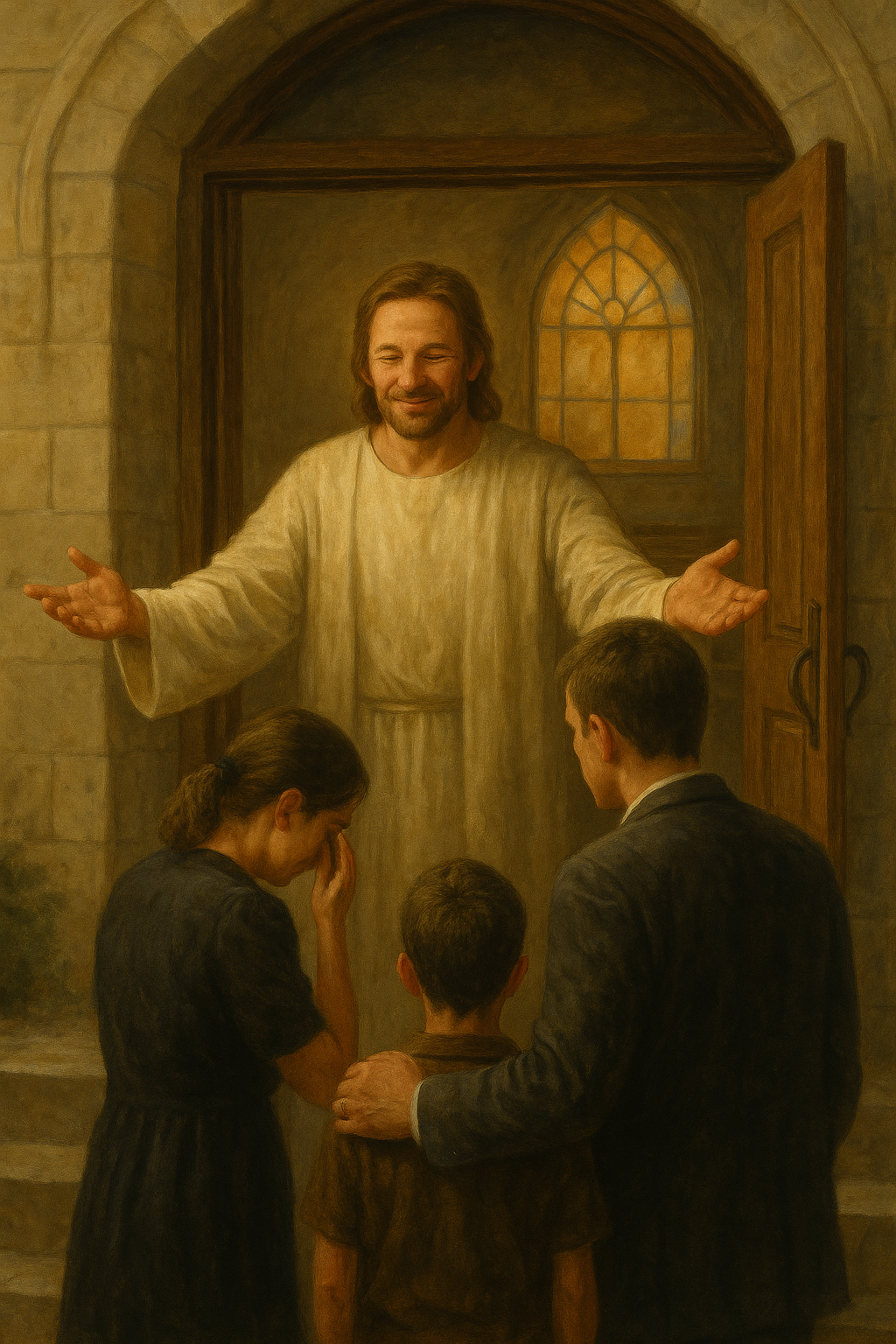
Matthew chapter 11 verses 28 through 30
"Come unto me, all ye that labour and are heavy laden, and I will give you rest. Take my yoke upon you, and learn of me; for I am meek and lowly in heart: and ye shall find rest unto your souls. For my yoke is easy, and my burden is light."
VERSE CONTEXT
Matthew chapter 11 verses 28 through 30 sits at the heart of a very personal moment in Jesus’ ministry. By the time we reach these verses, He has just finished publicly denouncing cities like Chorazin, Bethsaida, and Capernaum—places that had seen His miracles yet refused to repent. But rather than ending on a note of judgment, Jesus pivots to one of the most tender and hope-filled invitations in all of Scripture. He calls to those who are not merely rebellious, but weary—those crushed under the weight of life, whether by sin, sorrow, or the suffocating demands of religion.
Jesus begins by saying, “Come unto me, all ye that labour and are heavy laden, and I will give you rest.” This is not a soft offer or vague encouragement—it is a divine summons. The word “come” here is a present tense call, full of urgency and compassion. He is not calling the proud or the self-sufficient; He is calling those who “labour,” a word which means to be worn out from hard toil, and those who are “heavy laden,” describing the crushing weight placed on a person from the outside. In the immediate Jewish context, this would have reminded listeners of the unbearable burden placed upon them by the scribes and Pharisees who had bound them with hundreds of religious laws and expectations (see Matthew chapter 23 verse 4: “For they bind heavy burdens and grievous to be borne, and lay them on men’s shoulders…”). But the weight Jesus speaks of is more than legalism—it includes the soul-wearying weight of guilt, shame, grief, and hopelessness.
Then He says, “I will give you rest.” The word “rest” here is not just sleep or relief from physical labor—it is soul-level peace. It is the same deep relief promised in Jeremiah chapter 6 verse 16, where the old paths of the Lord were said to lead to “rest for your souls.” Jesus is revealing Himself here not only as the Teacher, but as the fulfillment of every promise ever made about peace, about restoration, and about rest in God. He doesn’t offer to lessen the burden; He offers to replace it.
But He doesn’t stop there. He adds, “Take my yoke upon you, and learn of me; for I am meek and lowly in heart.” In ancient times, a yoke was a wooden harness laid across the shoulders of oxen to keep them walking side by side and to guide their work. Spiritually speaking, to be yoked to someone was to be tied to their teaching and their way of life. The Pharisees offered the “yoke of the law,” which became a symbol of impossible religious effort. Jesus offers His own yoke—one that still calls for discipleship and obedience, but not one based on shame or fear. He is “meek and lowly in heart.” The word “meek” here does not mean weak—it means gentle, controlled, approachable. “Lowly in heart” means He is humble, not aloof or unapproachable. Christ is telling the weary soul that He will not break them further—He will bind them to Himself in love, not in law.
He concludes by saying, “Ye shall find rest unto your souls. For my yoke is easy, and my burden is light.” His “yoke” is easy—not because life becomes effortless, but because it fits. It is suited for us because He bears it with us. When Jesus says His burden is “light,” He doesn’t mean the path is painless. He means it is shared, and therefore, bearable. The burden is no longer ours to carry alone. It becomes the blessed burden of walking with the Son of God, whose strength becomes ours.
Historically, this passage has been a balm to countless believers. It became especially cherished in times of persecution, poverty, or despair—when no other source of comfort could be found. John Calvin (1509–1564, Reformed) noted that “nothing is more sweet than this voice of Christ, which invites us to Himself with fatherly kindness.” Matthew Henry (1662–1714, Presbyterian) called it “the greatest refreshment to a soul weary of sin.” But even without the commentaries, this passage speaks plainly. The voice of the Savior here is not thundering from Sinai—it is whispering in the wind to the weary soul, “Come.”
This verse is for the mother crying in silence for the loss of her child, for the mom and dad struggling to keep a family together while their teenager is experiencing heart failure and needs a heart transplant, for the mom and dad who pray for their son and his addictions that keep him going in and out of jail and prison, for the sister struggling in an abusive relationship, for the brother who feels forgotten, for the elder saint worn down by pain, for the young soul crushed by anxiety or shame, for the person struggling financially with debt or unemployment, and for all of who have lost loved ones that break our hearts. It reminds us that Christ does not offer escape—He offers Himself. And in Him is rest not just for today, but forever.
BROADER CONTEXT
The invitation in Matthew chapter 11 verses 28 through 30 cannot be fully grasped unless we understand the chapter as a whole—and, even more, the heart of the Gospel of Matthew. These verses come at the close of a deeply revealing chapter, one that contrasts the hardness of men’s hearts with the openness of Christ’s.
Matthew chapter 11 begins with a moment of doubt from a faithful man—John the Baptist, now imprisoned, sends messengers to Jesus asking, “Art thou he that should come, or do we look for another?” (Matthew chapter 11 verse 3). Some take this as a wavering of John’s faith, but it’s more likely an honest struggle to reconcile what he knew of Jesus with what he was suffering. Jesus doesn’t rebuke John. Instead, He sends back evidence—the blind see, the lame walk, the deaf hear, the dead are raised, and the poor have the gospel preached to them. In other words, “Yes, I am the One who was to come, and you have not hoped in vain.”
Then Jesus turns to the crowds and honors John, calling him more than a prophet. Yet in that same breath, He rebukes the people and cities who had seen His miracles and still refused to believe. In Matthew chapter 11 verses 20 through 24, He compares these towns unfavorably to Tyre, Sidon, and even Sodom—wicked cities of the Old Testament. The cities of Chorazin, Bethsaida, and Capernaum had witnessed the divine but clung to unbelief. Their downfall wasn’t ignorance—it was prideful resistance.
That is what sets the stage for verses 25 through 30. After lamenting the hardness of hearts, Jesus offers praise to the Father, saying, “I thank thee, O Father…because thou hast hid these things from the wise and prudent, and hast revealed them unto babes” (Matthew chapter 11 verse 25). This doesn’t mean intelligence is condemned; rather, it means that spiritual truth is withheld from the proud who rely on their own wisdom and instead revealed to the humble, the childlike, the needy. Jesus is rejoicing that the kingdom of heaven is not accessed through intellect or pedigree, but through dependence and surrender.
Then, in verses 27 through 30, Jesus shifts from speaking to the Father to speaking directly to the people. It’s as if the curtain is drawn back and the heart of Christ is laid bare. All things are given to Him by the Father, and no one truly knows the Father except through the Son. The next words—“Come unto me…”—are not abstract theology. They are the outpouring of divine compassion. This is Christ calling out to the humble remnant, the wounded believer, the outsider longing for peace.
Zooming out further, this chapter reveals one of Matthew’s most consistent themes: the clash between religious pride and divine mercy. Throughout his Gospel, Matthew—writing especially to a Jewish audience—emphasizes Jesus as the fulfillment of the Old Testament, the true King and Messiah, and the compassionate Shepherd. Where the Pharisees offered rules, Jesus offers relationship. Where the law showed the problem, Jesus presents Himself as the answer.
Matthew chapter 11 also connects thematically to the next chapter. In Matthew chapter 12, we see the conflict escalate. The Pharisees accuse Jesus’ disciples of breaking the Sabbath for plucking grain, and later they plot against Him for healing a man with a withered hand. But in the midst of all that, Matthew quotes Isaiah: “He shall not strive, nor cry…a bruised reed shall he not break, and smoking flax shall he not quench” (Matthew chapter 12 verses 19–20). That prophetic word echoes and amplifies what we see in today’s passage: Jesus is gentle. He is close. He does not discard the weary—He restores them.
So in the broader arc of the book, these three verses serve as a turning point. They are not just a comfort to the hurting—they are a rebuke to the proud and a declaration to the world that Christ’s kingdom is not built on power or performance, but on grace, humility, and faith. These verses remind us that Jesus is not merely offering to help bear burdens—He is offering Himself as rest.
APPLICATION
The invitation of Jesus in Matthew chapter 11 verses 28 through 30 is deeply personal, yet universal in scope. It is extended to all who labour and are heavy laden—and that includes many among us right now. For those surrounded by sorrow, burdened by sin, or simply worn thin from the weight of life, this call stands unchanged. It is not a suggestion. It is a call to rest in the arms of the Savior.
Appreciating God’s Greatness
These verses reveal something about Christ that no earthly king or religious leader has ever matched: He is powerful enough to carry our burdens and yet meek enough to stoop down and walk with us. “I am meek and lowly in heart,” He says. This is not weakness—it is greatness in its most divine form. It takes unimaginable strength to bear the griefs of the world, yet do so with gentleness, never breaking the bruised reed or snuffing out the faintly burning wick.
Christ is the Creator, and yet He offers Himself as rest. This is the heart of the Gospel—that the One who spoke the stars into being now opens His arms to the weary soul and says, “Come unto me.” He does not demand that we be strong before we come. He calls us as we are—tired, overwhelmed, grieving, and fragile. His greatness is not seen merely in His power to rule, but in His willingness to carry the weight we cannot.
For the Believer
If you are a believer struggling beneath a heavy load—perhaps heartache, illness, financial fear, betrayal, or just exhaustion—these verses are for you. You may have cried quietly where no one saw. You may have worn a strong face in public but collapsed in private. Hear the voice of Jesus: “Come unto me.”
This passage reminds the believer that the Christian life is not one of self-reliance. It is not spiritual independence. Christ did not die to make us strong on our own. He died and rose so we could walk in dependence on Him. The yoke we are called to take is His—not the world’s, not the law’s, not the expectations of others, but His. And His yoke is never cruel. His leadership is always laced with love.
Call to Action
So what should the believer do with this passage? You must come. Not to a church building. Not to a ritual. Not even to a feeling. But to Him. That means prayer, yes—but more than that, it means surrender. Stop trying to prove yourself. Stop pretending you’re okay. Take off the mask and hand Him the burden. Say, “Lord, I can’t carry this—but I believe You can.” And then take His yoke, trusting that obedience is no longer a heavy burden, but a shared walk with the Savior who loves you.
Christ doesn’t promise a life free of storms. But He does promise that you will never face them alone.
For the Unbeliever
If you are not a believer—if you’re not sure where you stand with Christ—this is more than an encouragement. It is a rescue rope. The burdens you carry may be your own sin, or maybe it’s just the crushing emptiness of a life without peace. Maybe you’ve been running from God, or maybe you’ve just never been sure He was real. But here, in this verse, He calls to you.
He sees your pain. He sees your brokenness. And He is not asking you to clean yourself up first. He says, “Come.” That’s it. Come to the one who bled for you. Come to the one who was acquainted with grief, who wept at death, who walked through sorrow so He could walk with you through yours.
If you will turn from your sin and come to Christ in faith—believing He died for you and rose again to offer life eternal—you will find what your soul has been searching for all along. You will find rest.
FINAL ENCOURAGEMENT
Jesus did not come for the self-sufficient. He came for the burdened, the weary, and the broken. He did not say, “Come to me once you’ve figured it out,” or “Come after you’ve fixed yourself.” He simply said, “Come unto me.” This passage is a refuge for every soul crushed by sorrow or sin, a shelter for those carrying silent grief, and a promise to those who feel unseen. The Savior of the world, the Man of Sorrows, who was Himself acquainted with grief, now opens His arms and says, “Come.”
For the believer, this is your reminder: you don’t walk alone. And for the unbeliever, this is your opportunity: you don’t have to stay where you are. Jesus offers Himself—not as a philosophy, not as a burden, but as rest. The door is open. The invitation is real. His burden is light. His grace is sufficient. And His heart is for you.
PRAYER
Heavenly Father,
We come before You weary from a world heavy with sorrow and uncertainty. We thank You that in the midst of our pain, Your Son Jesus stands with open arms, offering rest for our souls. Lord, for every person reading who is burdened—whether by grief, fear, sin, or exhaustion—remind them of the invitation You have given: that we can come to You just as we are.
Let Your Spirit draw the broken-hearted close today. Let the weary believer feel Your strength beneath their weakness. Let the doubting soul hear Your voice, and let the one weighed down by sin find freedom in Christ. We ask for peace that surpasses understanding, and for courage to take on the yoke of Jesus, trusting that He walks beside us, never ahead of us, never apart from us.
Thank You for being our rest, our refuge, and our Redeemer. In Jesus’ holy name we pray, Amen.
CLOSING
If you’ve found these daily verses encouraging, enlightening, or fruitful, please consider helping us spread the truth and light of God’s Word by subscribing to the blog and YouTube channels and liking and following the Facebook page. Most of all, share Believers of Biblical Truth and our links with others who may need the sermons and daily teachings just as much as we do.
You are loved—so much in fact, that we want you to know and be Believers of Biblical Truth. Shalom Shalom.
Discover more from Believers of Biblical Truth
Subscribe to get the latest posts sent to your email.

 Believers of Biblical Truth
I know so many people who are heartbroken this morning. Life is pretty hard for some of my closest friends. The LORD’s words comforted me, I hope they bless you with the same peace and comfort. Not to just those I know are suffering and battling this morning, but also for those who visit this page that I do not know. You are loved and appreciated. He knows you! He knew you before you were born!!
LikeLiked by 1 person