
TODAY’S DAILY BIBLE VERSE

April 12, 2025

Proverbs chapter 4 verses 19 through 27
“The way of the wicked is as darkness: they know not at what they stumble. My son, attend to my words; incline thine ear unto my sayings. Let them not depart from thine eyes; keep them in the midst of thine heart. For they are life unto those that find them, and health to all their flesh. Keep thy heart with all diligence; for out of it are the issues of life. Put away from thee a froward mouth, and perverse lips put far from thee. Let thine eyes look right on, and let thine eyelids look straight before thee. Ponder the path of thy feet, and let all thy ways be established. Turn not to the right hand nor to the left: remove thy foot from evil.”

VERSE CONTEXT

The book of Proverbs is traditionally attributed to Solomon, the son of David and king of Israel, as noted in Proverbs chapter 1 verse 1. Solomon reigned during Israel’s golden age of peace and prosperity, and he was famously granted divine wisdom by God (First Kings chapter 3 verses 5–14). This wisdom formed the foundation of much of Proverbs, a book designed not just to teach knowledge, but to train the heart in discernment and godly living.

Proverbs chapter 4 forms part of a larger discourse from Solomon to his sons—or more broadly, to all who desire to walk in wisdom. It combines fatherly instruction with spiritual urgency. The passage from verses 19 through 27 closes the chapter by drawing a stark contrast between the wicked and the righteous, using imagery of darkness and light, blindness and sight, confusion and direction.

Verse 19 opens with, “The way of the wicked is as darkness: they know not at what they stumble.” Here the word “way” means not just a path, but a course of life or behavior. The “darkness” symbolizes moral blindness, ignorance of truth, and separation from God. Wickedness is not merely about breaking rules—it’s about walking blindfolded through life and then being shocked by the consequences. This darkness is not just around them—it is within them.

Then the tone shifts from describing the wicked to exhorting the righteous. In verses 20–21, Solomon urges his son: “My son, attend to my words; incline thine ear unto my sayings. Let them not depart from thine eyes; keep them in the midst of thine heart.” The use of the term “attend” means to focus deeply or give undivided attention. The image here is one of leaning in, clinging to truth with the ears, eyes, and heart. Solomon is saying: Don’t just hear wisdom—absorb it. Memorize it. Guard it. Live by it.

Verse 22 adds, “For they are life unto those that find them, and health to all their flesh.” The word “life” here is not poetic fluff—it refers to the life-giving, soul-preserving effect of godly wisdom. Similarly, “health to all their flesh” is a Hebrew idiom implying wholeness of being—mental, spiritual, and physical well-being rooted in righteous living.

Then comes the heart of the passage in verse 23:
“Keep thy heart with all diligence; for out of it are the issues of life.”
This is perhaps one of the most quoted and misunderstood verses in Proverbs. The term “keep” means to guard or protect like a watchman. The “heart” in Hebrew thought is not just emotion—it is the seat of your mind, will, and conscience. To guard your heart means to vigilantly protect your inner life—your affections, thoughts, motivations, and desires. Why? Because, Solomon says, “out of it are the issues of life,” meaning the entire direction of your life flows from what is inside. A polluted heart will always produce a polluted life.

Verses 24–25 move outward from the heart to the mouth and eyes:
“Put away from thee a froward mouth, and perverse lips put far from thee. Let thine eyes look right on, and let thine eyelids look straight before thee.”
A “froward” mouth refers to a dishonest, devious, or twisted tongue. The call here is to purify not just what we think but also what we speak. Likewise, the eyes symbolize focus and intention—Solomon is urging his reader to walk in single-minded pursuit of righteousness, not distracted by temptation.

Verses 26–27 conclude with a final call to examine your path:
“Ponder the path of thy feet, and let all thy ways be established. Turn not to the right hand nor to the left: remove thy foot from evil.”
The verb “ponder” means to weigh out carefully or measure. Solomon is saying: Be intentional. Evaluate where you’re going. Don’t drift—walk with purpose. And when you sense the temptation to deviate—whether to the left or the right—don’t entertain it. Don’t step into it. Step away.

In this final sequence, Solomon maps out the anatomy of godly living: guard the heart → purify the speech → fix the gaze → evaluate your walk → refuse evil. It is a progression of inward discipline to outward holiness.

This passage closes not with poetry, but with spiritual marching orders. And for the believer, it serves not only as a warning but as a guidepost for a life of integrity, wisdom, and victory.

BROADER CONTEXT

The broader context of Proverbs chapter 4 verses 19–27 rests in the full framework of the chapter—and even more broadly, in the flow of the first nine chapters of Proverbs. These chapters serve as a foundational instruction manual for moral and spiritual living. They are written as father-to-son discourses that urge the reader to pursue wisdom, reject folly, and walk in the fear of the LORD. The father in this case is Solomon, who—under divine inspiration—is passing down not only practical advice but theological imperatives rooted in covenantal obedience.

In Proverbs chapter 4, Solomon takes a deeply relational and urgent tone. He begins by reminding his children in verses 1–4 that he himself was taught by his father—David. There’s generational wisdom at work here: David taught Solomon to seek understanding, and now Solomon passes that same instruction to his children and to us.

The chapter builds around two contrasting paths:

  1. The path of the just (verses 11, 18),
  2. And the way of the wicked (verses 14, 19).

This contrast reaches its peak in verses 18 and 19, which serve as the hinge point between the two life outcomes. Proverbs chapter 4 verse 18 says, “But the path of the just is as the shining light, that shineth more and more unto the perfect day.” That’s the righteous path—it grows brighter, clearer, more stable. In contrast, verse 19 (where your selected passage begins) immediately switches gears to show that “The way of the wicked is as darkness: they know not at what they stumble.” This is more than just poetic contrast—it is a prophetic warning: what you choose to love will determine whether you walk in increasing clarity or increasing blindness.

Verses 20–27 form a climactic instruction at the end of Solomon’s appeal. He is no longer simply giving general advice; he is telling his son (and by extension, every believer): this is how you survive and thrive in a fallen world. Guard your heart. Speak carefully. Watch where you look. Weigh where you walk. Don’t drift into sin.

This portion of Scripture also fits perfectly into the entire structure of Proverbs, where wisdom is treated not as a mere skill, but as a moral and spiritual alignment with the character of God. Chapter 1 verse 7 famously says: “The fear of the LORD is the beginning of knowledge.” Everything that follows is built on that foundation. To walk in wisdom is to walk in reverence before the Lord, with clean motives and intentional steps.

Theologically, Proverbs 4:19–27 anticipates the New Testament’s call to inward transformation. For example:

  • Matthew chapter 15 verse 19: “For out of the heart proceed evil thoughts, murders, adulteries, fornications…”
  • Luke chapter 6 verse 45: “A good man out of the good treasure of his heart bringeth forth that which is good…”
  • And most profoundly, Romans chapter 12 verse 2, which urges believers to be transformed by the renewing of the mind—not conformed to the world.

Additionally, the “two-path” theme in Proverbs echoes the teachings of Christ, particularly in:

  • Matthew chapter 7 verses 13–14: “Enter ye in at the strait gate… for wide is the gate, and broad is the way, that leadeth to destruction…”

In light of all this, Proverbs chapter 4 verses 19–27 offers more than practical advice—it provides a spiritual blueprint for those who desire to walk in righteousness, avoid moral blindness, and be firmly established in the way of life. It teaches us to pursue internal purity over outward performance, and it anchors the believer in the truth that our direction always flows from our affection—that is, from the condition of our heart.

APPLICATION

The passage from Proverbs chapter 4 verses 19 through 27 is not simply instruction—it is divine invitation. It invites us to examine the path we are on, the condition of our heart, and the direction of our lives. This is where theology turns into practice—where biblical wisdom becomes the map for daily living.

Appreciating God’s Greatness

This passage shows us that God is not a distant lawgiver, but a loving Father who guides, warns, and protects through His Word. The fact that He tells us how to live well—how to guard our hearts, watch our words, and weigh our steps—demonstrates His care for every detail of our lives. He does not leave His children to stumble in darkness. He provides light, clarity, and stability in a world filled with confusion. That is an act of tender mercy and sovereign love.

Moreover, it is only because of God’s nature—His holiness, omniscience, and immutability—that the wisdom in Proverbs holds up across centuries. The paths may change, the scenery may shift, but the God who designed the heart and the way of life does not change. This passage reflects His unchanging faithfulness and the enduring truth that He knows best how life works because He is the author of life.

For the Believer

For believers, these verses are a daily roadmap. We are called to live wisely—not just for our sake, but as witnesses of the One who saved us. If we claim to know Christ but live without guarding our hearts, speaking carelessly, or walking aimlessly, we send mixed signals about our God. But when we live intentionally—watching our words, focusing our eyes on righteousness, resisting detours—we reflect the wisdom and holiness of Christ.

The command to “Keep thy heart with all diligence” should be a daily practice. We are to guard our thoughts, examine our motives, and filter what we allow in. Whether it’s through media, relationships, music, or thoughts, what enters the heart will eventually exit through behavior.

When Solomon says “Let thine eyes look right on” and “Ponder the path of thy feet,” he is challenging us to live on purpose—not haphazardly, not drifting from one emotional whim to another. This means believers must evaluate what we pursue, where we go, and who we follow.

Call to Action:

  • Start your day with a heart-check: What am I desiring most?
  • Speak slowly and intentionally. Put away froward lips. Speak life.
  • Guard what you watch, what you listen to, what you let influence your heart.
  • Take time each week to evaluate your path. Where are your feet taking you spiritually? Is your walk straight or drifting?
  • Don’t just avoid sin—“Remove thy foot from evil.” Be active in your resistance.

For the Unbeliever

FINAL ENCOURAGEMENT

To the unbeliever, this passage is a warning—“The way of the wicked is as darkness: they know not at what they stumble.” A person without Christ may believe they are walking in freedom or autonomy, but the Bible says they are in darkness, stumbling without even knowing the cause. That’s a terrifying state—lost without awareness of being lost.

But God, in His mercy, offers light. These verses are not just for the disciplined or religious. They are for the broken, the wandering, and the confused. If your heart feels chaotic, your direction unclear, your steps unstable—God is inviting you to a better path.

The way of Christ is the only way where the heart can be changed, the path can be established, and the darkness can be driven back. Jesus Christ, the true wisdom of God (First Corinthians chapter 1 verse 24), is the only one who can transform the heart that is prone to wander and give purpose to the feet that have strayed.

You don’t need to clean yourself up first. But you must be willing to repent, to stop trusting your own understanding, and to follow the One who is the Light of the World.

There is no more urgent command for today’s believer than this: “Keep thy heart with all diligence; for out of it are the issues of life.” That is not just a verse to memorize—it is a reality to live by. The heart, as Scripture teaches, is not just the emotional center of man but the very control tower of our will, affections, and intentions. When our heart is unguarded, our life will drift. But when we guard our heart with God’s Word, the rest of our life falls in line—our speech, our vision, our direction, and our resistance to evil.

You can’t control everything that happens to you, but you can control what takes root inside of you. The call here is not just behavior modification—it is heart transformation. And that begins by keeping your heart close to the Word of God, hidden in it (Psalm 119:11), cleansed by it (John 15:3), and ruled by it (Colossians 3:15–16).

Solomon’s message to his son becomes God’s message to all of us:
Don’t follow the path of the wicked. Don’t live in darkness.
Instead, attend to His words. Fix your eyes on righteousness.
Guard your heart like a sentry.
Speak what is holy. Walk with purpose. Step away from evil.

Because that’s the path that leads to life—not just long life, but abundant life in Christ.


Encouraging Prayer

Heavenly Father,
Thank You for the light of Your Word that exposes every dark path and shows us the way of life. Thank You for loving us enough to warn us and for giving us wisdom to guard our hearts. Lord, help us to be diligent. Help us to watch what we allow in, to speak words that please You, to look straight ahead without distraction, and to walk in a way that honors Your name. If we are off the path, correct us. If we are blind to danger, open our eyes. If we are weary, renew our strength. Let our hearts be soft to Your instruction and firm in Your truth.
In Jesus’ name,
Amen.


CLOSING

If you’ve found these daily verses encouraging, enlightening, or fruitful, please consider helping us spread the truth and light of God’s Word by subscribing to the blog and YouTube channels and liking and following the Facebook page. Most of all, share Believers of Biblical Truth and our links with others who may need the sermons and daily teachings just as much as we do.

You are loved—so much in fact, that we want you to know and be Believers of Biblical Truth.

Shalom Shalom.

Today’s Daily Bible Verse

April 11, 2025

Psalm chapter 18 verse 2: “The LORD is my rock, and my fortress, and my deliverer; my God, my strength, in whom I will trust; my buckler, and the horn of my salvation, and my high tower.”

VERSE CONTEXT

This verse was written by David, the second king of Israel, who was both a warrior and a worshiper. Psalm 18, where this verse is found, is a personal song of praise that David wrote to the LORD on the day when he was delivered “from the hand of all his enemies, and from the hand of Saul” (Psalm 18, title). It’s a deeply intimate, autobiographical testimony of divine rescue and sustaining power.

David had spent years on the run from King Saul, hiding in caves, living among enemies, and narrowly escaping death more than once. The pressure of being God’s anointed while being hunted like a criminal would have been immense. Yet throughout it all, David maintained his relationship with the LORD and trusted in Him completely.

Psalm 18 is therefore not a theoretical psalm—it is born out of personal warfare, betrayal, and survival. Its core is deliverance.

The verse itself uses eight vivid metaphors to describe who God is to David:

  1. My rock – This refers to stability and a foundation. The Hebrew concept here involves something firm, unmovable, and protective—often a high rocky crag, a place of refuge in battle.
  2. My fortress – A fortress is a strong, fortified place of defense. David would have spent much of his fugitive life seeking such places in the wilderness.
  3. My deliverer – The one who rescues, who pulls out of danger. David is saying, “God is the One who gets me out when there’s no way out.”
  4. My God – This is personal. Not a god, but my God. It reflects the covenant relationship David had with the LORD.
  5. My strength – The Hebrew root here implies not just physical strength but firmness and reliability. When David was weak, he drew strength from the LORD.
  6. My buckler – An older term for a small, maneuverable shield, used in close combat. The LORD is not a distant shield, but One who defends at intimate range.
  7. The horn of my salvation – In biblical language, the horn is a symbol of power and victory. This phrase suggests God is the source of victorious salvation.
  8. My high tower – A refuge placed high above danger, where enemies cannot reach and where vision and protection are maximized.

What’s important is how deeply personal this verse is. David is not writing a theological textbook—he’s writing from the battlefield of life. The repetition of the word “my” reveals a relationship, not just knowledge. He doesn’t merely believe about God—he knows God Himself. This is his rock, his shield, his fortress.

The language of this verse is not poetic exaggeration. It is the hard-won truth of a man who had been saved time and time again by God’s direct intervention. This psalm is also duplicated nearly word-for-word in Second Samuel chapter 22, suggesting that David preserved this song as a personal anthem of praise throughout his life.

Additionally, some commentators view Psalm 18 as messianic, foreshadowing the deliverance Jesus would bring. While the psalm is rooted in David’s experience, it stretches forward prophetically to the ultimate Deliverer—Jesus Christ—who provides eternal refuge, strength, and salvation.

The psalm was likely first written for private devotion and then publicly shared for worship and instruction. As king, David was not only testifying to God’s deliverance in his own life but modeling for the people of Israel what trust in the LORD looked like during times of trial.

BROADER CONTEXT

Psalm 18 is among the longest psalms in the Book of Psalms, with 50 verses, and it is deeply autobiographical. It opens with a superscription that anchors it in a specific historical context: “A Psalm of David, the servant of the LORD, who spake unto the LORD the words of this song in the day that the LORD delivered him from the hand of all his enemies, and from the hand of Saul.” That preface gives us an undeniable clue to the emotional and historical backdrop of the chapter. This is not simply a moment of joy—it is a culmination of years of warfare, wilderness wandering, royal uncertainty, and constant peril.

This Psalm is also found almost identically in Second Samuel chapter 22, written during the final season of David’s life. That chapter acts as a retrospective song of praise—a spiritual memoir of deliverance. That helps us understand that this Psalm didn’t emerge from a single crisis, but was shaped over a lifetime of hardship. It gathers the memory of a thousand dangers and the consistency of God’s saving grace into one towering testimony.

The language of the Psalm shifts between high praise and detailed accounts of God’s acts. Verses 4–6 describe David’s distress: “The sorrows of death compassed me,” he says. In verse 7, the imagery becomes explosive as God arises in wrath to defend His servant. That section—verses 7–15—reads like a divine theophany (God appearing in dramatic form), with earthquakes, fire, and smoke. It paints God not as passive but as a warrior-king, rising to shake the heavens for the sake of His anointed.

The broader structure of the Psalm shows a movement from desperation to deliverance to exaltation:

  • Verses 1–3: Declaration of trust and praise (where verse 2 is found).
  • Verses 4–6: Cry of distress.
  • Verses 7–19: God’s dramatic response.
  • Verses 20–29: Reward for righteousness.
  • Verses 30–45: Testimony of God’s strength in battle.
  • Verses 46–50: Final praise and acknowledgment of God’s steadfast love.

Now, let’s narrow in on how verse 2 functions in that structure. It is part of the introductory declaration. David begins by saying, “I will love thee, O LORD, my strength” (verse 1), and then immediately launches into the comprehensive list of metaphors in verse 2. This is his foundational theology—everything that follows in the Psalm grows out of this understanding: God is stable, safe, rescuing, and trustworthy.

This is why verse 2 has become a lifeline for many believers, especially in seasons of anxiety, stress, and uncertainty. It does not belong to the battlefield alone—it belongs to the exhausted parent, the discouraged worker, the burdened minister, and the believer crushed by invisible burdens. That is why this verse is so powerful for a Friday. The end of the work week often represents emotional depletion. Many people are carrying burdens from the office, home, or personal life—and they may be holding on by a thread.

Psalm 18 verse 2 reminds us that God does not change. He is still a fortress. Still a rock. Still a deliverer. This is a declaration we can speak even while the battle rages—and it becomes an anchor that keeps our faith from drifting in the storm.

Matthew Henry (1662–1714), a Nonconformist minister and commentator, wrote that “those who by faith fly to God for support and shelter shall find Him a rock under their feet, a buckler over their heads, a horn of salvation on their heads, and a high tower in which they are safe.” His emphasis on God being a complete refuge—above, around, under, and within—is drawn directly from the language of this Psalm.

Charles Spurgeon (1834–1892), a Reformed Baptist preacher, echoed this idea when he said, “This verse is a perfect mosaic of precious stones gathered from the quarry of divine faithfulness.” That poetic language points us to a truth: each name David gives to God in this verse is not ornamental—it’s earned.

Whether David was hiding in the caves of Adullam, seeking refuge in the strongholds of Engedi, or walking the palace halls of Jerusalem as king, his confession remained the same: the LORD is his rock.

APPLICATION

Appreciating God’s Greatness

Psalm chapter 18 verse 2 is not a list of titles—it is a confession of experience. It magnifies the Lord by declaring what He is rather than simply what He does. David doesn’t say, “The LORD gives me strength”—he says, “The LORD is my strength.” That distinction matters. God is not a vendor of support—He is the very embodiment of it. He is the place we run to, the power we stand in, and the protection we depend on.

Each image in the verse—rock, fortress, deliverer, shield, horn, tower—gives us a multifaceted vision of God’s greatness. His strength is not one-dimensional. He is our defense in war, our safety in storms, our shelter in grief, and our victory in battle.

God’s greatness here is relational, not distant. These aren’t just majestic metaphors—they’re evidence of a living God who enters the chaos of our lives and establishes peace by His presence.

For the Believer

David’s words in this verse invite believers to rest in God’s character, not in their circumstances. Whether you’re facing battles like David or simply carrying the slow grind of daily responsibilities, the call is the same: run to the Rock.

For many, Friday brings exhaustion—not just physical, but emotional and spiritual. The workweek can leave people strained, overlooked, or spiritually dry. This verse reminds us that God is not worn out when we are. He doesn’t rest—He is the rest. He doesn’t need to be refilled to fill us. The “fortress” David speaks of is not far away or locked—it is open and ready.

That’s why this verse is especially meaningful at the end of a long week. The weekend is not just a break from work—it is an opportunity to refresh with praise and rebuild with prayer. When we slow down, we can once again see how safe we are in Him. Instead of retreating into worldly distraction, we can retreat into divine refuge. Worship becomes our weapon, and prayer becomes our high tower.

David trusted God not only in caves and palaces, but in the quiet spaces between. So should we.

Call to Action:

As the week winds down, take time this weekend to actively rest in the Lord. Don’t simply collapse into entertainment—enter into worship. Carve out moments of stillness to read this verse aloud. Personalize it: “LORD, You are my rock. My strength. My deliverer.” Let His identity settle your anxiety. Trust Him in every layer of stress, and let your weekend be shaped not by escape—but by encounter.

For the Unbeliever

If you do not yet belong to Christ, this verse still invites you in. It shows what is available to all who put their trust in the Lord. The God who was David’s refuge wants to be your refuge too.

The storms of life are no respecter of persons. They come to the rich and the poor, the faithful and the faithless. The difference is this: one stands exposed, the other is hidden in the fortress of God’s love.

The same God who protected David from spears, armies, and betrayal has extended His hand to you through Jesus Christ. Jesus is the ultimate deliverer—He didn’t just save a man from battle; He saved a world from sin.

You may have tried to be your own rock, your own strength, your own tower—but it doesn’t hold. Come to Christ. He is strong enough to carry your guilt, and gentle enough to hold your wounds. Let today be the day you call Him your rock.

FINAL ENCOURAGEMENT:

Psalm chapter 18 verse 2 is more than a declaration—it’s a shelter. It reminds us that the same God who defended David in the wilderness defends us in the chaos of our lives. Whether you’re facing battles of the heart, mind, or circumstances, the invitation is the same: trust in the Lord as your rock. You don’t have to hold yourself up. You don’t have to be your own strength. You don’t have to run without rest.

Let this weekend be a time not of collapse, but of communion. Praise the God who has sustained you all week, and find your peace not just in the absence of work—but in the presence of your Fortress. The LORD is not just a place to run—He is the only place strong enough to hold your heart.

PRAYER:

Heavenly Father,
Thank You for being our unshakable rock, our fortress in every storm, and our strength when we are weak. We come to You now with our burdens—some that we speak aloud, and others too deep for words. Let us find peace in knowing that You are our refuge, not just for today but for every tomorrow. Wrap Your presence around us this weekend. Restore our weary hearts. Help us to trust You, not just with our lips, but with our lives. And may we, like David, declare with confidence: You are my rock, my deliverer, and my high tower. In Jesus’ name we pray,
Amen.

CLOSING:

If you’ve found these daily verses encouraging, enlightening, or fruitful, please consider helping us spread the truth and light of God’s Word by subscribing to the blog and YouTube channels and liking and following the Facebook page. Most of all, share Believers of Biblical Truth and our links with others who may need the sermons and daily teachings just as much as we do.

You are loved—so much in fact, that we want you to know and be Believers of Biblical Truth.

Shalom Shalom.

TODAY’S DAILY BIBLE VERSE

April 10, 2025

John chapter 8 verse 44

“Ye are of your father the devil, and the lusts of your father ye will do. He was a murderer from the beginning, and abode not in the truth, because there is no truth in him. When he speaketh a lie, he speaketh of his own: for he is a liar, and the father of it.”

VERSE CONTEXT

The speaker here is Jesus Christ. He is not talking to criminals, pagans, or Rome’s political leaders. He is talking to the religious leaders of His day—the scribes and Pharisees—who claimed to represent God. These were men who dressed in the garments of holiness, who quoted the Scriptures, and who had the respect of the people. Yet Jesus, knowing their hearts, looks them dead in the eye and says: “Ye are of your father the devil.”

That phrase was not just cutting—it was shocking, even scandalous. In the Jewish culture of the first century, lineage was everything. To say someone was not a child of Abraham, but rather a child of Satan, was not only an insult—it was a declaration that they were outside the covenant of God, servants of the enemy, and under divine judgment. It wasn’t just offensive—it was damning.

But Jesus didn’t stop there. He exposed their moral character by saying:

“The lusts of your father ye will do.”

That word “lusts” doesn’t just mean sensual temptation. It refers to evil desires, corrupted intentions, and the will to do wickedness. Jesus was saying: You don’t love God—you love evil. You carry out the devil’s agenda.

Then He builds His case further by stating:

“He was a murderer from the beginning, and abode not in the truth… he is a liar, and the father of it.”

Jesus was drawing a line from Cain, who murdered his brother, to these men who now sought to kill the Son of God. He was saying that they shared the spiritual DNA of Satan—murder, deception, pride, rebellion. And then came the coup de grâce:

“There is no truth in him.”

In one statement, Jesus condemns their entire religious system. He doesn’t offer compromise. He doesn’t smooth it over. He exposes their lies, unmasks their hypocrisy, and tells them they are liars—just like their father, the devil.

Now pause and think about the weight of that accusation. Even today, to be called a liar is offensive. It strikes at a man’s integrity. But in the religious setting of first-century Judaism, to call a Pharisee or scribe a liar would have been seen as blasphemy or social assault. And Jesus didn’t care about their offense—because He was speaking truth, and truth is always more loving than comfort.

This verse utterly destroys the false idea that Jesus was some soft, tolerant teacher who would never raise His voice or hurt someone’s feelings. He didn’t come to coddle sin—He came to confront it. He came to uphold the Father’s holiness, and when men twisted the truth of God, He unleashed holy fire.

And that is the Jesus we must follow. Not a weak imitation made in the world’s image. We are not called to be passive observers of evil. We are not called to whisper the truth in shadows. We are called to stand, to rebuke sin, to expose lies, and to be filled with unction and zeal just as our Savior was.

Jesus didn’t say, “You made some mistakes, but God loves you anyway.”

He said, “Ye are of your father the devil.”

That’s love. That’s truth. And that’s the voice we need today in pulpits, on street corners, in homes, and in every place where God’s name is being dishonored.

BROADER CONTEXT

The Gospel of John was written by the apostle John, “the disciple whom Jesus loved,” and it is structured not just to tell stories of Christ’s life, but to prove His divinity. Over and over again, John uses Christ’s words, miracles, and interactions to declare that Jesus is the Son of God, the Light of the World, and the only way to salvation (John chapter 14 verse 6: “I am the way, the truth, and the life: no man cometh unto the Father, but by me.”). The purpose is made plain in John chapter 20 verse 31:

“But these are written, that ye might believe that Jesus is the Christ, the Son of God; and that believing ye might have life through his name.”

Now, John chapter 8 opens in familiar territory: the account of the woman taken in adultery. But this entire chapter is about truth vs. deception, light vs. darkness, and spiritual liberty vs. bondage to sin. As the chapter unfolds, Jesus speaks first to the crowd, then to the Pharisees, and by verse 12 declares:

“I am the light of the world: he that followeth me shall not walk in darkness, but shall have the light of life.”

This was not a soft statement—it was a divine claim, and it set the Pharisees on edge. They challenge Him immediately, saying He bears record of Himself and thus His testimony isn’t valid. What follows is a prolonged and escalating confrontation.

In verse 31, we find Jesus speaking to those Jews who believed on Him—but the very next verses prove their belief was shallow and false, because Jesus tells them that true discipleship means continuing in His word, not just agreeing with Him for a moment.

That’s when the temperature rises. Jesus says:

“Whosoever committeth sin is the servant of sin” (verse 34).

And when they boast of their Abrahamic lineage, He makes a sharp distinction between physical descent and spiritual allegiance. That’s what sets up the dagger-point of John chapter 8 verse 44. He is not talking to atheists or Romans—He is speaking to professing religious Jews who claimed to love God but refused to believe the Son He sent.

Jesus is not being “unkind”—He is being righteously bold. He is not sinning in anger—He is acting in holy love. These men were leading others to hell while wearing the robes of holiness. That is not a moment for diplomacy. That is a moment for truth without apology.

And we must say it plainly—this same scene is playing out today. False teachers in pulpits, celebrity pastors promoting compromise, entire denominations abandoning truth in the name of tolerance—and the modern church has responded by going silent, soft, and scared.

But Jesus didn’t.

And if we belong to Him, neither can we. Jude chapter 1 verse 3 commands us to “earnestly contend for the faith which was once delivered unto the saints.” That word “contend” means to struggle for, to fight for—it is not passive. The faith isn’t just something we confess—it’s something we protect and proclaim, even when it offends.

We are not more loving than Jesus when we remain silent about sin.

We are not more gracious than Jesus when we tolerate error in His name.

We are not more holy than Jesus when we trade boldness for political correctness.

The real Christ—the one who said “Ye are of your father the devil”—is the Christ we follow. And the same Jesus who rebuked liars, flipped tables, and warned of hellfire, is the one who told us in Luke chapter 9 verse 26:

“For whosoever shall be ashamed of me and of my words, of him shall the Son of man be ashamed.”

He was not ashamed to call out sin.

We must not be ashamed to do the same.

APPLICATION

Appreciating God’s Greatness

John chapter 8 verse 44 shows us a side of Jesus that the world tries to ignore—the zealous, confrontational, truth-telling King. The greatness of God is not found only in His mercy, but in His fierce holiness, His unwavering justice, and His refusal to compromise with evil. When Jesus calls out the Pharisees, He is defending His Father’s name, His Word, and His mission. That is love—not passive acceptance, but active protection of righteousness. Psalm chapter 97 verse 10 says:

“Ye that love the Lord, hate evil…”

And Jesus, who is the express image of the Father, did exactly that. He didn’t “tolerate” falsehood—He crushed it with truth. That’s greatness. That’s glory. That’s God incarnate doing battle for souls.

For the Believer

This verse calls us to zeal, to courage, and to conviction. Jesus wasn’t worried about hurting feelings—He was concerned with saving souls, and He knew that sin, lies, and religious deception were leading people straight to hell. So He confronted it. Openly. Publicly. Fearlessly.

We are called to do the same. Titus chapter 2 verse 15 gives us our marching orders:

“These things speak, and exhort, and rebuke with all authority. Let no man despise thee.”

Too many Christians today are more afraid of offending sinners than offending God. We’ve confused niceness with love, and as a result, many believers remain silent while churches embrace the world’s version of grace—a version that permits sin, promotes error, and protects feelings instead of honoring God.

But Romans chapter 12 verse 9 says:

“Let love be without dissimulation. Abhor that which is evil; cleave to that which is good.”

That word “dissimulation” means pretending. Fake love. And Jesus never loved like that. His love was full of truth, and His truth was full of holy fire.

Call to Action:

  • Speak truth even when it costs you relationships.
  • Defend the faith even when others stay silent.
  • Rebuke sin not with malice, but with unction and clarity, knowing that eternal souls are at stake.
  • Study the real Jesus—not the soft caricature, but the Lion who roars against darkness.

We are not called to blend in. We are called to stand out, to stand firm, and to stand fast.

For the Unbeliever

To the unbeliever, this verse may feel harsh. It may sound judgmental. But it is, in truth, the most loving thing Jesus could have said. Because He was telling the truth—even when it hurt. If He had kept silent, they would have stayed deceived. But He loved them too much to let them die in their sins without a warning.

Jesus is still speaking today. And if you’ve rejected the truth, distorted God’s Word, or followed a religion that denies the Son, Jesus says this to you: You are of your father the devil. But He doesn’t say it to condemn you permanently—He says it to wake you up. To rescue you from deception. To call you to repentance.

John chapter 1 verse 12 gives the invitation:

But as many as received him, to them gave he power to become the sons of God, even to them that believe on his name.”

You don’t have to stay a child of the devil. You can become a child of God. But only through Jesus Christ.

FINAL ENCOURAGEMENT

Jesus was not weak. He was not passive. He was not afraid. He stood for truth when the world hated it. And He calls us to do the same. Let this verse remind us that true love doesn’t hide the truth—it proclaims it, even when it stings. If we are to be like Christ, then we must be bold. We must be clear. We must be unashamed.

The time for quiet Christianity is over.

The time for courageous truth-tellers is now.

PRAYER

Heavenly Father, we praise You today for sending us a Savior who did not flinch in the face of evil. Thank You for the truth of Jesus Christ, for His boldness, His righteousness, and His unwavering defense of Your holy name. Lord, make us more like Him. Give us the courage to speak when others are silent, to stand when others fall away, and to love not in softness, but in holiness. Help us reject fear, reject compromise, and reject every false version of love that permits sin. Fill us with Your Spirit. Let us be truth-bearers and light-shiners in a dark and deceived world. In Jesus’ mighty name we pray. Amen.

CLOSING

If you’ve found these daily verses encouraging, enlightening, or fruitful, please consider helping us spread the truth and light of God’s Word by subscribing to the blog and YouTube channels and liking and following the Facebook page. Most of all, share Believers of Biblical Truth and our links with others who may need the sermons and daily teachings just as much as we do.

You are loved—so much in fact, that we want you to know and be Believers of Biblical Truth.

Shalom Shalom.
TODAY’S DAILY BIBLE VERSE

April 9, 2025

Isaiah chapter 5 verse 20:
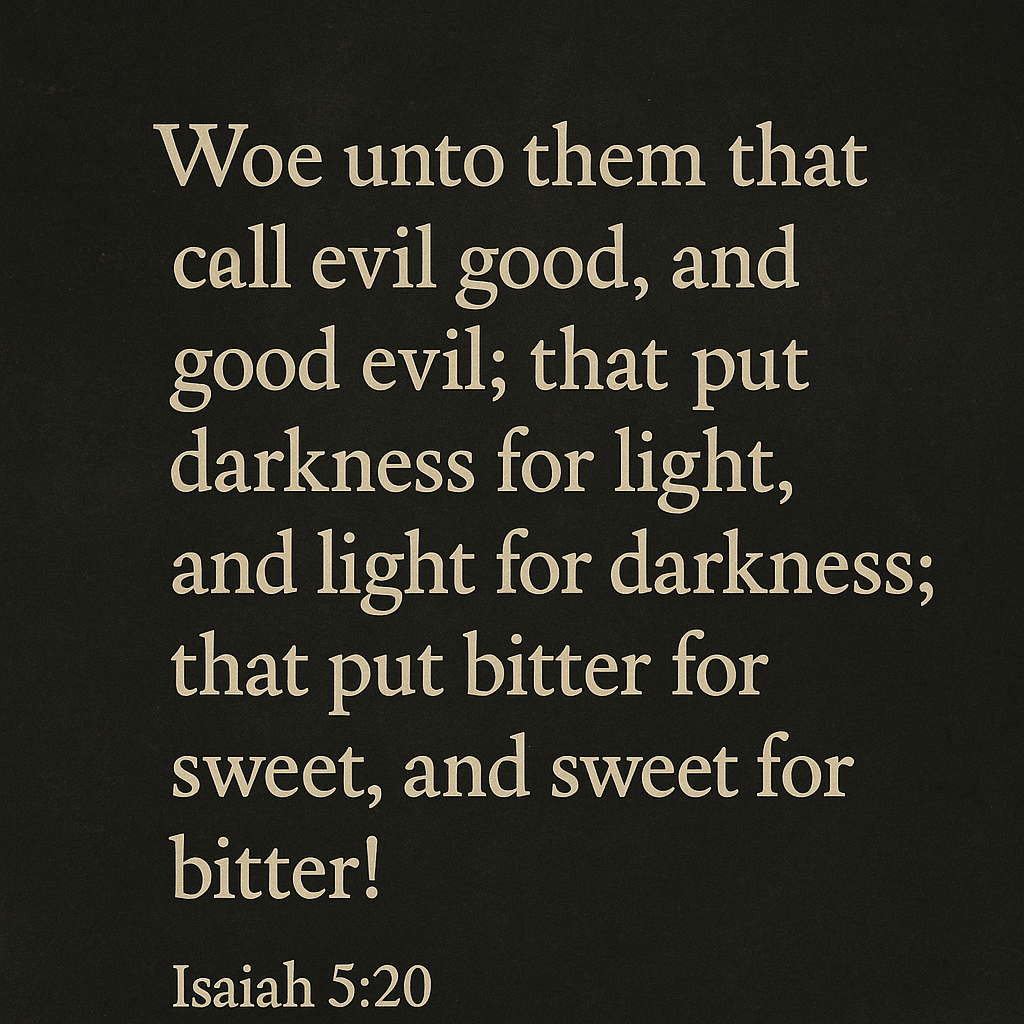
Woe unto them that call evil good, and good evil; that put darkness for light, and light for darkness; that put bitter for sweet, and sweet for bitter!

VERSE CONTEXT

Isaiah chapter 5 verse 20 says: “Woe unto them that call evil good, and good evil; that put darkness for light, and light for darkness; that put bitter for sweet, and sweet for bitter!” The word “woe” is a prophetic cry of sorrow, warning, or denunciation. It signals divine judgment. This isn’t just an emotional reaction—it’s a formal declaration from God through the prophet Isaiah (Eye-zay-uh) that serious consequences are coming. In Hebrew, this woe is used like a funeral lament—it carries the tone of a death sentence being pronounced over a morally bankrupt people.

Isaiah, ministering in Judah during the reigns of Uzziah, Jotham, Ahaz, and Hezekiah, is speaking to a nation that had hardened itself against the truth. Chapter 5 opens with what is often called “The Song of the Vineyard,” a parable where God is portrayed as a vineyard owner who did everything necessary to produce good fruit, but instead His vineyard (representing Israel) brought forth “wild grapes.” These wild grapes symbolize the unrighteousness and injustice springing from the hearts of the people, despite God’s provision, protection, and patience.

When we reach verse 20, Isaiah is several woes into a legal indictment, each one highlighting a particular category of sin. This verse targets those who “call evil good, and good evil.” The word “evil” here refers to moral wickedness—actions, attitudes, and systems that stand in direct opposition to the holiness of God. It means that which is corrupt, destructive, and contrary to God’s moral law. To “call evil good” is not merely to tolerate sin but to celebrate it, defend it, and redefine it as righteous. The word “good” here means upright, morally excellent, and aligned with God’s standards. So this phrase exposes the deliberate moral inversion taking place—what should be condemned is being praised, and what should be honored is being scorned.

The next pair of contrasts says, “that put darkness for light, and light for darkness.” “Darkness” in Scripture is frequently a metaphor for sin, deception, and separation from God. It represents spiritual blindness, confusion, and ignorance of truth. To “put darkness for light” is to make lies appear as truth, or to treat rebellion as enlightenment. Conversely, “light” is a symbol for God’s truth, righteousness, and His very presence. Light exposes sin and guides the way to holiness. When people exchange these—choosing lies over truth, sin over righteousness—they are spiritually disoriented and morally upside-down. This is not confusion born of ignorance, but rebellion born of pride.

The final contrast in the verse reads: “that put bitter for sweet, and sweet for bitter.” “Bitter” in this setting stands for the painful, destructive consequences of sin. It describes that which should bring sorrow or revulsion to the soul. Meanwhile, “sweet” speaks of that which is pleasant, desirable, and right in the eyes of God. This is the tragic point: the people of Judah had reached the stage where their tastes were so corrupted that what should have turned their stomach now delighted them—and what should have satisfied them now repulsed them. The conscience, having been dulled and reshaped by sin, was no longer a reliable guide.

This verse doesn’t describe accidental stumbling or simple confusion—it describes a willful, stubborn refusal to submit to God’s standard. Commentator Matthew Henry (1662–1714, Presbyterian) saw this woe as evidence of a people not only sinning, but actively rewriting the moral code. They glorify sin and mock righteousness. John Calvin (1509–1564, Reformed) likewise warned that this is the highest degree of corruption, when man attempts to overrule God’s own definitions of right and wrong, declaring themselves the final authority.

This verse remains powerfully relevant today. It speaks directly to cultures that celebrate immorality, redefine family, defend perversion, silence truth, and elevate feelings over facts. It warns that when a society no longer blushes at sin, but applauds it, it is standing at the edge of divine judgment.

BROADER CONTEXT

Isaiah chapter 5 is structured as both a parable and a courtroom indictment. The first seven verses present what scholars often call “The Song of the Vineyard,” where God is likened to a vineyard owner who carefully cultivated His vineyard—Israel—but was rewarded not with the sweet fruit of righteousness, but with wild grapes, a metaphor for injustice, idolatry, and moral decay. The vineyard parable sets the stage for the remaining verses of the chapter, where God, through Isaiah (Eye-zay-uh), issues six distinct “woes,” each announcing divine judgment for a particular category of sin. Isaiah chapter 5 verse 20 is the fourth of these woes.

This particular woe is surrounded by others that speak to greed, drunkenness, pride, corruption, and injustice, all of which had infected the nation of Judah at every level. The people had not merely stumbled into sin—they had institutionalized it. Leaders were corrupt, priests were compromising, and the common people had lost discernment. What makes verse 20 particularly dangerous is that it shows sin being reframed as virtue. While the earlier woes address behavior, this one attacks ideology—it targets the redefinition of morality itself. It is not just sinning—it is calling sin “good.” It is not just ignoring righteousness—it is mocking it as “evil.” This tells us Judah had reached a critical point where moral confusion had become national policy. The culture had normalized rebellion.

The book of Isaiah as a whole was written during a time of political instability and spiritual rebellion. The northern kingdom of Israel was on the verge of being conquered by Assyria, and the southern kingdom of Judah, to whom Isaiah preached, was following closely in its wicked footsteps. God raised up Isaiah to confront both the leadership and the people with uncomfortable truth: judgment was coming, not merely because of foreign powers, but because of their own sin. And yet, Isaiah’s message always carried a future hope—the promise of restoration through a remnant and the coming of a Messiah.

Isaiah chapter 5 sits at a turning point in the prophet’s writings. Chapters 1 through 5 form an introduction to the themes of the entire book: judgment, justice, repentance, and restoration. Chapter 6 will mark Isaiah’s dramatic vision of God’s holiness and his own calling as a prophet. So when we read chapter 5, especially verse 20, we are hearing the final warning before Isaiah’s personal commission. This gives verse 20 a climactic urgency—it marks the point where God says, in effect, “This is the condition of the nation, and this is why judgment is just.” The nation had not only disobeyed—they had overturned God’s moral order.

Theologically, Isaiah chapter 5 verse 20 connects to the larger biblical theme that truth is not subjective. From Genesis to Revelation, God makes clear that He alone defines good and evil. In Proverbs chapter 17 verse 15 it says: “He that justifieth the wicked, and he that condemneth the just, even they both are abomination to the LORD.” This is exactly what Isaiah is addressing—when society flips righteousness and wickedness on their heads, it becomes an abomination. In Romans chapter 1 verse 25, Paul echoes this same theme: “Who changed the truth of God into a lie and worshipped and served the creature more than the Creator…”—again pointing to the willful exchange of divine truth for manmade falsehoods.

Isaiah’s warning applies not only to ancient Judah, but to every generation tempted to redefine morality apart from God. It shows the progression of sin: first we tolerate it, then we celebrate it, then we punish those who oppose it. By the time verse 20 is fulfilled in a culture, that society is no longer drifting from God—it is shaking its fist at Him.

APPLICATION

When Isaiah cried “Woe unto them that call evil good, and good evil,” he wasn’t just pointing out corruption—he was revealing something profound about the character of God. This verse confronts us with the unchanging nature of divine truth. God is not like man. He does not shift with culture, emotion, or opinion. His standards of good and evil are rooted in His own holy nature. That means He alone defines morality, not society, not governments, and not religious leaders who compromise under pressure. This should stir awe in us. It tells us that truth isn’t floating in opinion—it’s anchored in the eternal person of God Himself. He is both righteous and just, and He hates moral confusion not only because it distorts society, but because it misrepresents Him.

This verse also reveals the depth of God’s holiness. By highlighting the inversion—calling darkness light and bitter sweet—it shows how God sees sin: not just as rebellion, but as a direct contradiction to everything He is. Just as light cannot coexist with darkness, God’s truth cannot tolerate deception. And when people attempt to blur that line, it is not just morally wrong—it is spiritually dangerous. This kind of twisting of truth invites divine judgment, not because God is cruel, but because He is holy and just. So appreciating God’s greatness means recognizing that His justice is an extension of His love. He loves His creation too much to let lies go unchallenged.

For the believer, this verse functions as both a warning and a calling. We are not just to avoid calling evil good—we are to actively stand for what God calls good, even when the world calls it evil. In today’s culture, there is tremendous pressure to redefine sin as acceptance, to replace righteousness with tolerance, and to paint holiness as hatred. Isaiah’s warning speaks directly to that climate. Believers are called to be salt and light—not neutral, not quiet, and not afraid. Light, by its very nature, exposes darkness. If our witness is not exposing anything, it may be because it’s not shining.

The call to action for believers is simple but bold: stand unflinchingly on God’s definitions. Don’t shrink from calling sin what it is. Don’t bend to a world that is trying to rewrite moral reality. Paul said in Ephesians chapter 5 verse 11: “And have no fellowship with the unfruitful works of darkness, but rather reprove them.” That word “reprove” doesn’t just mean to avoid or ignore—it means to confront, expose, and correct. The believer’s job isn’t to make truth more palatable, but to proclaim it lovingly and clearly. And we must do so knowing that calling good “good” in a world that celebrates evil will cost us. But it’s a cost that honors Christ.

For the unbeliever, this verse serves as both a mirror and a warning. It shows what sin does to the heart and mind. It desensitizes. It distorts. It makes evil look appealing and righteousness look oppressive. If someone finds themselves defending what God calls wicked, or mocking what God calls holy, they are not just misguided—they are in grave danger. Isaiah’s woe is not poetic—it is prophetic. It is God’s way of saying, “This path ends in destruction.”

But even here, there is hope. The fact that God sent Isaiah to speak this warning shows that God still offers repentance before judgment. If you are someone who has believed the world’s lies, if you’ve exchanged light for darkness and called it enlightenment, or bitterness for sweetness and called it freedom, God is not finished with you. Jesus said in John chapter 8 verse 12: “I am the light of the world: he that followeth me shall not walk in darkness, but shall have the light of life.” That invitation is still open. You can leave the darkness of confusion and step into the clarity of God’s truth—but it begins with repentance.

Final Encouragement

Isaiah chapter 5 verse 20 is not just an ancient cry of judgment—it is a living warning for our day, and a clear dividing line between the truth of God and the lies of this world. “Woe unto them that call evil good, and good evil” is a verse that rings louder the more society drifts from God’s Word. But for the believer, it is also a verse of clarity and courage. We are not confused. We know what is good because God has told us. We know what is evil because God has defined it. And we know our task—to be people of truth, even when the truth costs us something.

God has not left His people in the dark. He has given us light. Not just abstract moral categories, but the light of Christ Himself. He is our compass in a crooked world. He is our standard when the world has none. And He is our strength when we are called to stand alone. This verse reminds us that the truth is not up for debate, and that standing with God is the only way to avoid standing in judgment.

Prayer

Heavenly Father,

You are holy, righteous, and true. Thank You for being a God who never changes, who always calls good “good” and evil “evil.” We live in a world that blurs every line You have drawn, but we ask You to give us eyes to see clearly, hearts that love truth, and the courage to stand for what is right. Help us not to fear the world’s approval or fall for the enemy’s confusion. Let us speak with grace but also with boldness, knowing that Your Word is life and light.

For those who have wandered into confusion, who no longer know the difference between light and darkness—draw them back. Break through the lies they’ve believed and shine the light of Christ into their hearts. Let repentance rise. Let truth be loved again. Let Your people be unashamed of what is right. In Jesus’ name we pray, Amen.

Closing

If you’ve found these daily verses encouraging, enlightening, or fruitful, please consider helping us spread the truth and light of God’s Word by subscribing to the blog and YouTube channels and liking and following the Facebook page. Most of all, share Believers of Biblical Truth and our links with others who may need the sermons and daily teachings just as much as we do.

You are loved—so much in fact, that we want you to know and be Believers of Biblical Truth. Shalom Shalom.

TODAY’S DAILY BIBLE VERSE

April 8, 2025

Isaiah chapter 5 verses 11 and 12: Isaiah chapter 5 verses 11 and 12:

11: Woe unto them that rise up early in the morning, that they may follow strong drink; that continue until night, till wine inflame them! 12: And the harp, and the viol (vee-ol), the tabret (tab-ret), and pipe, and wine, are in their feasts: but they regard not the work of the Lord, neither consider the operation of his hands.

VERSE CONTEXT

These two verses form the second “woe” in Isaiah’s series of judgments found in chapter 5, spoken by the prophet Isaiah to the people of Judah in the eighth century B.C. This woe is directed not merely at those who drink, but at those whose lives are governed by the pursuit of intoxication. The phrase “Woe unto them that rise up early in the morning, that they may follow strong drink” brings immediate judgment upon those whose first desire upon waking is for strong drink. The term “strong drink” here refers to a highly intoxicating fermented beverage stronger than ordinary wine—often similar to what we would call liquor or hard alcohol. It is associated in Scripture not with occasional consumption but with habitual abuse and loss of control. This isn’t simply about having a drink; it’s about being mastered by the desire for it, placing pleasure before God from the very start of the day.

Isaiah continues: “that continue until night, till wine inflame them.” This draws a full-day picture of indulgence: from morning to night, they chase the pleasure of alcohol. The phrase “wine inflame them” uses the image of a fire being kindled—to inflame means to set ablaze or consume. Here it describes how the wine stirs up their passions and carries them into reckless behavior. The physical intoxication is only part of the problem; the deeper issue is the spiritual dullness and loss of self-control that comes with it. John Calvin (1509–1564, Reformed) noted that this verse reveals a people “so besotted by pleasure that they have drowned all sense of duty and shame,” and he argued that this is a sign of a heart that has cast off restraint.

Verse 12 paints a fuller scene of this unholy lifestyle: “And the harp, and the viol (vee-ol), the tabret (tab-ret), and pipe, and wine, are in their feasts.” Isaiah is not condemning instruments or music itself—the harp, viol (vee-ol) (a stringed instrument like a lyre), tabret (tab-ret) (a type of hand drum or tambourine), and pipe (a wind instrument like a flute)—were often used in festive celebrations and even in temple worship. But here, they are used in self-centered banquets, not for God’s glory, but for selfish enjoyment. The verse pictures a scene of parties filled with music, wine, and laughter—while entirely ignoring the holiness of life and the presence of God. The key issue isn’t the sound of music but the heart of the feast. These were pleasure feasts, not thanksgiving feasts. Their gatherings were sensuous rather than sacred.

The indictment closes with a devastating line: “but they regard not the work of the Lord, neither consider the operation of his hands.” To “regard” something means to look upon it with care and reverence. But instead of acknowledging the Lord’s hand in their lives, they have chosen to ignore it. The “operation of his hands” refers to God’s visible actions—His providence in creation, His judgment, and His ongoing care for Israel. The people of Judah were so focused on their entertainment and indulgence that they had lost all sense of God’s active role in their world. Matthew Henry (1662–1714, Presbyterian) observed that their sin was not simply drunkenness, but a kind of “atheism of the heart”—living as if God did not exist, even while enjoying the blessings of His creation.

What makes this more tragic is that these people were part of God’s covenant nation. They knew His law. They had access to His prophets. They had seen His works in history. And yet they filled their days with drink and music and celebration, never once lifting their eyes to heaven. Albert Barnes (1798–1870, Presbyterian) commented that this passage strikes at “the luxury and thoughtlessness of a people hardened by prosperity,” noting that the problem is not just personal sin, but a cultural decay where pleasure becomes more important than righteousness.

Spiritually, this reveals a society whose heart has grown numb. They wake up to chase liquor, stay drunk all day, and fill their nights with loud music—and all the while, they do not even pause to consider that it is God who gave them breath, rain, crops, family, and the very wine they abuse. Their sin is rooted in forgetting God.

This passage stands as a warning not just against drunkenness, but against any lifestyle so consumed with pleasure and distraction that it forgets the hand of God in everything. This is why Isaiah calls out this behavior with a prophetic woe. It’s not about condemning pleasure—it’s about calling people back to reverence, to awareness, and to worship.

BROADER CONTEXT

The verses we’re studying—Isaiah chapter 5 verses 11 and 12—are part of a longer prophetic indictment that stretches through the entire fifth chapter. Isaiah, speaking by the Spirit of God, issues a series of six “woes” against the people of Judah, highlighting the moral and spiritual decay that had spread through the nation. These woes are not random; they follow a logical and moral progression, demonstrating how once a nation forsakes God’s righteousness, it falls into personal sin, then public sin, then systemic sin, and finally faces divine judgment. The warning is not just about individuals who sin, but about a culture that embraces sin as normal.

The first seven verses of this chapter are framed as a parable of a vineyard, where Isaiah uses poetic imagery to describe how God carefully prepared and planted Israel as His vineyard. He did everything right—cleared the land, planted good vines, built a watchtower, and protected it. But instead of yielding good fruit, it brought forth wild grapes—a metaphor for corrupt behavior and injustice. This imagery mirrors the Lord’s covenant care for Israel and their shocking rebellion in return. As Isaiah chapter 5 verse 4 says: “What could have been done more to my vineyard, that I have not done in it? wherefore, when I looked that it should bring forth grapes, brought it forth wild grapes?” This rhetorical question emphasizes that the fault lies not in the Gardener but in the vine—Israel.

Following this parable, Isaiah pronounces six specific woes. The second one, found in verses 11 and 12, confronts the sin of drunkenness and self-indulgence, as we’ve explored. But when viewed in the full arc of chapter 5, it becomes clear that Isaiah is warning about more than alcohol—it’s about the callousness of a people who seek pleasure over holiness, distraction over devotion, and entertainment over obedience. The people are not atheists; they are spiritual adulterers—numb to the sacred, obsessed with the sensual. This attitude becomes the foundation for the other woes: greed (verse 8), moral inversion (verse 20), pride (verse 21), and corrupt justice (verse 23). All are symptoms of a people who have “cast away the law of the Lord of hosts” as Isaiah later says in verse 24.

Isaiah’s audience here is Judah, the southern kingdom. This prophecy is likely set during the reign of King Uzziah or shortly thereafter. During this time, Judah enjoyed relative economic success and political stability, but the wealth came with spiritual compromise. The prosperity they enjoyed dulled their sense of dependence on God. Worship became hollow, and the people gave themselves over to luxury, sensuality, and lawlessness—justifying sin and silencing truth. The Temple still stood. Sacrifices still happened. But the heart of the people was far from the Lord.

This chapter serves as a warning that God’s patience with sin is not endless. Verse 25 declares that “the anger of the Lord is kindled against his people.” Eventually, His judgment would come in the form of foreign invasion, devastation, and exile—a prophecy that would come true less than two centuries later with the Babylonian conquest. But Isaiah’s message was meant to awaken the people before that happened. He spoke with urgency and grief, not delighting in their judgment but longing for their repentance.

Zooming out even further, the book of Isaiah as a whole is structured in two major movements. Chapters 1–39 emphasize judgment, while chapters 40–66 emphasize comfort and restoration. Chapter 5 falls within that first section, where Isaiah is pleading with the nation to see the consequences of their rebellion before it’s too late. Yet even in these hard words, there is an invitation: if they would just open their eyes, if they would just “regard the work of the Lord” and “consider the operation of his hands,” they could turn back and be healed.

From a theological standpoint, these verses reflect several core truths:

  • God is not indifferent to sin.
  • Cultural corruption begins in the heart but spreads when leaders and people normalize wickedness.
  • There is a connection between sensual indulgence and spiritual blindness.
  • Judgment is not cruel; it is just, especially when it follows repeated divine warnings.

The New Testament picks up this thread in multiple places. For example, Paul writes in First Thessalonians chapter 5 verse 7: “For they that sleep sleep in the night; and they that be drunken are drunken in the night.” He contrasts the behavior of the children of light with those of darkness—again using drunkenness as a metaphor for spiritual unawareness. Similarly, Jesus warns in Luke chapter 21 verse 34: “And take heed to yourselves, lest at any time your hearts be overcharged with surfeiting, and drunkenness, and cares of this life…” showing that the dangers of indulgence weren’t just for ancient Israel—they’re for all people in all generations.

Isaiah chapter 5 verses 11 and 12 therefore stand not only as a diagnosis of Judah’s condition but as a timeless warning to every generation. The people were too busy feasting to fear, too full of wine to worship, and too wrapped up in entertainment to ever consider eternity. And that blindness would cost them everything.

APPLICATION

Appreciating God’s Greatness

This passage reveals God’s greatness through the clarity of His holiness and the justice of His character. He is not distant or indifferent to how His people live. The fact that He sends a prophet like Isaiah to speak directly against drunkenness and spiritual apathy shows that God sees everything—from private habits to public festivals. His greatness is not only seen in power or creation but in His moral perfection and relational involvement. He is not a silent observer of sin but a holy and righteous Judge who holds people accountable for how they treat His gifts. God gave Judah the vineyard, the rain, the music, the harvest, and the wine, but they used those very gifts to forget Him. What makes God so great in this passage is His mercy to warn them before He judges them. He is long-suffering, patient, and deeply committed to truth. The greatness of God is displayed in how He calls His people to wake up—He doesn’t abandon them to destruction without a voice. This is a King who confronts because He cares.

For the Believer

For believers, this passage serves as a sharp but needed reminder about the dangers of spiritual distraction. It is very easy, especially in times of peace and prosperity, to begin placing comfort, pleasure, and entertainment above God. While wine may not be the literal idol in every believer’s life, the principle behind this woe speaks to a much broader issue—what do we wake up desiring, and what do we go to bed thinking about? When our days revolve around what pleases the flesh instead of what honors the Lord, we start to fall into the very trap Isaiah condemned. The music, the feasting, the celebrations—none of it was evil on its own. But when the heart becomes obsessed with gathering pleasures and ignoring God, the soul begins to starve. Believers are called to be sober-minded (First Peter chapter 5 verse 8: “Be sober, be vigilant; because your adversary the devil, as a roaring lion, walketh about…”). We are to live each day aware of God’s presence, seeking His will above our own desires. This passage challenges believers to examine whether our lives are filled with distractions that have made us numb to the operation of God’s hand in our lives.

Call to Action

The call to action here is urgent: Fast from what dulls your awareness of God. If there is a pleasure, habit, or indulgence in your life that is pushing God to the margins of your heart—cut it off before it cuts off your spiritual clarity. Rise in the morning with prayer, not personal gratification. End the day with thanksgiving, not with numbing entertainment. Ask daily: “Have I regarded the work of the Lord today?” Take time to truly see God’s hand in your family, in your provision, in your convictions, and in the way He disciplines and guides you. Let Isaiah’s warning be a safeguard—not just against drunkenness, but against letting comfort replace commitment.

For the Unbeliever

For those who do not yet know God, these verses are not just a judgment—they are a mirror. God is showing what life looks like when He is not considered. The people of Judah partied, drank, laughed, and sang—but they were blind to the One who gave them breath. This is the danger of living without a relationship with the living God. Life becomes a series of pleasures with no purpose. When the music stops and the wine runs out, what is left? What Isaiah is offering is not condemnation without hope—he’s offering a chance to look up. To see that the blessings in your life—the sun, the rain, the food, the joy—come from a Creator who loves you and calls you to Himself. Ignoring Him doesn’t change the truth. He is still there, still holy, and still calling you to repentance. Acts chapter 17 verse 30 says: “And the times of this ignorance God winked at; but now commandeth all men every where to repent.” This is your opportunity—not to entertain your way to the grave, but to repent and find the joy of knowing the One who gives all things richly to enjoy (First Timothy chapter 6 verse 17).

FINAL ENCOURAGEMENT

Isaiah chapter 5 verses 11 and 12 are more than just a rebuke against drunkenness—they are a piercing reminder that the gifts of life can become distractions when we forget the Giver. God is not opposed to joy or music or celebration; He created those things. But when they replace our reverence, when they become the center of our life instead of expressions of worship, they lead us into spiritual blindness. These verses are a loving wake-up call—a cry from the heart of a holy God who desires to be known, regarded, and honored. Whether you’re a believer needing to reset your priorities, or someone who has never truly looked up to consider the hand of God, the message is the same: Open your eyes. Look upon His works. Consider His hand. Turn back before it’s too late.

PRAYER

Heavenly Father, We thank You for Your mercy to warn us when our hearts wander. Thank You for the reminder that joy without You is empty, and pleasure without purpose leaves the soul hollow. Help us to rise each day with a hunger for righteousness instead of indulgence. Help us to recognize the distractions that steal our attention from You. Make us sober-minded, not just in body but in spirit—eager to see Your hand at work, to consider Your will in all things. Forgive us when we have filled our lives with noise and forgotten to listen for Your voice. Open our eyes to the operation of Your hands and stir in us a holy awe for Your greatness. In Jesus’ name we pray, Amen.

CLOSING

If you’ve found these daily verses encouraging, enlightening, or fruitful, please consider helping us spread the truth and light of God’s Word by subscribing to the blog and YouTube channels and liking and following the Facebook page. Most of all, share Believers of Biblical Truth and our links with others who may need the sermons and daily teachings just as much as we do. You are loved—so much in fact, that we want you to know and be Believers of Biblical Truth.
Shalom Shalom.