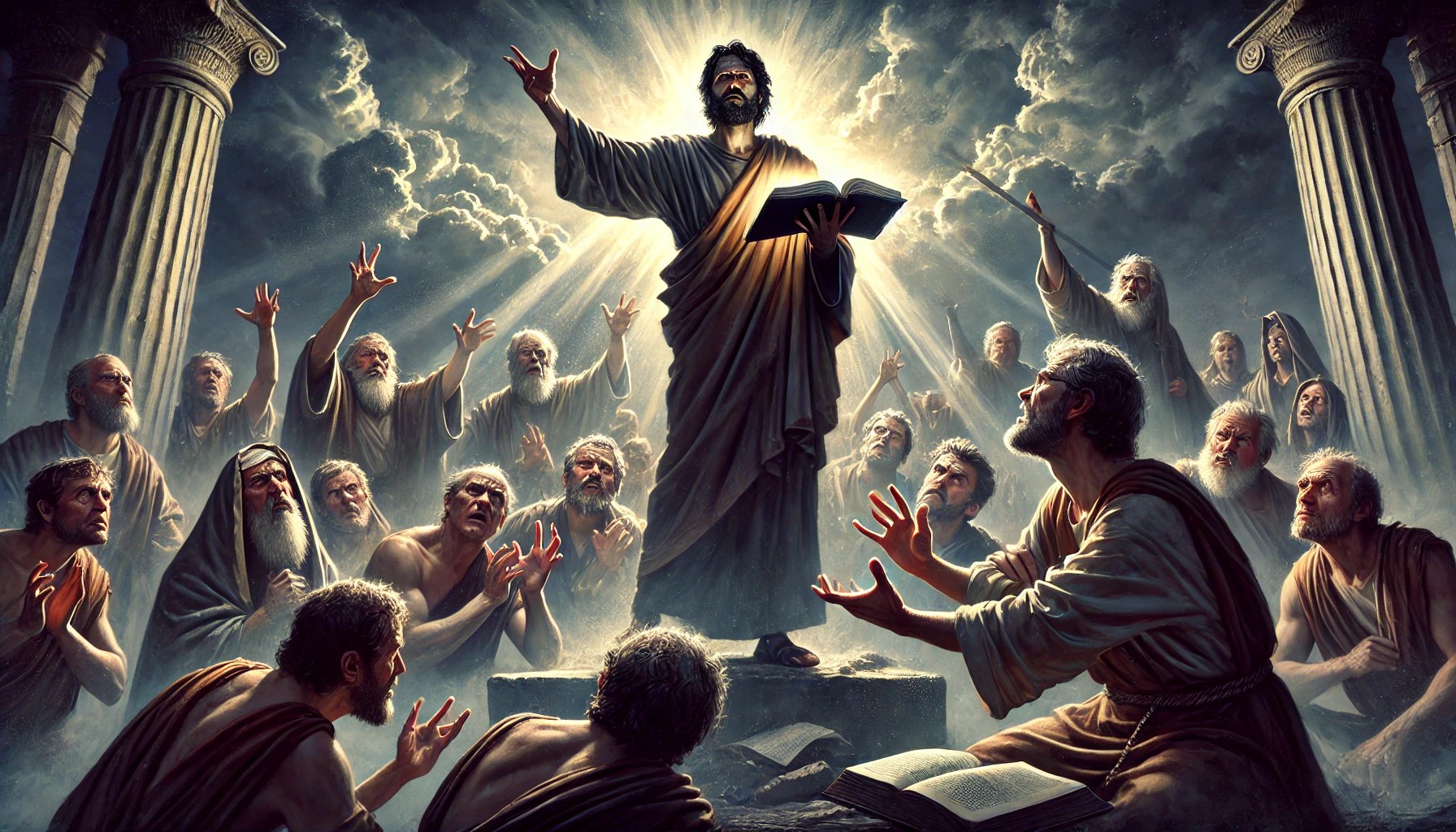
DAILY BIBLE VERSE

Revelation chapter 3 verses 1 through 6:

“And unto the angel of the church in Sardis (Sahr-dis) write; These things saith he that hath the seven Spirits of God, and the seven stars; I know thy works, that thou hast a name that thou livest, and art dead. Be watchful, and strengthen the things which remain, that are ready to die: for I have not found thy works perfect before God. Remember therefore how thou hast received and heard, and hold fast, and repent. If therefore thou shalt not watch, I will come on thee as a thief, and thou shalt not know what hour I will come upon thee. Thou hast a few names even in Sardis (Sahr-dis) which have not defiled their garments; and they shall walk with me in white: for they are worthy. He that overcometh, the same shall be clothed in white raiment; and I will not blot out his name out of the book of life, but I will confess his name before my Father, and before his angels. He that hath an ear, let him hear what the Spirit saith unto the churches.”

Verse Context

The book of Revelation, including this message to the church at Sardis (Sahr-dis), was written by the Apostle John while exiled on the island of Patmos (Pat-mohs), likely around A.D. 95-96. John received this revelation directly from Jesus Christ, who instructed him to write to the seven churches of Asia Minor, located in modern-day Turkey. Sardis was a wealthy city with a rich history, but by the time this letter was written, its reputation far exceeded its reality. Sardis had once been a great capital of the Lydian kingdom, known for its impressive fortress and its role in commerce and trade, but it had fallen into complacency and decline.

In verse 1, Jesus describes Himself as the One who holds the “seven Spirits of God” and the “seven stars.” The phrase “seven Spirits” (Greek: ta hepta pneumata tou Theou) reflects the fullness and completeness of the Holy Spirit’s work (Isaiah chapter 11 verse 2 lists seven aspects of the Spirit’s ministry—Spirit of the Lord, wisdom, understanding, counsel, might, knowledge, and fear of the Lord). The “seven stars” are the angels, or messengers, of the seven churches (Revelation chapter 1 verse 20). By introducing Himself this way, Jesus reminds Sardis that He holds complete authority over the spiritual life and destiny of the church.

Jesus immediately confronts the reality that Sardis has a name—a reputation—that they are alive, but they are actually spiritually dead. This accusation strikes at the heart of Sardis’ greatest failing: they looked good on the outside but were lifeless inside. The word “name” (Greek: onoma) refers to their public identity or reputation, but Christ sees through to the truth.

Verse 2 calls them to “be watchful” (Greek: gregoreo), which means to stay alert and vigilant. This is a pointed rebuke for Sardis, a city that had twice in its history fallen to enemies because of its failure to keep watch at its walls. Spiritually, the church mirrored the city—careless, complacent, and unaware of its own vulnerability.

Jesus urges them to “strengthen the things which remain, that are ready to die.” This implies there were still faint embers of spiritual life, but without immediate action, even those would perish. The phrase “not found thy works perfect before God” uses the Greek word pleroo, meaning complete or fully filled. Their works lacked full obedience and wholehearted devotion.

In verse 3, Jesus tells them to “remember,” “hold fast,” and “repent.” This echoes the warnings given to Israel by the prophets—calling them to remember God’s word, cling to it, and turn back from their sinful ways. The threat of Jesus coming “as a thief” draws directly from His own teaching in Matthew chapter 24 verse 43, where the thief comes unexpectedly to those who are unprepared.

Verse 4 brings comfort, noting that there are still “a few names” in Sardis who have “not defiled their garments.” The phrase “defiled” (Greek: moluno) means to stain or pollute. In ancient Sardis, the making and dyeing of garments was a major industry, so this imagery would have been immediately understood. White garments symbolize purity and victory, a promise for those who have remained faithful.

Verse 5 promises the overcomer will be “clothed in white raiment” and their name will not be blotted out of the “book of life.” The book of life (Greek: biblos zoes) is a heavenly record of all who belong to God (Exodus chapter 32 verse 32; Philippians chapter 4 verse 3). To “confess his name before my Father” recalls Jesus’ teaching in Matthew chapter 10 verse 32. This is a promise of personal recognition and public affirmation before the throne of God.

Finally, verse 6 repeats the refrain given to all seven churches: “He that hath an ear, let him hear what the Spirit saith unto the churches.” This is a call to spiritual sensitivity, urging every believer to pay attention to the Spirit’s voice.

Broader Context

The message to Sardis is part of a larger series of letters to the seven churches in Revelation chapters 2 and 3. Each church receives a message tailored to its unique condition, yet all are called to overcome and remain faithful. Sardis stands out because it receives no commendation—only correction. This underscores the seriousness of their spiritual complacency.

Thematically, Revelation emphasizes that Christ is Lord of the Church, fully aware of its true condition, and that spiritual reputation means nothing if it does not reflect reality. Sardis was physically rich but spiritually bankrupt. The message fits within Revelation’s larger call to endure faithfully in the face of both persecution and prosperity. As Matthew Henry noted, “There may be a name to live where there is no spiritual life.”

Application

Appreciating God’s Greatness
This passage reveals God’s perfect knowledge of His Church. While others see outward appearances, God sees the heart. His ability to discern truth from illusion reminds us that nothing is hidden from His gaze (Hebrews chapter 4 verse 13). His sovereignty over the Spirit and the angels of the churches shows that Christ is fully in control of His people and their destiny.

For the Believer
The warning to Sardis serves as a sobering reminder for believers today. It is possible to have an impressive outward reputation while being spiritually dead inside. Jesus calls us to stay alert, repent, and cling to what we have received—the pure gospel of grace.

Call to Action: Examine your spiritual life. Are you resting on a reputation, or are you pursuing a vibrant, living relationship with Christ? Strengthen what remains by returning to regular prayer, studying scripture, and seeking the Holy Spirit’s guidance every day.

For the Unbeliever
This passage exposes the danger of false confidence. Having a name, attending church, or performing religious acts does not equal salvation. True life comes only through faith in Jesus Christ, who offers purity, forgiveness, and eternal security to those who repent and believe.

If you have never fully surrendered to Christ, today is the day to repent and believe the gospel. Trust in Him, and your name will be written in the Lamb’s book of life.

Final Encouragement
The church at Sardis teaches us that spiritual life is not about reputation but about reality. Jesus offers mercy to those who will wake up and repent, but He also warns that ignoring His call invites judgment. Whether you are a seasoned believer or someone seeking truth, the message is clear: true life is found in Christ alone.

You are loved, so much in fact that we want you to know and be Believers of Biblical Truth.

DAILY BIBLE VERSE


James chapter 2 verses 8 through 12

Verse Context:
James chapter 2 verses 8 through 12 states: “If ye fulfil the royal law according to the scripture, Thou shalt love thy neighbour as thyself, ye do well: But if ye have respect to persons, ye commit sin, and are convinced of the law as transgressors. For whosoever shall keep the whole law, and yet offend in one point, he is guilty of all. For he that said, Do not commit adultery, said also, Do not kill. Now if thou commit no adultery, yet if thou kill, thou art become a transgressor of the law. So speak ye, and so do, as they that shall be judged by the law of liberty.”

James, the half-brother of Jesus, wrote this letter to Jewish believers who had been scattered outside of Palestine. These were early Christians, many of whom were poor and facing persecution for their faith. James wrote to challenge these believers to live out their faith with real evidence — practical obedience to God’s word. Scholars date this letter around AD 44 to 49, making it one of the earliest New Testament writings.

In this passage, James addresses partiality, meaning the sinful practice of showing favor to some people (like the rich) while dishonoring others (like the poor). He calls believers to fulfill what he calls the royal law, which comes from the Greek phrase nomon basilikon (NOH-mohn bah-see-LEE-kohn). The word basilikon means kingly or belonging to a king. This term is important because it shows that this law is not just another rule among many. It is the chief command — the one that governs all others — because it reflects the heart of God’s law given to Moses, specifically in Leviticus chapter 19 verse 18: “Thou shalt love thy neighbour as thyself.” By calling this the royal law, James highlights that loving your neighbor isn’t optional or secondary; it’s a foundational command from the King of Heaven Himself.

James immediately confronts a problem — respect to persons, which comes from the Greek word prosōpolēmpsia (pros-oh-poh-lem-SEE-ah). This word paints a picture of lifting up someone’s face in preference over another. It describes judging someone’s worth based on external appearance, wealth, status, or influence. In Jewish legal thought, this kind of favoritism was not just rude — it was a form of injustice that violated the very law God gave to ensure fairness. James wants students of scripture to understand that favoritism is not merely bad manners; it is sin, meaning it directly offends God’s holy standard.

Next, James expands this teaching by showing that breaking even one law makes a person guilty of breaking the entire law. This reflects the Jewish understanding that God’s law is a unified covenant, not a collection of disconnected rules. To violate any part of it was to stand as a parabatēs (par-ah-BAH-tace), a word meaning a deliberate violator who crosses the boundary line God established. This is why James uses the example of adultery and murder. If a person avoids adultery but commits murder, they are still a transgressor, fully guilty before God. The law is not a checklist where some rules matter more than others; it is a single expression of God’s holiness.

James closes this section by reminding believers that they will be judged under the law of liberty, which is nomou tēs eleutherias (NOH-moo tays el-yoo-THEH-ree-ahs). This law of liberty refers to God’s moral law, now revealed through Christ, who fulfills the law on behalf of believers and empowers them to obey it through the Holy Spirit. It is called liberty because Christ frees believers from the condemnation of the law, but it is still law because God’s righteous standard has not changed. James emphasizes this to teach that grace does not remove our responsibility to obey — rather, grace enables true obedience, motivated by love rather than fear.

Commentary Insights:
Matthew Henry observes that love for our neighbor is the visible proof of our love for God. If we show favoritism, we violate the very law that sums up all others, proving that our faith is defective. John Gill explains that the unity of the law reflects the unity of God’s character — to break part of the law is to offend the Lawgiver Himself. Adam Clarke highlights that true faith produces consistent obedience — not selective obedience where we pick and choose which commands to follow.

Broader Context:
This passage fits into the larger flow of James chapter 2, which addresses the relationship between faith and works. In the first seven verses, James rebukes his audience for giving special treatment to wealthy visitors while treating poor believers with contempt. In verses 8 through 12, James explains why this favoritism is so serious — it violates the royal law and makes them guilty before God.

This chapter fits into James’ overall message: faith without works is dead. Real faith produces actions that align with God’s heart — and God’s heart is to show mercy, fairness, and love to all people, regardless of social status. This teaching ties back to Jesus’ own words in Matthew chapter 22 verses 37 through 40, where He declared that loving God and loving neighbor are the two commands upon which all the law and prophets depend.

Application:
Appreciating God’s Greatness:
This passage reveals the perfection of God’s law and the absolute justice of His judgment. God does not allow any sin to go unnoticed, whether it’s favoritism or murder. At the same time, God’s law is called the law of liberty because in Christ, mercy triumphs over judgment for all who believe. This perfect balance — absolute justice fulfilled through absolute mercy — reveals God’s greatness and wisdom.

For the Believer:
Believers must guard against partiality in every form. We are called to love all people, especially fellow believers, with equal honor and care. To show favoritism because of wealth, race, social standing, or influence is to deny the very heart of the gospel. True faith produces consistent love — love that reflects the King’s own heart.

Call to Action:
Examine your heart and your church community. Do you show more attention to people who seem “important” while overlooking those who seem “ordinary”? Ask God to help you see others as He sees them — equally made in His image, equally loved, and equally in need of grace. Resolve today to practice the royal law by treating every person with the same love you desire for yourself.

For the Unbeliever:
This passage reminds those outside of Christ that selective morality will not save you. It is not enough to be “mostly good” if you still break God’s law in other ways. The law stands as a single, unbroken reflection of God’s holiness — and only Christ has fulfilled it perfectly. If you are relying on your own goodness to face God’s judgment, you will be found guilty. But if you trust in Christ, who kept the whole law in your place, you can stand before God covered in His perfect righteousness. That is the liberty James speaks of — freedom from guilt through the work of Jesus.

Final Encouragement:
James teaches us that obedience to God is not a game of percentages. God calls for whole-hearted obedience, driven by whole-hearted love. But even when we fall short, Christ stands as our perfect Law-Keeper and merciful Judge. As you go through today, let His royal law guide your steps and His law of liberty remind you that you are free to love others fully because you have been fully loved by Him.

You are loved, so much in fact that we want you to know and be Believers of Biblical Truth.

The Holy Spirit: Our Teacher and Our Peace

John 14:26-27
“But the Comforter, which is the Holy Ghost, whom the Father will send in my name, he shall teach you all things, and bring all things to your remembrance, whatsoever I have said unto you.Peace I leave with you, my peace I give unto you: not as the world giveth, give I unto you. Let not your heart be troubled, neither let it be afraid.”

Commentary

Jesus spoke these words to His disciples on the night before His crucifixion. He knew what was about to happen. He knew they would be afraid, confused, and shaken by what they were about to witness. Yet, instead of dwelling on His own suffering, He comforted them with a promise—one that would not only sustain them in the days ahead but would be a source of strength and guidance for all believers to come.

The disciples had spent years walking with Jesus, hearing His teachings, and witnessing His miracles. But soon, He would no longer be physically with them. That reality must have felt overwhelming. How would they remember everything He had taught them? How would they carry on His mission? Would they be left alone in their struggles?

Jesus reassures them that they will not be abandoned. The Comforter, the Holy Ghost, would come. More than just a presence, the Spirit would actively teach them, remind them of Christ’s words, and guide them in truth. This was not an empty promise—it was a pledge of ongoing support, wisdom, and divine presence that would continue long after Jesus’ physical departure.

Then, He gives them another promise: peace. Not the kind of peace the world offers—the temporary, fragile peace that depends on circumstances—but a peace that is unshakable. The peace of Christ is something that cannot be stolen by hardship, fear, or uncertainty. It is a peace that settles deep in the soul, one that comes from knowing that no matter what happens, God is in control, and we are never alone.

And then He says something that applies as much to us today as it did to those disciples sitting around Him in that upper room: “Let not your heart be troubled, neither let it be afraid.”


Application

When we look at our world today, it is easy to feel troubled and afraid. Chaos seems to be everywhere. Wars, division, moral decay, uncertainty about the future—all of these things press on our minds and hearts. Anxiety has become a defining struggle for many people, and even faithful Christians can sometimes feel overwhelmed.

But Jesus’ words remind us that peace is not found in perfect circumstances. It is not found in a life free of struggle. It is found in Him.

Through the Holy Spirit, we are not left to navigate this world on our own. The Spirit is our teacher, illuminating the Scriptures and helping us understand God’s truth. The Spirit is our guide, leading us in righteousness when we might otherwise be led by our emotions or the pressures of the world. The Spirit is our reminder, bringing back to mind the things Christ has said so that in moments of doubt or fear, we are strengthened.

If you are feeling unsettled, if you are battling fear or uncertainty, this promise is for you. The Holy Spirit is with you, living within you, ready to bring clarity, guidance, and peace. It is not a fleeting feeling but a deep-rooted assurance that no matter what happens, you belong to God, and He will never leave you.


Broader Context

The Gospel of John was written by the Apostle John, one of Jesus’ closest disciples. It was written decades after Jesus’ resurrection, during a time when the early church faced persecution and uncertainty. Many of those who had walked with Christ were now suffering for their faith. Some had been martyred. Others were forced into hiding. The believers needed encouragement—they needed to be reminded of the promises Jesus had given.

That same reassurance applies to us today. The Holy Spirit is not just a concept or a doctrine; He is a living presence in the life of every believer. The peace Jesus gives is not just something we hope for—it is something we can experience right now, regardless of the turmoil around us.

Christ’s words were spoken to a group of men about to endure incredible hardship, yet they were not spoken in despair. They were words of confidence and certainty. The Holy Spirit did come, just as Jesus promised. The disciples were not left alone, and neither are we.


Final Encouragement

If you are struggling today, remember this: the Holy Spirit is with you. When doubts arise, when fear creeps in, when the world feels like too much to handle—He is your Comforter. He will remind you of truth, teach you what you need to know, and fill you with peace that surpasses understanding.

Jesus never promised that life would be easy. But He did promise that we would never face it alone. His Spirit is present, and His peace is available. Will you embrace it?


Call to Action

If you are a believer, take some time today to pray and invite the Holy Spirit to fill you with His peace. Open the Scriptures and ask Him to teach you, to remind you of Christ’s words, and to calm your troubled heart. You do not have to navigate life on your own—He is with you.

If you have never placed your faith in Jesus, this peace is available to you too. The world cannot give what only God can offer. Surrender your heart to Christ today, and allow the Holy Spirit to enter your life, bringing truth, comfort, and assurance that you are never alone.


You are loved, so much in fact that we want you to know and be believers of biblical truth.

“God’s Design for Women: Honored, Treasured, and Purposeful”

February 22, 2025

Bible Verse (KJV)

1 Peter 3:7
“Likewise, ye husbands, dwell with them according to knowledge, giving honour unto the wife, as unto the weaker vessel, and as being heirs together of the grace of life; that your prayers be not hindered.”


Commentary

Verse Context

This verse, written by the Apostle Peter, speaks directly to the relationship between husbands and wives, providing an essential understanding of God’s design for women. It instructs husbands to:

  • Dwell with their wives with understanding – Recognizing the unique way that God made them.
  • Give honor to their wives – Treating them with value and respect.
  • Acknowledge the differences – Recognizing that women are the weaker vessel, which refers to physical differences and emotional sensitivity, not spiritual worth or intelligence.
  • View marriage as a partnership in God’s grace – Both men and women are heirs together of God’s promises.

This verse does not demean women but instead elevates them in their God-given role. In Peter’s time, women were often seen as inferior, but this passage commands men to honor and cherish them.

At the same time, it rejects modern feminist ideas of total independence from men. God designed women to be a necessary help to men, not competitors or isolated individuals.


Application

Appreciating God’s Greatness

God’s perfect design is seen in the relationship between men and women. The world distorts this by either demeaning women or pushing them into roles that were not meant for them. But God’s way is one of balance, honor, and purpose:

  • Women are not meant to be weak, but they are meant to be cherished.
  • Men are not meant to dominate, but they are meant to lead in love.
  • Both are heirs together of God’s grace.

This is God’s greatness in creation—giving men and women distinct but complementary roles, both valuable in His sight.

For the Believer

  1. Men Must Honor Their Wives
    • Many Christian men fail in this. They either dominate their wives or neglect their leadership role altogether.
    • A godly husband leads with love, wisdom, and protection, ensuring his wife is cared for and honored.
    • Ephesians 5:25 says, “Husbands, love your wives, even as Christ also loved the church, and gave himself for it.”
  2. Women Must Embrace Their God-Given Role
    • The modern world pushes independence and rebellion against God’s order, but Scripture makes it clear that women are to be helpers, nurturers, and godly examples.
    • Genesis 2:18 reminds us that “It is not good that the man should be alone; I will make him an help meet for him.”
    • Proverbs 31 praises the virtuous woman as one who supports her husband, nurtures her home, and is full of wisdom and strength.
  3. The Curse of the Fall: Positional Lust, Not Sexual Lust
    • Many misunderstand Genesis 3:16, where God tells Eve:
      “Thy desire shall be to thy husband, and he shall rule over thee.”
    • This desire is not sexual lust, but a positional desire—a craving for power over her husband.
    • The curse of the fall placed in women a natural rebellion against male headship. This is the root of feminism, where women seek to be both man and woman, both leader and nurturer, both father and mother.
    • This applies to:
      • Single mothers trying to fill the role of father and mother.
      • Wives who refuse to submit to their husbands and attempt to take control.
      • Women who reject marriage altogether, claiming total independence.
    • Biblical womanhood means rejecting this curse-driven rebellion and embracing God’s good design.
  4. Beware of Feminism’s Influence in the Church
    • Many churches celebrate feminism, forgetting that Scripture never calls women to seek dominance or independence from men.
    • Isaiah 3:12 warns, “As for my people, children are their oppressors, and women rule over them.” This was a judgment on Israel for rejecting God’s order.
    • Biblical womanhood is about faithfulness, wisdom, and nurturing—not rebellion and contention.

For the Unbeliever

The world distorts the value of women, either treating them as inferior or promoting independence from men and rejection of God’s order. Neither is biblical.

  • God designed women with purpose—not to be exploited, and not to be in rebellion, but to fulfill a unique and honored role.
  • True joy is found in living according to God’s design. Modern feminism promises freedom, but instead, it leaves many women alone, struggling, and unfulfilled.
  • God’s way is better. If you’ve been chasing independence, consider the beauty of God’s design—a life of honor, love, and purpose in His perfect plan.

Christ redeems and restores. No matter where you are today, you can find your identity and purpose in Him.


Broader Context

What Does the Bible Say About Women?

📖 Genesis 2:18“It is not good that the man should be alone; I will make him an help meet for him.”
🔹 Women were created to complement and support men, not to compete with them.

📖 1 Corinthians 11:8-9“For the man is not of the woman; but the woman of the man. Neither was the man created for the woman; but the woman for the man.”
🔹 This verse reinforces the order of creation and the role of women in supporting men.

📖 Proverbs 31:10-12“Who can find a virtuous woman? for her price is far above rubies. The heart of her husband doth safely trust in her, so that he shall have no need of spoil. She will do him good and not evil all the days of her life.”
🔹 A godly woman strengthens her home, her husband, and her family through faithfulness.

📖 Genesis 3:16“Thy desire shall be to thy husband, and he shall rule over thee.”
🔹 This desire is not romantic longing but a desire to rule over him, which is part of the curse of the fall.

📖 Isaiah 3:12“As for my people, children are their oppressors, and women rule over them.”
🔹 A nation where men fail to lead and women take charge is under judgment, not blessing.


Final Encouragement

The world promotes lies about womanhood, but the Bible tells the truth:

  • Women are honored in God’s design.
  • Women are meant to be treasured, not exploited.
  • Women were created for a unique and beautiful purpose—to support and nurture, not to dominate or rebel.

For believers, this is a call to embrace biblical womanhood and manhood. For non-believers, this is an invitation to discover the joy of living in God’s perfect plan.

The feminist movement has redefined womanhood, but it has not improved the lives of women. God’s way is better

You are loved, so much in fact that we want you to know and be believers of biblical truth.

No Excuses: God’s Truth Is Clear, but Are We Listening?

Bible Verses (KJV)

Romans 1:18-23
For the wrath of God is revealed from heaven against all ungodliness and unrighteousness of men, who hold the truth in unrighteousness;
Because that which may be known of God is manifest in them; for God hath shewed it unto them.
For the invisible things of him from the creation of the world are clearly seen, being understood by the things that are made, even his eternal power and Godhead; so that they are without excuse:
Because that, when they knew God, they glorified him not as God, neither were thankful; but became vain in their imaginations, and their foolish heart was darkened.
Professing themselves to be wise, they became fools,
And changed the glory of the uncorruptible God into an image made like to corruptible man, and to birds, and fourfooted beasts, and creeping things.


Commentary

Verse Context

This passage is a bold declaration of God’s justice against human sin. Paul is laying the groundwork for the universal need for salvation by explaining that mankind is without excuse when it comes to recognizing God.

  • Verse 18 – The wrath of God is already being revealed against those who suppress the truth. This wrath is not random but targeted at sin and rebellion.
  • Verses 19-20 – God has clearly shown Himself through creation. No one can claim ignorance of Him because His eternal power and divine nature are evident in the world around us.
  • Verses 21-23 – Even though people knew of God, they refused to honor Him. Instead, they chose idolatry, worshiping creation rather than the Creator.

This passage confronts the deliberate rejection of God, showing that those who turn away are not victims of ignorance but of willful rebellion.


Application

Appreciating God’s Greatness

God has never hidden Himself from humanity. His power, authority, and divine nature are clearly seen in the world He created. From the stars in the sky to the complexity of life, everything points to Him.

The greatness of God is revealed in:

  • His patience – Though He has the right to destroy all sin immediately, He gives time for repentance.
  • His revelation – He has made Himself known, yet mankind still rejects Him.
  • His justice – His wrath is not without reason; it is a response to deliberate sin and suppression of truth.

For the Believer

  1. Live as Those Who Recognize God
    • Many acknowledge God exists, but do they honor Him?
    • Verse 21 warns against knowing God but failing to glorify Him. Many believers go through life without true gratitude or reverence for God.
  2. Beware of False Wisdom
    • Verse 22 says, “Professing themselves to be wise, they became fools.”
    • The world often rejects God’s truth in the name of intelligence, yet wisdom apart from God is empty and dangerous.
    • 1 Corinthians 3:19 reminds us: “For the wisdom of this world is foolishness with God.”
  3. Guard Against Idolatry
    • Verse 23 exposes the tragedy of exchanging God’s glory for idols.
    • While most people today don’t bow to statues, idolatry still exists—in the form of money, success, pleasure, and self-worship.
    • Anything that takes God’s place in our lives is an idol.

For the Unbeliever

This passage leaves no room for excuses.

  • Verse 20 states that all people are “without excuse.”
  • Every person has seen evidence of God in creation, yet many choose to reject Him.
  • Atheism and agnosticism are not ignorance but suppression of truth.

If you have ignored or denied God, this passage is a wake-up call. He has made Himself known, and rejecting Him has consequences.

  • Will you continue suppressing the truth?
  • Or will you turn to the One who created you and surrender to Him?

Broader Context

Who Wrote Romans?

The Apostle Paul wrote Romans around A.D. 57, during his ministry to spread the Gospel across the Roman Empire. Romans is considered Paul’s most profound theological letter, explaining the guilt of all humanity, the grace of God, and the power of salvation through Christ.

To Whom Was It Written?

Romans was written to Christians in Rome, both Jews and Gentiles, teaching them the fullness of the Gospel and how faith in Christ is the only way to be saved.

Why Was It Written?

Romans 1:18-23 serves as Paul’s argument for why all people need salvation. He begins by showing the universal guilt of humanity—we have all seen evidence of God, but many choose to reject Him.

How Does This Apply Today?

  • People still reject God, claiming “there isn’t enough evidence.” But the Bible says the evidence is clear and overwhelming.
  • Modern idolatry is alive and well. People still worship creation—whether it’s science, celebrities, material wealth, or self-fulfillment.
  • Human wisdom apart from God leads to destruction. Many profess to be wise but reject God’s truth in favor of empty philosophies.

Romans 1 is a warning that when we push God away, our hearts and minds become darkened. Are we paying attention?


Final Encouragement

This passage eliminates all excuses. God is real, He has revealed Himself, and rejecting Him is a choice with consequences.

For believers, this is a call to gratitude and holiness. For unbelievers, it is a call to repentance before it’s too late.

The wrath of God is not an emotional outburst—it is a just and measured response to those who suppress the truth. Will you honor God, or will you continue to ignore Him?


Call to Action

Believers:

  • Examine your heart—are you truly honoring God, or have you taken Him for granted?
  • Stand firm in truth, even when the world calls it foolishness.
  • Guard against modern idolatry—are you placing anything above God?

Non-Believers:

  • There are no excuses—God has revealed Himself, and rejection is a choice.
  • Turn to Him today. The longer you suppress the truth, the darker your heart will become.
  • Seek Jesus while there is still time.

You are loved, so much in fact that we want you to know and be believers of biblical truth.