April 9, 2025
Isaiah chapter 5 verse 20:
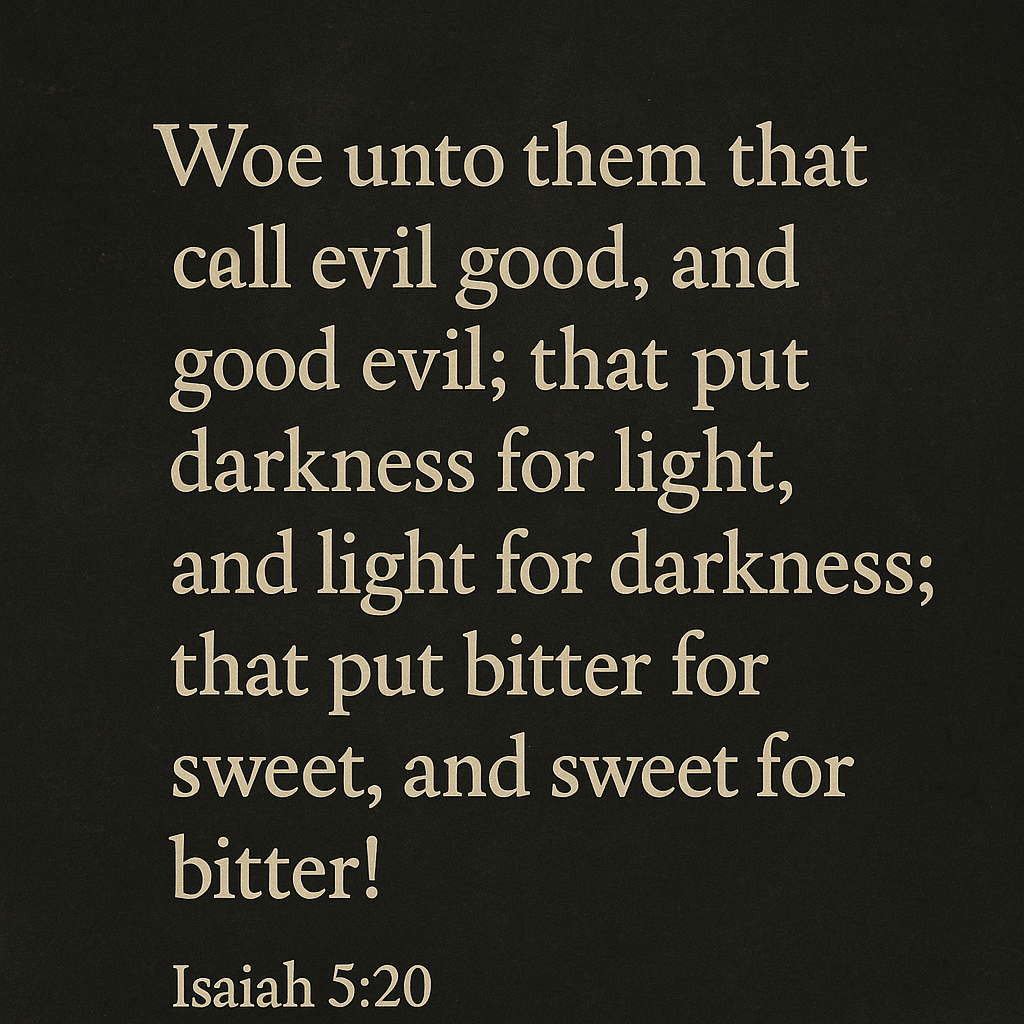
Woe unto them that call evil good, and good evil; that put darkness for light, and light for darkness; that put bitter for sweet, and sweet for bitter!
VERSE CONTEXT
Isaiah chapter 5 verse 20 says: “Woe unto them that call evil good, and good evil; that put darkness for light, and light for darkness; that put bitter for sweet, and sweet for bitter!” The word “woe” is a prophetic cry of sorrow, warning, or denunciation. It signals divine judgment. This isn’t just an emotional reaction—it’s a formal declaration from God through the prophet Isaiah (Eye-zay-uh) that serious consequences are coming. In Hebrew, this woe is used like a funeral lament—it carries the tone of a death sentence being pronounced over a morally bankrupt people.
Isaiah, ministering in Judah during the reigns of Uzziah, Jotham, Ahaz, and Hezekiah, is speaking to a nation that had hardened itself against the truth. Chapter 5 opens with what is often called “The Song of the Vineyard,” a parable where God is portrayed as a vineyard owner who did everything necessary to produce good fruit, but instead His vineyard (representing Israel) brought forth “wild grapes.” These wild grapes symbolize the unrighteousness and injustice springing from the hearts of the people, despite God’s provision, protection, and patience.
When we reach verse 20, Isaiah is several woes into a legal indictment, each one highlighting a particular category of sin. This verse targets those who “call evil good, and good evil.” The word “evil” here refers to moral wickedness—actions, attitudes, and systems that stand in direct opposition to the holiness of God. It means that which is corrupt, destructive, and contrary to God’s moral law. To “call evil good” is not merely to tolerate sin but to celebrate it, defend it, and redefine it as righteous. The word “good” here means upright, morally excellent, and aligned with God’s standards. So this phrase exposes the deliberate moral inversion taking place—what should be condemned is being praised, and what should be honored is being scorned.
The next pair of contrasts says, “that put darkness for light, and light for darkness.” “Darkness” in Scripture is frequently a metaphor for sin, deception, and separation from God. It represents spiritual blindness, confusion, and ignorance of truth. To “put darkness for light” is to make lies appear as truth, or to treat rebellion as enlightenment. Conversely, “light” is a symbol for God’s truth, righteousness, and His very presence. Light exposes sin and guides the way to holiness. When people exchange these—choosing lies over truth, sin over righteousness—they are spiritually disoriented and morally upside-down. This is not confusion born of ignorance, but rebellion born of pride.
The final contrast in the verse reads: “that put bitter for sweet, and sweet for bitter.” “Bitter” in this setting stands for the painful, destructive consequences of sin. It describes that which should bring sorrow or revulsion to the soul. Meanwhile, “sweet” speaks of that which is pleasant, desirable, and right in the eyes of God. This is the tragic point: the people of Judah had reached the stage where their tastes were so corrupted that what should have turned their stomach now delighted them—and what should have satisfied them now repulsed them. The conscience, having been dulled and reshaped by sin, was no longer a reliable guide.
This verse doesn’t describe accidental stumbling or simple confusion—it describes a willful, stubborn refusal to submit to God’s standard. Commentator Matthew Henry (1662–1714, Presbyterian) saw this woe as evidence of a people not only sinning, but actively rewriting the moral code. They glorify sin and mock righteousness. John Calvin (1509–1564, Reformed) likewise warned that this is the highest degree of corruption, when man attempts to overrule God’s own definitions of right and wrong, declaring themselves the final authority.
This verse remains powerfully relevant today. It speaks directly to cultures that celebrate immorality, redefine family, defend perversion, silence truth, and elevate feelings over facts. It warns that when a society no longer blushes at sin, but applauds it, it is standing at the edge of divine judgment.
BROADER CONTEXT
Isaiah chapter 5 is structured as both a parable and a courtroom indictment. The first seven verses present what scholars often call “The Song of the Vineyard,” where God is likened to a vineyard owner who carefully cultivated His vineyard—Israel—but was rewarded not with the sweet fruit of righteousness, but with wild grapes, a metaphor for injustice, idolatry, and moral decay. The vineyard parable sets the stage for the remaining verses of the chapter, where God, through Isaiah (Eye-zay-uh), issues six distinct “woes,” each announcing divine judgment for a particular category of sin. Isaiah chapter 5 verse 20 is the fourth of these woes.
This particular woe is surrounded by others that speak to greed, drunkenness, pride, corruption, and injustice, all of which had infected the nation of Judah at every level. The people had not merely stumbled into sin—they had institutionalized it. Leaders were corrupt, priests were compromising, and the common people had lost discernment. What makes verse 20 particularly dangerous is that it shows sin being reframed as virtue. While the earlier woes address behavior, this one attacks ideology—it targets the redefinition of morality itself. It is not just sinning—it is calling sin “good.” It is not just ignoring righteousness—it is mocking it as “evil.” This tells us Judah had reached a critical point where moral confusion had become national policy. The culture had normalized rebellion.
The book of Isaiah as a whole was written during a time of political instability and spiritual rebellion. The northern kingdom of Israel was on the verge of being conquered by Assyria, and the southern kingdom of Judah, to whom Isaiah preached, was following closely in its wicked footsteps. God raised up Isaiah to confront both the leadership and the people with uncomfortable truth: judgment was coming, not merely because of foreign powers, but because of their own sin. And yet, Isaiah’s message always carried a future hope—the promise of restoration through a remnant and the coming of a Messiah.
Isaiah chapter 5 sits at a turning point in the prophet’s writings. Chapters 1 through 5 form an introduction to the themes of the entire book: judgment, justice, repentance, and restoration. Chapter 6 will mark Isaiah’s dramatic vision of God’s holiness and his own calling as a prophet. So when we read chapter 5, especially verse 20, we are hearing the final warning before Isaiah’s personal commission. This gives verse 20 a climactic urgency—it marks the point where God says, in effect, “This is the condition of the nation, and this is why judgment is just.” The nation had not only disobeyed—they had overturned God’s moral order.
Theologically, Isaiah chapter 5 verse 20 connects to the larger biblical theme that truth is not subjective. From Genesis to Revelation, God makes clear that He alone defines good and evil. In Proverbs chapter 17 verse 15 it says: “He that justifieth the wicked, and he that condemneth the just, even they both are abomination to the LORD.” This is exactly what Isaiah is addressing—when society flips righteousness and wickedness on their heads, it becomes an abomination. In Romans chapter 1 verse 25, Paul echoes this same theme: “Who changed the truth of God into a lie and worshipped and served the creature more than the Creator…”—again pointing to the willful exchange of divine truth for manmade falsehoods.
Isaiah’s warning applies not only to ancient Judah, but to every generation tempted to redefine morality apart from God. It shows the progression of sin: first we tolerate it, then we celebrate it, then we punish those who oppose it. By the time verse 20 is fulfilled in a culture, that society is no longer drifting from God—it is shaking its fist at Him.
APPLICATION
When Isaiah cried “Woe unto them that call evil good, and good evil,” he wasn’t just pointing out corruption—he was revealing something profound about the character of God. This verse confronts us with the unchanging nature of divine truth. God is not like man. He does not shift with culture, emotion, or opinion. His standards of good and evil are rooted in His own holy nature. That means He alone defines morality, not society, not governments, and not religious leaders who compromise under pressure. This should stir awe in us. It tells us that truth isn’t floating in opinion—it’s anchored in the eternal person of God Himself. He is both righteous and just, and He hates moral confusion not only because it distorts society, but because it misrepresents Him.
This verse also reveals the depth of God’s holiness. By highlighting the inversion—calling darkness light and bitter sweet—it shows how God sees sin: not just as rebellion, but as a direct contradiction to everything He is. Just as light cannot coexist with darkness, God’s truth cannot tolerate deception. And when people attempt to blur that line, it is not just morally wrong—it is spiritually dangerous. This kind of twisting of truth invites divine judgment, not because God is cruel, but because He is holy and just. So appreciating God’s greatness means recognizing that His justice is an extension of His love. He loves His creation too much to let lies go unchallenged.
For the believer, this verse functions as both a warning and a calling. We are not just to avoid calling evil good—we are to actively stand for what God calls good, even when the world calls it evil. In today’s culture, there is tremendous pressure to redefine sin as acceptance, to replace righteousness with tolerance, and to paint holiness as hatred. Isaiah’s warning speaks directly to that climate. Believers are called to be salt and light—not neutral, not quiet, and not afraid. Light, by its very nature, exposes darkness. If our witness is not exposing anything, it may be because it’s not shining.
The call to action for believers is simple but bold: stand unflinchingly on God’s definitions. Don’t shrink from calling sin what it is. Don’t bend to a world that is trying to rewrite moral reality. Paul said in Ephesians chapter 5 verse 11: “And have no fellowship with the unfruitful works of darkness, but rather reprove them.” That word “reprove” doesn’t just mean to avoid or ignore—it means to confront, expose, and correct. The believer’s job isn’t to make truth more palatable, but to proclaim it lovingly and clearly. And we must do so knowing that calling good “good” in a world that celebrates evil will cost us. But it’s a cost that honors Christ.
For the unbeliever, this verse serves as both a mirror and a warning. It shows what sin does to the heart and mind. It desensitizes. It distorts. It makes evil look appealing and righteousness look oppressive. If someone finds themselves defending what God calls wicked, or mocking what God calls holy, they are not just misguided—they are in grave danger. Isaiah’s woe is not poetic—it is prophetic. It is God’s way of saying, “This path ends in destruction.”
But even here, there is hope. The fact that God sent Isaiah to speak this warning shows that God still offers repentance before judgment. If you are someone who has believed the world’s lies, if you’ve exchanged light for darkness and called it enlightenment, or bitterness for sweetness and called it freedom, God is not finished with you. Jesus said in John chapter 8 verse 12: “I am the light of the world: he that followeth me shall not walk in darkness, but shall have the light of life.” That invitation is still open. You can leave the darkness of confusion and step into the clarity of God’s truth—but it begins with repentance.
Final Encouragement
Isaiah chapter 5 verse 20 is not just an ancient cry of judgment—it is a living warning for our day, and a clear dividing line between the truth of God and the lies of this world. “Woe unto them that call evil good, and good evil” is a verse that rings louder the more society drifts from God’s Word. But for the believer, it is also a verse of clarity and courage. We are not confused. We know what is good because God has told us. We know what is evil because God has defined it. And we know our task—to be people of truth, even when the truth costs us something.
God has not left His people in the dark. He has given us light. Not just abstract moral categories, but the light of Christ Himself. He is our compass in a crooked world. He is our standard when the world has none. And He is our strength when we are called to stand alone. This verse reminds us that the truth is not up for debate, and that standing with God is the only way to avoid standing in judgment.
Prayer
Heavenly Father,
You are holy, righteous, and true. Thank You for being a God who never changes, who always calls good “good” and evil “evil.” We live in a world that blurs every line You have drawn, but we ask You to give us eyes to see clearly, hearts that love truth, and the courage to stand for what is right. Help us not to fear the world’s approval or fall for the enemy’s confusion. Let us speak with grace but also with boldness, knowing that Your Word is life and light.
For those who have wandered into confusion, who no longer know the difference between light and darkness—draw them back. Break through the lies they’ve believed and shine the light of Christ into their hearts. Let repentance rise. Let truth be loved again. Let Your people be unashamed of what is right. In Jesus’ name we pray, Amen.
Closing
If you’ve found these daily verses encouraging, enlightening, or fruitful, please consider helping us spread the truth and light of God’s Word by subscribing to the blog and YouTube channels and liking and following the Facebook page. Most of all, share Believers of Biblical Truth and our links with others who may need the sermons and daily teachings just as much as we do.
You are loved—so much in fact, that we want you to know and be Believers of Biblical Truth. Shalom Shalom.
 Believers of Biblical Truth
You must be logged in to post a comment.