Isaiah 40:31
But they that wait upon the LORD shall renew their strength; they shall mount up with wings as eagles; they shall run, and not be weary; and they shall walk, and not faint.
Verse Context
The Book of Isaiah was written by the prophet Isaiah, whose ministry spanned the reigns of several kings in Judah, roughly from 740 to 681 B.C. Isaiah chapter 40 marks a clear transition in the book—from judgment and warning to consolation and comfort. In fact, Isaiah 40 is often seen as the opening of the “Book of Comfort” within Isaiah (chapters 40–66), which shifts the focus from Israel’s failure to God’s promises of restoration and redemption.
This verse appears in a context where God is reminding His people of His incomparable power and everlasting nature. Isaiah 40:28–30 leads into this by highlighting the weakness of even the strongest human beings: “Even the youths shall faint and be weary, and the young men shall utterly fall.” But verse 31 offers a glorious contrast—the strength of those who wait on the LORD.
They that wait upon the LORD – The word “wait” here is not passive; it’s a deep, trusting expectancy. It means to confidently hope in the Lord, relying on His timing and provision rather than our own effort.
Shall renew their strength – To “renew” means to exchange. This is not just regaining strength, but trading in our weakness for His divine strength.
Mount up with wings as eagles – The eagle was considered the strongest and highest-flying bird. To “mount up” suggests elevation above life’s chaos, just as an eagle soars above the storm. It’s a picture of spiritual power and victory.
They shall run, and not be weary; and they shall walk, and not faint – These represent both the rapid pace of life’s urgent moments (running) and the steady endurance needed for the daily journey (walking). In both, God supplies what is needed.
Commentator Matthew Henry (1662–1714, English Nonconformist) explains it this way: “Those that hope in the Lord shall have the comfort of it; they shall be supplied with grace sufficient for them.” John Gill (1697–1771, Reformed Baptist) also notes that this waiting involves faith, prayer, and patient endurance.
Broader Context
Isaiah 40 opens with the tender words: “Comfort ye, comfort ye my people, saith your God.” The people of Judah, discouraged by warnings of judgment and exile, are now being reminded of God’s unmatched greatness and intimate care. The chapter builds on the contrast between human frailty and divine omnipotence. The point is clear: God does not grow tired or weak—He gives power to the faint (Isaiah 40:29).
The broader message is one of covenant faithfulness. Though Israel had sinned, God’s promises endure. The comfort in verse 31 is not generic motivation—it’s covenantal assurance: God strengthens those who trust in Him because He has bound Himself to His people by promise.
Isaiah 40:31 is not isolated inspiration—it is the climax of a chapter that teaches theology through poetry: God is Creator, Sustainer, King, Shepherd, and Redeemer. The encouragement here flows from His nature, not ours.
Application
Appreciating God’s Greatness
This verse magnifies God’s character. He alone can offer renewed strength to the weary because He Himself is never weary. He lifts His people from despair not by easing every burden immediately, but by infusing them with supernatural endurance.
For the Believer
Believers are often tempted to act quickly, solve everything themselves, or despair in the silence. But God says to wait—to trust, to linger in prayer, to be still while He works. The reward is not just rest but a total transformation of strength. You will fly again, not crawl. You will run, not collapse. You will walk on faithfully, not give up.
Call to Action:
If you are weary today, resist the urge to quit or to take shortcuts. Instead, renew your focus on the Lord. Spend time in His Word, pray without rushing, and ask Him to help you wait with expectancy. Strength is promised—not to those who act first, but to those who trust first.
For the Unbeliever
If you do not yet know the Lord, your strength is your own—and it will eventually fail. You may run for a while, even soar briefly—but weariness will come. Only those who trust in the Lord Jesus Christ as Savior and Redeemer can experience this supernatural renewal. You were not made to carry your burdens alone. Come to the One who gives rest to the weary and strength to the faint.
Final Encouragement
Isaiah 40:31 is more than poetry—it’s a promise. God is not distant. He is near, strong, and faithful. Whatever today holds, know that if you place your hope in Him, He will carry you through. Not with your own limited strength, but with His unlimited supply.
Prayer
Heavenly Father, thank You for the promise of renewed strength. So often we feel weary, overwhelmed, and unsure of the path ahead. But You do not grow tired, and You never abandon Your people. Help us today to wait on You—not with anxiety, but with trust. Teach us to rest in Your timing and draw on Your power. Let us mount up with wings as eagles, rise above discouragement, and walk forward with courage, knowing You go before us. In Jesus’ name, Amen.
You are loved—so much in fact, that we want you to know and be Believers of Biblical Truth.
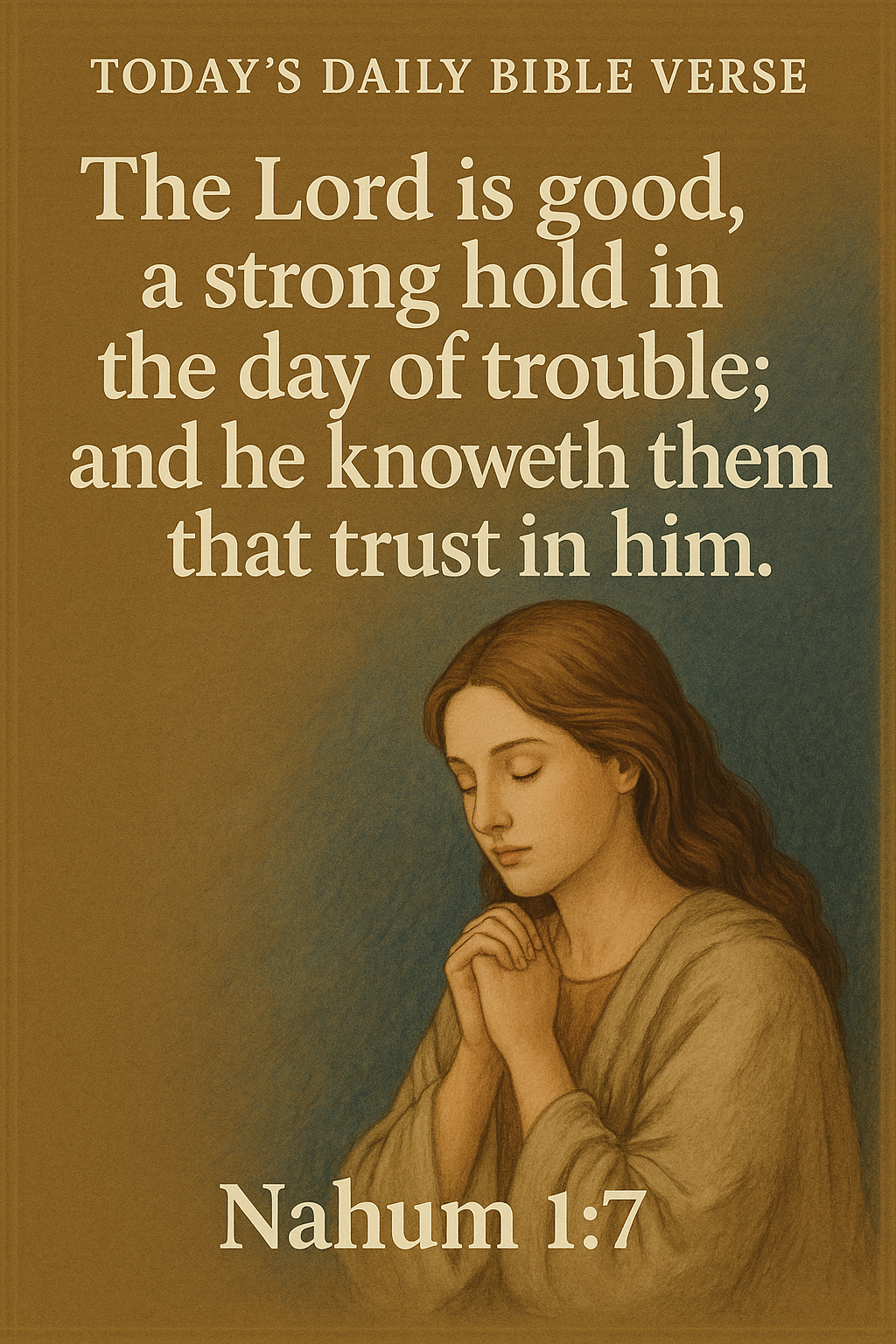
Nahum 1:7: The Lord is good, a strong hold in the day of trouble; and he knoweth them that trust in him.
Verse Context:
This verse appears right in the middle of a judgment oracle, and that contrast is powerful. Nahum, the prophet whose name means “comfort,” is declaring the downfall of the wicked city of Nineveh. Verses before and after this one thunder with divine wrath—God’s vengeance, fury, and power over His enemies. But here, in Nahum 1:7, there is a sudden and beautiful shift. It’s as if God pauses mid-sentence to comfort His faithful remnant, assuring them that while judgment comes for the wicked, safety remains for those who trust in Him.
The statement “The Lord is good” is not a general remark; it is a theological anchor. In a chapter filled with divine anger, this is a reminder that God’s justice is not cruelty—it is goodness expressed through holiness. The word “good” here implies moral perfection, kindness, and covenantal loyalty. It’s not a temporary or shifting trait—it is His eternal nature (see Psalm 100:5: “For the Lord is good; his mercy is everlasting; and his truth endureth to all generations.”).
Next, the LORD is described as “a strong hold in the day of trouble.” A strong hold, or fortress, was a place of refuge from siege or disaster. This phrase reveals God’s role as protector, not merely from physical enemies but from every form of distress. The day of trouble is not limited to one event—it refers to any moment of suffering, oppression, or calamity. God’s people were surrounded by violent empires, and yet He was their invisible fortress.
The last phrase—“he knoweth them that trust in him”—is deeply intimate. The word “knoweth” implies more than simple awareness. It’s a covenantal knowing—a recognition, a loving attentiveness. It’s the same kind of knowledge expressed in Second Timothy 2:19: “The Lord knoweth them that are his.” To trust in him means to find one’s security, loyalty, and hope in the LORD alone. It’s not a vague belief but a committed dependence, even when surrounded by threat.
This verse teaches that God’s wrath and God’s refuge are not contradictory—they are parallel truths. The same fire that devours the wicked warms the faithful. To those who oppose Him, He is a whirlwind. To those who trust Him, He is a wall.
Broader Context:
The book of Nahum was written sometime between 663 and 612 B.C., after the fall of Thebes (Nahum 3:8–10) but before the fall of Nineveh. This was a time of international tension, and the Assyrian Empire was the world’s most feared superpower. They had destroyed the northern kingdom of Israel and terrorized Judah. But God now declares that Assyria’s reign of terror would end. Nahum’s message is both a pronouncement of doom for Nineveh and a message of hope for God’s people.
Chapter 1 introduces this theme of judgment and refuge side-by-side. Verses 2–6 highlight God’s wrath, His power over the earth, and His intolerance for sin. Then, suddenly, verse 7 shifts the tone: to the faithful, God is good. This creates a powerful theological balance: God is not one-dimensional. He is both Judge and Savior, furious against evil and tender toward the humble.
This theme is consistent throughout Scripture. In Exodus chapter 34 verse 6, when God reveals His name to Moses, He says: “The Lord, The Lord God, merciful and gracious, longsuffering, and abundant in goodness and truth.” That goodness is on display in Nahum 1:7.
Application:
Appreciating God’s Greatness:
Nahum 1:7 showcases the multifaceted nature of God. He is not only a consuming fire (Hebrews 12:29) but also a place of safety. His justice is not detached from His goodness. In fact, it is because He is good that He must judge evil. But His greatness is seen most clearly in His personal care for those who trust Him. He doesn’t just see us—He knows us. His knowledge is relational, personal, and loving. This is not the distant deity of paganism, but the intimate God of covenant.
For the Believer:
When life collapses, when fear rises, when trials surround—the Lord is good. He is not just good in theory, but good to you. He is a strong hold. Not a crumbling wall, not a paper-thin shield, but a fortress built by the eternal God. If you trust Him, He knows your name, your pain, your prayers.
Call to Action:
Take time today to run into that strong hold. Don’t trust in yourself, your job, your family, or your strength. Trust in the One who knows you and has never once failed. Write this verse on your heart and speak it over your storm.
For the Unbeliever:
This verse offers hope, but it also implies a decision. It says God knows those who trust in Him—but what about those who do not? This verse is comfort for the believer, but it’s a challenge for the lost. If you are not trusting in the LORD, then you remain outside the strong hold. And when the day of trouble comes—whether it be national collapse, personal tragedy, or the final day of judgment—there will be no refuge unless you are found in Christ. But today you can turn to Him. Trust Him. He already knows your heart. Let Him redeem it.
Final Encouragement:
Nahum 1:7 is one of the greatest promises in a book full of judgment. It reminds us that in every generation, even when the world shakes and evil seems to rise, God is still good. He is still strong. And He still knows His people. Whatever trouble you face today—emotional, spiritual, physical—remember that God’s goodness is not shaken. His strong hold still stands.
Prayer:
Father God, You are good—always. Even when storms rage and the world groans, Your goodness does not change. Thank You for being our strong hold, our place of shelter in every trouble. Thank You for knowing us—really knowing us—and still loving us. Help us trust You more today. Remind us that we are not forgotten, not forsaken. And for those who do not yet know You, please let this be the day they run into Your arms. We praise You for being both mighty and merciful. In the name of Jesus, our Rock and our Redeemer, Amen.
Closing:
If you’ve found these daily verses encouraging, enlightening, or fruitful, please consider helping us spread the truth and light of God’s Word by subscribing to the blog and YouTube channels and liking and following the Facebook page. Most of all, share Believers of Biblical Truth and our links with others who may need the sermons and daily teachings just as much as we do.
You are loved—so much in fact, that we want you to know and be Believers of Biblical Truth.
Psalm chapter 18 verse 2: “The LORD is my rock, and my fortress, and my deliverer; my God, my strength, in whom I will trust; my buckler, and the horn of my salvation, and my high tower.”
VERSE CONTEXT
This verse was written by David, the second king of Israel, who was both a warrior and a worshiper. Psalm 18, where this verse is found, is a personal song of praise that David wrote to the LORD on the day when he was delivered “from the hand of all his enemies, and from the hand of Saul” (Psalm 18, title). It’s a deeply intimate, autobiographical testimony of divine rescue and sustaining power.
David had spent years on the run from King Saul, hiding in caves, living among enemies, and narrowly escaping death more than once. The pressure of being God’s anointed while being hunted like a criminal would have been immense. Yet throughout it all, David maintained his relationship with the LORD and trusted in Him completely.
Psalm 18 is therefore not a theoretical psalm—it is born out of personal warfare, betrayal, and survival. Its core is deliverance.
The verse itself uses eight vivid metaphors to describe who God is to David:
My rock – This refers to stability and a foundation. The Hebrew concept here involves something firm, unmovable, and protective—often a high rocky crag, a place of refuge in battle.
My fortress – A fortress is a strong, fortified place of defense. David would have spent much of his fugitive life seeking such places in the wilderness.
My deliverer – The one who rescues, who pulls out of danger. David is saying, “God is the One who gets me out when there’s no way out.”
My God – This is personal. Not a god, but my God. It reflects the covenant relationship David had with the LORD.
My strength – The Hebrew root here implies not just physical strength but firmness and reliability. When David was weak, he drew strength from the LORD.
My buckler – An older term for a small, maneuverable shield, used in close combat. The LORD is not a distant shield, but One who defends at intimate range.
The horn of my salvation – In biblical language, the horn is a symbol of power and victory. This phrase suggests God is the source of victorious salvation.
My high tower – A refuge placed high above danger, where enemies cannot reach and where vision and protection are maximized.
What’s important is how deeply personal this verse is. David is not writing a theological textbook—he’s writing from the battlefield of life. The repetition of the word “my” reveals a relationship, not just knowledge. He doesn’t merely believe about God—he knows God Himself. This is his rock, his shield, his fortress.
The language of this verse is not poetic exaggeration. It is the hard-won truth of a man who had been saved time and time again by God’s direct intervention. This psalm is also duplicated nearly word-for-word in Second Samuel chapter 22, suggesting that David preserved this song as a personal anthem of praise throughout his life.
Additionally, some commentators view Psalm 18 as messianic, foreshadowing the deliverance Jesus would bring. While the psalm is rooted in David’s experience, it stretches forward prophetically to the ultimate Deliverer—Jesus Christ—who provides eternal refuge, strength, and salvation.
The psalm was likely first written for private devotion and then publicly shared for worship and instruction. As king, David was not only testifying to God’s deliverance in his own life but modeling for the people of Israel what trust in the LORD looked like during times of trial.
BROADER CONTEXT
Psalm 18 is among the longest psalms in the Book of Psalms, with 50 verses, and it is deeply autobiographical. It opens with a superscription that anchors it in a specific historical context: “A Psalm of David, the servant of the LORD, who spake unto the LORD the words of this song in the day that the LORD delivered him from the hand of all his enemies, and from the hand of Saul.” That preface gives us an undeniable clue to the emotional and historical backdrop of the chapter. This is not simply a moment of joy—it is a culmination of years of warfare, wilderness wandering, royal uncertainty, and constant peril.
This Psalm is also found almost identically in Second Samuel chapter 22, written during the final season of David’s life. That chapter acts as a retrospective song of praise—a spiritual memoir of deliverance. That helps us understand that this Psalm didn’t emerge from a single crisis, but was shaped over a lifetime of hardship. It gathers the memory of a thousand dangers and the consistency of God’s saving grace into one towering testimony.
The language of the Psalm shifts between high praise and detailed accounts of God’s acts. Verses 4–6 describe David’s distress: “The sorrows of death compassed me,” he says. In verse 7, the imagery becomes explosive as God arises in wrath to defend His servant. That section—verses 7–15—reads like a divine theophany (God appearing in dramatic form), with earthquakes, fire, and smoke. It paints God not as passive but as a warrior-king, rising to shake the heavens for the sake of His anointed.
The broader structure of the Psalm shows a movement from desperation to deliverance to exaltation:
Verses 1–3: Declaration of trust and praise (where verse 2 is found).
Verses 4–6: Cry of distress.
Verses 7–19: God’s dramatic response.
Verses 20–29: Reward for righteousness.
Verses 30–45: Testimony of God’s strength in battle.
Verses 46–50: Final praise and acknowledgment of God’s steadfast love.
Now, let’s narrow in on how verse 2 functions in that structure. It is part of the introductory declaration. David begins by saying, “I will love thee, O LORD, my strength” (verse 1), and then immediately launches into the comprehensive list of metaphors in verse 2. This is his foundational theology—everything that follows in the Psalm grows out of this understanding: God is stable, safe, rescuing, and trustworthy.
This is why verse 2 has become a lifeline for many believers, especially in seasons of anxiety, stress, and uncertainty. It does not belong to the battlefield alone—it belongs to the exhausted parent, the discouraged worker, the burdened minister, and the believer crushed by invisible burdens. That is why this verse is so powerful for a Friday. The end of the work week often represents emotional depletion. Many people are carrying burdens from the office, home, or personal life—and they may be holding on by a thread.
Psalm 18 verse 2 reminds us that God does not change. He is still a fortress. Still a rock. Still a deliverer. This is a declaration we can speak even while the battle rages—and it becomes an anchor that keeps our faith from drifting in the storm.
Matthew Henry (1662–1714), a Nonconformist minister and commentator, wrote that “those who by faith fly to God for support and shelter shall find Him a rock under their feet, a buckler over their heads, a horn of salvation on their heads, and a high tower in which they are safe.” His emphasis on God being a complete refuge—above, around, under, and within—is drawn directly from the language of this Psalm.
Charles Spurgeon (1834–1892), a Reformed Baptist preacher, echoed this idea when he said, “This verse is a perfect mosaic of precious stones gathered from the quarry of divine faithfulness.” That poetic language points us to a truth: each name David gives to God in this verse is not ornamental—it’s earned.
Whether David was hiding in the caves of Adullam, seeking refuge in the strongholds of Engedi, or walking the palace halls of Jerusalem as king, his confession remained the same: the LORD is his rock.
APPLICATION
Appreciating God’s Greatness
Psalm chapter 18 verse 2 is not a list of titles—it is a confession of experience. It magnifies the Lord by declaring what He is rather than simply what He does. David doesn’t say, “The LORD gives me strength”—he says, “The LORD is my strength.” That distinction matters. God is not a vendor of support—He is the very embodiment of it. He is the place we run to, the power we stand in, and the protection we depend on.
Each image in the verse—rock, fortress, deliverer, shield, horn, tower—gives us a multifaceted vision of God’s greatness. His strength is not one-dimensional. He is our defense in war, our safety in storms, our shelter in grief, and our victory in battle.
God’s greatness here is relational, not distant. These aren’t just majestic metaphors—they’re evidence of a living God who enters the chaos of our lives and establishes peace by His presence.
For the Believer
David’s words in this verse invite believers to rest in God’s character, not in their circumstances. Whether you’re facing battles like David or simply carrying the slow grind of daily responsibilities, the call is the same: run to the Rock.
For many, Friday brings exhaustion—not just physical, but emotional and spiritual. The workweek can leave people strained, overlooked, or spiritually dry. This verse reminds us that God is not worn out when we are. He doesn’t rest—He is the rest. He doesn’t need to be refilled to fill us. The “fortress” David speaks of is not far away or locked—it is open and ready.
That’s why this verse is especially meaningful at the end of a long week. The weekend is not just a break from work—it is an opportunity to refresh with praise and rebuild with prayer. When we slow down, we can once again see how safe we are in Him. Instead of retreating into worldly distraction, we can retreat into divine refuge. Worship becomes our weapon, and prayer becomes our high tower.
David trusted God not only in caves and palaces, but in the quiet spaces between. So should we.
Call to Action:
As the week winds down, take time this weekend to actively rest in the Lord. Don’t simply collapse into entertainment—enter into worship. Carve out moments of stillness to read this verse aloud. Personalize it: “LORD, You are my rock. My strength. My deliverer.” Let His identity settle your anxiety. Trust Him in every layer of stress, and let your weekend be shaped not by escape—but by encounter.
For the Unbeliever
If you do not yet belong to Christ, this verse still invites you in. It shows what is available to all who put their trust in the Lord. The God who was David’s refuge wants to be your refuge too.
The storms of life are no respecter of persons. They come to the rich and the poor, the faithful and the faithless. The difference is this: one stands exposed, the other is hidden in the fortress of God’s love.
The same God who protected David from spears, armies, and betrayal has extended His hand to you through Jesus Christ. Jesus is the ultimate deliverer—He didn’t just save a man from battle; He saved a world from sin.
You may have tried to be your own rock, your own strength, your own tower—but it doesn’t hold. Come to Christ. He is strong enough to carry your guilt, and gentle enough to hold your wounds. Let today be the day you call Him your rock.
FINAL ENCOURAGEMENT:
Psalm chapter 18 verse 2 is more than a declaration—it’s a shelter. It reminds us that the same God who defended David in the wilderness defends us in the chaos of our lives. Whether you’re facing battles of the heart, mind, or circumstances, the invitation is the same: trust in the Lord as your rock. You don’t have to hold yourself up. You don’t have to be your own strength. You don’t have to run without rest.
Let this weekend be a time not of collapse, but of communion. Praise the God who has sustained you all week, and find your peace not just in the absence of work—but in the presence of your Fortress. The LORD is not just a place to run—He is the only place strong enough to hold your heart.
PRAYER:
Heavenly Father, Thank You for being our unshakable rock, our fortress in every storm, and our strength when we are weak. We come to You now with our burdens—some that we speak aloud, and others too deep for words. Let us find peace in knowing that You are our refuge, not just for today but for every tomorrow. Wrap Your presence around us this weekend. Restore our weary hearts. Help us to trust You, not just with our lips, but with our lives. And may we, like David, declare with confidence: You are my rock, my deliverer, and my high tower. In Jesus’ name we pray, Amen.
CLOSING:
If you’ve found these daily verses encouraging, enlightening, or fruitful, please consider helping us spread the truth and light of God’s Word by subscribing to the blog and YouTube channels and liking and following the Facebook page. Most of all, share Believers of Biblical Truth and our links with others who may need the sermons and daily teachings just as much as we do.
You are loved—so much in fact, that we want you to know and be Believers of Biblical Truth.
7 Then came together unto him the Pharisees, and certain of the scribes, which came from Jerusalem.
2 And when they saw some of his disciples eat bread with defiled, that is to say, with unwashen, hands, they found fault.
3 For the Pharisees, and all the Jews, except they wash their hands oft, eat not, holding the tradition of the elders.
4 And when they come from the market, except they wash, they eat not. And many other things there be, which they have received to hold, as the washing of cups, and pots, brasen vessels, and of tables.
5 Then the Pharisees and scribes asked him, Why walk not thy disciples according to the tradition of the elders, but eat bread with unwashen hands?
6 He answered and said unto them, Well hath Esaias prophesied of you hypocrites, as it is written, This people honoureth me with their lips, but their heart is far from me.
7 Howbeit in vain do they worship me, teaching for doctrines the commandments of men.
8 For laying aside the commandment of God, ye hold the tradition of men, as the washing of pots and cups: and many other such like things ye do.
9 And he said unto them, Full well ye reject the commandment of God, that ye may keep your own tradition.
10 For Moses said, Honour thy father and thy mother; and, Whoso curseth father or mother, let him die the death:
11 But ye say, If a man shall say to his father or mother, It is Corban, that is to say, a gift, by whatsoever thou mightest be profited by me; he shall be free.
12 And ye suffer him no more to do ought for his father or his mother;
13 Making the word of God of none effect through your tradition, which ye have delivered: and many such like things do ye.
14 And when he had called all the people unto him, he said unto them, Hearken unto me every one of you, and understand:
15 There is nothing from without a man, that entering into him can defile him: but the things which come out of him, those are they that defile the man.
16 If any man have ears to hear, let him hear.
17 And when he was entered into the house from the people, his disciples asked him concerning the parable.
18 And he saith unto them, Are ye so without understanding also? Do ye not perceive, that whatsoever thing from without entereth into the man, it cannot defile him;
19 Because it entereth not into his heart, but into the belly, and goeth out into the draught, purging all meats?
20 And he said, That which cometh out of the man, that defileth the man.
21 For from within, out of the heart of men, proceed evil thoughts, adulteries, fornications, murders,
23 All these evil things come from within, and defile the man.
I had it on my mind today to talk about thinking. You know…….a man left alone with his own thoughts and what God thinks about that. After all, most of what we hear today is derived from our own thoughts. Whether you are one who chooses to think that God does not exist, that God is a God of love and accepts or tolerates everything and everyone, or that the rules God has may be a little more conservative than this liberal world would like Him to be, or thinks He is. No matter what, I got to thinking…..what does God think about our wisdom compared to His. I was led to Mark chapter 7 and read this beautiful nugget of wisdom. I praise God for His teaching.
First let’s take note that Jesus corrected sinners. Yes, that’s right, Jesus corrected people. Please, don’t take my word for it, read it here. The Pharisees were self-righteous people who thought that they were better than everybody else because they were righteous and everybody else was not. They thought they did not sin, and they were trying to trick Jesus into blasphemy as they questioned His wisdom with their own. Their conduct is sin, its idolatry. And notice that Jesus referred to the Pharisees as hypocrites. Why is that important? Because if Jesus was alive today and did that so many people would say, “Don’t judge me.” Notice that Jesus did not condemn them, so there was no judgment. He did identify a behavior and called it our as such. The point here is that there really is a difference. I think that sometimes we are guilty of reading the written word and injecting emotion where it ought not to be. However, I also believe that sometimes we read the written word and fail to inject the appropriate tone, inflection, excitement, anger, and other emotions too. We think what our minds want us to think. I believe that means that we want to think that Jesus never corrected anyone, he never called a man out on his sin, and he never got angry or spoke with emotion. I believe these verses tell a different story. I believe that Jesus was passionate about being about His Father’s business. I think these words indicate that Jesus was not the all loving God that tolerated everything. I think it clearly states that Jesus was the all loving God who put his foot down and did apply emotion when it was the right time.
Notice verse 21. Let’s clearly indicate that when we talk about the heart, it is a metaphor for the brain. Let’s admit what we know, the human heart is a muscle that pumps blood through the body. It does not think, feel, love, or engage the rest of the body in any form of action. It pumps blood as commanded and regulated by the brain and that’s it. The brain is where we think and that is what Christ is talking about here. From our mind, where we are to meditate on God in ALL ways and at ALL times, we derive evilness. These are not my words, but those of Christ. Here Jesus tells us where we go wrong most of the time. He tells us that the things we say, the things that come from within, and the thoughts that generate our words and our action are what defile a man. In our mind we think of all the things he mentions in the remaining words of 21 and in verses 22 and 23. Jesus tells us the things we contrive in our head are sinful, but if we were to think on the things above, we would not sin.
2 Timothy 3
3 This know also, that in the last days perilous times shall come.
2 For men shall be lovers of their own selves, covetous, boasters, proud, blasphemers, disobedient to parents, unthankful, unholy,
3 Without natural affection, trucebreakers, false accusers, incontinent, fierce, despisers of those that are good,
4 Traitors, heady, highminded, lovers of pleasures more than lovers of God;
5 Having a form of godliness, but denying the power thereof: from such turn away.
6 For of this sort are they which creep into houses, and lead captive silly women laden with sins, led away with divers lusts,
7 Ever learning, and never able to come to the knowledge of the truth.
8 Now as Jannes and Jambres withstood Moses, so do these also resist the truth: men of corrupt minds, reprobate concerning the faith.
9 But they shall proceed no further: for their folly shall be manifest unto all men, as their’s also was.
10 But thou hast fully known my doctrine, manner of life, purpose, faith, longsuffering, charity, patience,
11 Persecutions, afflictions, which came unto me at Antioch, at Iconium, at Lystra; what persecutions I endured: but out of them all the Lord delivered me.
12 Yea, and all that will live godly in Christ Jesus shall suffer persecution.
13 But evil men and seducers shall wax worse and worse, deceiving, and being deceived.
14 But continue thou in the things which thou hast learned and hast been assured of, knowing of whom thou hast learned them;
15 And that from a child thou hast known the holy scriptures, which are able to make thee wise unto salvation through faith which is in Christ Jesus.
16 All scripture is given by inspiration of God, and is profitable for doctrine, for reproof, for correction, for instruction in righteousness:
17 That the man of God may be perfect, thoroughly furnished unto all good works.
Again, I read verse 8 and wanted to post it. But as I read the verses around it, and saw the context, I see again that God is better at explaining His point than I am. I am so unworthy. In verse 8 God tells us that in the end times man will have a corrupt mind. Now I do not know exactly how close we are or are not to the last day. I will not even pretend to guess, as God has clearly told us how foolish that is. Man has also made himself out to be a fool by repeatedly predicting the end of time inaccurately. But again, in this chapter we are seeing the unacceptable behaviors laid out for us to know and understand. We are also told what the acceptable behaviors are. It does not matter who you are, you cannot change those. If you are an unsaved sinner looking to make God into something that brings you comfort in your sin, you will not find that in the Christian faith that I belong to. If you are a Christian trying to tell the world that living in sin is okay because God loves everyone, then you are not telling God’s word you are telling your own story and according to verse 8 you are reprobate concerning the faith, which is to say that you are so far away from the faith that you have no conscience for your sin. You have no shame or guilt for your sinfulness. And to approve of sinfulness would indeed be a message that is anti-scripture and, as fruit, would indicate that the truth is not in you. I know too many people who proclaim Christ and tell me that hanging out with sinners is good, and that even Jesus did it. Yes, He did, as he talked to them about that sin. He did not sit with them and drink booze, smoke cigarettes, watch horror movies, throw parties and give them any reason to believe that living in their sin was okay with our ways. What does it say from the end of verse 5? “From such turn away.” You are not the God man, you are not to befriend and live with the unsaved. You are told to stay away because you may fall yourself, and Christ knows that so He tells you to say no to those relationships.
I love verse 16 because in it, we are told to use the scripture to reprove (which means correct) each other and that those who are of the spirit will receive that correction. Those who wish to do good works would be wise to hear it, and do it. In James we are told to be doers of the word, not just hearers of the word. If you hear the correction, then make the correction.
This world is not kind to correction. It is absolutely comfortable living in its sin. It is only going to get worse. But we exacerbate that because Christians are not following the word. We are letting the people we love slip away from God by being too afraid to hurt their feelings, or to lose them as a family member. We are picking our earthly relationships over our Godly relationship. In that end, we will only ever have our earthly relationships.
I love you so much that I will not lie to you. I love you so much that I will not withhold from you the truth that set me free, because I want you to be free from the consequence of sin too. I will love you so much that I will not quit or give in just because you say God’s truthful love is hateful; because I know that no one really wants to endure correction, even me. I will love you so much that I will not hoard salvation all to myself, but rather share with you the truths you need to know so you can make the best choice in your life, to receive Christ into your mind and share His greatest gift of all, the cleansing love of the blood of Christ.
If you stand in the mirror, what will the reflection tell you about your relationship with God and what are you going to do about it? May the peace of God be abundantly heaped upon you and your home, straight from the cross to the Christian!
This world is coming unraveled, and it is speeding up the unraveling with each passing day. The bible warns us, many times over, of what is to come (which I believe is already here in some regard) and how to identify it, and then how to deal with it. We can boil the reasons down to just one, sin. But I know that is when people start rolling their eyes and say, “Yeah, yeah, yeah! Sin, that’s the reason for everything with you people!” So instead of just saying ‘sin’, let me try to put it another way, let me reveal how God puts it, and see if we can’t clear some things up.
I am reading from the second epistle (a short dispatch or note) of John. There is only one chapter, so let’s go directly to verses 7 through 11.
7 For many deceivers are entered into the world, who confess not that Jesus Christ is come in the flesh. This is a deceiver and an antichrist.
To start off with, we are told here that if there be a person who does not confess that Jesus Christ is God in the flesh, they are a deceiver. We have no need to interpret this, as it is plain. There is no reason why a Christian entertains theory from a person who does not believe that Jesus Christ was God in the flesh. In fact, there are many who confess this, but fail to actually believe it. This is a principal that is a huge hiccup for a lot of people. Faith is more than lip service. It is a total belief system. You say it, but do you confess it from the nucleus of your mind? With all of your logical senses, do you truly confess that Christ is God in the flesh? In the next verse, John starts of with the word ‘THIS’. The word indicates the behavior. ‘This’ really means those who do not confess and believe that Christ is the God man, and that this behavior makes a person a deceiver and the enemy of Christ. I know that when we talk about an anti-christ, we think of just one person that is going to rise to power as the testimony of Christ reveals in the pages of Revelation. But here, John is letting you know that ALL who do not believe are an enemy of Christ. This is serious business folks. I put it to you because I think the Christian of today believes that a relationship with Christ is some cavalier on again off again deal. Christ is not your trophy girlfriend, or your boy toy. He is almighty God and this is a lot more serious than you think!
Ellicot wrote– “among all the human errors by which the influence of the Evil One is manifested, this is the most destructive. Those who adopt such errors are the most fatal deceivers and opponents of Christ and truth.”
John Gill wrote- “who confess not that Jesus Christ is come in the flesh; these were not the Jews who denied that Jesus was the Christ, though they would not allow that Christ was come in the flesh; but these were some who bore the Christian name, and professed to believe in Jesus Christ, but would not own that he was really incarnate, or assumed a true human nature, only in appearance; and denied that he took true and real flesh of the virgin, but only seemed to do so; and these are confuted by the apostle and upon everyone of these he justly fixes the following character.”
8 Look to yourselves, that we lose not those things which we have wrought, but that we receive a full reward.
Why is the gathering of the saints important? Why is a church home important? Why should the brethren be the most important people in your life? Because we are to ‘look to ourselves’. We are to be AWAKE!! We are to be on constant guard for the series of men who deceive and who are an anti-christ. We are to be a peculiar people set aside all on one accord, like minded so that when we see that which is not right we can identify it as such and stay clear of it. Christians are not hate mangers and we are not filled with phobias. We believe the BIBLE declares a right behavior and a wrong behavior. As we all should be on the constant lookout for flaws in our own lives, we are also on the constant lookout for the snares of the world. And we are to identify them, call them out so we can all, together, stay clear of them. Why? So that we do not lose the things which we have wrought. This is very clear. We must be watchful for if we fail, we lose all the ground we covered. It is a constant effort, it is an endless walk, it is enduring to the end, it is making the good choice, it is leaving behind your earthly flesh and giving over to God all that is you. There is a finish line to cross, a reward to be lost, and a hell to shun. But there is a full reward to be had, a heaven to be gained for those who endure unto the end. In Galations 3:3 Paul asks the Galatians if they were so foolish as to begin “in the spirit” and then be “perfected by the flesh”. We must remain vigilant in rebuking those who would mislead us with wrong interpretations of God’s word. That is the answer to the ‘why’ questions. So that we can bare each other’s burdens and be our brother’s keepers.
Benson comments– “Lest you lose the reward of what you have already done, which every apostate does; but that we receive — Which every one that is faithful unto death shall do; a full reward — That, having fully employed all our talents to the glory of him that gave them, we may receive the whole portion of felicity which God has promised to diligent, persevering Christians.”
Adam Clarke comments– “This reading is more consistent and likely, and is supported by at least as good evidence as the other. We find that if these persons did not keep on their guard they might lose their salvation, and the apostles their rejoicing in the day of the Lord Jesus. Even this intimation might put them on their guard. Had the apostle said ye cannot finally fall, what a different effect would it have produced!”
Ellicott writes– “The result of the error would be loss of the fellowship with the Father and the Son in truth and love.”
9 Whosoever transgresseth, and abideth not in the doctrine of Christ, hath not God. He that abideth in the doctrine of Christ, he hath both the Father and the Son. 10 If there come any unto you, and bring not this doctrine, receive him not into your house, neither bid him God speed: 11 For he that biddeth him God speed is partaker of his evil deeds.
Again, there really is not need for too much discussion as this is pretty clear. If you subscribe to crying out LORD LORD and do not have the doctrine in you, you are not abiding with God. These are His words. Not only does God want you to believe in Him, He wants that faith to produce obedience. He does not just want you to believe in Him, He wants you to abide with him. The word abide (μενων) refers to being one with, not separating or becoming something different. That’s how close God wants you to be with Him. But if we transgress by not being one with the doctrine of Christ, God tells us we are not one with Him, but that we have become something different; we are apart from Him. If we do keep the doctrine then we are one with Him. And this is so important to God that He tells us, that if anyone comes teaching something that is not right, we are not to receive that person. Now, John is saying that this person should not be permitted to teach or preach in the house of God because that is not the doctrine of Christ. But this verse does not stop at the house of God alone. If you are a true Christian, then when you leave church and go home, you are truly leaving one house of worship and going to another house of worship. So if the anti-christ is not to be in the church house, he is not to be in your home also. In-fact, the next few words tells you to not bid him God’s speed. This means that we are not to encourage them to continue to preach, teach, talk false doctrine. If you encourage an anti-christ, you then are promoting the false doctrine and are now one with the enemy of Christ. God is simply saying, pick a side. There is no middle. You are either one with me, or you are not.
Benson states– “….so the Christian sister to whom the apostle wrote this letter, being probably rich, and of a benevolent disposition, thought herself under an obligation to supply the wants of those strangers who went about preaching. Wherefore, to prevent her from being deceived by impostors, the apostle here directs her to require such teachers to give an account of the doctrines which they taught; and if she found that they did not hold the true Christian doctrine, he advised her not to receive them into her house, nor to give them any countenance. And this advice of the apostle was certainly perfectly proper, because they who entertained, or otherwise showed respect to, false teachers, enabled them the more effectually to spread their erroneous doctrine, to the seduction and ruin of those whom they deceived.”
Ellicott writes– “Although it would be possible to love unbelievers, in the sense of earnestly desiring that they might come to a knowledge of the truth, it would be wrong—for sincere Christians it would be impossible—to hold out to them the right hand of fellowship. Especially dangerous would it be for the matron and her family.”
This sharing of the word is done so that we may allow the spirit to convict each of us accordingly. I can only know for sure where I stand. Am I a deceiver, or does God abide in me and me in him? I fail everyday to be perfect. But I strive to be as perfect as possible. I am confident that this is a goal that only Christ attained, but I cannot let that be the excuse to do less than I am gifted to do. The truth is, I may not be gifted to do much at all. But God, I believe, loves to see the effort. I must try to grow and learn and to allow the spirit in me to produce works that bring glory to the throne of God.
If you stand in the mirror, what will the reflection tell you about your relationship with God and what are you going to do about it? May the peace of God be abundantly heaped upon you and your home, straight from the cross to the Christian!



 Believers of Biblical Truth
You must be logged in to post a comment.