Daily Bible Verse

May 22, 2025

2 Timothy 1:7
“For God hath not given us the spirit of fear; but of power, and of love, and of a sound mind.”

VERSE CONTEXT

The Apostle Paul wrote this second letter to Timothy during his final imprisonment in Rome, not long before his martyrdom. Unlike his earlier epistles, which were more doctrinal or pastoral in nature, 2 Timothy is deeply personal. It reads like a final charge from a father in the faith to his spiritual son. Paul knew his time was short. He was passing the torch, urging Timothy to carry the gospel forward with courage and conviction.

In the opening verses of chapter 1, Paul reminds Timothy of the sincere faith that dwelled in his grandmother Lois and his mother Eunice. He exhorts him to stir up the gift of God that is in him through the laying on of Paul’s hands. Then comes this powerful reminder in verse 7: “For God hath not given us the spirit of fear; but of power, and of love, and of a sound mind.”

The word translated “fear” in this verse does not refer to godly reverence or awe—it speaks of cowardice, timidity, or the kind of paralyzing fear that causes one to shrink back from duty. Paul is telling Timothy that fear does not originate from God. If fear is ruling his heart, then something has been allowed to take root that God did not plant. This is a crucial message not only for Timothy but for every believer tempted to let fear silence their witness or compromise their calling.

Paul contrasts this spirit of fear with three things God does give: power, love, and a sound mind.

“Power” refers to the strength and boldness that comes from the Holy Ghost. It is not human strength, but divine enablement to do what we could never do in our own flesh.

“Love” speaks to the self-sacrificing, others-centered love that flows from the indwelling Spirit. It is not rooted in self-preservation, which fear often is, but in selfless concern for others.

“A sound mind” refers to self-control, discipline, and spiritual clarity. It is the ability to remain steady, composed, and scripturally grounded even when circumstances provoke anxiety or panic.

Paul’s reminder is simple, but profound. God has not given us fear. What He has given is enough to overcome every fear we face—His power, His love, and a mind renewed by His truth.

BROADER CONTEXT

Paul’s second epistle to Timothy is one of the most personal and urgent writings in the New Testament. Written from a Roman dungeon, this letter carries the weight of final words from a spiritual father to his beloved son in the faith. Unlike Paul’s earlier imprisonment, where he was under house arrest, this time he is chained like a criminal. He knows that the time of his departure is at hand. He says as much in chapter 4 verse 6: “For I am now ready to be offered, and the time of my departure is at hand.” This is the final charge of a dying man of God.

Timothy, by contrast, was young, often timid, and serving in a difficult ministry setting at Ephesus. He faced not only persecution but also internal church problems and opposition from false teachers. Paul knew that fear could easily take hold of Timothy’s heart and tempt him to draw back. That is the immediate context for Paul’s exhortation in verse 7. He is urging Timothy to stay the course, to be unashamed of the testimony of Christ, and to endure afflictions as a good soldier of Jesus Christ.

In the verses that follow, Paul reminds Timothy of the eternal purpose of the gospel. In verse 9, he says that God “hath saved us, and called us with an holy calling, not according to our works, but according to his own purpose and grace, which was given us in Christ Jesus before the world began.” This is not merely a pep talk. It is a grounding in eternal truth. Paul is saying, your calling is not rooted in circumstances or feelings—it is rooted in God’s purpose and grace, planned before time began.

Paul then points to Christ as the one who has abolished death and brought life and immortality to light through the gospel. That is why he can say in verse 12, “For the which cause I also suffer these things: nevertheless I am not ashamed.” Paul is imprisoned, not because he lost, but because he followed Christ. And he wants Timothy to understand that suffering does not negate the power of the gospel—it confirms it.

This letter is filled with reminders to endure, to preach the word, to remain faithful, and to guard the treasure of truth. In chapter 2, Paul tells Timothy to be strong in the grace that is in Christ Jesus. In chapter 3, he warns of perilous times and evil men who will wax worse and worse. In chapter 4, he charges Timothy to preach the word, to be instant in season and out of season, to reprove, rebuke, and exhort with all longsuffering and doctrine.

So when Paul says in chapter 1 verse 7 that God has not given us the spirit of fear, he is laying a foundation for everything that follows. Fear has no place in the heart of a man or woman called by God. Not in ministry. Not in hardship. Not in suffering. God equips His people with power to act, love to serve, and a sound mind to stand firm in truth. This is not a motivational slogan—it is the spiritual birthright of every believer who has received the Holy Ghost.

APPLICATION

The truth of 2 Timothy chapter 1 verse 7 is needed now more than ever. Fear has become a dominant force in the world. It paralyzes, distracts, silences, and isolates. It draws the heart away from faith and turns the eyes inward, instead of upward. But Paul reminds Timothy, and us, that fear is not from God. It is foreign to the new nature we receive in Christ. What God gives is not fear, but strength, love, and clarity. These are not attitudes we work up in ourselves. They are spiritual gifts, implanted in us by the Holy Ghost.

When fear enters, it comes as an intruder, not a friend. It whispers lies that God never spoke. It sows doubt where God has already spoken truth. The believer must be able to discern the source of their thoughts. If it is fear, it is not from God. If it is intimidation, if it is timidity that holds us back from obedience, then it is not the Spirit speaking. God does not call and then cripple. He calls and equips.

This verse is not only personal, it is practical. It equips every believer with a test: is this thought, this feeling, this impulse truly from God? It also emboldens those who face resistance, persecution, or temptation to remain silent. Paul was not ashamed of his chains, and he was calling Timothy to that same courage. This courage is not natural. It is supernatural. It is not worked up from emotion. It is planted by grace.

This truth applies directly to those in ministry, but also to every believer facing fear—whether in witnessing, parenting, leading, serving, or enduring hardship. The same Spirit that emboldened Paul and strengthened Timothy is alive in us. That is our confidence.

For Believers
If you are in Christ, then God has given you His Spirit. That Spirit is not fearful, not anxious, not timid. You do not need to search for boldness—it has already been given. What is needed is a stirring up of the gift within you, just as Paul instructed Timothy. Boldness is not arrogance. It is Spirit-born confidence in the truth and presence of God. Power is not domination. It is Holy Ghost enablement to do what is righteous. Love is not mere affection. It is sacrificial, others-first obedience to God’s commands. A sound mind is not intellectual pride. It is self-control, sobriety, and scriptural stability.

Fear will still knock. The difference is, you no longer have to answer. You have been given something better. Do not wait for the feeling of fear to go away. Act on what God has given, and fear will retreat.

Call to Action
Examine your life. Where has fear been speaking louder than the voice of God? Where has the spirit of timidity crept in? It may be in your silence when you should have spoken. It may be in hesitation when God told you to move forward. It may be in your thoughts, where the enemy sows uncertainty and shame. Call it what it is. Reject it. Say to yourself, “This is not from God.” And then walk in what He has given.

Pray and ask God to stir up the gift that is in you. Yield yourself afresh to the Spirit of power, love, and a sound mind. Step into bold obedience, not because you are fearless, but because God is faithful.

For Unbelievers
If you are not born again, then fear may be the ruling voice in your heart. Fear of death, fear of judgment, fear of exposure, fear of loss. But God is not the author of fear. He is the giver of life, and He has offered you more than survival. He has offered you salvation.

Jesus Christ came not only to save you from sin, but to free you from the bondage of fear. Hebrews chapter 2 verse 15 says that He came to “deliver them who through fear of death were all their lifetime subject to bondage.” That may be you. And the good news is, that bondage can end today.

Turn to Christ. Confess your sin. Believe that He died and rose again for you. Ask Him to give you His Spirit. What He gives will drive out the fear that has held you captive. You were not created to be ruled by fear. You were created to live by faith. That begins with repentance and ends in eternal life.

FINAL ENCOURAGEMENT

2 Timothy chapter 1 verse 7 is a word for today. It cuts through the noise of panic, the lies of the enemy, and the weakness of the flesh. It reminds us that fear is not our portion, not our inheritance, not our identity. God does not call us and then leave us unequipped. He fills us with His Spirit, and that Spirit brings power to stand, love to serve, and a sound mind to endure.

When fear rises, let this verse rise higher. When doubt whispers, let truth speak louder. When the path feels unclear, walk forward by faith, knowing that what God has given is enough. The world will pressure you to shrink, to soften your witness, to bow to fear. But remember what God has placed in you. That Spirit is not afraid. That Spirit does not run. That Spirit leads you in truth and stands firm in the face of trials.

You are not alone. You are not powerless. You are not confused. You are filled with the Spirit of the living God. Let that truth be your anchor today.

PRAYER

Father, we thank You that You have not given us the spirit of fear. You have given us power, love, and a sound mind. Lord, we ask that You would stir up these gifts within us. When we are tempted to draw back, remind us that fear does not come from You. When we hesitate to speak truth, strengthen us with boldness. When the world pushes fear into our minds, renew us with the peace and clarity that come from Your Word.

Help us to live courageously, not because of who we are, but because of who lives in us. Make us a people who walk in power, serve in love, and stand firm with a sound mind. And Lord, for those still gripped by fear, we pray You would draw them to Yourself, that they would find salvation, freedom, and peace in Jesus Christ.

We give You all glory, and we trust in Your Spirit to carry us through. In Jesus’ name, Amen.

CLOSING

If today’s Daily Bible Verse has been a help or blessing to you, we encourage you to share it with someone who may be battling fear or discouragement. Subscribe to the blog, follow along on YouTube, and join us on Facebook as we continue to lift up the Word of God daily.

Truth is still truth, and God is still speaking. Let us be bold together, not in ourselves, but in the Spirit He has given us.

You are loved, and you are not alone. You are a Believer of Biblical Truth. Shalom Shalom.

Today’s Daily Bible Verse

May 21, 2025

Isaiah 41:10 (KJV)
“Fear thou not; for I am with thee: be not dismayed; for I am thy God: I will strengthen thee; yea, I will help thee; yea, I will uphold thee with the right hand of my righteousness.”

Verse Context

This verse comes from the prophet Isaiah’s message to the people of Israel during a time of immense political threat and personal uncertainty. Assyria had already ravaged much of the region, and Babylon loomed in the prophetic distance. Isaiah 41 is God’s direct word of reassurance to His covenant people, reminding them that they are not abandoned or alone.

The opening command, “Fear thou not,” is not a suggestion, it’s a divine directive, grounded in God’s presence: “for I am with thee.” The word “dismayed” carries the sense of gazing about in despair or being overwhelmed by what’s ahead. But God answers that dismay by identifying Himself: “for I am thy God.” He doesn’t just comfort, He declares possession, relationship, and commitment.

The verse contains three promises: I will strengthen thee, I will help thee, I will uphold thee. Each clause builds on the last, emphasizing God’s active role in sustaining His people. The image of being upheld by “the right hand of my righteousness” conveys both power and integrity. God is not only willing to help, He is morally bound to do so because of His character and His covenant.

Matthew Henry (1662–1714, Presbyterian) wrote, “This is a word in season to all that are fearful and faint-hearted.” He noted that these words are for those “in danger and doubt,” assuring them that God’s grace is sufficient. Albert Barnes (1798–1870, Presbyterian) observed that the threefold repetition of divine help was meant to overwhelm fear with reassurance, “as if every fear was to be met with a promise.”

Broader Context

Isaiah 41 sits within a larger section of prophetic comfort that begins in chapter 40, often referred to as the “Book of Consolation.” After long oracles of judgment in earlier chapters, God begins to speak tenderly to His people, offering hope of restoration, deliverance, and divine presence. He reassures Israel of their unique calling and His abiding faithfulness, even as they face the consequences of their rebellion.

God contrasts the impotence of idols (Isaiah 41:7, 24) with His sovereign power. While the nations tremble and turn to false gods, Israel is told to stand firm, not because of their strength, but because of God’s. This entire chapter declares that God alone rules history, chooses His people, and carries them through every trial.

This section would have been especially meaningful to later generations exiled in Babylon. To them, Isaiah’s words weren’t ancient poetry, they were a lifeline of hope pointing to a God who had not forgotten them.

Application

Appreciating God’s Greatness

This verse reveals a God who is deeply personal and infinitely powerful. He does not stand far off, indifferent to our fear, He steps into it. He speaks directly to it. He replaces it with strength, help, and divine support. His greatness is not just in what He can do, but in what He will do for those who belong to Him.

For the Believer

When fear threatens to unravel your peace, whether from uncertain finances, health battles, strained relationships, or spiritual warfare, Isaiah 41:10 is your anchor. God is not calling you to suppress fear through grit. He is calling you to replace it with faith in His presence and promises. You don’t have to hold yourself up; God will uphold you with His righteous right hand.

Call to Action

In moments of panic or pressure, speak this verse aloud. Let it rewire your reflexes from fear to faith. Meditate on the personal nature of God’s words, I am with thee… I am thy God… I will help thee. Write it on your mirror, your journal, your phone background. Let it become the truth that drowns out every lie fear tells you.

For the Unbeliever

If you don’t know God personally, this verse is an invitation. The promises here belong to those who belong to Him. But the door is open. You don’t have to face your fears alone. God offers His strength and help, not just for temporary relief, but for eternal rescue. Turn to Him, believe in His Son Jesus Christ, and receive the hope that fear can never shake.

Final Encouragement

Fear may come, but it doesn’t have to stay. God’s presence is not a theory, it’s a promise. His help is not symbolic, it’s real. And His strength doesn’t run out. Whatever you’re facing today, this verse is for you: Do not fear. God is with you.

Prayer

Lord God, thank You that You are not distant from our fear, but present in it. You are our strength when we feel weak, our help when we are overwhelmed, and our support when we feel like we’re falling. Remind us today that we don’t have to be dismayed because You are our God. Strengthen us. Help us. Uphold us. And let Your righteous right hand be our firm foundation. In Jesus’ name, Amen.

Closing

If you’ve found these daily verses encouraging, enlightening, or fruitful, please consider helping us spread the truth and light of God’s Word by subscribing to the blog and YouTube channels and liking and following the Facebook page. Most of all, share Believers of Biblical Truth and our links with others who may need the sermons and daily teachings just as much as we do.

You are loved—so much in fact, that we want you to know and be Believers of Biblical Truth. Shalom Shalom.

TODAY’S DAILY BIBLE VERSE: Great is Thy Faithfulness

May 19, 2025

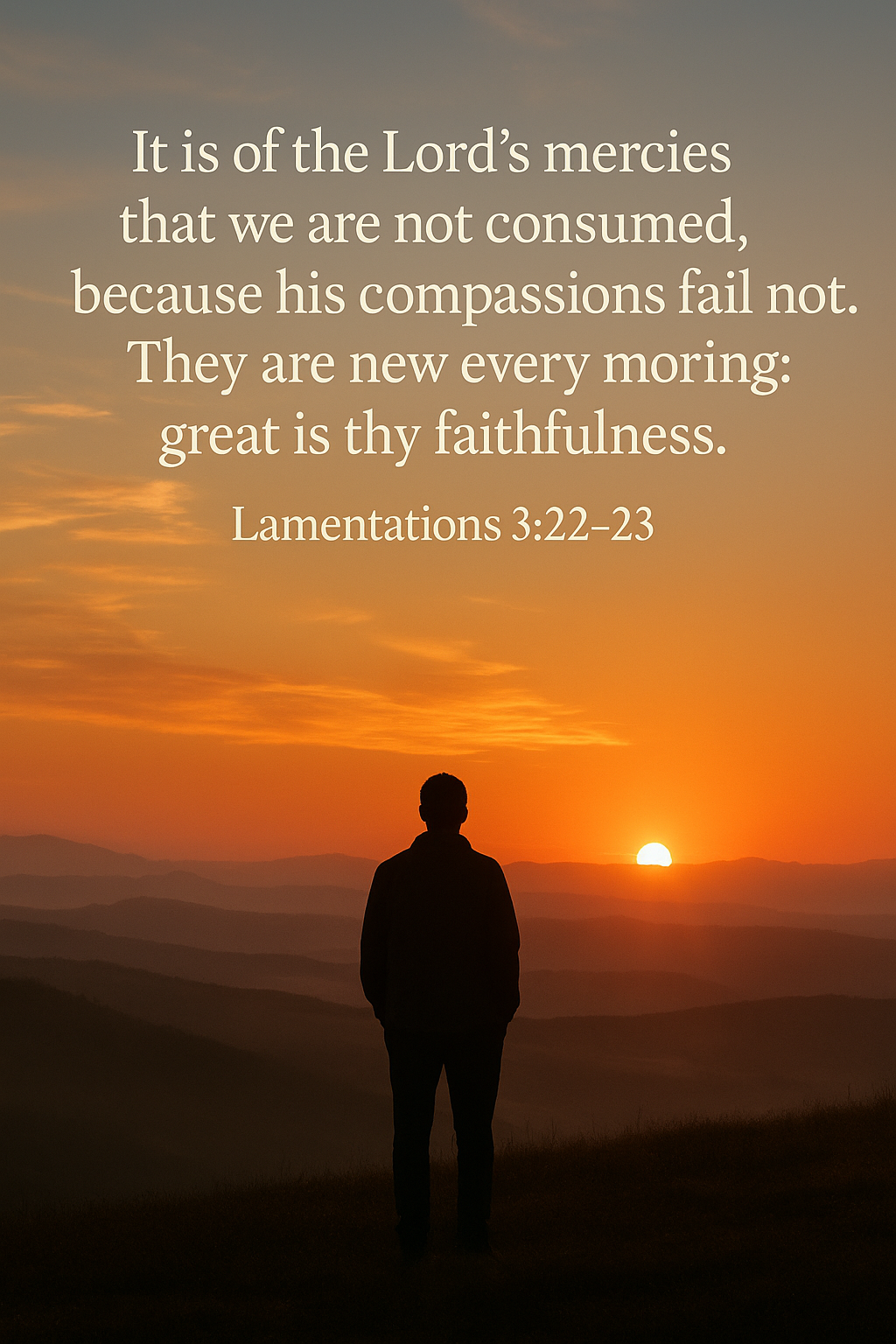
Lamentations 3:22–23 “It is of the Lord’s mercies that we are not consumed, because his compassions fail not. They are new every morning: great is thy faithfulness.”

Verse Context
The Book of Lamentations was written by the prophet Jeremiah, often called “the weeping prophet,” and it reflects the sorrow and devastation that followed the destruction of Jerusalem by the Babylonians in 586 BC. Jeremiah is writing in the midst of national ruin, personal suffering, and divine judgment. Yet right in the heart of this book—chapter 3—he shifts from despair to hope. That transition begins in verse 21: “This I recall to my mind, therefore have I hope.” What does he recall? The verses that follow are among the most treasured in all of Scripture for anyone struggling with guilt, grief, or regret.

Verse 22 says, “It is of the Lord’s mercies that we are not consumed…” The word “mercies” here refers to God’s deep covenantal love, a loyal, faithful, unbreakable kindness that continues in spite of sin and failure. The Hebrew idea behind this word carries more than just forgiveness; it’s a committed compassion that doesn’t let go, even when judgment has been deserved. The word “consumed” points to the full destruction that could have rightly fallen on God’s people, but didn’t, because His mercy held it back.

Then Jeremiah adds, “because his compassions fail not.” The word “compassions” here refers to tender, motherly care, the kind of love that instinctively reaches out to help. This isn’t cold forgiveness; it’s warm, emotional, affectionate love. God’s compassions don’t fade, wear out, or dry up. They “fail not.”

Verse 23 continues, “They are new every morning: great is thy faithfulness.” Here is the turning point. In the middle of disaster, Jeremiah looks at the sunrise and says, today is a new start. Every single morning brings a fresh supply of mercy. The people had failed miserably, but the Lord had not. His faithfulness was unwavering, unchanging, and ever-renewing. This wasn’t an emotional response; it was a theological one. He preached to himself that God’s mercy is not based on human performance but on God’s own character.

Commentator Matthew Henry (1662–1714, Presbyterian) writes, “The streams of mercy are as full, as fresh, and as free as ever.” John Gill (1697–1771, Baptist) agrees, saying that the Lord’s mercies are like the manna in the wilderness, fresh every day, always enough, never failing. In a world where goals can fall short and days don’t always go as planned, God’s compassions still meet us at dawn.

The repetition of “new every morning” also echoes the idea of the daily bread provided in Exodus chapter 16 verse 4: “Then said the Lord unto Moses, Behold, I will rain bread from heaven for you; and the people shall go out and gather a certain rate every day…” Just like the Israelites, we are invited to begin each day by gathering the fresh mercy God has already prepared.The Book of Lamentations is a poetic lament written by the prophet Jeremiah in the wake of Jerusalem’s destruction. Each chapter is a structured acrostic poem, expressing profound grief over the fall of the city and the suffering of its people. Lamentations 3 is the emotional and theological centerpiece of the book. It is also unique: while the other chapters speak as a community voice or a city personified, chapter 3 is deeply personal. It is the voice of an individual sufferer who speaks on behalf of the people but also reveals his own internal anguish. Jeremiah becomes a symbol of righteous suffering amid corporate sin.

Lamentations 3 opens with heavy words: “I am the man that hath seen affliction by the rod of his wrath” (3:1). The chapter begins with a long recounting of pain, darkness, and divine chastisement. Jeremiah sees God as the one who has “turned his hand against me,” who has “made my flesh and my skin old,” and who has “broken my bones” (verses 3–4). The poet walks through despair, isolation, unanswered prayer, and emotional imprisonment. He says in verse 18: “My strength and my hope is perished from the Lord.”

But everything changes at verse 21: “This I recall to my mind, therefore have I hope.” From that verse through verse 33, we find the strongest declarations of God’s goodness and mercy found in the whole book. Lamentations 3:22–23 sits in the middle of that hope. The message is not that suffering is over, but that mercy is not over. Even when God’s discipline is real, as it was for Israel, His love never ceases. His character never fails.

Thematically, this passage draws attention to God’s covenantal loyalty, a central idea in the entire Old Testament. The people have broken their covenant with God, but He remains faithful to His own name and promises. The faithfulness referenced in verse 23 is not dependent on human performance, it is rooted in God’s own perfection. This means that when failure overwhelms us, mercy meets us.

In the larger story of Scripture, this passage points us toward Jesus Christ. The ultimate proof that God’s compassions “fail not” is seen in the cross, where judgment and mercy met. As the Apostle Paul writes in Second Timothy 2:13, “If we believe not, yet he abideth faithful: he cannot deny himself.” God’s faithfulness is never in question.

Application

Appreciating God’s Greatness
Lamentations 3:22–23 puts the character of God on full display. In the ashes of a broken city and the heart of a broken man, we are given one of the clearest pictures of God’s unwavering love. His mercy holds back destruction. His compassion reaches down into despair. His faithfulness remains steady, not because we deserve it, but because He is unchanging. Unlike men, whose patience wears thin, the Lord renews His mercies every morning. This is not poetic exaggeration. It is theological truth, rooted in who He is. His greatness is not only seen in power or judgment but in His ability to love without exhaustion. Great is His faithfulness indeed.

For the Believer
Every believer has days, or seasons, where we feel like we’ve failed God. Missed goals, spiritual lethargy, emotional discouragement, or even sin can make us feel disqualified. Lamentations 3:22–23 is the antidote to that shame. It calls us to look up and see the sunrise as more than nature. It’s a spiritual invitation. A new morning means new mercy. We may not have gotten it right yesterday, but the Lord still beckons us today. We are not consumed. We are not cast off. His compassion has not failed. That truth becomes our fuel, not to sit idle, but to rise in gratitude and walk forward.

Call to Action
If you’re burdened with disappointment, whether over a spiritual shortfall, an unmet goal, or a troubled heart, take time this morning to do what Jeremiah did in verse 21: “This I recall to my mind, therefore have I hope.” Write the verse out. Say it aloud. Let it sink in. Then act on it. Get up. Pray. Start the new week with courage. The mercy of God isn’t theoretical, it’s practical. Go forward today not because you’re strong, but because His mercies are new. Begin again, not in shame, but in grace.

For the Unbeliever
If you are reading this and don’t yet know Jesus Christ, this verse speaks directly to you. You are not beyond His mercy. The fact that you woke up today is proof of His compassion. You are not consumed. That’s not because of chance—it’s because of grace. God is giving you another morning, another breath, another opportunity to repent and believe. The same faithfulness that spared Israel in their rebellion is still available to you through Jesus Christ. The cross is where mercy was made available, and the resurrection is how it reaches you. Today can be the day of salvation. His mercies are new, even for you.

Final Encouragement
There’s something sacred about a Monday morning. It marks not just the start of a new week, but often the weight of what didn’t get done the week before. If that burden is pressing on your heart today, remember this: “It is of the Lord’s mercies that we are not consumed.” You are not here by accident. You are not finished. You are not forgotten. You are being kept by a God whose compassions are unfailing and whose mercies are brand new, today. Lamentations 3:22–23 doesn’t celebrate your performance; it celebrates God’s promise. Let this Monday be a mercy-driven one. Great is His faithfulness.

Prayer
Heavenly Father, thank You for this new day and the mercy that greets us with it. Forgive us for the times we’ve failed to redeem our time well or have let discouragement take root in our hearts. We confess our weakness and lean into Your strength. Help us begin this week not in guilt, but in gratitude. Restore our joy, renew our focus, and strengthen our hands to work as unto You. Let us remember that our hope is not in yesterday’s victories or failures but in Your unfailing compassion today. In Jesus’ name, Amen.

Closing
If you’ve found these daily verses encouraging, enlightening, or fruitful, please consider helping us spread the truth and light of God’s Word by subscribing to the blog and YouTube channels and liking and following the Facebook page. Most of all, share Believers of Biblical Truth and our links with others who may need the sermons and daily teachings just as much as we do.

You are loved, so much in fact, that we want you to know and be Believers of Biblical Truth.

Shalom Shalom.

TODAY’S DAILY BIBLE VERSE

May 1, 2025

Zephaniah 3:17
“The LORD thy God in the midst of thee is mighty; he will save, he will rejoice over thee with joy; he will rest in his love, he will joy over thee with singing.”

Verse Context

The book of Zephaniah, written by the prophet Zephaniah during the reign of King Josiah (circa 640–609 B.C.), delivers a fiery and sobering message of judgment against Judah and the nations. But it ends with a striking reversal—one of joy, renewal, and restoration. Zephaniah was a descendant of King Hezekiah and ministered during a time of widespread idolatry and corruption, just before Josiah’s major reforms (which we read about in Second Kings and Second Chronicles). The Lord gave him a word not just of national judgment but of a future hope. That hope explodes into view in Zephaniah 3:17.

The verse opens with: “The LORD thy God in the midst of thee is mighty.” The phrase “in the midst” shows personal closeness and presence—not a distant deity but one living among His people. “Mighty” here refers to a warrior—specifically a victorious one. In Hebrew thought, this word implies a champion who delivers and defends. It isn’t about potential strength; it’s about strength proven in action. He has already won.

Then we read: “He will save.” This is not just a general saving, but a covenantal rescue. God doesn’t save out of obligation but out of relationship. He’s not stepping in reluctantly—He is coming as the Hero of His people.

Next: “He will rejoice over thee with joy.” This is one of the most shocking claims in all of Scripture. The infinite, holy, all-powerful God—rejoices over His people. The word “rejoice” here is more than quiet approval—it refers to exultation, even dancing or leaping with gladness. God is not tolerating you; He is delighting in you.

The phrase that follows is even more intimate: “He will rest in his love.” Commentators have long wrestled with this line. The word “rest” can also mean “be silent” or “be still.” Some suggest it refers to God being so content and pleased in His love for His people that He has nothing left to say—no rebuke, no wrath, just peace. Others interpret it as a settled, immovable love that doesn’t need to be proved—it simply is. Either way, the image is of a God who is not fretting or striving, but fully content in the love He has for His redeemed.

Finally, we see: “He will joy over thee with singing.” The image here is breathtaking—God Himself sings over His people. This isn’t poetic fluff. This is a declaration of divine emotion—God’s overwhelming delight expressed in a song. The same God who gave Israel the Psalms is shown here composing His own. That’s the kind of God we serve.

Commentator Matthew Henry (1662–1714, English nonconformist) described this verse as showing “how heartily God loves His people.” He says that God’s joy is not just in what His people do, but in who they are in Him. Albert Barnes (1798–1870, Presbyterian) says God’s rejoicing here is the joy of a father reunited with his child, or a bridegroom with his bride—a deeply personal, uncontainable gladness.

This verse is also a quiet rebuke to every false religion that portrays God as cold, distant, or forever angry. Yes, Zephaniah has many words of wrath—but here we see the endgame: redemption, joy, love. When God’s judgment has purged the wickedness, what remains is not silence, but song.

Broader Context

Zephaniah 3:17 is nestled near the very end of the book, which makes its message all the more profound. To understand the weight of this verse, we must consider the full arc of Zephaniah’s prophecy. The book begins with thunder—“The great day of the LORD is near, it is near, and hasteth greatly” (Zephaniah 1:14). The prophet announces a sweeping and terrifying judgment, not only on Judah but on all nations. God’s fury is described as all-consuming. No sin is left unaddressed—idolatry, pride, violence, and spiritual complacency are all condemned.

In chapter 2, the focus expands to surrounding nations—Philistia, Moab, Ammon, Ethiopia, and Assyria—showing that God’s justice is not confined to Israel. Everyone is accountable to His holiness. And yet, tucked into Zephaniah 2:3 is a critical invitation: “Seek ye the LORD, all ye meek of the earth… it may be ye shall be hid in the day of the LORD’s anger.” There’s a remnant being called forth, even in judgment.

By the time we reach chapter 3, the message shifts. After confronting the rebellion of Jerusalem itself, God promises purging, purification, and restoration. Zephaniah 3:9 says: “For then will I turn to the people a pure language, that they may all call upon the name of the LORD, to serve him with one consent.” This points not only to a national revival but to a global unity under God’s name. That foreshadowing of the Gospel age—the time when Jew and Gentile alike are brought near—is directly connected to the joy of 3:17.

What’s remarkable about Zephaniah is that it moves from cosmic judgment to personal affection. God isn’t merely rebuilding a city or nation—He is rebuilding a relationship. Zephaniah 3:14 sets the tone: “Sing, O daughter of Zion; shout, O Israel… The LORD hath taken away thy judgments.” This sets the stage for 3:17. It is the culmination of both justice and mercy: God has judged sin, purified His people, and now He dwells with them in joy.

This verse also anticipates the Gospel. Just as Zephaniah portrays a coming cleansing and rejoicing, so the New Testament reveals the ultimate fulfillment in Christ. Titus 2:14 says of Jesus: “Who gave himself for us, that he might redeem us from all iniquity, and purify unto himself a peculiar people…” That is the song God is singing in Zephaniah—a song about His redeemed.

It’s also worth noting how rare this image is in Scripture. God is often shown listening to the songs of His people—but here, He is the Singer. Just as Jesus wept in John 11:35, this verse adds depth to the emotional life of God. He is not unmoved by His people. He delights in them.

Martin Luther (1483–1546, German reformer) once commented that this verse contains “the entire Gospel in one short verse”—judgment, salvation, relationship, and rejoicing. And it comes not from Paul, not from John, but from Zephaniah—a book so overlooked it’s sometimes called one of the “minor of the Minor Prophets.” Yet in this “forgotten” book, God gives us one of the most vivid portraits of divine joy in all the Bible.

Application

Zephaniah 3:17 is not merely poetic—it’s profoundly personal. The verse reveals God’s heart in a way that overturns cold theology and quiet doubts. For every believer who has felt invisible, unworthy, or unloved, this verse whispers a truth louder than shame or sorrow: God is in your midst. He is mighty. He rejoices over you. He rests in His love. And He sings because you are His.

Appreciating God’s Greatness
We often speak of God’s power, His wrath, His authority—and rightly so. But here, Zephaniah shows us the other side of His majesty: tenderness. God’s greatness isn’t only seen in creation or judgment—it’s revealed in His emotional investment in His people. That the Almighty would “rest in his love” over you, that He would sing with joy because of His relationship with the redeemed—that is greatness too. This verse shows us a God who is not only Judge and King, but Father and Bridegroom. And not a silent one. A singing one.

For the Believer
This verse is for those who have been rescued—not the rebellious, but the redeemed. That’s the key. Zephaniah is not describing a general love for all humanity in this verse. He’s talking about those who belong to Him. Those who have been purified and restored by grace. Believer, you are not just forgiven—you are delighted in. You are not merely tolerated—you are cherished. You may not feel worthy of such affection, but that’s the point. Grace is not based on your loveliness, but on His love.

Call to Action:
Let this verse rebuke your self-hatred and fuel your worship. Too many Christians live as if God is only disappointed in them, as if salvation was a cold transaction. But this verse calls you to rejoice with Him. Praise Him. Rest in His rest. And then imitate Him. Do you rejoice over your fellow believers like God does? Do you bring songs of joy into others’ lives like God brings into yours? Let your life echo the melody He sings over you—by living with humility, celebration, and love.

For the Unbeliever
If you have not yet turned to Christ in repentance and faith, then Zephaniah’s opening chapters still hang over your head. The “mighty one” who sings is also the One who judges. The Day of the LORD is not a sweet hymn for the lost—it is a trumpet of terror. But here is the invitation: you can move from wrath to rejoicing. God is not cold. He longs to sing over you. He has made a way through Christ. Will you continue under judgment, or will you come into the song?

You are not invited into a system. You are invited into a relationship—a covenant where God is not only Savior but Rejoicer. Come to Him today, while the music still plays.

Final Encouragement

Zephaniah 3:17 offers something that many believers forget in the quiet corners of their pain or the loud accusations of their past: God is not only with you—He delights in you. He is not pacing angrily through heaven, waiting for you to earn His affection. No—He is in the midst of you, mighty to save, joyfully resting in the love He has for you, and even singing because you are His.

This is not sentiment—it is Scripture. Let this truth anchor your heart when shame rises, when fear creeps in, when loneliness whispers that you’ve been forgotten. You have not been forgotten. You are not unwanted. You are not barely tolerated. You are deeply, personally, eternally rejoiced over by the God of the universe.

So take this verse and let it fill the silence. When the enemy reminds you of your failures, let the voice of God’s song drown him out. The judgment has passed. The Savior is present. And the love that saved you now sings over you.

Prayer

Heavenly Father,
We are overwhelmed by the truth of Your Word today. That You, the Almighty God, the Holy One of Israel, would dwell in our midst—not in wrath, but in love—is more than we deserve and more than we can fully comprehend. Thank You for saving us, for delighting in us, and for quieting our fears with the settled peace of Your love.

Teach us to rejoice in You as You rejoice over us. Let us worship You not only with songs of praise but with lives that reflect the joy and rest You have already declared. Help us to never forget that Your presence is not a burden but a blessing, not a threat but a comfort. May Your song be the anthem that steadies our hearts and calls the lost to come home.

In the name of Jesus, who made this joy possible, we pray. Amen.

Closing

If you’ve found these daily verses encouraging, enlightening, or fruitful, please consider helping us spread the truth and light of God’s Word by subscribing to the blog and YouTube channels and liking and following the Facebook page. Most of all, share Believers of Biblical Truth and our links with others who may need the sermons and daily teachings just as much as we do.

You are loved—so much in fact, that we want you to know and be Believers of Biblical Truth.

Shalom Shalom.

Today’s Daily Bible Verse: Wait Upon The LORD

April 24, 2025

Isaiah chapter 40 verse 31: 

“But they that wait upon the Lord shall renew their strength; they shall mount up with wings as eagles; they shall run, and not be weary; and they shall walk, and not faint.

Verse Context:

The Book of Isaiah was written by the prophet Isaiah, whose ministry spanned roughly from 740 to 686 BC during the reigns of several kings in Judah. This particular chapter—Isaiah chapter 40—is a turning point in the book. The first 39 chapters of Isaiah deal heavily with judgment, sin, and warnings to Israel and the surrounding nations. But chapter 40 opens a new section—a message of comfort and hope directed to the people of God in exile, reminding them that God has not forgotten them and that His promises still stand.

Isaiah chapter 40 verse 31 is the crescendo of this comforting reassurance. The verse begins with the phrase “they that wait upon the Lord,” which means more than just patience. The word wait here carries the meaning of expectantly looking to or relying on God. It’s not passive. It’s an active trust in His strength and timing. It implies dependency, surrender, and expectation all at once.

The phrase “shall renew their strength” speaks of a divine exchange: those who are weak and weary give up their own failing strength and in return receive God’s supernatural enabling. The word renew here means to exchange or replace, not just to recharge like a battery, but to actually receive something new and better—His power for our weakness.

“They shall mount up with wings as eagles” draws on the imagery of the eagle—one of the strongest and most majestic of birds. Eagles don’t flap endlessly like smaller birds; they rise above the turbulence by catching the thermal updrafts. This is a picture of effortless strength that comes from trusting in God’s provision, not our own striving. It’s also symbolic of rising above circumstances rather than being trapped beneath them.

The verse continues with “they shall run, and not be weary; and they shall walk, and not faint.” These aren’t random stages—they represent real seasons in the life of a believer. Sometimes God empowers us to soar above it all, sometimes He enables us to run through the intense pressures of life, and sometimes He simply keeps us walking, one faithful step at a time, when that’s all we can do. But in each case, His strength sustains us—not our own.

The 18th-century theologian Matthew Henry (1662–1714, Presbyterian) explains this verse as God’s promise that He will “fit His people for their trials, employ them in His service, and enable them to persevere in duty.”

John Oswalt (b. 1940, Wesleyan/Methodist), in his NICOT commentary on Isaiah, adds that this verse “offers a total transformation of the human condition, not by changing circumstances, but by changing the person within them.”

And practically, this passage speaks with special power to those in long trials—people waiting on healing, clarity, purpose, or relief. It tells us not only that God can renew us, but that He will—in His perfect time and way.

Broader Context:

Isaiah chapter 40 is the beginning of what many scholars call the “Book of Comfort” within the larger Book of Isaiah. While the first 39 chapters primarily warn of judgment and exile due to Israel’s rebellion, chapter 40 shifts dramatically in tone, opening with the words: “Comfort ye, comfort ye my people, saith your God.” This is not just a casual encouragement—it’s a divine command to console and restore hope to a broken and scattered people. It was written prophetically for those who would one day be in Babylonian exile, reminding them that God’s promises would outlast their punishment.

The structure of Isaiah from this point forward reflects a future hope rooted in the character and power of God Himself. Chapter 40 is foundational—it reintroduces God’s people to who He really is: not a distant deity, but a powerful, compassionate Creator who cares deeply for the weak and will redeem His people.

In the broader scope of chapter 40, Isaiah does three major things:

  1. He reminds the people that God is coming with power and tenderness (verses 1–11). Verses like “He shall feed his flock like a shepherd” show the soft, gentle care of the Lord alongside His might.
  2. He contrasts the greatness of God with the frailty of man (verses 12–26). Isaiah poses questions like “Who hath measured the waters in the hollow of his hand?” to highlight God’s sovereignty over creation. These questions are rhetorical and meant to humble the reader and awaken awe.
  3. He closes by declaring that this all-powerful God gives strength to the weary (verses 27–31). This is where our daily verse lives. It’s not only a conclusion but also a rebuke to those who say “My way is hid from the Lord.” Isaiah is saying: You may feel forgotten, but you’re not. The everlasting God never faints, never grows weary, and He will renew you.

This section serves both a theological and pastoral role. Theologically, it reminds the exiles—and us—that God does not change, and His purposes stand firm. Pastorally, it meets the reader in their exhaustion and says: God sees you, and He will carry you.

What’s beautiful is that this passage sets up the chapters that follow, where God will reveal the role of His servant—the Messiah—who will bring justice (chapter 42), bear the people’s sins (chapter 53), and eventually establish a kingdom of peace. All of that begins with this word of comfort in chapter 40.

Isaiah chapter 40 verse 31, then, is not a mere inspirational quote. It is the climax of a holy declaration: You are not forgotten, your strength is not lost, and your hope is not foolish. Wait on the Lord. He will lift you up.

Application

Appreciating God’s Greatness

Isaiah chapter 40 verse 31 draws our eyes upward—not just to the sky like the eagle—but to the eternal God who rules over the sky, the stars, the seasons, and every soul that calls on Him. This verse reveals a magnificent truth about God’s nature: He is never exhausted. Unlike us, He does not tire, weaken, or grow frustrated by time. He is never too late, too distracted, or too weary to act.

We serve a God who gives power to the faint (Isaiah chapter 40 verse 29), and that power is not recycled—it’s fresh and full. The picture of the eagle soaring isn’t about freedom alone—it’s about strength without striving, rest while rising, and height without fear. God’s greatness is not just seen in creation but in His care for the crushed and His renewal of the weary.

For the Believer

This verse is a daily anchor for the Christian walk. We all experience seasons where the path ahead seems long, the strength behind us feels drained, and our spirits are tempted to faint. But Isaiah’s words assure us that waiting on the Lord is not wasting time—it’s preparing for a supernatural exchange of strength. Believers who trust in God’s timing and lean on His promises will rise again—not always in a dramatic moment, but often in the quiet renewal of daily endurance. You might not feel like an eagle today. You may feel like you’re barely walking. That’s okay—God promises that even your walk will not end in fainting.

This is a call to hold fast. To wait—not with idle hands, but with a surrendered heart. It’s a reminder that the spiritual strength you need is not manufactured by sheer willpower, but received through surrender and faith. The more you lean on Him, the stronger you’ll become—not because you’ve trained harder, but because He has lifted you higher.

Call to Action: If you’re weary today—emotionally, physically, spiritually—don’t turn inward. Turn upward. Carve out intentional time to seek God in prayer and in His Word. Don’t rush your waiting; renewal comes in the waiting. Encourage someone else today who is struggling—send them this verse. Be the one who helps another soul take flight again.

For the Unbeliever

If you are reading this and you don’t know Jesus, this promise still reaches for you. You may be living in your own strength, trying to bear the weight of life’s burdens on your shoulders. That strength will eventually fail—it was never meant to carry eternal pressure. But there is One who never grows weary, who calls all who labor and are heavy laden to come to Him for rest (Matthew chapter 11 verse 28: “Come unto me, all ye that labour and are heavy laden, and I will give you rest.”). This is not a poetic escape—it is a real invitation from a real Savior.

Jesus Christ offers more than just comfort—He offers life, peace, and a future. You may feel grounded right now, burdened, or even broken—but He will lift you. Come to Him with your whole heart, surrender your self-reliance, and trust the One who can cause you to rise with wings as eagles.

Final Encouragement

Isaiah chapter 40 verse 31 is not simply a verse about energy or motivation—it is a divine promise. God sees the tired. He lifts the low. And He strengthens those who stop striving in their own might and begin waiting in His. Whether you are soaring, running, or barely walking, you are not forgotten. Your strength will be renewed—not by your own hands, but by His.

Let today be a turning point. Choose to wait—not with frustration, but with faith. Let your soul rest in the assurance that the God who never sleeps is working all things for your good. And when the time is right, He will lift you up—higher than you imagined, stronger than you believed, and more stable than you’ve ever stood before.

Prayer

Heavenly Father,
We thank You for being the God who never grows weary. In a world that constantly drains us, You are our unending source of strength. For every weary soul reading this today, I ask that You would fulfill Your promise—renew their strength. For those who are walking, help them not to faint. For those who are running, sustain their pace. And for those who are ready to rise, lift them like eagles. Teach us to wait on You—not in fear or frustration, but in faith and expectation. Let Your peace steady us, Your Spirit empower us, and Your Word anchor us. We rest in You today, Lord. In Jesus’ name, Amen.

Closing

If you’ve found these daily verses encouraging, enlightening, or fruitful, please consider helping us spread the truth and light of God’s Word by liking this and other posts, subscribing to the blog and YouTube channels, and liking and following the Facebook page. Most of all, share Believers of Biblical Truth and our links with others who may need the sermons and daily teachings just as much as we do.

You are loved—so much in fact, that we want you to know and be Believers of Biblical Truth.

Shalom Shalom.