
To Believe is to Follow

Have you ever wondered why things just never seem to get better, even after giving your heart to Christ? Have you ever heard the conflicting stories of a God that is filled with love, and a God that kills people and wondered which one was the truth? Have you ever wondered if you would ever know the truth about anything? Do the stories of the old testament clear up or profoundly intensify these questions? I want to share a story about a prophet and my take on how it answers these questions.


The Israelites were a very disobedient people. Many ask, if God is such a good God, why did he kill so many people, why was he so violent? First, in defense of his chosen people. We cannot ever forget that with the fall of Adam and Eve, sin and death entered into the world, at the choice of man. That’s when our free will to do bad things was introduced. When our children do bad things, we discipline them. Death may be hard to see as a punishment, but take a violent sick criminal. He has broken into your home to kill you, but first he wants to torture and kill the children, then the adults. Is death too great a consequence for this chosen action? As we will see, God has very clear rules. Many want God to be this soft, loving and tender God. But the truth stings because it can be hard. And God is the most perfect truth there is. In this story, we see captivity being used as a form of punishment for His people who worshipped other Gods and other idols. They were grossly disobedient. However, even in this punishment, it was important to God that His people understand the reasoning. Is that not true for a parent who reasonably disciplines their child? Isn’t it important for our children to know why they are being punished? Of course it is. Otherwise, you are just punishing out of anger and that is nothing but the beginning of problems. So God anointed Ezekiel to be a prophet who would reveal to the Israelites why God was doing what he was doing, and the deeper lessons behind the actions. God also wanted Ezekiel to give them hope of the end goal which was for the nation to get right with God, so at that point he could free them.


We don’t have prophets today.  All that we can learn is right there in the closed cannon of scripture. There is nothing new.  However, there is the Holy Spirit, one-third of the triune God Head. He is imputed to us when we receive Christ as our savior. Through the convictions of the Holy Spirit we hear the correction, we feel the chastisement. That is why the same scripture can feel new time and time again. The people in this story had anointed prophets who relayed to them what was going on. Today, we have to practice our faith so we can clearly hear both the shouts and the whispers of the spirit.


If we study the book of Ezekiel, we will find many similarities in God’s love, and God’s correction that we have today. First, we see the sin. The Israelites were living in Sin. If we are not living in sin, then there is no need for Christ. This is an imperative part of us understanding salvation. God did not send his son to earth to die a horrible death to save us from love. Out of love, God sent his son to save us from death caused by sin. But as I stated earlier, sin and death have been in the world since the fall of man. We are born into sin. Sin is all over us from the very beginning. Many only want to talk about particular sins, but we are covered in it. Lies, lust, jealousy, envy, and so on. There are many actions that are sinful, but most boil down to some of these most basic sins. This is why it doesn’t matter if we talk about drunkenness, or stealing, or lying, or any sexually immoral sin. It is all sin and so it is all the same to God. We, as individuals, are no different than Israel in that they are covered in their sin and need to be redeemed by God. We cannot save ourselves, and we cannot save each other. Only the blood of Jesus can cleanse us of our sin.  In the Old Testament, it was through the blood of a perfect animal sacrifice. Today, it is by professing your faith in Christ and accepting Jesus as your savior, your perfect sacrifice.


God allowed Israel to be held captive because of their sin, in fact He put them there. So the question is really not why did He do that. The answer is clear, they were disobedient. The real question is why do you think God is going to treat the present day unsaved sinner any different. He has promised a place called hell, and He has promised to cast out those who do not endure unto the end, who do not follow his son Jesus the Christ. We have not yet received our punishment for our disobedience, but the bible and Jesus promise it is coming. Again, the one man in all of the bible who spoke about hell the most was not a mortal man, but the God-man, Jesus.


We battle against our flesh daily and that is why we are told to die to ourselves daily. We must give up our propensity to respond to and to satisfy our desires of our flesh. One of Ezekiel’s goals was to make sure that Israel knew that captivity was not going to be brief. They were grossly disobedient, so a great deal of time was going to be needed to change their ways. When we die while living in sin, we need to understand the same principle. Our consequence is for eternity. There is no ‘Get out of Jail Free” card. It is a punishment that will last forever and ever! Ezekiel was also to prophesy a new hope to the nation. Hope that one day God will deliver them. While they lived in captivity, they had to believe. Through the birth, life, death, burial, and resurrection of Christ, we have been given a promise as to His glorious return. Through the bible, we are briefed about it, and have the opportunity to be reminded of the promise as often as we choose to read about it. This is our hope in a redemption that leads to eternal life, not eternal death. But as the motto of this blog indicates, to believe is to follow. There are many who say, “Yes, I believe in Jesus” but have no reason why other than they do not want to go to hell. They do not practice a disciplined life style of any kind. They do not study the word, nor do they engage in any form of worship toward the one true God who is the only God who can save them from the eternal death. Ezekiel was to connect all this with the realization that Israel needs to have a genuine reliance on God the Father. They need to depend on God for their redemption, and their provisions, and the fulfillment of the promised to bring them out of captivity. The entire life of Christ is about the sins of our life as he was sin-free, our inability to save ourselves as he is God and did raise himself from the dead- meaning Christ did save himself, the need to rely on God and to have hope in the promise of His return. We have hope in eternal life, because we believe in that which we have not seen.


Ezekiel means “God is strong”, or, “God makes strong”. In the beginning of their captivity, Israel was weak, and far away from their ordained relationship with the Father. So are we. It is a false strength when we believe that we can go through life without God. It is an offense of idolatry very similar to the idol worshiping that Israel engaged in. Only we are worshiping ourselves. Through this ordeal, and with the leadership, obedience, and God ordained strength of Ezekiel, God strengthened Israel. As we study, and pray, and fellowship with other believers, and learn to be obedient to the convictions of the spirit we too are strengthened unto the end. This is how we endure to the end, this is how we finish well, and this is how we win the race. Only by grace, mercy, and God’s sovereignty are we strengthened.


Ezekiel’s first vision is his calling. Studying the scriptures to be a priest or teacher is one thing, to be a prophet is another. Nothing in Ezekiel’s training could prepare him for this journey. Sometimes we think our sin is too great, sometimes we think we are too broken to be called, to be used, to be redeemed. Sometimes we struggle with this idea because we look at it from the idea that we are in charge of morals. We are violators of our own moral ideas, and therefore not redeemable. A murderer for example, may think that he is unredeemable because he is so morally corrupt. Even more common, drunkards, addicts, liars, cheaters, and ordinary people who just see every flaw in their make-up believe that they are morally bankrupt. And sometimes as a society we help them with that by thinking that they are so morally wrong that we need to cast them out of society all together. But the truth here is that God is the only PERFECT MORAL AUTHORITY! We argue that God is to harsh when he consequences. Again, as a matter of Idolatry, we believe that our wrath is more intelligent, more loving, more righteous than God’s. In other words, I don’t want to worship a God who sends people to hell because that is not loving enough for me, and I am right and God is wrong. This is boiled down to us thinking that we have the right to exact wrath. Forgiveness is not about forgive and forget, it is not absolution. It is me saying that I give up my right to revenge in this matter. I am hurt and I may choose to stay away from you, but I turn over my desire to have wrath to God. Forgiveness is for you and the offender. God is the creator of morality. If we can remember that, if we can see that God is so morally perfect and all powerful we will understand how He can say, your bankruptcy is forgiven, you have no more debt. My son has paid it for you. And if we understand that God is the true judge, then we can understand that He means what he says when He teaches us the foretold consequence for living in sin.


The final thought on this is a sobering one. Ezekiel was a captive too!! He worked with what God gave him, where God gave it to him, how God gave it to him, and when God gave it to Ezekiel. If anyone thinks they need to wait for a perfect leader to come and talk about sin, to take your hand and walk you back into the light, if you think that God does not put leaders right in the middle of despair, broken themselves, then you will be waiting forever, because that is not how it works. God revealed himself to Ezekiel in a vision and prepared him for this journey. Similarly, Christ came in the form of man and revealed God to mankind. Jesus prepared us to hear the message of salvation, just as God did for Ezekiel.  Open you ears and hear the word, hear the gospel. Receive the hope that is in Jesus the Christ.


If you stand in the mirror what will the reflection tell you about yourself, and what are you going to do about it? May the peace of God be abundantly heaped upon you and your house, straight from the cross to the Christian!
There is nothing that you can do for yourself.

There is an incredible burden on my heart, one that has been even more profound these last few weeks. Daily sanctification is a journey. When we truly confess our sins, and have a genuine repenting heart, and professed that Jesus Christ is LORD, His blood cleanses the soul. After we have a soul free from the bonds of sin, then the spirit is free to dwell inside. Justification is the result of faith in and acceptance of God’s grace and mercy. Once the Spirit of the LORD dwells inside of us, we are able to have intense fellowship with God. It is a direct line to Him. We feel that correction of a loving father through the imputing of the Holy Spirit. The conviction we feel when something is wrong, or when we have offended someone comes from the Holy Spirit that dwells in us. But so does power. When we have the Holy Spirit inside of us, and we call on the Holy Spirit to take control and genuinely give up that control to the Holy Spirit we have power from God. It is important to recognize that that power is not ours. It is important to recognize and praise the source of that power. The indwelling of the Holy Spirit strengthens us as well as corrects us.

This is on my heart because of two things. The first is this. These past few weeks I have been confronted by a man. I believe he is a good man, and a hard-working man. I should know I work with. Over the past few weeks, and especially the last week, he has texted me often. He has been quoting scripture as he seeks answers for some work related issues. But this man believes that he is being wronged by administrators of our company. This man has a tendency to allow anger to overcome him. And I believe that he is using Scripture to authorize his anger and wrath. The second thing is simple. I believe I recognize this because I am guilty of the very same thing. We have been told “it takes one to know one”. Well, I believe that is true in this case. I love the word of God. I love the feeling of communication and communion with God during biblical studies, prayer, fellowship with like-minded Christians, and other situations where the presence of the Lord is genuinely felt. But in situations where things are not going well, the sinful flesh of my old self wants to take over. It is in this regard that my heart is burdened.

All of us, every self-proclaimed follower of Jesus Christ who believes that they benefit from the mercy and grace of the Almighty Father, better understand one thing. There is nothing that you can do for yourself. The Holy Scripture is meant to be our source of many things. The Scripture is our source of wisdom, of comfort, of guidance, of power, and so on. What the Bible is not, is a weapon to be used to justify our own desires. We cannot talk about putting on the full armor of God to go to battle to defend our desire of selfishness and still be in the will of God. In one of his texts, my coworker quoted the book of James. The book of James is one of my most favorite books. It should not be misconstrued as a book of works righteousness, but rather instruction on how the indwelling Holy Spirit brings about good works through you. Once again, you better understand that there is nothing that man can do for himself. My coworker specifically quoted verse 22 and 23.

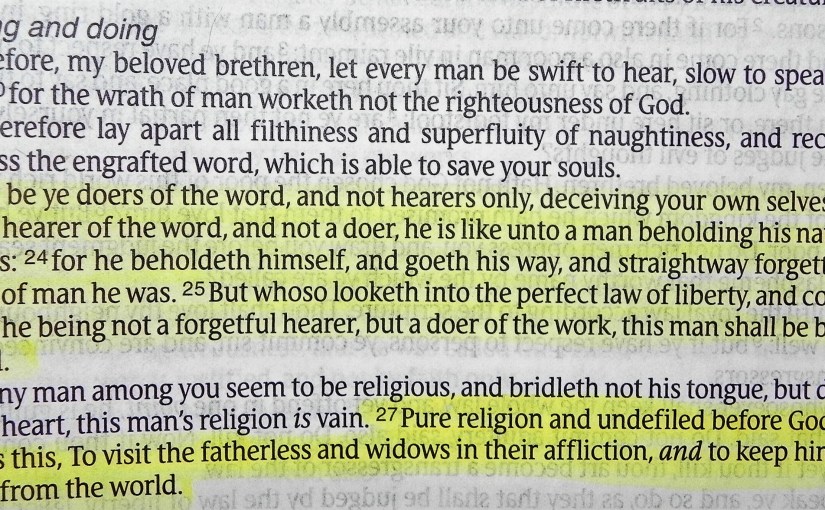
James 1:22-23, “22 But be ye doers of the word, and not hearers only, deceiving your own selves. 23 For if any be a hearer of the word, and not a doer, he is like unto a man beholding his natural face in a glass:”

My coworker went on to quote a few other Scriptures. He was collecting them verse by verse from various places, trying to explain to me that the Bible says that we are to stand up and defend the faith and defend his position that he is not going to take anymore of the administrations non-sense by saying in his words, “compromising no more.” This would be a good thought if what we were talking about not compromising was faith in the word of God. My coworker is struggling with some personnel issues with administration, as well as some pay issues. In some regards I don’t think Jesus ever expected us to be pushovers. If we were to truly let all non-believers, like ISIS, just kill all of us, there would be no-one left to preach the word. But I do think that he expected us to use the spirit to help us discern between what’s right and wrong. My observation is that my coworker will take Scripture and use it to defend the execution of his wrath instead of allowing himself to be humbled by the spirit so that God’s wrath will prevail. Once again there is nothing that man can do for himself. God’s wrath will always be more righteous and more just than anything that man can come up with. I must repeat myself. I do not say this to lecture my coworker. I say this because it is a hard lesson, one that I have learned about myself over and over. I am grateful for the conviction of the spirit.

So let’s take a look at what James is saying here. It is my intention to lift up the word of God so that we can have a better understanding of what it means to be doers of the word. In order to do that, I think we have to quote more than just two versus, to keep everything in context. So let’s start and James verse 19

James 1:19-27
19 Wherefore, my beloved brethren, let every man be swift to hear, slow to speak, slow to wrath: 20 For the wrath of man worketh not the righteousness of God.
21 Wherefore lay apart all filthiness and superfluity of naughtiness, and receive with meekness the engrafted word, which is able to save your souls. 22 But be ye doers of the word, and not hearers only, deceiving your own selves. 23 For if any be a hearer of the word, and not a doer, he is like unto a man beholding his natural face in a glass: 24 For he beholdeth himself, and goeth his way, and straightway forgetteth what manner of man he was. 25 But whoso looketh into the perfect law of liberty, and continueth therein, he being not a forgetful hearer, but a doer of the work, this man shall be blessed in his deed. 26 If any man among you seem to be religious, and bridleth not his tongue, but deceiveth his own heart, this man’s religion is vain. 27 Pure religion and undefiled before God and the Father is this, To visit the fatherless and widows in their affliction, and to keep himself unspotted from the world.

My study Bible the Tyndale life application study Bible has a small paragraph providing commentary on the 27th verse. That commentary, on page 1887, reads as follows,
“to keep ourselves unpolluted (“unspotted”) from the world, we need to commit ourselves to Christ’s ethical and moral system not the world’s. We are not to adapt to the world’s value system based on money, power, and pleasure. True faith means nothing if we are contaminated with such values.

I think that it is absolutely awesome that Joseph Benson makes the following commentary about “slow to speak”. When I think of my coworker and myself I think about his words here that say,

“To deliver his opinion in matters of faith, that he does not yet well understand. Persons half instructed frequently have a high opinion of their own knowledge in religious matters, are very fond of teaching others, and zealous to bring them over to their opinions.”

We have a high opinion of our own knowledge and are very fond of teaching others in order to bring them over to our opinions. Again, I have to be honest. If you cannot look at this and say, “Yep, that is me sometimes.” the let me simply say that it is most certainly me sometimes. Unfortunately, for my co-worker, I think that is so true in these text messages. I love the book of James and am very familiar with it. And when I know what my coworker is trying to accomplish; and I see the Scriptures that he’s quoting in order to accomplish it, I see these words by Joseph Benson come to life. My coworker also texted to me that brethren in the faith, “also stand up for each other when we are being wronged” I would say that I would go to war for a friend if I believe my friend was being wronged. The problem is what he believes is wrong and what I believe are wrong are two different things. And he is willing to put our spiritual relationship on a hook if I don’t stand up for him; If I don’t go to war with him over what he believes is right. The Scripture does not say anything close to that. But I must say I have shared that opinion in the past and had the audacity to be upset with a brother for not being on my side. You want to talk about guilt. Once I realized what I was doing, there was no apology big enough. But THANK GOD FOR THE BLOOD OF CHRIST that allowed a brother to forgive another brother and for one brother to learn to pay attention to his mouth more often.

I’m going to continue with more commentary by Joseph Benson, because I believe he is spot on. Continuing to refer to the rest of the verses in James 1:19-27, he writes,

“The apostle, however, may be understood as cautioning his readers against easily yielding to provocation in any respect whatever, and especially when injuriously treated by their persecutors. For the wrath of man — Even when it appears in the garb of religious zeal, worketh not — But, on the contrary, greatly obstructs, the righteousness of God — Instead of promoting the cause of true religion in the world, it is a reproach to it, and a means of exciting the prejudices of mankind against it. Persecution, in particular, the effect of the wrath of man, if violent, may make men hypocrites, by forcing them to profess what they do not believe; but it has no influence to produce that genuine faith which God accounts to men for righteousness. Nothing but rational arguments, with the illumination of the Spirit of God, can do this.”

When I read these words I cannot help but think of myself, “On more than one occasion I have represented this hypocrisy, lack of influence to produce genuine faith, and reproach in exercising my own wrath. I am certain that people have looked at me and said, “who is this man?” One minute I was talking about God and the next minute I was acting like a lunatic. I am ashamed to admit that this still happens from time to time. My daily sanctification has me working on this issue because I believe every word that Joseph Benson is saying here is truth. I believe that this is something that I clearly see in others because I am so acutely aware of its existence inside my own body. It is something that I wanted to take time to caution everyone about. We live in a day and age where people are looking at Christians and scrutinizing us with the most critical eye. We cannot afford to dampen the light of Jesus Christ, we cannot afford to contaminate the ethical and moral system of Jesus Christ with our own wrath brought about by the violation of our own morals. This whole relationship, salvation, is not about us. I say again, there is nothing that we can do for ourselves. Everything is about Jesus the Christ!

I have had many conversations with myself, the man in the mirror, and the triune God. My question to you is, “are you having these conversations yourselves?” I know many Christians, just like my coworker and I, who have used or continue to use Scripture to validate their questionable behavior. There is righteous anger. There is anger that has compassion for change in it. But if your anger leads to sin, if it produces hate in your heart or even just a little anger in your thoughts, then perhaps this conversation in the mirror is something you should take time to have sooner rather than later.

If you stand in the mirror what will the reflection tell you about yourself, and what are you going to do about it? May the peace of God be abundantly heaped upon you and your house, straight from the cross to the Christian!


It’s not always about us!

Have you ever been so low in your life, so downtrodden, in the deepest depression that you felt there was no break coming anytime soon? Have you ever been in such a place where hope is absent, help seemed impossible, or that such a despair was so routine you honestly believed sorrow itself is your destiny?

Have you ever been to prison? Sometimes these feelings are exactly what prisoners go through on a daily basis. Consequences for our actions can be harsh. Even if they are deserved, they can still be harsh. People can still feel remorse and suffering even if it is a just consequence. But sometimes, consequences are lodged against the innocent. Let us take Paul as an example of this.

One of the first churches on the European started was the church in Philippi. The church had sent Paul a gift while he was imprisoned in Rome. Paul was in prison, which by the way are nothing like the prisons we have today. Let us remember as we look at the behavior of Paul here that he is living in a dungeon, on dirt floors, in stench, and with little to no light. He had no friends around him, and was most likely being mocked by the Roman Guards. The book of Philippians is the letter that Paul wrote to the church in Philippi thanking them for that gift. And there are five basic themes to the book of Philippians. Humility, self-sacrifice, and Christian living are among those five. But there is a particular verse into particular themes that I read one night before bed. It is this topic has been on my mind ever since, and that is why I share it here.

Chapter 2 starting at first three we read, “2 Fulfil ye my joy, that ye be likeminded, having the same love, being of one accord, of one mind. 3 Let nothing be done through strife or vainglory; but in lowliness of mind let each esteem other better than themselves. 4 Look not every man on his own things, but every man also on the things of others. 5 Let this mind be in you, which was also in Christ Jesus”

I would like to pay attention, for just a moment, to verse number four. This verse, for some reason, struck me to the point where I would read a couple more verses but I would go back and reread verse four. I did that several times. What does it mean? Here’s a man imprisoned for being a Christian, a follower of Christ, or as it was said in those days a member of “the way”, and his thank you letter is one filled with encouragement and joy. During a time in his life when no one would blame him for being despondent, or sad, or to not take the time to say thank you for the gift at all because of the situation that he finds himself in, Paul maintains his focus on two of the five attributes of this book and they are right Christian living and JOY!

The first eight words of verse four clearly indicate the instruction to pay attention to others. However, the word also indicates that there is a time to measure yourself. Most commentators agree that because God made each of us unique, we should take care to meet our own needs.

I like the way Charles Ellicott comments on verse four, “Yet by the word “also” we see that St. Paul does not, in the spirit of some forms of modern transcendentalism, denounce all self-consciousness and self-love, as in a bad sense “selfish.” For man is individual as well as social; he can subordinate “his own things” to “the things of others,” but cannot ignore them.”

We must remember that the Bible tells us that if we do not take care of ourselves and our home and our family inside of our home then we are worse than an infidel.

John Gill reminds us of this in his commentary on this verse. “Not but that a man should take care of his worldly affairs, and look well unto them, and provide things honest in the sight of all men, for himself and his family, otherwise he would be worse than an infidel;”

But as the case is in nearly everything we do, there is a line between what is righteous and reasonable, and what is excessive and sinful. And here Paul is telling us that, as they have looked in on him by way of messenger and gift, they should be looking in on each other. It’s not always about us! You cannot be a follower of Christ and still live a life that says Me! Me! Me! They should be mindful of the needs and the feelings of the members of their own church. This lesson transcends the walls of the church house to the brethren of the body of Christ. This verse does not intend to refer to just secular needs, but also the spiritual needs. The word “look” in this verse does not infer a light gaze. It’s meaning is not one of surface observance. Paul is not telling us to merely see the needs of others. It has a much deeper and intense meaning. It infers an attentiveness, one that causes observation and consideration. It infers that you are to “beware”. We are told many times throughout the Bible to “beware”. This infers that our eyes to be wide open, for us to be alert. When we are being told to “beware”, the usual reference is that we are to be on guard for the lion who walks to and fro seeking out whom he can devour. To have that understanding of the word look here in verse four, we should then take, with a great deal of seriousness, our Christian duty to beware of the physical and spiritual needs of our brethren in the body of Christ.

I came across the these two short stories that illustrate verse four. I will leave you here with these great examples of how we are to look onto the needs of others.

Sunday Magazine printed this,
Thomas Sampson was a working miner, and worked hard for his bread. The captain of the mine said to him on one occasion, “Thomas, I’ve got an easier berth for you, where there is little comparatively to do, and where you can earn more money. Will you accept it?” What do you think he said? “Captain, there’s our poor brother Tregony. He has a sick body, and he is not able to work as hard as I am. I fear his toil will shorten his useful life. Will you let him have the berth?” The captain, pleased with his generosity, sent for Tregony, and gave him the berth. Thomas was gratified, and added, “I can work a little longer yet.”


T.T. Shore tells this short story;
A German countryman went one day with his four sons to the neighbouring town to transact some business. While there, in the market place, he bought five peaches. One of these he kept for his wife, who was at home, and the others he gave to his boys. When they were sitting round the fire the next evening, he thought he would ask each of his sons what he had done with his peach. The eldest said he had eaten his, but had kept the stone to plant in the garden, in hopes that it would grow up and bear some peaches as good as the one he had so much enjoyed. The youngest boy confessed he had eaten his own peach and thrown the stone away, and after his return home had helped his mother to eat half of her peach! The second eldest boy told how he had picked up the stone which his little brother had thrown away, and cracked it, and eaten the kernel. “It was nice and sweet,” he added, “and I sold my own peach for so much money that I have enough to buy several peaches now with what I got for it.” The third son then had to tell his tale. The others had told all theirs at once with no hesitation and no shame, but this little lad blushed as he began his story: “I took my peach to a poor little friend who has been in bed for so long, and suffers so much pain. He refused to take it from me, so I put it on his bed and ran away.” His mother’s kisses, as she heard these words, were far sweeter on his young lips than any fruit.

If you stand in the mirror what will the reflection tell you about yourself, and what are you going to do about it? May the peace of God be abundantly heaped upon you and your house, straight from the cross to the Christian!


Jesus became your scapegoat

When Lee Harvey Oswald was arrested and charged with the assassination of President Kennedy, he made the comment that he was just a patsy. I believe that there are people who are imprisoned for crimes they did not commit. I believe there are people who are sitting on death row for crimes they did not commit. I believe that our criminal justice system has put people to death who were innocent of the crimes they were sentenced to die for. Having said that, I am just as certain that, even if it was not as dramatic and tragic as these, so many of us can reflect back to a time where we were actually accused of something we didn’t do. Maybe the police were not involved. Maybe your parents weren’t involved. Maybe the only consequence you suffered was a loss of a friend because they believe a rumor that you did something you really were innocent of.

In the Old Testament the Israelites, in Leviticus chapter 16, are instructed to observe sacrifice ceremony of atonement. Jewish people today celebrate it still. They call it Yom Kippur. The word Yom means “day” in Hebrew. Kippur means “to atone”. In the English language we call it the Day of Atonement. In Leviticus chapter 16 verses 15 through 22 we see instructions to the Israelites on how to proceed with a ceremony for atonement. Today there is fasting and prayer for the entire day. However, I would like to talk about an Old Testament ceremony that I find interesting.

Leviticus 16:15 – 22

15then shall he kill the goat of the sin offering, that is for the people, and bring his blood within the veil, and do with that blood as he did with the blood of the bullock, and sprinkle it upon the mercy seat, and before the mercy seat: and he shall make an atonement for the holy place, because of the uncleanness of the children of Israel, and because of their transgressions in all their sins: and so shall he do for the tabernacle of the congregation, that remaineth among them in the midst of their uncleanness. And there shall be no man in the place until he come out and have made atonement for himself, and for his household, and for all the congregation of Israel. And he shall go out on to the alter that is before the Lord and made an atonement for it; and shall take of the blood of the bullock, and of the blood of the goat, and put it upon the horns of the altar round about. And he shall sprinkle of the blood upon it with his finger seven times, and cleanse it, and hallow it from the uncleanness of the children of Israel. And when he hath made an end of reconciling the holy place, and the tabernacle of the congregation, and the altar, he shall bring the live goat: and Aaron shall lay both his hands upon the head of the live goat, and confess over him all the iniquities of the children of Israel, and all their transgressions in all their sins, putting them up on the head of the goat, and shall send him away by the hand of a fit man into the wilderness: and the goat shall bear upon him all their iniquities unto a land not inhabited: and he shall let go the goat in the wilderness.

It is in this chapter and in verse 26 we see this goat called a “scapegoat”. This is where we get our present day use of this word. Upon this goat is laid all of the sins of the Israelites. This goat is permitted to “escape” into the wilderness. Remaining in the Old Testament but moving ahead in time we come to the prophet Isaiah. Isaiah is known as one of the greatest prophets. In the beginning of his prophesying, Isaiah is well respected and very well-liked. But as time goes on, and as Isaiah continues to prophesy the future truthfully, more and more people are offended by his words. Does that sound familiar? It was just as common to revile the truth and hate the truthsayer back then as it is today. There are fewer and fewer men standing in pulpits preaching the truth because there is an increasing number of men and women who are offended by the very same truths that Isaiah prophesied about in the Old Testament. The truth is, Isaiah spoke a lot about the coming Messiah. He prophesied often about Jesus the Christ. In chapter 53, in the book of Isaiah we see the great profit talking about the final sacrifice, the final atonement.

Isaiah 53:2 – 6

2For he shall grow up before him as a tender plant, and as a root out of a dry ground: he hath no form nor comeliness; and when we shall see him, there is no beauty that we should desire him. He is despised and rejected of men; a man of sorrows, and acquainted with grief: and we hid as it were our faces from him; he was despised, and we esteemed him not. Surely he hath borne our griefs, and carried out our sorrows: yet we did esteem him stricken, smitten of God, and afflicted. But he was wounded for our transgressions; he was bruised for our iniquities: the chastisement of our peace was upon him; and with his stripes we are healed. All we like sheep have gone astray; we have turned every one to his own way; and the Lord hath laid on him the iniquity of us all.

In this chapter, and in these verses, we see a prophet, living in the Old Testament times, take an Old Testament ceremony and combine the two acts required in the ceremony of atonement into one final sacrifice. Upon the cross Jesus Christ was sacrificed. His blood flowed like a river of life from up top of Mount Calvary. Bruised, pierced, flesh cut wide open, and put to death we see Jesus our Lord take the place of the first goat. When darkness came, and Jesus felt the loneliness of the absence of His heavenly Father, as God put upon him the sin of all the world, we heard him cry out “it is finished” and die. With the sin of the world on his shoulders we see him take the place of the second goat. On the Cross, Jesus was executed for crimes he did not commit. On the Cross Jesus became your scapegoat!

John 3:16

For God so loved the world, that he gave his only begotten son, that whosoever believeth in him should not perish, but have everlasting life.

John 3:16 is probably one of the most familiar verses of the Bible in the entire world. It is a snapshot of just how much God truly loves his children. It is repeated in ceremonies over and over again. But do we understand fully, the need for that love. Because of the love of God, otherwise known as Agape love, we were given the gift of atonement through the blood and sacrifice of Jesus Christ. This gift was given because of God’s righteous and perfect love. Let us not forget that the Israelites were commanded to participate in the twofold sacrifice procedure on the Day of Atonement because of their sinfulness. Likewise, we needed the final sacrifice, the final and most perfect SCAPEGOAT because of our sinfulness. We need to focus on the fact that our sin is to such a huge degree, that there is nothing that man can do for himself to create an effective scapegoat. I cannot save you, and you cannot save me. That is how doomed we are without the perfect scapegoat. Jesus Christ committed no sin. Yet he took our sin to the cross. He did not try to defend himself. He never said I didn’t do it. He was a willing patsy, he was a willing scapegoat. Upon him was laid the sin of all of us. And if you choose to turn your life over to him, he will take your sin and he will put it in a place where you will never see it again, like the goat that goes to the wilderness where no one lives. God’s love provides us with this avenue to redemption. But we cannot forget there is a reason why he had to do what he did, there is a reason why he had to show us such a great love. And that reason is because we are a fallen creature, filled with sin, driven by a desire to serve our flesh.

The scapegoat has already taken the sin, he has already gone to the cross, he has already provided the cleansing blood that wipes away sin, and he has already died and sacrificed himself for you. Are you willing, on this day, to give him all of your sin? Are you willing to take advantage of the greatest love that anyone man could possibly know, and repent? Are you willing to turn away from the desires of your flesh, and live a life for the scapegoat who died for you on the cross, himself being an innocent man? Are you willing to put all childishness and folly behind you and be a follower of Christ?

If you stand in the mirror what will the reflection tell you about yourself, and what are you going to do about it? May the peace of God be abundantly heaped upon you and your house, straight from the cross to the Christian!

From Such Turn Away!

Mark 7

7 Then came together unto him the Pharisees, and certain of the scribes, which came from Jerusalem.

2 And when they saw some of his disciples eat bread with defiled, that is to say, with unwashen, hands, they found fault.

3 For the Pharisees, and all the Jews, except they wash their hands oft, eat not, holding the tradition of the elders.

4 And when they come from the market, except they wash, they eat not. And many other things there be, which they have received to hold, as the washing of cups, and pots, brasen vessels, and of tables.

5 Then the Pharisees and scribes asked him, Why walk not thy disciples according to the tradition of the elders, but eat bread with unwashen hands?

6 He answered and said unto them, Well hath Esaias prophesied of you hypocrites, as it is written, This people honoureth me with their lips, but their heart is far from me.

7 Howbeit in vain do they worship me, teaching for doctrines the commandments of men.

8 For laying aside the commandment of God, ye hold the tradition of men, as the washing of pots and cups: and many other such like things ye do.

9 And he said unto them, Full well ye reject the commandment of God, that ye may keep your own tradition.

10 For Moses said, Honour thy father and thy mother; and, Whoso curseth father or mother, let him die the death:

11 But ye say, If a man shall say to his father or mother, It is Corban, that is to say, a gift, by whatsoever thou mightest be profited by me; he shall be free.

12 And ye suffer him no more to do ought for his father or his mother;

13 Making the word of God of none effect through your tradition, which ye have delivered: and many such like things do ye.

14 And when he had called all the people unto him, he said unto them, Hearken unto me every one of you, and understand:

15 There is nothing from without a man, that entering into him can defile him: but the things which come out of him, those are they that defile the man.

16 If any man have ears to hear, let him hear.

17 And when he was entered into the house from the people, his disciples asked him concerning the parable.

18 And he saith unto them, Are ye so without understanding also? Do ye not perceive, that whatsoever thing from without entereth into the man, it cannot defile him;

19 Because it entereth not into his heart, but into the belly, and goeth out into the draught, purging all meats?

20 And he said, That which cometh out of the man, that defileth the man.

21 For from within, out of the heart of men, proceed evil thoughts, adulteries, fornications, murders,

22 Thefts, covetousness, wickedness, deceit, lasciviousness, an evil eye, blasphemy, pride, foolishness:

23 All these evil things come from within, and defile the man.

I had it on my mind today to talk about thinking. You know…….a man left alone with his own thoughts and what God thinks about that. After all, most of what we hear today is derived from our own thoughts. Whether you are one who chooses to think that God does not exist, that God is a God of love and accepts or tolerates everything and everyone, or that the rules God has may be a little more conservative than this liberal world would like Him to be, or thinks He is. No matter what, I got to thinking…..what does God think about our wisdom compared to His. I was led to Mark chapter 7 and read this beautiful nugget of wisdom. I praise God for His teaching.

First let’s take note that Jesus corrected sinners. Yes, that’s right, Jesus corrected people. Please, don’t take my word for it, read it here. The Pharisees were self-righteous people who thought that they were better than everybody else because they were righteous and everybody else was not. They thought they did not sin, and they were trying to trick Jesus into blasphemy as they questioned His wisdom with their own. Their conduct is sin, its idolatry. And notice that Jesus referred to the Pharisees as hypocrites. Why is that important? Because if Jesus was alive today and did that so many people would say, “Don’t judge me.” Notice that Jesus did not condemn them, so there was no judgment. He did identify a behavior and called it our as such. The point here is that there really is a difference. I think that sometimes we are guilty of reading the written word and injecting emotion where it ought not to be. However, I also believe that sometimes we read the written word and fail to inject the appropriate tone, inflection, excitement, anger, and other emotions too. We think what our minds want us to think. I believe that means that we want to think that Jesus never corrected anyone, he never called a man out on his sin, and he never got angry or spoke with emotion. I believe these verses tell a different story. I believe that Jesus was passionate about being about His Father’s business. I think these words indicate that Jesus was not the all loving God that tolerated everything. I think it clearly states that Jesus was the all loving God who put his foot down and did apply emotion when it was the right time.

Notice verse 21. Let’s clearly indicate that when we talk about the heart, it is a metaphor for the brain. Let’s admit what we know, the human heart is a muscle that pumps blood through the body. It does not think, feel, love, or engage the rest of the body in any form of action. It pumps blood as commanded and regulated by the brain and that’s it. The brain is where we think and that is what Christ is talking about here. From our mind, where we are to meditate on God in ALL ways and at ALL times, we derive evilness. These are not my words, but those of Christ. Here Jesus tells us where we go wrong most of the time. He tells us that the things we say, the things that come from within, and the thoughts that generate our words and our action are what defile a man. In our mind we think of all the things he mentions in the remaining words of 21 and in verses 22 and 23. Jesus tells us the things we contrive in our head are sinful, but if we were to think on the things above, we would not sin.

2 Timothy 3

3 This know also, that in the last days perilous times shall come.

2 For men shall be lovers of their own selves, covetous, boasters, proud, blasphemers, disobedient to parents, unthankful, unholy,

3 Without natural affection, trucebreakers, false accusers, incontinent, fierce, despisers of those that are good,

4 Traitors, heady, highminded, lovers of pleasures more than lovers of God;

5 Having a form of godliness, but denying the power thereof: from such turn away.

6 For of this sort are they which creep into houses, and lead captive silly women laden with sins, led away with divers lusts,

7 Ever learning, and never able to come to the knowledge of the truth.

8 Now as Jannes and Jambres withstood Moses, so do these also resist the truth: men of corrupt minds, reprobate concerning the faith.

9 But they shall proceed no further: for their folly shall be manifest unto all men, as their’s also was.

10 But thou hast fully known my doctrine, manner of life, purpose, faith, longsuffering, charity, patience,

11 Persecutions, afflictions, which came unto me at Antioch, at Iconium, at Lystra; what persecutions I endured: but out of them all the Lord delivered me.

12 Yea, and all that will live godly in Christ Jesus shall suffer persecution.

13 But evil men and seducers shall wax worse and worse, deceiving, and being deceived.

14 But continue thou in the things which thou hast learned and hast been assured of, knowing of whom thou hast learned them;

15 And that from a child thou hast known the holy scriptures, which are able to make thee wise unto salvation through faith which is in Christ Jesus.

16 All scripture is given by inspiration of God, and is profitable for doctrine, for reproof, for correction, for instruction in righteousness:

17 That the man of God may be perfect, thoroughly furnished unto all good works.

Again, I read verse 8 and wanted to post it. But as I read the verses around it, and saw the context, I see again that God is better at explaining His point than I am. I am so unworthy. In verse 8 God tells us that in the end times man will have a corrupt mind. Now I do not know exactly how close we are or are not to the last day. I will not even pretend to guess, as God has clearly told us how foolish that is. Man has also made himself out to be a fool by repeatedly predicting the end of time inaccurately. But again, in this chapter we are seeing the unacceptable behaviors laid out for us to know and understand. We are also told what the acceptable behaviors are. It does not matter who you are, you cannot change those. If you are an unsaved sinner looking to make God into something that brings you comfort in your sin, you will not find that in the Christian faith that I belong to. If you are a Christian trying to tell the world that living in sin is okay because God loves everyone, then you are not telling God’s word you are telling your own story and according to verse 8 you are reprobate concerning the faith, which is to say that you are so far away from the faith that you have no conscience for your sin. You have no shame or guilt for your sinfulness. And to approve of sinfulness would indeed be a message that is anti-scripture and, as fruit, would indicate that the truth is not in you. I know too many people who proclaim Christ and tell me that hanging out with sinners is good, and that even Jesus did it. Yes, He did, as he talked to them about that sin. He did not sit with them and drink booze, smoke cigarettes, watch horror movies, throw parties and give them any reason to believe that living in their sin was okay with our ways. What does it say from the end of verse 5? “From such turn away.” You are not the God man, you are not to befriend and live with the unsaved.  You are told to stay away because you may fall yourself, and Christ knows that so He tells you to say no to those relationships.

I love verse 16 because in it, we are told to use the scripture to reprove (which means correct) each other and that those who are of the spirit will receive that correction. Those who wish to do good works would be wise to hear it, and do it. In James we are told to be doers of the word, not just hearers of the word. If you hear the correction, then make the correction.

This world is not kind to correction. It is absolutely comfortable living in its sin. It is only going to get worse. But we exacerbate that because Christians are not following the word. We are letting the people we love slip away from God by being too afraid to hurt their feelings, or to lose them as a family member. We are picking our earthly relationships over our Godly relationship. In that end, we will only ever have our earthly relationships.

I love you so much that I will not lie to you. I love you so much that I will not withhold from you the truth that set me free, because I want you to be free from the consequence of sin too. I will love you so much that I will not quit or give in just because you say God’s truthful love is hateful; because I know that no one really wants to endure correction, even me. I will love you so much that I will not hoard salvation all to myself, but rather share with you the truths you need to know so you can make the best choice in your life, to receive Christ into your mind and share His greatest gift of all, the cleansing love of the blood of Christ.

If you stand in the mirror, what will the reflection tell you about your relationship with God and what are you going to do about it? May the peace of God be abundantly heaped upon you and your home, straight from the cross to the Christian!