
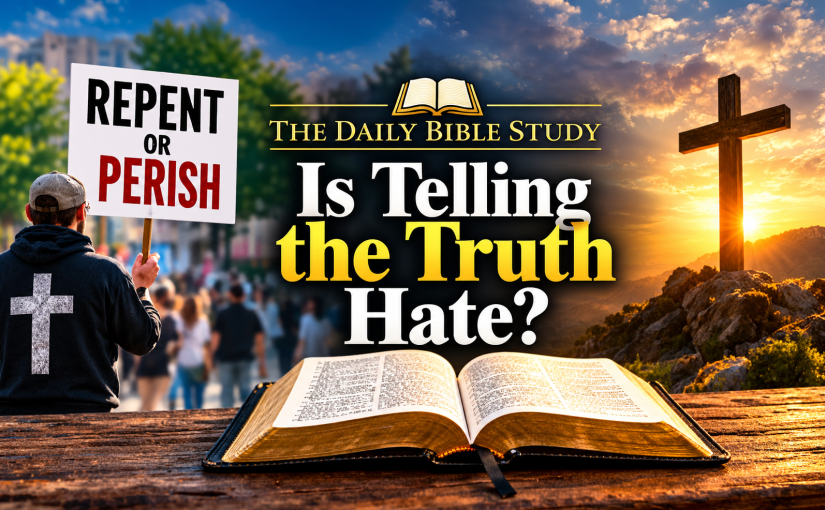
TODAY’S DAILY BIBLE STUDY: Is Telling the Truth Hate?

Wednesday, September 30, 2026

Ezekiel 33:3–11 (KJV)- “11 Say unto them, As I live, saith the Lord GOD, I have no pleasure in the death of the wicked; but that the wicked turn from his way and live: turn ye, turn ye from your evil ways; for why will ye die, O house of Israel?”

WHY THIS STUDY TODAY

Recently, a man stood publicly holding a large sign warning people about sin and its eternal consequences. His message specifically addressed gay pride, with the word “pride” displayed in rainbow colors, making his reference unmistakable. His message was that celebrating and continuing in conduct that the Bible identifies as sinful places a person in spiritual danger and that sin ultimately leads to judgment if a person refuses to turn to God.

The response from many people was immediate. He was accused of spreading hate. His message was described as “hate speech.” Others accused him of judging people and condemning them to hell. Some responded with the familiar slogan, “Love is love,” and argued that warning people about homosexuality or its eternal consequences is incompatible with loving them. Particularly concerning is that these arguments do not come only from people who reject Christianity. Some people who identify themselves as Christians make the same arguments.

That raises several questions Christians cannot answer merely according to personal feelings, political opinions, cultural attitudes, or popular slogans. So the biggest question void of all of those is, “What does the Bible say?”

There is an important distinction between passing our own judgment upon another person and warning another person about a judgment God has already revealed in His Word. The man holding the sign does not possess the authority to send anyone to hell. Neither does a preacher standing behind a pulpit, a Christian sharing the Gospel, or the person writing this Bible study. Eternal judgment belongs to God.

But does that mean Christians must remain silent about God’s judgment? If a Christian accurately tells another person what Scripture says about sin and judgment, the Christian has not thereby become the Judge. The Christian is pointing to the warning of the Judge. That distinction matters. Calling the messenger judgmental can shift attention away from the message itself. Once the discussion becomes primarily about whether the messenger is hateful, judgmental, intolerant, or offensive, the much more important question can disappear: Is the warning true? That is the question we must answer.

If the warning is genuinely what God has revealed in Scripture, then faithfully sharing it can require both love and courage. It is relatively easy to tell people what they want to hear. It can be considerably harder to tell someone something that may anger them, offend them, or cause them to reject us. Biblical love cannot mean simply affirming whatever another person desires. If God has warned that a particular course leads toward destruction, love cannot require Christians to hide that warning.

This study is, therefore, not about attacking homosexual people. Christians have no biblical permission to mistreat, ridicule, threaten, or hate them. Nor is homosexuality the only sin condemned by Scripture. Every human being is a sinner in need of the saving grace of Jesus Christ. Homosexuality is specifically before us today because it was the subject of the public warning that prompted this study and because our society increasingly celebrates what Scripture identifies as sinful. But the principle we are examining applies to all sin.

A heterosexual adulterer cannot escape God’s Word by accusing the Christian who quotes it of judging him. A drunkard cannot change God’s standard by calling the messenger hateful. A thief cannot make theft righteous by being offended that someone called it sin. And a person practicing homosexuality cannot settle the biblical question merely by accusing the person delivering the warning of hatred. In every case, the messenger must be tested against Scripture. If the messenger has misrepresented God’s Word, then the messenger should be corrected. But if the message faithfully communicates what God has actually said, rejecting the messenger does not change the message. That is why we are doing this study.

We are going to open the Bible and examine what God says about truth, love, judgment, sin, repentance, courage, and salvation. We are going to ask whether speaking biblical truth constitutes hatred, whether warning someone of God’s judgment constitutes judging them ourselves, and whether genuine Christian love sometimes requires enough courage to say something the world does not want to hear.

The Christian is not the Judge. The Christian is not the one who condemns a soul to hell. But if God has given humanity a warning, loving our neighbor cannot mean pretending that warning does not exist.

Verse Context

Our cornerstone verse comes from God’s instructions to the prophet Ezekiel. To understand the tremendous statement God makes in Ezekiel 33:11, we need to understand what immediately precedes it. God begins with an illustration that the people would easily understand: a watchman standing guard over a city.

Ezekiel 33:3–6 (KJV)- “If when he seeth the sword come upon the land, he blow the trumpet, and warn the people; then whosoever heareth the sound of the trumpet, and taketh not warning; if the sword come, and take him away, his blood shall be upon his own head. He heard the sound of the trumpet and took no warning; his blood shall be upon him. But he that taketh warning shall deliver his soul. But if the watchman see the sword come, and blow not the trumpet, and the people be not warned; if the sword come, and take any person from among them, he is taken away in his iniquity; but his blood will I require at the watchman’s hand.”

The watchman’s responsibility was not to create the danger. He did not send the approaching sword. He did not decide whether the danger was real. His responsibility was to recognize the danger and sound the warning. If he sounded the trumpet and the people refused to listen, the watchman had fulfilled his responsibility. But if he saw danger approaching and remained silent, God held him responsible for failing to warn them. Then God explains the spiritual meaning of the illustration.

Ezekiel 33:7–9 (KJV)- “So thou, O son of man, I have set thee a watchman unto the house of Israel; therefore thou shalt hear the word at my mouth, and warn them from me. When I say unto the wicked, O wicked man, thou shalt surely die; if thou dost not speak to warn the wicked from his way, that wicked man shall die in his iniquity; but his blood will I require at thine hand. Nevertheless, if thou warn the wicked of his way to turn from it; if he do not turn from his way, he shall die in his iniquity; but thou hast delivered thy soul.”

God appointed Ezekiel as the watchman “unto the house of Israel.” We should respect that historical context. This was a specific commission given by God to Ezekiel concerning Israel. Christians today should not simply claim Ezekiel’s prophetic office for themselves. But there is something here that is essential to understanding verse 11. God tells Ezekiel: “thou shalt hear the word at my mouth, and warn them from me.” The warning originated with God. Ezekiel did not invent the standard. Ezekiel did not determine what was wicked. Ezekiel did not decide the punishment. And Ezekiel did not have the power to make the judgment happen. His responsibility was to communicate faithfully what God had already said. Then Israel responds to the seriousness of its sin.

Ezekiel 33:10 (KJV)- “Therefore, O thou son of man, speak unto the house of Israel; Thus ye speak, saying, If our transgressions and our sins be upon us, and we pine away in them, how should we then live?”

The people recognize the weight of their transgressions and ask a desperate question: How can we live? And now we arrive at our cornerstone verse. God’s answer reveals something enormously important about why He sends the warning in the first place.

Ezekiel 33:11 (KJV)- “Say unto them, As I live, saith the Lord GOD, I have no pleasure in the death of the wicked; but that the wicked turn from his way and live: turn ye, turn ye from your evil ways; for why will ye die, O house of Israel?”

God does not say that He delights in watching wicked people perish. He says exactly the opposite. He has “no pleasure in the death of the wicked.” The warning therefore has a purpose: “that the wicked turn from his way and live.” God is calling them to repentance. The Hebrew idea behind “turn” is especially important. The word is shuv (שׁוּב, pronounced SHOOV), meaning to turn, return, or turn back. It is one of the important Old Testament words used to describe turning away from sin and returning toward God. And notice the urgency: “turn ye, turn ye from your evil ways.” God does not redefine their evil ways so that they can comfortably remain in them. He calls them to turn from them. Yet the purpose of that call is not difficult to see. God wants them to live. That is the heart of Ezekiel 33:11.

Now we can carefully compare the passage with the event that prompted this study. The man holding the sign was accused of hatred and of judging other people because he publicly warned about sin and its eternal consequences. Ezekiel 33 teaches us that we must distinguish between the person delivering a warning and the authority who established the warning. Ezekiel was not Israel’s ultimate Judge. He was the messenger. Likewise, a Christian today does not possess the authority to determine who goes to hell. We cannot create God’s moral standards, pronounce eternal sentences according to our personal preferences, or condemn people simply because we disapprove of them.

But that does not answer the question of whether Christians should communicate warnings that God has already given. That requires us to determine whether the warning actually comes from Scripture. And Ezekiel 33:11 gives us something else that directly challenges the claim that every warning about sin must be motivated by hatred. God’s warning and God’s desire for the sinner to live exist in the very same verse. That is enormously important. Warning someone about sin is not automatically evidence that we hate that person. In this passage, God warns precisely because He is calling sinful people away from destruction. But there is also a serious responsibility placed upon anyone claiming to deliver God’s warning: we must be certain that what we are calling sin is actually something God calls sin.

We cannot substitute prejudice for Scripture. We cannot substitute personal opinion for Scripture. We cannot substitute cultural tradition for Scripture. And neither can we substitute modern cultural acceptance for Scripture. So before we can determine whether the man holding the sign was faithfully sounding a biblical warning, we must move into the Broader Context and ask what the rest of Scripture actually says.

Does God’s Word identify homosexual conduct as sin? Does Scripture teach that sin has eternal consequences? Does Scripture distinguish between warning someone of God’s judgment and personally condemning them? Does the New Testament command Christians to speak God’s truth even when that truth is unpopular? And most importantly, does the Gospel offer the sinner a way to turn and live?

Only Scripture can answer those questions.

BROADER CONTEXT

Who Determines What Is True?

Before we can decide whether the man holding the sign was speaking truth or spreading hate, we have to answer a more fundamental question: Who determines what is true?

If truth is determined by culture, then truth can change whenever culture changes. If truth is determined by individual feelings, then one person’s truth can contradict another person’s truth. If truth is determined by the Christian holding the sign, then his opinion possesses no greater authority simply because he claims to speak for God.

Jesus gives us the standard in John 17:17 (KJV)- “Sanctify them through thy truth: thy word is truth.”

A Quick KJV Word Note — “Thy”

The word “thy” simply means “your.” In the King James Bible, thy is a singular possessive form of thou—it refers to something belonging to the one person being addressed.

Here, Jesus is praying to the Father. Therefore, when Jesus says “thy truth” and “thy word,” He means the Father’s truth and the Father’s word. Read in today’s English, the meaning is straightforward: God’s truth; God’s Word.

This is one reason readers should not be intimidated by words such as thee, thou, and thy in the King James Bible. They are not mysterious theological words. They are older English pronouns that can actually communicate distinctions that modern English often does not. And once we understand “thy,” the authority behind this verse becomes unmistakable. Jesus does not tell us that popular opinion is truth, that personal feelings are truth, or even that the Christian’s opinion is truth. The standard is not the man. The standard is not the crowd opposing him. The standard is not church denomination, political movement, social-media campaign, or popular slogan. God’s Word is truth.

Therefore, Christians have no authority to manufacture sins that God has not called sin. But neither do Christians have authority to declare acceptable something God has called sin. Our responsibility is to submit ourselves to what God has revealed. That means the accusation of hate cannot settle the question before us. Neither can the man’s assertion that he is speaking for God. His message must be tested against Scripture.

So let us test it.

Does the Bible Actually Identify Homosexual Conduct as Sin?

Because homosexuality prompted this particular study, we should address it directly rather than hide behind general statements about sin.

Paul writes: Romans 1:24–27 (KJV)- “Wherefore God also gave them up to uncleanness through the lusts of their own hearts, to dishonour their own bodies between themselves: Who changed the truth of God into a lie, and worshipped and served the creature more than the Creator, who is blessed for ever. Amen. For this cause God gave them up unto vile affections: for even their women did change the natural use into that which is against nature: And likewise also the men, leaving the natural use of the woman, burned in their lust one toward another; men with men working that which is unseemly, and receiving in themselves that recompence of their error which was meet.”

Whatever modern culture may believe about homosexuality, we cannot honestly read this passage and conclude that Paul presents same-sex sexual conduct as morally acceptable. He does not. Paul addresses the subject again when writing to the Corinthians.

1 Corinthians 6:9–11 (KJV)- “Know ye not that the unrighteous shall not inherit the kingdom of God? Be not deceived: neither fornicators, nor idolaters, nor adulterers, nor effeminate, nor abusers of themselves with mankind, Nor thieves, nor covetous, nor drunkards, nor revilers, nor extortioners, shall inherit the kingdom of God. And such were some of you: but ye are washed, but ye are sanctified, but ye are justified in the name of the Lord Jesus, and by the Spirit of our God.”

Notice what Scripture does—and what it does not do.

Homosexual conduct is included among behaviors associated with unrighteousness. Therefore, a Christian cannot faithfully teach that Scripture approves of homosexual sexual relationships. But notice something equally important: homosexuality is not standing alone in Paul’s list. Fornication is there. Idolatry is there. Adultery is there. Theft is there. Covetousness is there. Drunkenness is there. Reviling is there. Extortion is there. This study was prompted by the public celebration of homosexuality, so we are addressing homosexuality directly. But biblical integrity requires us to apply God’s standard consistently. We cannot condemn the sins celebrated by somebody else while excusing the sins we have decided to tolerate in ourselves. And verse 11 prevents this passage from becoming merely a weapon of condemnation.

Paul is writing to Christians and tells them that some of them had previously lived in the very sins he had just identified. Their former sin was not the end of their story. They had been washed. They had been sanctified. They had been justified in the name of Jesus Christ. That is already showing us something about the purpose of biblical confrontation with sin. Christianity does not merely announce what a person is doing wrong. The Gospel announces what Jesus Christ can do for the sinner.

The Larger Problem Is Unrepentant Sin

Now we must widen the lens. The eternal warning of Scripture is not reserved for homosexuals. The fundamental human problem is sin.

Romans 3:23 (KJV)- “For all have sinned, and come short of the glory of God;”

The word “all” leaves none of us standing outside the problem. The man holding the sign needs a Savior. The homosexual needs a Savior. The adulterer needs a Savior. The drunkard needs a Savior. The person shouting accusations at the man holding the sign needs a Savior. The person writing this study needs a Savior. We all do. And Scripture tells us why sin is so serious.

Romans 6:23 (KJV)- “For the wages of sin is death; but the gift of God is eternal life through Jesus Christ our Lord.”

Notice that Paul does not leave us with death. The verse contains both the warning and the rescue. Sin pays wages: death. God offers a gift: eternal life through Jesus Christ. Therefore, the Christian message concerning sin should never stop with condemnation. If we warn people about sin but never tell them about the Savior, we have left out the glorious heart of the Gospel. But neither can we proclaim the Savior while refusing to tell people why they need saving.

Struggling With Sin Is Not the Same as Making Peace With Sin

This distinction is important. Christianity does not teach that a person becomes instantly incapable of temptation or failure after coming to Christ. Christians still battle the flesh. Paul describes that conflict:

Galatians 5:16–17 (KJV)- “This I say then, Walk in the Spirit, and ye shall not fulfil the lust of the flesh. For the flesh lusteth against the Spirit, and the Spirit against the flesh: and these are contrary the one to the other: so that ye cannot do the things that ye would.”

There is a difference between fighting sin and declaring that our sin is no longer sin. A believer may stumble. A believer may experience powerful temptation. A believer may have to fight the same temptation repeatedly. The existence of that struggle does not mean that God has changed His definition of righteousness. The dangerous step occurs when instead of bringing our desires under the authority of God’s Word, we attempt to bring God’s Word under the authority of our desires. This principle applies equally to every sin. The adulterer cannot redefine adultery because he sincerely loves the person with whom he is committing adultery. The covetous person cannot redefine greed because possessions make him happy. The drunkard cannot declare drunkenness righteous because alcohol brings him pleasure. Likewise, sincere affection does not possess the authority to redefine what God has revealed concerning sexual morality. This is where the popular expression “love is love” fails as a biblical moral standard. Human affection may be genuine, powerful, and deeply felt, but human affection does not determine righteousness. God does.

Who Is Actually Doing the Judging?

Now we can return directly to another accusation made against the man holding the sign: “Who are you to judge?”

There is an important question hidden inside that accusation. If the man were inventing his own standard and declaring people condemned according to his personal preferences, then the criticism would have considerable force. Human beings do not possess the authority to determine another person’s eternal destiny. Jesus Christ is the Judge.

John 5:22 (KJV)- “For the Father judgeth no man, but hath committed all judgment unto the Son:”

Therefore, the Christian holding the sign does not send anyone to hell. The preacher does not send anyone to hell. The Christian witnessing to a neighbor does not send anyone to hell.  But Scripture makes another distinction that our culture frequently overlooks: Warning someone about God’s judgment is not the same thing as becoming the Judge. God demonstrated this principle dramatically through Ezekiel.

Ezekiel 33:7–9 (KJV)- “So thou, O son of man, I have set thee a watchman unto the house of Israel; therefore thou shalt hear the word at my mouth, and warn them from me. When I say unto the wicked, O wicked man, thou shalt surely die; if thou dost not speak to warn the wicked from his way, that wicked man shall die in his iniquity; but his blood will I require at thine hand. Nevertheless, if thou warn the wicked of his way to turn from it; if he do not turn from his way, he shall die in his iniquity; but thou hast delivered thy soul.”

Quick KJV Word Help:

Thou means you (as the subject), thee means you (as the object), and thy/thine mean your/yours; these forms normally address one person. Hast simply means have, as in “thou hast” = “you have.”

We must respect the historical context. God specifically appointed Ezekiel as a watchman to Israel. This passage is not declaring that every Christian possesses Ezekiel’s prophetic office. But look at the principle God reveals. God gives the warning. The watchman delivers the warning. The watchman does not create the judgment. That distinction speaks directly to the issue before us. If the message on a Christian’s sign contradicts Scripture, we should reject the message. If the Christian twists Scripture to condemn something God has not condemned, we should correct him. But if Scripture actually gives the warning, pointing someone toward that warning does not make the Christian the author of the judgment. The messenger is not the Judge. And the very next verses reveal God’s heart behind the warning.

Ezekiel 33:10–11 (KJV)- “Therefore, O thou son of man, speak unto the house of Israel; Thus ye speak, saying, If our transgressions and our sins be upon us, and we pine away in them, how should we then live? Say unto them, As I live, saith the Lord GOD, I have no pleasure in the death of the wicked; but that the wicked turn from his way and live: turn ye, turn ye from your evil ways; for why will ye die, O house of Israel?”

Quick KJV Word Help: Thus ye means this is what you say/do, pine means waste away or suffer under distress, saith means says, turn ye means you turn/turn yourselves, and ye die means you die.

This changes the way we should think about biblical warnings. God does not present the warning here because He delights in destruction. God says: “turn ye, turn ye from your evil ways.” Why? Because He desires that the wicked “turn from his way and live.” The warning is therefore not evidence that God hates the sinner. The warning itself demonstrates that God is calling the sinner to turn.

Sometimes Love Must Warn

Now we can return to our cornerstone verse with considerably more biblical context behind it.

Ephesians 4:15 (KJV)- “But speaking the truth in love, may grow up into him in all things, which is the head, even Christ:”

Love and truth are not competing Christian virtues. If someone were walking unknowingly toward physical danger, warning him would not normally be considered hateful. The warning might frighten him. It might interrupt what he wanted to do. He might even resent being told to stop. But if the danger were real, remaining silent merely to avoid upsetting him would not necessarily be loving. Scripture gives us an even stronger picture.

Proverbs 27:5–6 (KJV)- “Open rebuke is better than secret love. Faithful are the wounds of a friend; but the kisses of an enemy are deceitful.”

Biblical love sometimes says something difficult. That does not justify cruelty. It does not justify insults. It does not justify humiliating people, threatening them, or taking pleasure in their condemnation. But neither does biblical love require silence when God has spoken. Sometimes the person willing to tell us what we desperately do not want to hear is demonstrating greater love than the person willing to tell us whatever makes us comfortable.

Telling the Truth Can Require Courage

There is another part of the present-day example that deserves consideration. It takes very little courage to repeat something everyone around us already applauds. Speaking God’s truth becomes considerably more difficult when that truth is unpopular. The apostles encountered authorities who wanted them to stop publicly proclaiming Christ.

Acts 4:18–20 (KJV)- “And they called them, and commanded them not to speak at all nor teach in the name of Jesus. But Peter and John answered and said unto them, Whether it be right in the sight of God to hearken unto you more than unto God, judge ye. For we cannot but speak the things which we have seen and heard.”

Again, the immediate subject is the apostles’ proclamation of Jesus Christ, not homosexuality. We should not pretend otherwise. But the principle concerning Christian courage is clear: the reaction of the surrounding culture does not determine whether God’s truth should be spoken. That brings us back to the man standing publicly with his sign. People may ridicule him. People may call him judgmental. People may accuse him of hatred. None of those reactions proves that his message is true. But neither do those reactions prove that his message is false. The question remains the same: Does what he is saying agree with what God has said? Where it does, courage may require speaking even when speaking carries a social cost.

The Warning Must Lead to the Gospel

Finally, we must never allow the warning to become the destination. The destination is Jesus Christ. Jesus did not come merely to announce condemnation to an already fallen world.

John 3:16–17 (KJV)- “For God so loved the world, that he gave his only begotten Son, that whosoever believeth in him should not perish, but have everlasting life. For God sent not his Son into the world to condemn the world; but that the world through him might be saved.”

And Scripture immediately explains why salvation is necessary.

John 3:18–19 (KJV)- “He that believeth on him is not condemned: but he that believeth not is condemned already, because he hath not believed in the name of the only begotten Son of God. And this is the condemnation, that light is come into the world, and men loved darkness rather than light, because their deeds were evil.”

There is both love and warning in the same Gospel. God loved. God gave His Son. Christ saves. Sin remains serious. Judgment remains real. Human beings are called out of darkness and toward the Light. That means the most loving Christian message cannot simply be, “God condemns your sin.” But neither can it honestly be, “Continue as you are; God does not care.” The biblical message is far greater: God has told us the truth about our sin because He loves us. God has warned us of judgment because judgment is real. And God has provided Jesus Christ because He desires to save sinners.

The Christian does not have the authority to remove the warning. The Christian does not have the authority to change God’s definition of sin. And the Christian certainly does not have the authority to decide who is beyond God’s grace. Our responsibility is to tell the truth, tell it in love, and point sinners—not merely homosexual sinners, but all sinners—to Jesus Christ. That is not a message of hatred. It is the message of a God who warns sinners of where sin leads while still calling them to turn, come to Christ, and live.

APPLICATION

Appreciating God’s Greatness

One of the most remarkable truths revealed in Ezekiel 33:11 is that God’s holiness and His mercy are not in conflict. God does not lower His standard of righteousness in order to demonstrate love, nor does His judgment of sin mean that He lacks compassion for the sinner. He remains perfectly holy while calling sinful people to turn from the very conduct that separates them from Him.

Ezekiel 33:11 (KJV)- “Say unto them, As I live, saith the Lord GOD, I have no pleasure in the death of the wicked; but that the wicked turn from his way and live: turn ye, turn ye from your evil ways; for why will ye die, O house of Israel?”

Look carefully at what God does in this verse. He calls their ways evil, warns them that those ways lead to death, commands them to turn, and expresses His desire that they live. Biblical love, therefore, does not require God to pretend that evil is good. His love is demonstrated in part by the fact that He tells sinners the truth and calls them away from destruction.

The same character of God is revealed in the New Testament. God does not delight in the destruction of sinners; He has acted at tremendous cost to provide salvation for them.

Romans 5:8 (KJV)- “But God commendeth his love toward us, in that, while we were yet sinners, Christ died for us.”

Notice that God’s love did not require Him to stop calling us sinners. Instead, His love provided the remedy for our sin. The greatness of God is seen not in overlooking sin, redefining sin, or pretending that judgment does not exist, but in providing Jesus Christ for people who could never save themselves. The God who says, “turn ye, turn ye from your evil ways,” is the same God who sent His Son to die for sinners.

For the Believer

The believer must resist two opposite errors. The first is speaking about sin without love, compassion, humility, or any apparent desire to see the sinner saved. The second is becoming so afraid of being called hateful or judgmental that we refuse to tell people what God’s Word actually says. Neither approach represents the whole counsel of Scripture. Paul gives us the proper balance.

Ephesians 4:15 (KJV)- “But speaking the truth in love, may grow up into him in all things, which is the head, even Christ:”

Truth and love are not enemies. Biblical love does not require silence about sin, and biblical truth does not give us permission to be cruel. If Scripture identifies homosexual conduct as sin, the believer should not deny that truth simply because the culture considers the teaching offensive. At the same time, the person engaged in homosexual conduct is not someone Christians have permission to ridicule, mistreat, threaten, or hate. That person is a human being for whom Christ died and to whom the Gospel should be offered.

The believer must also remember that homosexuality is not the only sin Scripture condemns. We have no biblical basis for pointing angrily at one group of sinners while excusing adultery, fornication, drunkenness, greed, dishonesty, hatred, or our own sins. Paul deliberately places many different sins together when warning the Corinthians.

1 Corinthians 6:9–11 (KJV)- “Know ye not that the unrighteous shall not inherit the kingdom of God? Be not deceived: neither fornicators, nor idolaters, nor adulterers, nor effeminate, nor abusers of themselves with mankind, Nor thieves, nor covetous, nor drunkards, nor revilers, nor extortioners, shall inherit the kingdom of God. And such were some of you: but ye are washed, but ye are sanctified, but ye are justified in the name of the Lord Jesus, and by the Spirit of our God.”

Those final words are essential. “And such were some of you.” The Christian message is not that certain sinners are uniquely disgusting or beyond redemption. The message is that sinners can be washed, sanctified, and justified through Jesus Christ. That is why our warning must always leave room for the Gospel.

A Call to Action for the Believer

Before speaking about another person’s sin, ask yourself two questions: Is what I am about to say actually supported by God’s Word, and am I saying it because I genuinely desire that person’s spiritual good? We should never call something sinful merely because we dislike it, and we should never use Scripture as a weapon for humiliating someone. However, once God has clearly spoken, fear of criticism must not persuade us to change His message.

Paul reminded Timothy that faithfulness to Scripture would sometimes require correction and rebuke, but he also told him how that work was to be done.

2 Timothy 4:2–4 (KJV)- “Preach the word; be instant in season, out of season; reprove, rebuke, exhort with all longsuffering and doctrine. For the time will come when they will not endure sound doctrine; but after their own lusts shall they heap to themselves teachers, having itching ears; And they shall turn away their ears from the truth, and shall be turned unto fables.”

Notice the combination: reprove, rebuke, exhort, but do it “with all longsuffering and doctrine.” The believer is not commanded merely to win arguments. We are to remain faithful to God’s Word while patiently seeking the spiritual good of the person hearing it.

That means we should examine our own conduct as carefully as we examine our message. If we speak about homosexuality, adultery, drunkenness, fornication, greed, or any other sin, our purpose should never be to demonstrate our superiority. We are sinners who have needed God’s mercy ourselves. Our objective is to point another sinner toward the same Savior who rescued us.

When the culture says that biblical truth is hateful, do not respond with hatred. When someone calls you judgmental, do not become arrogant or defensive. Open the Bible, examine what God has actually said, and speak that truth faithfully, humbly, courageously, and lovingly. The goal is not merely to tell someone that his way is wrong. The goal reflected in Ezekiel 33:11 is that the sinner might turn and live.

For the Unbeliever

If you are reading this as someone who does not follow Jesus Christ, please understand what this study is not saying. Christianity does not teach that homosexual people are the only sinners standing under God’s judgment while Christians stand safely on the other side because they are better people. Scripture says something far more sweeping.

Romans 3:23 (KJV)- “For all have sinned, and come short of the glory of God;”

That includes homosexuals and heterosexuals, religious people and irreligious people, the person holding the sign and the people criticizing him. Every one of us has violated God’s standard and needs His mercy.

The question, therefore, is not whether your sins are worse than someone else’s. The question is what you will do with the truth God has revealed and with the Savior He has provided. God does not ask you to make yourself righteous enough to earn salvation. Salvation is His gift through Jesus Christ.

Romans 6:23 (KJV)- “For the wages of sin is death; but the gift of God is eternal life through Jesus Christ our Lord.”

If God’s Word identifies something in your life as sin, the loving response is not to tell you that God has changed His mind so that you can remain comfortable. Neither is the loving response to mock you, despise you, or treat you as though you are beyond God’s mercy. The biblical response is to tell you the truth about sin while also telling you the wonderful truth about Jesus Christ.

John 3:16–17 (KJV)- “For God so loved the world, that he gave his only begotten Son, that whosoever believeth in him should not perish, but have everlasting life. For God sent not his Son into the world to condemn the world; but that the world through him might be saved.”

Jesus Christ came to save sinners. The warning about sin is not the end of the Christian message; it explains why the Gospel is such extraordinarily good news. God calls you to turn from sin, place your faith in Jesus Christ, and receive the life that only He can give.

The words God spoke through Ezekiel still reveal something beautiful about God’s heart: He does not delight in the destruction of the wicked. His call is to turn and live.

FINAL THOUGHT

Telling someone the truth is not automatically an act of hatred simply because the truth is difficult to hear. At the same time, claiming to possess the truth does not give Christians permission to be cruel, arrogant, or hateful. We must have both truth and love. We must be courageous enough to say what God has said and compassionate enough to remember why He has said it.

The man holding the sign did not become the judge of everyone who read it simply because he warned them about sin and judgment. The real question is whether his warning agreed with the Word of God. When Scripture speaks clearly, Christians should never be ashamed to speak clearly as well. We should do so humbly, remembering that we too are sinners who desperately needed the grace of God.

Perhaps the most important words in this entire study are not about judgment at all. They are God’s words in Ezekiel 33:11: He desires that the wicked “turn from his way and live.” That is the purpose of the warning. God is not standing eagerly waiting for another sinner to perish. He is calling sinners to turn from their evil ways and offering them life.

So, Christian, do not allow the fear of being called hateful to silence you when God has spoken. But never allow your commitment to truth to become an excuse for actually becoming hateful. Speak the truth with courage, humility, compassion, and love, always pointing people toward Jesus Christ.

And if you are the person hearing the warning, do not become so focused on the messenger that you never examine the message. The person holding the sign cannot condemn you to hell, and neither can the person who shared this Bible study. But God has spoken in His Word, and each of us must decide how we will respond to what He has said. His invitation is still before us: turn and live.

A PRAYER FOR YOU

Heavenly Father, thank You for loving us enough to tell us the truth. Thank You that You are holy and righteous, yet rich in mercy toward sinners. Your Word tells us that You have no pleasure in the death of the wicked, but desire that the wicked turn from his way and live. Help us never to mistake Your warnings for hatred when those warnings are calling us away from destruction and toward life.

Lord, I pray for the believer reading this study. Give us courage to stand upon Your Word when the world pressures us to remain silent or change what You have said. At the same time, guard our hearts against pride, cruelty, anger, and self-righteousness. Remind us that we are not the Judge and that we have no authority to invent Your standards or condemn people according to our own opinions. Teach us to speak Your truth faithfully and lovingly, with a genuine desire that sinners come to know Jesus Christ.

Father, I also pray for the person reading this who has not accepted Jesus Christ as Savior. Whatever the sin may be, help that person understand that Your warning is not a declaration that he or she is beyond hope. Let Your Holy Spirit bring conviction, open that person’s heart to the truth of Your Word, and lead that person to repentance and saving faith in Jesus Christ. Help every one of us to examine our own lives rather than merely identifying the sins of others.

Thank You for sending Your Son to die for sinners. Thank You that forgiveness, cleansing, and eternal life are available through Jesus Christ. May we never hide the seriousness of sin, but may we also never speak of sin without proclaiming the wonderful hope of the Gospel. Help us to speak the truth in love, to stand courageously upon Your Word, and to point people toward the Savior who calls sinners to turn and live.

In Jesus’ name, Amen.

CLOSING

If you’ve found these daily verses encouraging, enlightening, or fruitful, please consider helping us spread the truth and light of God’s Word by subscribing to the blog and YouTube channels and liking and following the Facebook page. Most of all, share Believers of Biblical Truth and our links with others who may need the sermons and daily teachings just as much as we do.

You are loved—so much in fact, that we want you to know and be Believers of Biblical Truth.

Shalom Shalom.

TODAY’S DAILY BIBLE VERSE: We Don’t Mar the Image

Today is September 23, 2025

Exodus 20:13- “Thou shalt not kill.”

Verse Context

This commandment is the sixth of the Ten Commandments given by God to Israel at Mount Sinai. Moses, as the mediator, records these words as part of the covenant between God and His chosen people. The immediate setting is a holy encounter: thunder, lightning, smoke, and the trembling of the mountain as God speaks directly to the people (Exodus 19–20). These commandments are not arbitrary rules but expressions of God’s holy character, showing Israel how to live in covenant relationship with Him and with one another.

The Hebrew phrase translated “kill” in the King James Bible specifically carries the sense of “murder”, the deliberate, unlawful, or unjust taking of human life. It does not prohibit all killing in every circumstance, as the law itself later distinguishes between accidental death, judicial execution, warfare, and personal murder (see Exodus 21 and Deuteronomy 19). What God forbids here is the intentional shedding of innocent blood.

The intent of this commandment is to preserve human life because it is sacred, made in the image of God (Genesis 1:26–27). It is a reaffirmation of the principle already given after the Flood in Genesis 9:6, where God declared that to shed human blood unjustly is to attack His image. By placing this commandment at the center of Israel’s covenant law, God sets a standard that life is not to be ended by human willfulness, vengeance, or hatred.

This law also functioned as a boundary for the community of Israel. Surrounded by nations that often practiced violence, blood feuds, and child sacrifice, Israel was to stand apart as a people who recognized life’s divine value. The commandment drew a clear line: no individual has the right to arrogate God’s authority over life and death for selfish or malicious purposes.

When read in its original setting, this commandment is not only a social safeguard but a theological declaration. Life belongs to God, and man may not treat it cheaply. The commandment also sets the stage for further elaborations in the law that distinguish between killing that is murder and killing that is not, creating the foundation for discussions of justice, defense, and accountability that run throughout the rest of Scripture.

Broader Context

The sixth commandment, “Thou shalt not kill” (Exodus 20:13), stands as one of the shortest yet weightiest statements in all of Scripture. At its core it condemns murder. But Scripture does not leave the command hanging in the air without clarity; it anchors it in God’s image and then surrounds it with teaching that helps God’s people distinguish murder from other forms of killing that may arise in a fallen world.

The first anchor point is Genesis 1:26–27 and Genesis 9:6. From the beginning, mankind was created in the image of God, and after the Flood God reaffirmed this principle: “Whoso sheddeth man’s blood, by man shall his blood be shed: for in the image of God made he man.” The logic is simple yet profound: because man bears God’s image, to strike down a human life unjustly is to deface the Creator Himself. I would use this as the strongest argument against abortion even for those who do not believe. The sixth commandment is therefore not merely a rule for social order but a theological declaration of God’s ownership of life.

The law of Moses further clarifies this command. Exodus 21:12–14 distinguishes between premeditated murder and accidental killing: “He that smiteth a man, so that he die, shall be surely put to death… But if a man come presumptuously upon his neighbour, to slay him with guile; thou shalt take him from mine altar, that he may die.” Intent and malice are the critical factors that turn killing into murder. Likewise, Numbers 35:9–15 establishes the cities of refuge for those guilty of manslaughter, again affirming that not every loss of life is equivalent to murder in God’s eyes.

The law also makes room for the defense of life. Exodus 22:2–3 teaches that if a thief breaks into a house at night and is struck down, the defender is not guilty of bloodshed. However, if the same happens in the daylight, when danger can be assessed more clearly, there is guilt if the intruder is killed. The point is restraint. God allows for protection of innocent life but requires careful judgment to prevent vengeance or excess. In this way, the command “Thou shalt not kill” stands alongside provisions for self-defense, showing that God’s goal is the preservation of life, not the rigid prohibition of every form of killing.

The prophets often return to the spirit of this command when they condemn Israel for shedding innocent blood. Jeremiah 22:3 declares, “Thus saith the LORD; Execute ye judgment and righteousness, and deliver the spoiled out of the hand of the oppressor: and do no wrong, do no violence to the stranger, the fatherless, nor the widow, neither shed innocent blood in this place.” Murder was not only an individual act but a societal sin when nations or leaders exploited or destroyed the vulnerable. God’s command reached beyond personal morality to national righteousness.

In the New Testament, Jesus raises the bar from the physical act of murder to the inward condition of the heart. In Matthew 5:21–22 He says, “Ye have heard that it was said by them of old time, Thou shalt not kill; and whosoever shall kill shall be in danger of the judgment: But I say unto you, That whosoever is angry with his brother without a cause shall be in danger of the judgment.” Christ reveals that the sixth commandment was always meant to do more than prevent physical violence; it was to expose the anger, hatred, and contempt that seed murder long before a weapon is drawn. John carries this thought further: “Whosoever hateth his brother is a murderer: and ye know that no murderer hath eternal life abiding in him” (1 John 3:15). Thus, the commandment calls us not only to restrain our hands but to submit our hearts to God’s transforming grace.

Paul reinforces this in Romans 13:9–10: “Thou shalt not kill… and if there be any other commandment, it is briefly comprehended in this saying, namely, Thou shalt love thy neighbour as thyself. Love worketh no ill to his neighbour: therefore love is the fulfilling of the law.” Love is the positive fulfillment of the negative command. Not murdering is the starting line; actively loving others as oneself is the goal.

Taken together, the broad biblical witness shows that Exodus 20:13 is not an isolated prohibition but part of a sweeping ethic rooted in God’s holiness. It distinguishes between murder, manslaughter, and just defense; it condemns hatred, vengeance, and bloodshed; it calls societies to protect the weak; and it presses individuals to cultivate love instead of anger. In short, the sixth commandment points us to the sanctity of life and the God who gave it, urging us to honor Him by valuing His image in every person.

Application

Appreciating God’s Greatness
The commandment, “Thou shalt not kill,” is not simply a rule to restrain violence but a revelation of God’s greatness. It reminds us that life belongs to Him alone. He is the Author of life, the One who formed man from the dust and breathed into his nostrils the breath of life (Genesis 2:7). His greatness is seen in the dignity He has given to every human being, for we are made in His image. That truth extends even to those outside the faith, those who do not believe or who live in rebellion against Him. To take their life unjustly is still to mar the image of God and to despise His creative work. This is why the commandment holds universal weight, it is rooted not in human legislation but in divine authority. God’s greatness in creation calls us to respect life in all its forms, to treat every person as bearing His mark, and to honor His sovereignty over life and death.

For the Believer
For those who follow Christ, this commandment takes on both a sobering and a hopeful tone. It sobers us because it teaches that murder is not only an act of violence but a reflection of the heart. Jesus exposed the seed of murder in anger and hatred, showing us that to harbor such feelings is already to break the commandment (Matthew 5:21–22). Therefore, the believer must guard against bitterness, rage, and contempt, knowing that these sins dishonor God’s image in others. At the same time, this commandment fills us with hope, for it is part of God’s covenant love to protect His people and preserve life. Believers are called to mourn with those who mourn, to comfort the grieving, and to uphold justice with humility. When violence and murder strike close to home, as in the tragic deaths of Melissa and Mark Hortman, Charlie Kirk, and Iryna Zarutska, Christians are not to give way to despair or vengeance but to cling to the God who values life and promises resurrection through His Son.

Call to Action
The believer’s call to action is clear. We are to honor life by loving our neighbors as ourselves, refusing to repay evil with evil, and resisting the temptation to dehumanize others even in our thoughts. We must pray for grieving families, stand beside survivors, and declare boldly that life is sacred. We are also called to forgive as Christ forgave us, even while working for justice in our communities. This means speaking truth about the value of every person, refusing to allow politics or partisanship to determine whose life is worth more, and being peacemakers in a culture saturated with violence and hate. By doing these things, we demonstrate the gospel of life to a watching world and magnify the God who has conquered death through Jesus Christ.

For the Unbeliever
For those outside of Christ, this commandment is a mirror. Some mock death and even profit from it, revealing the hardness of their hearts. To treat human life as a joke or a means for gain is to despise God’s image and invite His judgment. Scripture warns, “Be not deceived; God is not mocked: for whatsoever a man soweth, that shall he also reap” (Galatians 6:7). Yet for others, these tragedies stir searching questions. They long to know why life feels so fragile and what hope can be found in the face of death. The answer is not in laws, politics, or empty comforts. The answer is found in Jesus Christ, who said, “I am the resurrection, and the life: he that believeth in me, though he were dead, yet shall he live” (John 11:25). He offers forgiveness for sin, peace with God, and eternal life. To those searching: your value is real, your life has meaning, and the One who gave you breath calls you to Himself for salvation and everlasting hope.

Final Encouragement

Even in a world shaken by violence, we must not forget that God is still on His throne. The sixth commandment reminds us that He values life so deeply that He guards it with His own law. While headlines may grieve us, while murder and injustice may weigh us down, God’s people are never left powerless. The Holy Spirit abides within every believer, comforting us in sorrow and strengthening us for courage. Communities are rising together, churches are uniting in prayer, and the gospel continues to shine. This is not the time to give up; this is the time to stand firm. Like a team coming out of the locker room after a hard first half, the church must remember that the game is not lost. The victory is already secure in Christ. Death is defeated, sin has been overcome, and Satan’s end is certain. Do not lose heart; press forward in faith. Win with Jesus, who has already won for you.

Our Prayer for You

Lord, we thank You that You are the Giver of life and the One who has power over death. We ask You today to comfort those who mourn, to strengthen those who are weak, and to give courage to Your people as they face the brokenness of this world. Holy Spirit, abide with us. Fill us with Your presence so that fear is driven out and love takes root. Help us to defend the vulnerable, to honor the image of God in others, and to shine with the light of Christ in dark places. Encourage us when we feel weary, lift us when we fall, and send us out with boldness to live as witnesses of Your truth. May we never forget that in Christ we already stand on the side of victory. We pray this in the name of Jesus, our Savior and Lord. Amen.

Closing

If you’ve found these daily verses encouraging, enlightening, or fruitful, please consider helping us spread the truth and light of God’s Word by subscribing to the blog and YouTube channels and liking and following the Facebook page. Most of all, share Believers of Biblical Truth and our links with others who may need the sermons and daily teachings just as much as we do.

You are loved, so much in fact, that we want you to know and be Believers of Biblical Truth.

Shalom Shalom.

TODAY’S DAILY BIBLE VERSE: Total Surrender

September 17, 2025

VerseRomans 12:1–2 – 1I beseech you therefore, brethren, by the mercies of God, that ye present your bodies a living sacrifice, holy, acceptable unto God, which is your reasonable service. 2And be not conformed to this world: but be ye transformed by the renewing of your mind, that ye may prove what is that good, and acceptable, and perfect, will of God.

Verse Context

In Romans 12:1–2, Paul shifts from doctrine to duty, from what God has done (chapters 1–11) to how believers must respond (chapters 12–16). Whenever the Bible uses the word “therefore” it is saying, “Because of what I just told you…” Sometimes that could be a sentence, a passage, a chapter or even several chapters. In this case, Paul I referring to everything back to Chapter 1. After eleven chapters of explaining justification, sanctification, and God’s sovereign plan of salvation, Paul now “beseeches”, pleads earnestly, with believers to live in light of God’s mercies.

Verse 1 calls Christians to present their bodies as a “living sacrifice, holy, acceptable unto God.” Under the Old Covenant, sacrifices were dead animals offered on an altar. But Paul now calls for a greater and continual sacrifice, the believer’s whole self, alive and set apart for God’s use. This is “reasonable service” (Greek logikē latreia), meaning it is logical, spiritual worship in response to God’s mercy. Matthew Henry (1662–1714, Presbyterian) explains: “The sacrificing of the beasts was reasonable service, but the sacrificing of ourselves, body and soul, to God, is much more so.”

Verse 2 warns believers not to be “conformed to this world.” The world system (its values, priorities, and corruptions) presses constantly against believers to shape them. Instead, Paul calls for transformation (metamorphoō, the same root used for Christ’s transfiguration in Matthew 17:2), through the renewing of the mind. John Gill (1697–1771, Reformed Baptist) notes: “It is not a mere outward reformation, but an inward transformation by the Spirit of God, a change of the very soul into the image of Christ.”

The purpose of this transformation is so believers may “prove what is that good, and acceptable, and perfect, will of God.” Wayne Grudem (1948– , Evangelical) explains that God’s will here is not hidden, but something lived and discerned as believers grow in holiness: “The more our minds are renewed, the more we will approve, delight in, and choose what is pleasing to God.”

Paul’s call echoes Jesus’ own words: “^24If any man will come after me, let him deny himself, and take up his cross, and follow me” (Matthew 16:24). Just as Christ gave Himself fully, believers are called to give themselves wholly in response; not half, not only on Sundays, not only on Easter and Christmas, but completely and utterly every hour we are awake.

I have met many who call themselves Christians. They read their Bible for five minutes in the morning and attend church on Sundays, provided it does not interfere with other plans. They give begrudgingly to the church, yet they have no hesitation in spending hundreds or thousands of dollars on conventions. They eagerly dress up in elaborate costumes they have made, but they despise the idea of presenting themselves respectfully when meeting with their Savior.

I have watched people argue for over an hour about video games, so passionate that their voices carried for everyone around to hear. Yet when it comes to Jesus, there is barely a murmur; there is certainly not an hour-long conversation filled with zeal. If you truly live by Jesus’ words, then put down the game controller, pick up your Bible, and live a clean life for Christ. There is nothing heavenly about video games that promote murder.

Broader Context

Romans 12:1–2 marks a turning point in Paul’s letter. For eleven chapters, he has laid out God’s mercies, man’s sin (Romans 1–3), justification by faith (Romans 3–5), sanctification by the Spirit (Romans 6–8), and God’s sovereign plan for Jew and Gentile alike (Romans 9–11). Now, Paul takes all of that breathtaking theology and turns to the believer with a burning appeal: “I beseech you therefore, brethren, by the mercies of God…”

The word “therefore” is key, it connects every truth Paul has already proclaimed to the believer’s responsibility. In other words, because God has shown you mercy in Christ, your life must now be offered back to Him. This is not cold duty, but joyful devotion. Charles Spurgeon (1834–1892, Baptist) once said: “When I thought God was hard, I found it easy to sin; but when I found God so kind, so good, so overflowing with compassion, I smote upon my breast to think I could ever have rebelled against One who loved me so and sought my good.” Paul’s appeal is rooted not in fear but in God’s mercy.

The “living sacrifice” language ties back to Israel’s temple worship. Sacrifices under the Law were dead and temporary, but in Christ, the believer becomes a living, continual sacrifice. This is echoed in 1 Peter 2:5: “5Ye also, as lively stones, are built up a spiritual house, an holy priesthood, to offer up spiritual sacrifices, acceptable to God by Jesus Christ.” God is not looking for dead offerings but holy, living lives surrendered to Him.

Then Paul contrasts conformity and transformation. “Be not conformed to this world: but be ye transformed by the renewing of your mind…” The word “conformed” (Greek syschēmatizō) implies being pressed into a mold. The world is always pressing; through culture, politics, entertainment, and temptation, seeking to shape us into its likeness. But Paul calls instead for transformation (metamorphoō), the same word used in Matthew 17:2 when Christ’s glory shone on the Mount of Transfiguration. Believers are to be reshaped from the inside out, by the Spirit, as minds are renewed in God’s Word. John Gill (1697–1771, Reformed Baptist) emphasized this: “It is not a putting on of a new form from without, but a thorough change within, wrought by the grace of God upon the soul.”

The outcome of this transformation is discerning and delighting in the will of God: “that ye may prove what is that good, and acceptable, and perfect, will of God.” Wayne Grudem (1948– , Evangelical) reminds us that God’s will here is not a mysterious code to be cracked, but a path of holiness to be walked: “The more our minds are renewed in Christ, the more we will approve, desire, and choose what God desires.”

N. T. Wright (1948– , Anglican) adds that this is the natural outworking of the gospel Paul has been preaching: “The gospel is designed to transform people, not merely to inform them. The renewed mind produces a new way of living, which is itself a sign of God’s kingdom breaking into the present age.”

In short, Romans 12:1–2 is Paul’s cry for total surrender. After beholding God’s mercy, there is only one logical response: present yourself wholly to Him. Not halfway, not someday, but now, fully, joyfully, and sacrificially.

Application

Appreciating God’s Greatness
Romans 12:1–2 displays the greatness of God not only in what He has done, but in what He calls forth from His people. He does not demand empty rituals, but living sacrifices. This is the beauty of His mercy: He saves us not to sit idle but to shine as His transformed people. Matthew Henry (1662–1714, Presbyterian) observed: “The apostle beseeches; he does not command. He would rather persuade by the mercies of God than drive by the terrors of His wrath.” God’s greatness is revealed in this kindness. He wins us by mercy, not coercion, and He equips us to walk in holiness.

For the Believer
For Christians, Paul’s words are both a challenge and an inspiration. To present your body as a living sacrifice is not to give God one part of life, but all of it. This means surrendering daily habits, choices, ambitions, even sufferings, to Him. As Paul himself said elsewhere: “I am crucified with Christ: nevertheless I live; yet not I, but Christ liveth in me: and the life which I now live in the flesh I live by the faith of the Son of God, who loved me, and gave himself for me” (Galatians 2:20).

John Gill (1697–1771, Reformed Baptist) reminds us that this is not an outward change but inward renewal: “The believer is to be wholly devoted to God, his body and soul, not conformed to corrupt customs of the world, but changed by divine grace into the likeness of Christ.” This is a lifelong transformation, not a one-time decision.

C. S. Lewis (1898–1963, Anglican lay theologian) once compared it to handing God the keys to every room of your heart: “Christ says, ‘Give me all. I don’t want so much of your time and so much of your money and so much of your work: I want You. I have not come to torment your natural self, but to kill it. No half-measures are any good.’” That is the true heart of Romans 12:1–2.
Call to Action: This week, examine where the world’s mold is pressing on your life. Are there places you’ve conformed — in speech, in entertainment, in priorities? Lay them before God. Present yourself fully to Him, not in theory but in practice, and let Him transform you by renewing your mind in His Word.

For the Unbeliever
Romans 12:1–2 is also a call to those outside of Christ. Paul says “be not conformed to this world” — but apart from Christ, conformity to the world is all you have. You may clean the outside, reform a habit, or adopt new ideals, but without the Spirit’s renewal, you remain unchanged at the core. Jesus said: “Except a man be born again, he cannot see the kingdom of God” (John 3:3).

Matthew Henry reminds us that God seeks the heart, not outward ritual. John Calvin (1509–1564, Reformed) echoed this truth: “We are not our own: let us therefore forget ourselves and all that is ours. We are God’s: let us therefore live and die to Him.” For the unbeliever, the call is clear: turn from sin, lay down your life, and be made new in Christ.

BBT is not content to whisper this truth; we call with urgency to all mankind: if you are saved but harboring undealt sin, repent and surrender fully. If you have not believed, do not wait until tomorrow. The world will press you into its mold and pay you with death. But Christ calls you today, offering life, renewal, and the joy of walking in His perfect will.

Final Encouragement

Romans 12:1–2 reminds us that God is not after half-measures. He has poured out His mercies in Christ, and the only logical response is full surrender, presenting our lives as living sacrifices, transformed by the renewing of our minds. This is not a burden but a joy, for in God’s will we find what is good, acceptable, and perfect. To live as a living sacrifice is not to lose life, but to gain true life in Christ.

Recap

This week in Romans has been a single, beautiful thread woven through five passages that speak to the heart of the gospel and the life it produces. We began with Paul’s fearless confession that the good news of Jesus is not a fragile idea we must protect, but the very power of God to save all who believe. From there we faced the sober truth that every one of us has fallen short of God’s glory, yet we were invited to rest in a righteousness we could never earn, but that was freely given by grace through the redeeming work of Christ. Then we lingered at the cross to behold love at its highest: God proved His love not after we improved, but while we were still sinners, as Christ died in our place. Having seen our need and His love, we stood at the fork in the road where sin pays its wage and God offers His gift, learning that death is what we have earned, but eternal life is what He delights to give in Jesus our Lord. And today we heard the only fitting response to such mercy: not a half-hearted nod, but our whole selves laid upon the altar as living sacrifices, minds renewed, lives transformed, joyfully seeking and doing the will of God. If this is the journey the Spirit has traced for us (power, need, love, choice, and response) then may our hearts answer with humble faith, holy resolve, and a deep desire to belong to Jesus without reservation.

Our Prayer for You

Lord, we thank You for the truth You have shown us in Romans this week, the power of the gospel, the reality of sin, the greatness of Your love, the seriousness of sin’s wages, and the call to live as transformed people. For every believer reading this, may today be the day of renewed surrender, presenting themselves as living sacrifices in Your service. For those who have not yet believed, may today be the day of repentance and faith, that they would no longer be conformed to the world but transformed by Christ.

And so Believers of Biblical Truth calls out to all mankind: if you are saved but living with undealt sin, repent and return to the Lord with your whole heart. If you are unsaved, do not harden your heart, Christ died for you, and eternal life is His free gift. The world offers death, but Jesus offers life. Choose Him today. In Jesus’ name, Amen.

Closing

If you’ve found these daily verses encouraging, enlightening, or fruitful, please consider helping us spread the truth and light of God’s Word by subscribing to the blog and YouTube channels and liking and following the Facebook page. Most of all, share Believers of Biblical Truth and our links with others who may need the sermons and daily teachings just as much as we do.

You are loved, so much in fact, that we want you to know and be Believers of Biblical Truth.

Shalom Shalom.

TODAY’S DAILY BIBLE VERSE: There is Hope

September 4, 2025

Verse
Romans 6:23 – “For the wages of sin is death; but the gift of God is eternal life through Jesus Christ our Lord.”

Verse Context

Romans 6:23 stands as one of the most concise summaries of the gospel in all of Scripture, setting two eternal destinies in sharp contrast. Paul has been teaching throughout the chapter that believers are no longer slaves to sin but have become servants of righteousness (Romans 6:16–22). He concludes with this summary: sin pays wages, but God gives a gift.

The first half of the verse declares: “For the wages of sin is death.” Just as a laborer receives payment for his work, so sin faithfully pays its servants, but its wage is always death. This includes physical death, spiritual separation from God, and ultimately eternal judgment. James confirms this pattern: “15Then when lust hath conceived, it bringeth forth sin: and sin, when it is finished, bringeth forth death” (James 1:15). Paul already made this point earlier in Romans: “12Wherefore, as by one man sin entered into the world, and death by sin; and so death passed upon all men, for that all have sinned” (Romans 5:12). Death is the unavoidable payment for sin.

The second half of the verse offers glorious contrast: “But the gift of God is eternal life through Jesus Christ our Lord.” Unlike wages, which are earned, eternal life is a free gift. Paul makes this same truth clear in Ephesians: “8For by grace are ye saved through faith; and that not of yourselves: it is the gift of God: 9Not of works, lest any man should boast” (Ephesians 2:8–9). This gift is secured only in Christ, who said: “6I am the way, the truth, and the life: no man cometh unto the Father, but by me” (John 14:6).

Commentators across the centuries emphasize this contrast. John MacArthur (1939–2025, Reformed Baptist) wrote: “Sin promises freedom but pays with death. God promises life, and gives it freely in Christ. These two masters, sin and God, offer only two destinies — death or eternal life.” Voddie Baucham (1969– , Reformed Baptist) echoes the same: “You cannot serve sin and receive life. The wages are death. But those who are in Christ receive not what they’ve earned, but what He has earned for them.”

Historic voices agree. Augustine (354–430, early church father) explained: “For death is owed by merit of sin, but life is given by grace of God.” Charles Spurgeon (1834–1892, Baptist) proclaimed: “It is a blessed thing to receive what you have not earned, and that is what salvation is. You deserve death, yet you are given life, and that life eternal, in Christ Jesus.”

Romans 6:23, then, is the gospel in miniature. Every person is either receiving the wages they have earned, death, or accepting the gift they could never earn, eternal life through Christ. There is no neutral ground.

Broader Context

Romans 6 is Paul’s great chapter on sanctification, the outworking of salvation in the believer’s daily life. After establishing in Romans 5 that justification comes by faith alone, Paul anticipates an objection: if salvation is by grace, does that mean Christians are free to continue in sin? He answers with an emphatic “God forbid” (Romans 6:2). Believers, Paul says, have been united with Christ in His death and resurrection, and therefore they should no longer live as slaves to sin.

Through Romans 6:16–22, Paul contrasts two masters: sin and righteousness. Everyone serves one or the other. Sin enslaves and leads to shame and ultimately death, while righteousness, empowered by God, leads to holiness and eternal life. Verse 23 is the climactic conclusion: “23For the wages of sin is death; but the gift of God is eternal life through Jesus Christ our Lord.”

The imagery of “wages” emphasizes certainty: just as a soldier or laborer receives guaranteed payment, sin also pays, but its currency is death. Revelation 20:14–15 confirms the finality of that payment: “14And death and hell were cast into the lake of fire. This is the second death. 15And whosoever was not found written in the book of life was cast into the lake of fire.” This is the ultimate wage of sin apart from Christ.

By contrast, Paul uses the word “gift” (Greek charisma) to underscore that eternal life is not earned. Titus 3:5 reinforces this: “5Not by works of righteousness which we have done, but according to his mercy he saved us, by the washing of regeneration, and renewing of the Holy Ghost.” Eternal life flows entirely from God’s mercy, secured “through Jesus Christ our Lord.” He is both the source and mediator of life, as He Himself said in John 10:28: “28And I give unto them eternal life; and they shall never perish, neither shall any man pluck them out of my hand.”

Theologians have consistently highlighted this verse’s stark contrast. John MacArthur (1939–2025, Reformed Baptist) summarized it this way: “Every human being will receive one of two things: either the justly earned wages of sin, which is eternal death, or the graciously given gift of God, which is eternal life.” Voddie Baucham (1969– , Reformed Baptist) presses the exclusivity of the gospel: “There aren’t three roads, only two. You’re either earning death or receiving life, and the difference is Christ.”

Even historic voices saw this verse as the fulcrum of Paul’s teaching. Augustine (354–430) used Romans 6:23 to defend the doctrine of grace against those who claimed salvation could be earned: “If it is wages, it is owed; if it is a gift, it is freely given. Thus life eternal is not owed to works, but given by grace.” Spurgeon (1834–1892) called it “the sum of the whole gospel in a single verse.”

So in its broader context, Romans 6:23 is not a detached proverb but the capstone of Paul’s argument: everyone is a servant, either of sin or of God. Sin pays its wage, death. God gives His gift, eternal life. One is earned, the other freely bestowed. And no one will escape choosing one or the other.

Application

Appreciating God’s Greatness
Romans 6:23 magnifies the justice and mercy of God side by side. His justice is displayed in that sin always pays its wage, death. His mercy is displayed in that He gives what no man could ever earn, eternal life through Christ. Matthew Henry (1662–1714, Presbyterian) explains: “Sin is the work, and death is the wages; but eternal life is the gift of God. Death is the due of sin; life is the undeserved gift of grace.” This dual reality shows God’s greatness: He never compromises His holiness, yet He freely offers salvation.

For the Believer
For Christians, Romans 6:23 provides both a warning and a comfort. The warning: sin still brings death and destruction if indulged. John Gill (1697–1771, Reformed Baptist) wrote: “Though freed from the curse and condemnation of sin, the believer is not freed from its wages in the body; yet eternal death is no more his lot, for life is secured in Christ.” In other words, sin still brings consequences, but eternal condemnation is no longer ours.

The comfort: eternal life is secure in Christ, not in our performance. Wayne Grudem (1948– , Evangelical systematic theologian) highlights that eternal life is more than endless existence; it is a quality of life lived in fellowship with God, beginning now and perfected in eternity (Systematic Theology). This means believers already taste that gift, even as they await its fullness.

Call to Action: Examine your life honestly this week. Are there sins you’re treating casually? Remember, even forgiven sin still carries wages. Turn from them quickly, and rejoice that eternal death is no longer your end, for your life is hidden in Christ (Colossians 3:3).

For the Unbeliever
For those outside of Christ, Romans 6:23 is both a warning and an invitation. Sin will pay you what you have earned, death. But God freely offers what you cannot earn, life in Christ. N. T. Wright (1948– , Anglican) notes that Paul here makes it impossible to remain neutral: “All humanity stands at the crossroads: continue in Adam and reap death, or belong to Christ and receive life.” The choice is unavoidable.

Charles Spurgeon (1834–1892, Baptist) pressed this urgency in his preaching: “Oh, the freeness of the gift! Yet the narrowness of the way! The wages are many, the gift is to few. Cling to Christ, and the gift is yours.”

For the unbeliever, then, the message is plain: you cannot buy life, you cannot earn it, and you cannot deserve it. But you can receive it, if you will humble yourself and come to Christ.

Final Encouragement

Romans 6:23 leaves no middle ground. Sin pays what it owes, death. God gives what only He can, eternal life through Christ. Every person is headed toward one of these two ends. For the believer, this verse is a reminder of the grace that saved you and the security you have in Christ. For the unbeliever, it is a merciful warning and a gracious invitation. The wages of sin need not be your story, the gift of God can be yours today.

Our Prayer for You

Gracious Lord, we thank You that though the wages of sin is death, You have freely given eternal life through Jesus Christ our Lord. Strengthen believers to walk in righteousness and turn quickly from sin, remembering the price that was paid. For those who do not yet know You, may their eyes be opened to the seriousness of sin and the beauty of Your gift. Let none who read these words choose death when life in Christ is offered. In Jesus’ name, Amen.

Closing

If you’ve found these daily verses encouraging, enlightening, or fruitful, please consider helping us spread the truth and light of God’s Word by subscribing to the blog and YouTube channels and liking and following the Facebook page. Most of all, share Believers of Biblical Truth and our links with others who may need the sermons and daily teachings just as much as we do.

You are loved, so much in fact, that we want you to know and be Believers of Biblical Truth.

Shalom Shalom.

TODAY’S DAILY BIBLE VERSE

September 3, 2025

Verse
Romans 5:8 – “But God commendeth his love toward us, in that, while we were yet sinners, Christ died for us.”

Verse Context
In this single, powerful sentence, Paul captures the heart of the gospel. The word “commendeth” means to demonstrate, to prove, or to show clearly. God’s love is not an abstract concept or a hidden feeling; it is made visible and undeniable through action. The greatest proof of that love is that “while we were yet sinners, Christ died for us.”


The timing here is vital. Christ did not die for us once we became worthy, or once we cleaned ourselves up, or once we promised to do better. He died for us while we were still in our sin. If we truly had the ability to clean ourselves up, Jesus would not have needed to come at all. His death on the cross would have been unnecessary, because we could have chosen to live without sin. But Scripture shows us the opposite — that no one is righteous, no, not one (Romans 3:10). We needed a Savior, and only Christ could accomplish what we never could.


Please think about how easy it is for us as humans to withhold love from one another. Political divides between Republicans and Democrats, racial and ethnic tensions, differences in geography, color, age, gender, socioeconomic status, or even criminal behavior, all of these so often give birth to hatred in our hearts. And as the end times draw nearer, humanity seems more hateful than ever. Yes, we may rightly uphold justice and the punishment of crimes, but we must be careful: too often our sense of justice exposes the venom and wickedness in our own hearts. Do we pray only for people with certain sicknesses, or show compassion only to those caught in certain kinds of sin? Do we believe only certain people are worthy of being saved?


Scripture is clear: Jesus died for all sinners, of which you and I are one. There are no exceptions. I for one am thankful for that. I am certain there is at least one person out in this world who would think me unworthy, what about you. I praise God that He is the one incharge of morality and grace and mercy. There is no sin so filthy that His blood cannot cleanse it, and no sinner so far gone that Christ’s sacrifice cannot reach them. God choses who to turnover to a rebrobate mind, and when enough is enough. Not us. So why does man declare that any sin is beyond the reach of Jesus’ cross? Why does one man want love and forgiveness when it comes to his sin, but condemns others for theirs. Please note that I am not talking about talking about sin. Many think that talking about sin is condemning one another. We are supposed to do that. What we are not to do is decide that someone is not worth talking to because of that sin. Paul’s words remind us that God’s love is wider, deeper, and stronger than human prejudice or hatred. Where man sets limits, God offers redemption. Where man says, “not you,” Christ says, “I died for you.”

Broader Context
Romans chapter 5 builds upon Paul’s argument that justification comes by faith alone, apart from works. Earlier in the chapter, Paul writes: “Therefore being justified by faith, we have peace with God through our Lord Jesus Christ” (Romans 5:1). This peace is not mere tranquility but reconciliation with a holy God, who once stood against us in judgment. Into this framework, Romans 5:8 bursts forth as the greatest demonstration of God’s love: He gave His Son to die for us while we were yet sinners.

This truth overturns every human instinct about love. Human love is often conditional, extended only to those we find worthy or likable. But God’s love is sovereign, unconditional, and proactive. The apostle John affirms this: “Herein is love, not that we loved God, but that he loved us, and sent his Son to be the propitiation for our sins” (1 John 4:10). Paul reinforces it again in Ephesians: “But God, who is rich in mercy, for his great love wherewith he loved us, even when we were dead in sins, hath quickened us together with Christ, (by grace ye are saved)” (Ephesians 2:4–5). These passages echo Romans 5:8, God acted for our salvation when we were helpless, undeserving, and spiritually dead.

Theologians across centuries have emphasized this point. John MacArthur (1939-2025, Reformed Baptist) explains that Paul’s argument in Romans 5 highlights the sheer undeserved nature of divine love: “God’s love is not a response to human merit, but an expression of His own character. Christ died for sinners, not for those who had anything to offer” (MacArthur New Testament Commentary: Romans 1–8). Voddie Baucham (b. 1969, Reformed Baptist) likewise underscores that this verse destroys pride and self-righteousness: “You didn’t clean yourself up and then bring yourself to Christ. You were dead, lost, and hostile. He came for you when you had nothing to give Him” (sermon, The Centrality of the Cross).

Historic voices echo the same. Charles Spurgeon (1834–1892, Baptist) marveled at the timing of God’s love: “Christ did not die for us when we were friends, but enemies; not when we were repentant, but while we were sinners.” Augustine (354–430, early church father) reflected that this verse demonstrates God’s grace over human ability: “For if we could have justified ourselves, Christ died in vain.”

Thus, Romans 5:8 is not an isolated thought, it is the linchpin in Paul’s argument that justification, reconciliation, and salvation are all of grace. It prepares the reader for the assurance Paul declares later in the chapter: “For if, when we were enemies, we were reconciled to God by the death of his Son, much more, being reconciled, we shall be saved by his life” (Romans 5:10). God’s love is proven at the cross and secured in the ongoing life of Christ.

Final Encouragement
Romans 5:8 assures us that God’s love is not conditional, shallow, or temporary. It was proven at the cross, when Christ died for us at our worst. If He loved us then, we can be certain He loves us now. This truth has been faithfully proclaimed by many through the centuries, from Augustine to Spurgeon, and in our own time by men like John MacArthur (1939–2025, Reformed Baptist) and Voddie Baucham (1969– , Reformed Baptist). MacArthur, who went home to be with the Lord in July 2025, reminded us often that the gospel’s power is rooted in God’s sovereign love, not in our worthiness. This enduring truth should strengthen our faith: the same love that reached us in our sin will carry us through to glory.

Our Prayer for You
Father, we thank You for demonstrating Your love at the cross of Christ. Thank You that Jesus died for us while we were still sinners, when we had nothing to offer You. Strengthen believers with this assurance, that nothing can separate us from Your love in Christ Jesus. For those who do not yet believe, open their eyes to see that they do not need to earn Your love, but simply receive it through faith. May the truth of Romans 5:8 comfort, convict, and transform hearts today. In Jesus’ name, Amen.

Closing
If you’ve found these daily verses encouraging, enlightening, or fruitful, please consider helping us spread the truth and light of God’s Word by subscribing to the blog and YouTube channels and liking and following the Facebook page. Most of all, share Believers of Biblical Truth and our links with others who may need the sermons and daily teachings just as much as we do.

You are loved, so much in fact, that we want you to know and be Believers of Biblical Truth.


Shalom Shalom.