June 24, 2025
Deuteronomy chapter 12 verse 32:
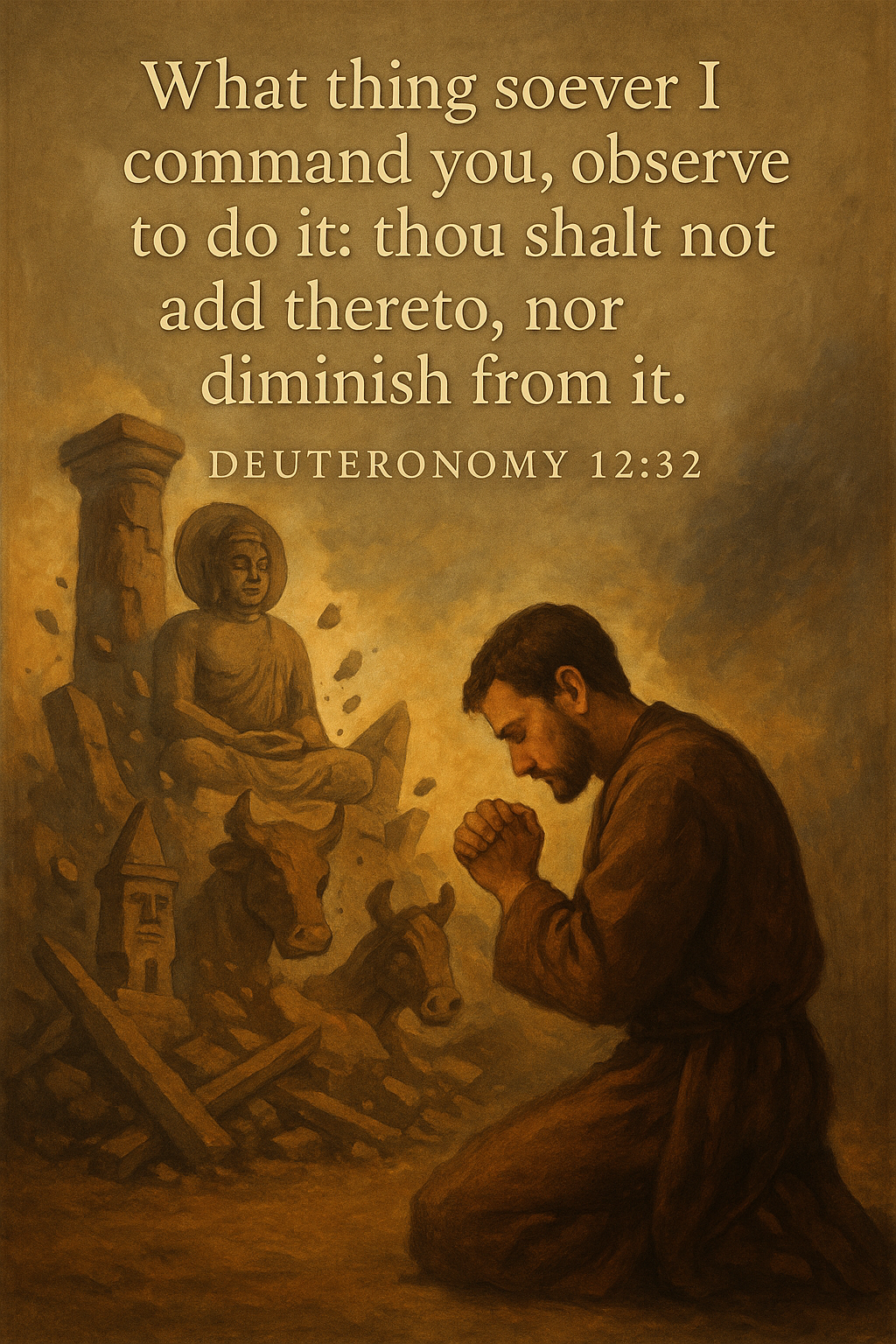
What thing soever I command you, observe to do it: thou shalt not add thereto, nor diminish from it.
Verse Context:
This verse comes at the end of a larger passage in which God warns His people against imitating the pagan worship practices of the nations they are to dispossess (see Deuteronomy chapter 12 verse 30). God had just commanded them to destroy the altars, groves, and images of false gods (see verse 3), and then firmly insisted that worship was to take place only in the way He prescribed, not by inventing new rituals or mixing in cultural trends.
Moses then seals this warning with a thunderous charge: “Observe to do it!” The Hebrew word here for observe is “shamar” (שָׁמַר), meaning to guard, watch closely, or keep diligently. This is no passive suggestion. It is a command to actively and carefully carry out God’s revealed instructions—nothing more and nothing less.
The second half of the verse uses legal language:
- “Thou shalt not add thereto”: meaning do not create additional rules, traditions, or spiritual ideas that God did not give.
- “Nor diminish from it”: meaning do not water down, ignore, or omit any part of His command.
This same command is echoed in Proverbs chapter 30 verse 6:
“Add thou not unto his words, lest he reprove thee, and thou be found a liar.”
And again in Revelation chapter 22 verses 18–19, where it applies to the entire prophetic message of Scripture.
This verse ultimately teaches the supremacy and sufficiency of God’s Word. There is one God, one truth, one standard, and one way to worship, and that way is not up for revision.
Broader Context:
Author: Moses, speaking under divine inspiration as the mediator of God’s covenant with Israel.
Time Period: Circa 1406 B.C., as Israel was preparing to enter the Promised Land.
Audience: The second generation of Israelites after the Exodus, who had not experienced Mount Sinai firsthand.
Setting: On the plains of Moab, just before crossing the Jordan River.
The Book of Deuteronomy is Moses’ final sermon series to Israel. In chapter 12, he begins the section known as the Deuteronomic Code: a covenantal restatement of how the Israelites are to live, worship, and govern themselves once they enter Canaan.
Deuteronomy chapter 12 particularly emphasizes God’s exclusive claim to worship, Destruction of idolatry, Centralized worship at the place God chooses (eventually Jerusalem). Strict obedience to His commands, without innovation or deviation
This chapter and verse is especially vital in today’s era where man-centered religion is increasingly normalized. People want to “customize” their Christianity, adding rituals, embracing ideologies God condemns, or subtracting anything that offends the flesh.
But Deuteronomy chapter 12 verse 32 lays it bare: You don’t have the authority to edit God.
Application:
Appreciating God’s Greatness:
This verse exalts God’s absolute authority. He alone sets the terms of worship, morality, and truth. He does not ask for input. He is not a consultant. He is the LORD. And it is His mercy that He gives us commands at all. Instead of leaving us blind, He gives us light. Instead of letting us destroy ourselves, He gives us a way to live that leads to blessing, peace, and eternal life. His Word is perfect, complete, and unchangeable.
For the Believer:
You must watch your life and doctrine closely (compare to First Timothy chapter 4 verse 16). Do not add to God’s commands by inventing personal convictions that He never required. And do not subtract from them just because culture finds them offensive.
Many believers today are unknowingly practicing “designer faith”: a form of Christianity edited to match personal comfort or social acceptance. This is disobedience cloaked in convenience.
Call to Action:
Return to the Word. Examine your worship, your doctrine, your lifestyle. Ask:
- Am I obeying God fully, or just partially?
- Have I added human traditions or personal opinions to God’s commands?
- Have I omitted anything God told me to do, like sharing the Gospel, honoring biblical gender roles, or speaking truth in love?
If so, repent, and recommit to full obedience.
For the Unbeliever:
You cannot create your own spiritual path and expect it to lead to Heaven. God has already revealed the only way: through faith in Jesus Christ (John chapter 14 verse 6: “I am the way, the truth, and the life: no man cometh unto the Father, but by me.”)
Any attempt to earn salvation through good works, self-made religion, or spiritual philosophies is rebellion. Salvation comes by grace through faith, but it is only given to those who receive the truth of God’s Word.
Today, submit yourself to the one true God. Stop rewriting the rules. Stop editing His commands. Believe the Gospel and obey His voice.
Final Encouragement:
The Word of God does not evolve, and truth does not bend. Our calling is not to reshape God’s commandments, but to honor them, live by them, and teach them without compromise. True freedom is not in self-rule, but in obedient worship of the one true God.
Prayer:
Heavenly Father,
We bow before You today as the One True God. Forgive us for every time we’ve tried to add to or take away from Your holy Word. Keep us from self-made religion, from cultural compromise, and from the pride that whispers we know better than You. Give us hearts that tremble at Your Word, and minds that cling to Your commands. Strengthen us to walk in obedience, even when it costs us everything. Teach us to worship You in spirit and in truth. In Jesus’ name, Amen.
Closing:
If you’ve found these daily verses encouraging, enlightening, or fruitful, please consider helping us spread the truth and light of God’s Word by subscribing to the blog and YouTube channels and liking and following the Facebook page. Most of all, share Believers of Biblical Truth and our links with others who may need the sermons and daily teachings just as much as we do.
You are loved, so much in fact, that we want you to know and be Believers of Biblical Truth.
Shalom Shalom.



 Believers of Biblical Truth
You must be logged in to post a comment.