Second Thessalonians 3:3: But the Lord is faithful, who shall stablish you, and keep you from evil.
VERSE CONTEXT
Paul’s second letter to the church at Thessalonica was written shortly after the first, around A.D. 51–52, most likely from Corinth. His primary purpose was to correct false teachings about the Day of the Lord and to encourage believers who were facing persecution and confusion about end times. In chapter 3, Paul is wrapping up his letter with final exhortations and prayers. Verse 3 stands as a powerful reminder to the believers that, even amid trouble, deception, or temptation, their God is not only aware of their trials but faithful in them.
The word faithful here refers to God’s unwavering trustworthiness—He is dependable, always keeps His promises, and never abandons His own. The phrase shall stablish you means that God will firmly strengthen, stabilize, and root the believer so that they are not easily shaken. This is not just a passing encouragement—it is a declaration of divine action. The final promise, keep you from evil, can also be translated as “from the evil one,” implying protection from Satan himself, but also from all kinds of wickedness and harm.
Paul is confident in this not because of human resilience but because of God’s character. The Thessalonians were not being told to muster their own strength—they were being assured that the faithfulness of God is the source of their endurance.
BROADER CONTEXT
The whole of 2 Thessalonians serves as both correction and comfort. Paul had previously taught them about Christ’s return, but confusion and even fear had set in among the believers, likely due to false letters and teachings claiming the Day of the Lord had already come. In chapters 1 and 2, Paul outlines judgment for the wicked and glory for the saints. Chapter 3 shifts to practical instructions for living until Christ returns. This verse is the heart of the believer’s hope amidst trial: God is not distant—He is faithful.
Paul’s earlier encouragement in First Thessalonians 5:24 reinforces this theme: Faithful is he that calleth you, who also will do it. And in Philippians 1:6, Paul writes: Being confident of this very thing, that he which hath begun a good work in you will perform it until the day of Jesus Christ. These all point to one truth—God finishes what He starts.
APPLICATION
Appreciating God’s Greatness: This verse exalts the constancy and character of God. Unlike false teachers, confused minds, or persecuting hands, the Lord is faithful. He is a protector, a builder, a defender. When the ground around us shakes, He is the foundation that never moves. That God Himself promises to strengthen and shield us shows His nearness and active involvement in the believer’s life. He is not only sovereign over the world but personally invested in those He calls His own.
For the Believer: You may feel under pressure, unsure, or spiritually attacked—but your Lord is faithful. You are not standing by your own power. God will establish you—He is your root system. He will guard you—He is your shield. Walk confidently in your calling, not because you have all the answers, but because you trust the One who does.
Call to Action: Pray today with bold trust in God’s faithfulness. Reflect on moments when He has kept you from sin, despair, or deception. Ask Him to establish your heart more deeply in His Word and to keep you from evil influences, habits, or thoughts. Rehearse His faithfulness aloud—speak it over your day.
For the Unbeliever: If you’ve been trying to stand on your own, let this verse show you something radical: God doesn’t call you to fix yourself—He offers to strengthen and protect you. His faithfulness reaches even to you. Jesus Christ, who died and rose again, is the proof of God’s faithfulness to save. He alone can protect you from the ultimate evil—eternal separation from God. Come to Him in faith, and you will know a strength and safety this world cannot give.
FINAL ENCOURAGEMENT
When everything around us feels uncertain, let this truth anchor your soul: But the Lord is faithful. Your strength is not in your own grip, it’s in His. Your hope is not in the absence of evil, it’s in the presence of God who keeps you through it. He has not forgotten you. He will strengthen you. He will keep you.
PRAYER
Heavenly Father, thank You for being faithful when we are weak and inconsistent. Thank You for strengthening us and guarding us when we do not even realize the danger. Help us lean into Your Word and trust Your promises today. Guard our hearts, our minds, and our actions. Establish us in holiness, and keep us from the snares of evil. Let Your faithfulness be the anthem of our day and the strength behind our obedience. In Jesus’ name we pray, Amen.
Closing
If you’ve found these daily verses encouraging, enlightening, or fruitful, please consider helping us spread the truth and light of God’s Word by subscribing to the blog and YouTube channels and liking and following the Facebook page. Most of all, share Believers of Biblical Truth and our links with others who may need the sermons and daily teachings just as much as we do.
You are loved—so much in fact, that we want you to know and be Believers of Biblical Truth.
Galatians 6:9
And let us not be weary in well doing: for in due season we shall reap, if we faint not.
Verse Context:
The apostle Paul is writing to the churches of Galatia, a region in what is now central Turkey, with a tone that is both corrective and pastoral. This particular verse falls near the end of the letter, in a section where Paul is urging believers to live out their faith through practical godliness, especially in how they treat one another. Leading up to verse 9, Paul has just instructed the Galatians in verses 1 through 8 to bear each other’s burdens, restore those overtaken in sin, avoid spiritual pride, and invest in spiritual things rather than carnal pleasures.
The immediate context of Galatians 6:9 follows verse 8, which contrasts two sowings: “For he that soweth to his flesh shall of the flesh reap corruption; but he that soweth to the Spirit shall of the Spirit reap life everlasting.”
Verse 9 then builds upon this sowing-reaping principle by encouraging the reader not to give up—even when the fruit of righteousness is delayed. “Well doing” here doesn’t just mean moral behavior in general; it specifically refers to Spirit-led acts of righteousness, mercy, generosity, and perseverance in ministry. The Greek word translated “weary” carries the sense of becoming utterly exhausted or discouraged in spirit. The phrase “in due season” implies that God’s timetable for the harvest is perfect, even if it doesn’t align with ours. Finally, “if we faint not” warns that there is a condition tied to the reward: endurance is required.
In essence, this verse is a charge to keep going—to continue doing good even when results are not visible—because God promises a harvest if we do not give up. Paul speaks here not merely as a theologian but as a seasoned laborer, encouraging others not to lose heart in the middle of the work.
Broader Context:
Paul’s letter to the Galatians was written to combat the infiltration of false teachers who were leading believers away from the gospel of grace and back into legalism, specifically the belief that one must follow the Mosaic Law (including circumcision) to be truly saved. Paul fiercely defends the doctrine of justification by faith alone throughout the letter, culminating in a practical exhortation in chapters 5 and 6 about how genuine faith expresses itself—not through bondage to the law, but through freedom, love, and Spirit-empowered living.
In Galatians chapter 6, Paul is showing the fruit of a Spirit-filled life in the context of community. He addresses how believers should handle the sins of others (verse 1), encourages humility and mutual accountability (verses 2–5), and emphasizes generous support for teachers of the Word (verse 6). He then reaffirms the principle of sowing and reaping in verses 7–8, not as karma or legalism, but as a spiritual truth: choices have consequences, and what we invest in spiritually will return as either corruption or eternal reward.
Verse 9, then, is Paul’s pastoral encouragement to weary laborers. It’s as if he is saying, “I know this walk isn’t easy. I know doing what is right often feels thankless, fruitless, or slow to produce results. But don’t stop.” This is a needed correction in a world where instant gratification tempts believers to quit when the harvest is delayed.
As Paul transitions toward his closing thoughts in verses 10–18, he widens the call to good works in verse 10: “As we have therefore opportunity, let us do good unto all men, especially unto them who are of the household of faith.” This reaffirms that well doing, acts of generosity, service, and encouragement, must not be seasonal, but constant, even when emotionally or physically draining. The entire letter, and especially chapter 6, argues against living under the law externally while ignoring the spiritual fruit that must flow from a transformed heart. Paul insists that true Christian life is lived from the inside out, energized by the Spirit, and evidenced by steadfast endurance in doing good.
In this broader context, Galatians 6:9 becomes a banner verse for faithful discipleship: no matter the fatigue, frustration, or delay, the harvest is coming—if we do not give up.
Application
Appreciating God’s Greatness:
Galatians 6:9 reveals the steady, gracious character of God as both just and faithful. His promise that we “shall reap” confirms that He is not blind to our labor. He is not hasty, but He is never late. God’s timing—“in due season”—reflects perfect sovereignty. He does not reward based on our clock, but according to His eternal wisdom. This verse reminds us that God does not forget faithfulness, even when others do. Every unnoticed act of obedience, every quiet moment of sacrifice, every exhausting day of well doing is seen by the Lord of the harvest. That alone sets Him apart from every false god or idol—He sees, He knows, and He honors what man overlooks.
For the Believer:
This verse is a lifeline to believers who are growing tired—not of righteousness itself, but of the burden it often carries in a broken world. Whether you are a pastor laboring week after week, a caregiver showing love to someone who cannot reciprocate, or a worker resisting corruption in your workplace, this verse is for you. Paul says, “Let us not be weary”—meaning we must fight that weariness. How? By remembering the “due season.” The Christian life is not one of immediate rewards. It is a life of sowing: sometimes in tears, sometimes in hope, but always with the assurance that God has appointed a harvest.
Call to Action for Believers:
Keep serving, even if no one thanks you. Keep preaching truth, even if no one listens. Keep showing kindness, even if it’s rejected. Keep living righteously, even if the results are delayed.
Do not grow weary in well doing—not just activity, but Spirit-led, gospel-rooted good. This verse is not just motivation; it is a warning that quitting before the harvest forfeits the fruit. If we “faint not,” we shall reap. That “if” calls for resolve. So pray for strength, stay in the Word, encourage one another, and trust that God’s season is better than ours.
For the Unbeliever:
To the one outside of Christ, this verse is not merely a motivational quote. It is an invitation to enter into a life where your efforts, your suffering, and your sacrifices are not wasted. The world offers shallow rewards for good deeds—but God offers eternal life through Jesus Christ. Verse 8 made that clear: “He that soweth to the Spirit shall of the Spirit reap life everlasting.” The path begins with surrender—by repenting of sin and trusting in Jesus. Without that foundation, no amount of good doing will yield the eternal harvest. But once you are in Christ, everything done by the Spirit’s power becomes seed in God’s soil.
To the unbeliever who is tired of living for empty things, this verse is a doorway to meaning. You were not made to chase worldly reward. You were made to serve a holy God and to reap a harvest that no one can steal—if you faint not.
Final Encouragement:
Galatians 6:9 is not a soft pat on the back—it is a battle cry for the weary, a steady voice calling us to endurance in the face of discouragement. It doesn’t promise that the work will be easy, only that the harvest will come. The seed of righteousness does not sprout overnight. The fruit of faithfulness takes time. But our God is not unjust to forget our labor of love. He is not idle concerning His promises. He is preparing a due season—and it will come right on time.
So to the believer who feels unnoticed, unappreciated, or overwhelmed, take heart. Your well doing has not gone unseen. Your prayers are not hitting the ceiling. Your efforts are not in vain. The command is simple: don’t faint. Don’t give up. Don’t stop sowing what is good, what is true, what is holy. There is a harvest already appointed by God, and if you keep going, you will see it—not because of your strength, but because of His faithfulness.
Prayer:
Father, thank You for the strength to keep going when we feel like quitting. You know our frame; You remember that we are dust. And yet, You call us to endure, not in our own might, but through the power of Your Spirit. Help us today to resist weariness and spiritual fatigue. Help us to remember that every act of obedience is a seed, and that You are the Lord of the harvest. Encourage those who are serving in secret, struggling in silence, or working without thanks. Remind us all that Your promises are sure and that in due season, we shall reap—if we faint not. Give us the faith to believe that, and the strength to walk it out. In Jesus’ name we pray, Amen.
Closing:
If you’ve found these daily verses encouraging, enlightening, or fruitful, please consider helping us spread the truth and light of God’s Word by subscribing to the blog and YouTube channels and liking and following the Facebook page. Most of all, share Believers of Biblical Truth and our links with others who may need the sermons and daily teachings just as much as we do.
You are loved—so much in fact, that we want you to know and be Believers of Biblical Truth.
Philippians 4:8–9: Finally, brethren, whatsoever things are true, whatsoever things are honest, whatsoever things are just, whatsoever things are pure, whatsoever things are lovely, whatsoever things are of good report; if there be any virtue, and if there be any praise, think on these things.Those things, which ye have both learned, and received, and heard, and seen in me, do: and the God of peace shall be with you.
VERSE CONTEXT
These two verses are Paul’s closing exhortation to the believers in Philippi, written from a Roman prison near the end of his life, likely around 60–62 AD. This epistle is personal, warm, and deeply pastoral. Paul is not only instructing them in doctrine, but modeling how to live out that doctrine in the midst of suffering. At this point in the letter, he has already dealt with divisions in the church (Philippians 4:2–3), anxiety (Philippians 4:6–7), and now turns to the believer’s thought life. This shift is not random—it’s strategic. Paul is reminding them that peace, joy, and steadfastness are deeply affected by what they allow their minds to dwell on.
In verse 8, Paul presents a series of moral and spiritual qualities for the Christian to meditate on—true, honest, just, pure, lovely, and of good report. These terms are not arbitrary. The Greek structure emphasizes that these are to be the habitual focus of the Christian’s thoughts, not passing ideas. The word “think” here means more than daydreaming; it implies meditation, intentional reflection, and choosing what to dwell on.
Let’s take a brief embedded look at a few of the terms for clarity:
True refers not only to what is factually accurate, but what is aligned with God’s truth. Jesus said in John 17:17, “Sanctify them through thy truth: thy word is truth.” This draws a direct line between a holy mind and a mind filled with Scripture.
Honest here means noble or worthy of respect. It refers to dignified thinking—the kind that lifts us toward heaven, not the base, cynical, or carnal thoughts that are so common in today’s culture.
Just means righteous—thinking that aligns with God’s standards of justice and rightness, not man’s fluctuating ethics.
Pure refers to moral purity—chaste, undefiled, clean in heart and mind. The word ties back to Paul’s earlier charge in Philippians 2:15: “That ye may be blameless and harmless, the sons of God, without rebuke…”
Lovely means things that call forth love and admiration—not sentimentality, but beauty that reflects God’s character.
Of good report describes what is commendable or admirable—things spoken well of for righteous reasons, not worldly approval.
Paul sums up with, “if there be any virtue, and if there be any praise,” broadening the list to include any excellent moral or spiritual quality worth praise in God’s eyes. These are the thoughts we are commanded to fix our minds on—not merely avoid sinful thoughts, but proactively choose to think like Christ.
Then in verse 9, Paul transitions from the mind to behavior: “Those things, which ye have both learned, and received, and heard, and seen in me, do.” He uses four distinct verbs to highlight the completeness of their exposure to his life and teaching. They didn’t just hear him preach—they saw how he lived. Paul had not only taught them the Word; he modeled how to apply it under pressure, in joy, and even in chains.
The final promise is both comforting and conditional: “and the God of peace shall be with you.” This is not speaking of the peace of God (as in verse 7), but the God who produces peace. His presence is tied to our obedience. When we think rightly and live accordingly, we experience not just peace as a feeling, but the fellowship of the God of peace Himself.
BROADER CONTEXT
The Book of Philippians is one of Paul’s “prison epistles,” written while he was under house arrest in Rome (Acts 28:30–31). Though chained and awaiting a verdict that could mean death, Paul writes with an unmistakable tone of joy, confidence, and spiritual encouragement. The letter is addressed to the believers in the Roman colony of Philippi—a city in Macedonia (modern-day northern Greece) that was both culturally Roman and heavily influenced by military pride, being a settlement for retired Roman soldiers. Paul had founded the church there during his second missionary journey (Acts 16), making it one of the first Christian communities in Europe. His imprisonment and ongoing suffering did not discourage them; in fact, they had sent support to him through Epaphroditus (Ee-paf-roh-DYE-tus), which prompted this heartfelt letter in return.
The overarching theme of Philippians is joy in Christ, regardless of circumstance. Chapter 1 stresses joy in suffering, chapter 2 focuses on joy in service, chapter 3 offers joy in knowing Christ, and chapter 4 concludes with joy in stability and provision. By the time we arrive at chapter 4, Paul is wrapping up the letter with final instructions for practical Christian living. These are not theoretical ideas—they’re deeply personal and modeled in Paul’s own life.
The immediate section (Philippians 4:4–9) contains some of the most quoted verses in the New Testament, beginning with “Rejoice in the Lord alway: and again I say, Rejoice.” This isn’t an empty motivational phrase. Paul is calling believers to a stable, Spirit-filled joy rooted in Christ—not based on outcomes or earthly peace. That’s followed by a call to gentleness, trust in God over anxiety, prayer with thanksgiving, and the peace of God guarding the heart and mind.
Verses 8–9 function as a sort of mental and behavioral capstone. After instructing them to pray right (verse 6) and experience peace (verse 7), Paul now calls them to think right (verse 8) and live right (verse 9). These are the necessary habits of the mature believer: filling the mind with what is godly, living out the Word in practice, and enjoying the presence of the God of peace as a result.
In terms of structure, the language Paul uses in 4:8–9 also serves as a closing to the ethical portion of the letter. The final verses of chapter 4 (verses 10–23) shift into a thank-you for the Philippians’ financial support and a meditation on contentment and God’s provision.
From a theological perspective, this passage underscores two great truths:
Sanctification involves the mind. It’s not enough to avoid sin; the Christian must actively meditate on what is good. Romans 12:2 reinforces this idea: “Be not conformed to this world: but be ye transformed by the renewing of your mind…”
Right thinking and right living are inseparable. Thinking about virtue without obedience is hypocrisy; acting without thinking leads to instability. Paul’s formula here—Think → Do → Experience God’s Presence—is the blueprint for spiritual peace.
APPLICATION
Appreciating God’s Greatness
Philippians 4:8–9 reveals a stunning truth about the character of God—He is not only the source of peace (verse 7), but He is the God of peace Himself (verse 9). That title tells us that peace is not merely a gift from God, it is part of who He is. Peace, in the biblical sense, is not the absence of conflict, but the presence of harmony with God’s will. It is a spiritual condition in which the believer is settled, stable, and secure—not because everything is calm around them, but because the Lord is dwelling with them. This intimate presence of the God of peace is a promise for those who walk in obedience, think in righteousness, and imitate the example of Christ (and Paul, who followed Him).
We also see God’s greatness in the pattern Paul gives. The moral and spiritual qualities listed in verse 8—truth, purity, justice, etc.—are not just personality goals. They reflect God’s own nature. To meditate on these is to think more like God and to desire more of His presence. God isn’t distant from our thoughts—He meets us in them when our minds are set on Him.
For the Believer
For the believer, this passage is both a mirror and a compass. It reveals where our thoughts may be drifting, and it redirects us toward what honors God. Paul’s instruction to “think on these things” is not a passive suggestion—it is a command. The health of a believer’s spiritual life is often shaped not by what they do alone, but by what they dwell on. Thoughts lead to beliefs, and beliefs shape behavior.
This passage also reminds the believer that peace is tied to obedience. So many Christians pray for peace but continue in disobedience or allow their minds to be consumed by ungodly influences—entertainment, bitterness, gossip, fear, or doubt. But peace is not found in avoiding problems. It is found when the believer lines up their thinking and behavior with the Word of God and the model of Christ.
Paul doesn’t just tell them to learn or study what’s right; he says to do what they’ve seen in him. This means the Christian life is meant to be visible, imitated, and lived in community. We don’t just teach truth—we model it. We don’t just read Scripture—we apply it. And when we do, the God of peace will not be far from us. He will walk beside us, anchoring our minds and hearts in stability.
Call to Action:
Believers must evaluate what fills their minds. What do we spend hours thinking about? Is it fear, entertainment, resentment, or comparison? Or is it the Word of God, the needs of others, the beauty of holiness, and the joy of grace? If we want peace, we must pursue the God of peace through righteous thinking and living. Let today be the day you begin filtering your thoughts through Philippians 4:8. Make it your mental checklist. Every thought must be tested: Is this true? Is it pure? Is it worthy of praise? If not—cast it down (Second Corinthians 10:5: “Casting down imaginations, and every high thing that exalteth itself against the knowledge of God, and bringing into captivity every thought to the obedience of Christ”).
For the Unbeliever
To the unbeliever or seeker, this passage may feel overwhelming. How can someone maintain this kind of mental discipline? How can peace really be found in a world filled with anxiety, evil, and restlessness? The answer is in verse 9: “The God of peace shall be with you.” Not a god of ease, not a god of indulgence, but the God of peace. Real, lasting peace cannot be manufactured by positive thinking, therapy, or success. It is the gift of God’s presence through Jesus Christ.
You cannot think rightly if your heart has not first been made right. The peace of God—and the God of peace—will only dwell with those who have received the righteousness of Christ by faith. If you’re tired of restlessness, guilt, confusion, and fear, there is hope. Jesus Christ came not only to forgive your sins, but to change your mind—to renew you, comfort you, and teach you how to live in harmony with God. The transformation starts with faith and surrender.
FINAL ENCOURAGEMENT
Philippians 4:8–9 offers a divine blueprint for peace—but not peace as the world gives. This peace is not circumstantial. It does not rely on the absence of trials or the presence of success. It is grounded in the character of God and cultivated in the mind and habits of the believer. Paul, a man imprisoned for his faith, is proof that peace is possible in the storm. His command to the Philippians is a call to us today: guard your thoughts, walk in what you’ve learned, and the God of peace will walk with you.
You are not alone in your battle for peace. God is not distant. He is the God of peace—and He has made Himself available to those who seek Him. The more you meditate on what is true, pure, and just—and the more you act in obedience to what you’ve received from His Word—the more you’ll know the stability and nearness of His presence. Peace is not only possible, it is promised—to those whose minds are stayed on Him.
PRAYER
Heavenly Father, Thank You for being not just the giver of peace but the God of peace. You are unshakable, holy, and near to all who call upon You in truth. Help us, Lord, to take every thought captive, to think on what is lovely, honest, pure, and of good report. Train our minds to reject fear, lust, anger, and lies—and to be filled with Your truth instead. Strengthen us to live out what we’ve learned through Your Word and to imitate godly examples in faith and obedience. Walk with us, O God, and teach us to walk in step with You. May our hearts be anchored in Your presence and our lives shaped by Your peace. In Jesus’ name we pray, Amen.
CLOSING
If you’ve found these daily verses encouraging, enlightening, or fruitful, please consider helping us spread the truth and light of God’s Word by subscribing to the blog and YouTube channels and liking and following the Facebook page. Most of all, share Believers of Biblical Truth and our links with others who may need the sermons and daily teachings just as much as we do.
You are loved—so much in fact, that we want you to know and be Believers of Biblical Truth.
Romans chapter 8 verse 28:And we know that all things work together for good to them that love God, to them who are the called according to his purpose.
Verse Context
Paul, the author of the Book of Romans, writes this letter to the believers in Rome around A.D. 57. His audience is primarily Gentile Christians living under Roman rule, who are often facing persecution, hardship, or the isolation that comes from following Christ in a pagan culture. In Romans chapter 8, Paul shifts from describing the struggle with sin to the hope and assurance that comes through life in the Spirit. By the time he reaches verse 28, he is building a crescendo of comfort. He is not saying that everything is good—but rather that everything is used for good by a sovereign God.
The word “work together” in this verse comes from a Greek root meaning to cooperate or synergize. In plain English, it means God is orchestrating all things—including suffering, loss, bad weather, and even our mistakes—for a good end. But Paul adds a qualifier: this promise is only for those who love God and are called according to His purpose. The phrase “called according to His purpose” speaks to God’s divine choosing and plan—a plan that is active, intentional, and unstoppable.
This is not a motivational slogan. This is a spiritual certainty grounded in the unchangeable nature of God. As Matthew Henry (1662–1714, Nonconformist minister) writes: “Even afflictions are for the good of the saints; they are designed for, and shall issue in, their spiritual and eternal good.”
Broader Context
Romans chapter 8 is often called the “mountaintop” of Paul’s letters. It opens with “There is therefore now no condemnation to them which are in Christ Jesus” (verse 1), and closes with the thunderous declaration that nothing shall separate us from the love of God in Christ (verse 39). Verse 28 falls in the middle, acting like a sturdy pillar to hold up the weight of suffering discussed in verses 17 through 27. Paul acknowledges that creation is groaning, believers are groaning, and even the Spirit is groaning on our behalf with “groanings which cannot be uttered” (verse 26). These groanings are not signs of defeat—they are birth pangs of God’s redemptive purpose.
Romans 8:28 is the hinge between suffering and glory. It assures believers that God is not passively watching the storm—He is actively working within it. The promise is not that we will avoid pain, but that pain will not be wasted.
This chapter, and this verse in particular, have comforted martyrs, missionaries, widows, war victims, and wounded saints for two thousand years. God is not improvising with your life—He is composing a masterpiece.
Application
Appreciating God’s Greatness
Rainy days often tempt us to complain or fall into discouragement, but Romans 8:28 reminds us that even dreary moments are under the care of a masterful God. The fact that He makes all things work together—even when those things seem contradictory or painful—is proof of His wisdom and sovereignty. We see only threads; He sees the tapestry.
For the Believer
This verse should anchor us on hard days. When nothing is going right, when the forecast outside matches the gloom inside, we can still say with confidence: “God is working.” If you love Him and are called by Him, nothing is random. That closed door, that lonely moment, that delay, that rainy day—it’s all part of God’s work in your life. Let this promise steady your soul.
Call to Action: Take a moment today, even in the rain, to thank God—not just for the good days, but for the hard ones too. Pray for spiritual eyes to see His purpose unfolding, even if it is hidden from view.
For the Unbeliever
If you’re reading this and wondering whether this promise is for you, Paul is clear—it is for “them that love God” and are “called according to his purpose.” That calling begins with repentance and faith in Jesus Christ. Without Him, life’s storms are just storms. But in Christ, they become part of something redemptive. God is offering you more than temporary comfort—He is offering you eternal purpose. Don’t let the rain pass without responding to the invitation.
Final Encouragement
A rainy day may dampen your plans, but it cannot cancel God’s promises. All things—the joyful, the painful, the confusing, the silent—are working together for your good if you are in Christ. On a day when the sky is gray and the air is heavy, lift your eyes and your heart. God is working. God is near. And God is good.
Prayer
Heavenly Father, thank You for the assurance that nothing in my life is wasted—not the sunshine, not the rain, not even the tears. Thank You that You are working even when I don’t see it. Help me today to trust Your timing, rest in Your purpose, and rejoice in Your presence. On days like this, when the sky is dark and my spirit feels weak, remind me that You are my light. In Jesus’ name, Amen.
Closing
If you’ve found these daily verses encouraging, enlightening, or fruitful, please consider helping us spread the truth and light of God’s Word by subscribing to the blog and YouTube channels and liking and following the Facebook page. Most of all, share Believers of Biblical Truth and our links with others who may need the sermons and daily teachings just as much as we do.
You are loved—so much in fact, that we want you to know and be Believers of Biblical Truth.
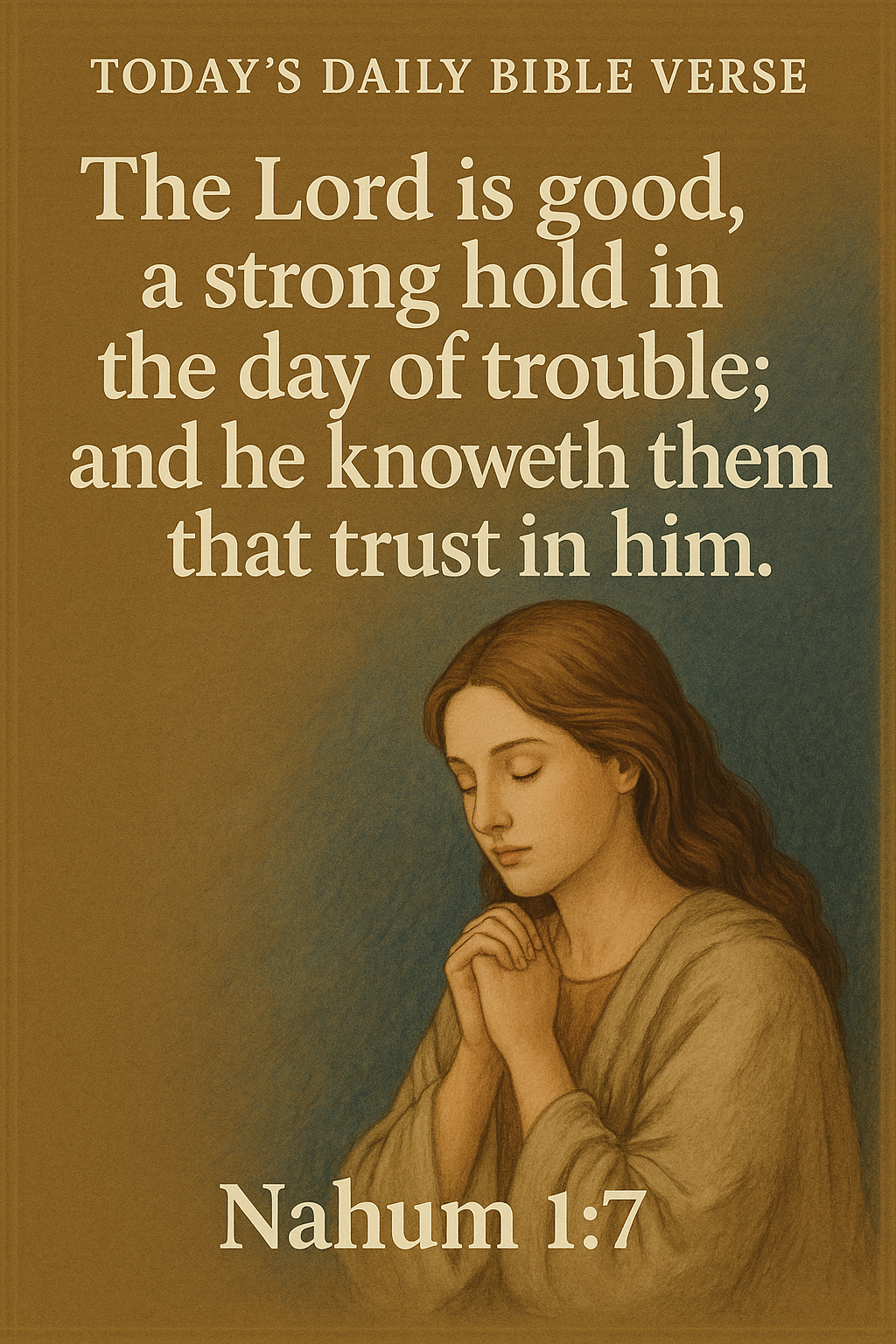
Nahum 1:7: The Lord is good, a strong hold in the day of trouble; and he knoweth them that trust in him.
Verse Context:
This verse appears right in the middle of a judgment oracle, and that contrast is powerful. Nahum, the prophet whose name means “comfort,” is declaring the downfall of the wicked city of Nineveh. Verses before and after this one thunder with divine wrath—God’s vengeance, fury, and power over His enemies. But here, in Nahum 1:7, there is a sudden and beautiful shift. It’s as if God pauses mid-sentence to comfort His faithful remnant, assuring them that while judgment comes for the wicked, safety remains for those who trust in Him.
The statement “The Lord is good” is not a general remark; it is a theological anchor. In a chapter filled with divine anger, this is a reminder that God’s justice is not cruelty—it is goodness expressed through holiness. The word “good” here implies moral perfection, kindness, and covenantal loyalty. It’s not a temporary or shifting trait—it is His eternal nature (see Psalm 100:5: “For the Lord is good; his mercy is everlasting; and his truth endureth to all generations.”).
Next, the LORD is described as “a strong hold in the day of trouble.” A strong hold, or fortress, was a place of refuge from siege or disaster. This phrase reveals God’s role as protector, not merely from physical enemies but from every form of distress. The day of trouble is not limited to one event—it refers to any moment of suffering, oppression, or calamity. God’s people were surrounded by violent empires, and yet He was their invisible fortress.
The last phrase—“he knoweth them that trust in him”—is deeply intimate. The word “knoweth” implies more than simple awareness. It’s a covenantal knowing—a recognition, a loving attentiveness. It’s the same kind of knowledge expressed in Second Timothy 2:19: “The Lord knoweth them that are his.” To trust in him means to find one’s security, loyalty, and hope in the LORD alone. It’s not a vague belief but a committed dependence, even when surrounded by threat.
This verse teaches that God’s wrath and God’s refuge are not contradictory—they are parallel truths. The same fire that devours the wicked warms the faithful. To those who oppose Him, He is a whirlwind. To those who trust Him, He is a wall.
Broader Context:
The book of Nahum was written sometime between 663 and 612 B.C., after the fall of Thebes (Nahum 3:8–10) but before the fall of Nineveh. This was a time of international tension, and the Assyrian Empire was the world’s most feared superpower. They had destroyed the northern kingdom of Israel and terrorized Judah. But God now declares that Assyria’s reign of terror would end. Nahum’s message is both a pronouncement of doom for Nineveh and a message of hope for God’s people.
Chapter 1 introduces this theme of judgment and refuge side-by-side. Verses 2–6 highlight God’s wrath, His power over the earth, and His intolerance for sin. Then, suddenly, verse 7 shifts the tone: to the faithful, God is good. This creates a powerful theological balance: God is not one-dimensional. He is both Judge and Savior, furious against evil and tender toward the humble.
This theme is consistent throughout Scripture. In Exodus chapter 34 verse 6, when God reveals His name to Moses, He says: “The Lord, The Lord God, merciful and gracious, longsuffering, and abundant in goodness and truth.” That goodness is on display in Nahum 1:7.
Application:
Appreciating God’s Greatness:
Nahum 1:7 showcases the multifaceted nature of God. He is not only a consuming fire (Hebrews 12:29) but also a place of safety. His justice is not detached from His goodness. In fact, it is because He is good that He must judge evil. But His greatness is seen most clearly in His personal care for those who trust Him. He doesn’t just see us—He knows us. His knowledge is relational, personal, and loving. This is not the distant deity of paganism, but the intimate God of covenant.
For the Believer:
When life collapses, when fear rises, when trials surround—the Lord is good. He is not just good in theory, but good to you. He is a strong hold. Not a crumbling wall, not a paper-thin shield, but a fortress built by the eternal God. If you trust Him, He knows your name, your pain, your prayers.
Call to Action:
Take time today to run into that strong hold. Don’t trust in yourself, your job, your family, or your strength. Trust in the One who knows you and has never once failed. Write this verse on your heart and speak it over your storm.
For the Unbeliever:
This verse offers hope, but it also implies a decision. It says God knows those who trust in Him—but what about those who do not? This verse is comfort for the believer, but it’s a challenge for the lost. If you are not trusting in the LORD, then you remain outside the strong hold. And when the day of trouble comes—whether it be national collapse, personal tragedy, or the final day of judgment—there will be no refuge unless you are found in Christ. But today you can turn to Him. Trust Him. He already knows your heart. Let Him redeem it.
Final Encouragement:
Nahum 1:7 is one of the greatest promises in a book full of judgment. It reminds us that in every generation, even when the world shakes and evil seems to rise, God is still good. He is still strong. And He still knows His people. Whatever trouble you face today—emotional, spiritual, physical—remember that God’s goodness is not shaken. His strong hold still stands.
Prayer:
Father God, You are good—always. Even when storms rage and the world groans, Your goodness does not change. Thank You for being our strong hold, our place of shelter in every trouble. Thank You for knowing us—really knowing us—and still loving us. Help us trust You more today. Remind us that we are not forgotten, not forsaken. And for those who do not yet know You, please let this be the day they run into Your arms. We praise You for being both mighty and merciful. In the name of Jesus, our Rock and our Redeemer, Amen.
Closing:
If you’ve found these daily verses encouraging, enlightening, or fruitful, please consider helping us spread the truth and light of God’s Word by subscribing to the blog and YouTube channels and liking and following the Facebook page. Most of all, share Believers of Biblical Truth and our links with others who may need the sermons and daily teachings just as much as we do.
You are loved—so much in fact, that we want you to know and be Believers of Biblical Truth.





You must be logged in to post a comment.