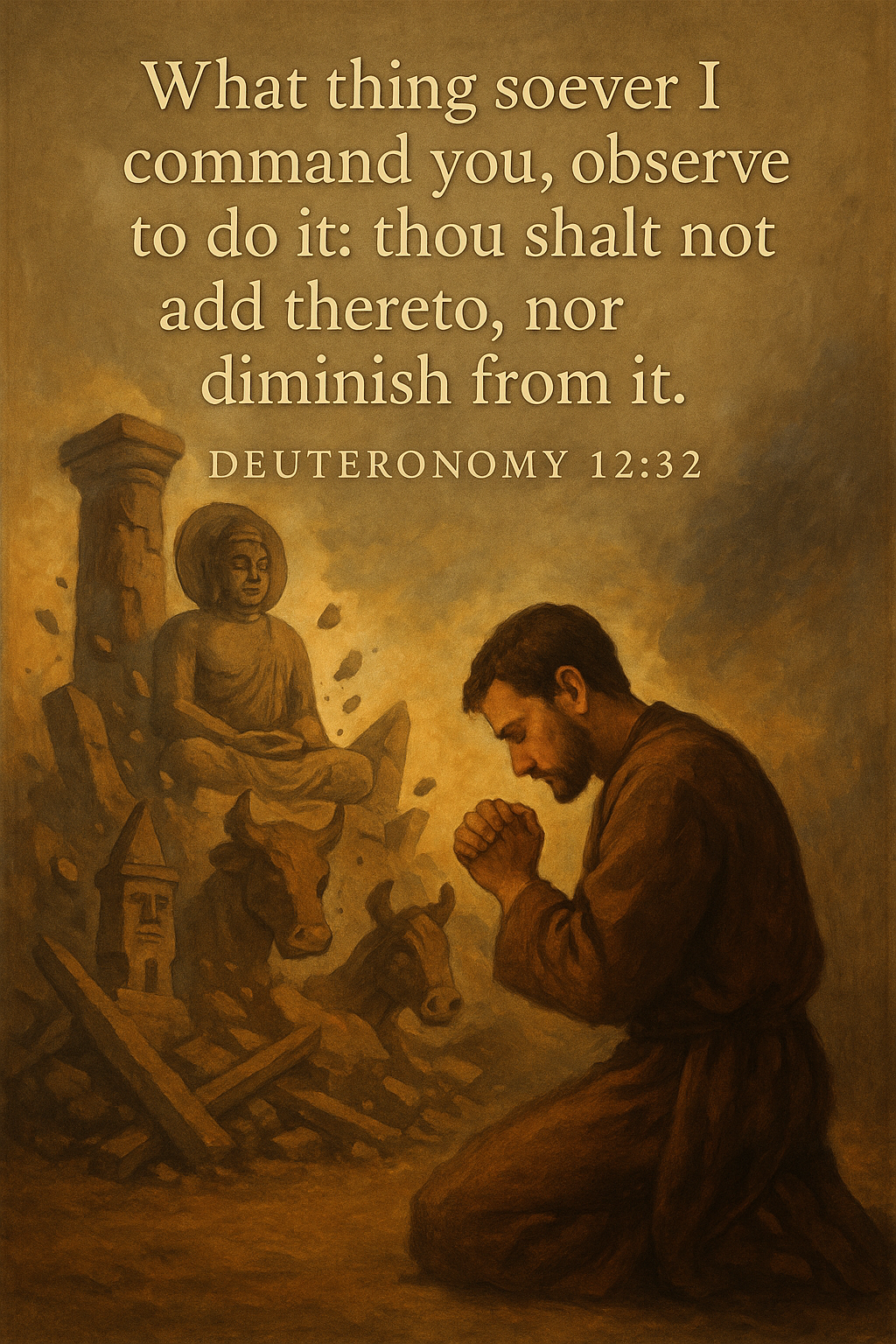
Deuteronomy chapter 12 verse 32: What thing soever I command you, observe to do it: thou shalt not add thereto, nor diminish from it.
Verse Context:
This verse comes at the end of a larger passage in which God warns His people against imitating the pagan worship practices of the nations they are to dispossess (see Deuteronomy chapter 12 verse 30). God had just commanded them to destroy the altars, groves, and images of false gods (see verse 3), and then firmly insisted that worship was to take place only in the way He prescribed, not by inventing new rituals or mixing in cultural trends.
Moses then seals this warning with a thunderous charge: “Observe to do it!” The Hebrew word here for observe is “shamar” (שָׁמַר), meaning to guard, watch closely, or keep diligently. This is no passive suggestion. It is a command to actively and carefully carry out God’s revealed instructions—nothing more and nothing less.
The second half of the verse uses legal language:
“Thou shalt not add thereto”: meaning do not create additional rules, traditions, or spiritual ideas that God did not give.
“Nor diminish from it”: meaning do not water down, ignore, or omit any part of His command.
This same command is echoed in Proverbs chapter 30 verse 6: “Add thou not unto his words, lest he reprove thee, and thou be found a liar.”
And again in Revelation chapter 22 verses 18–19, where it applies to the entire prophetic message of Scripture.
This verse ultimately teaches the supremacy and sufficiency of God’s Word. There is one God, one truth, one standard, and one way to worship, and that way is not up for revision.
Broader Context:
Author: Moses, speaking under divine inspiration as the mediator of God’s covenant with Israel. Time Period: Circa 1406 B.C., as Israel was preparing to enter the Promised Land. Audience: The second generation of Israelites after the Exodus, who had not experienced Mount Sinai firsthand. Setting: On the plains of Moab, just before crossing the Jordan River.
The Book of Deuteronomy is Moses’ final sermon series to Israel. In chapter 12, he begins the section known as the Deuteronomic Code: a covenantal restatement of how the Israelites are to live, worship, and govern themselves once they enter Canaan.
Deuteronomy chapter 12 particularly emphasizes God’s exclusive claim to worship, Destruction of idolatry, Centralized worship at the place God chooses (eventually Jerusalem). Strict obedience to His commands, without innovation or deviation
This chapter and verse is especially vital in today’s era where man-centered religion is increasingly normalized. People want to “customize” their Christianity, adding rituals, embracing ideologies God condemns, or subtracting anything that offends the flesh.
But Deuteronomy chapter 12 verse 32 lays it bare: You don’t have the authority to edit God.
Application:
Appreciating God’s Greatness:
This verse exalts God’s absolute authority. He alone sets the terms of worship, morality, and truth. He does not ask for input. He is not a consultant. He is the LORD. And it is His mercy that He gives us commands at all. Instead of leaving us blind, He gives us light. Instead of letting us destroy ourselves, He gives us a way to live that leads to blessing, peace, and eternal life. His Word is perfect, complete, and unchangeable.
For the Believer:
You must watch your life and doctrine closely (compare to First Timothy chapter 4 verse 16). Do not add to God’s commands by inventing personal convictions that He never required. And do not subtract from them just because culture finds them offensive.
Many believers today are unknowingly practicing “designer faith”: a form of Christianity edited to match personal comfort or social acceptance. This is disobedience cloaked in convenience.
Call to Action: Return to the Word. Examine your worship, your doctrine, your lifestyle. Ask:
Am I obeying God fully, or just partially?
Have I added human traditions or personal opinions to God’s commands?
Have I omitted anything God told me to do, like sharing the Gospel, honoring biblical gender roles, or speaking truth in love?
If so, repent, and recommit to full obedience.
For the Unbeliever:
You cannot create your own spiritual path and expect it to lead to Heaven. God has already revealed the only way: through faith in Jesus Christ (John chapter 14 verse 6: “I am the way, the truth, and the life: no man cometh unto the Father, but by me.”)
Any attempt to earn salvation through good works, self-made religion, or spiritual philosophies is rebellion. Salvation comes by grace through faith, but it is only given to those who receive the truth of God’s Word.
Today, submit yourself to the one true God. Stop rewriting the rules. Stop editing His commands. Believe the Gospel and obey His voice.
Final Encouragement:
The Word of God does not evolve, and truth does not bend. Our calling is not to reshape God’s commandments, but to honor them, live by them, and teach them without compromise. True freedom is not in self-rule, but in obedient worship of the one true God.
Prayer:
Heavenly Father, We bow before You today as the One True God. Forgive us for every time we’ve tried to add to or take away from Your holy Word. Keep us from self-made religion, from cultural compromise, and from the pride that whispers we know better than You. Give us hearts that tremble at Your Word, and minds that cling to Your commands. Strengthen us to walk in obedience, even when it costs us everything. Teach us to worship You in spirit and in truth. In Jesus’ name, Amen.
Closing:
If you’ve found these daily verses encouraging, enlightening, or fruitful, please consider helping us spread the truth and light of God’s Word by subscribing to the blog and YouTube channels and liking and following the Facebook page. Most of all, share Believers of Biblical Truth and our links with others who may need the sermons and daily teachings just as much as we do.
You are loved, so much in fact, that we want you to know and be Believers of Biblical Truth.
Romans chapter 8 verse 9:But ye are not in the flesh, but in the Spirit, if so be that the Spirit of God dwell in you. Now if any man have not the Spirit of Christ, he is none of his.
VERSE CONTEXT
The Apostle Paul is the author of the Book of Romans, writing under the inspiration of the Holy Spirit to the believers in Rome, a diverse audience of Jewish and Gentile Christians living under Roman rule and dealing with both internal struggles and external persecution. Romans chapter 8 is one of the most powerful and theologically rich chapters in all of Scripture. It explores life in the Spirit versus life in the flesh, affirming that true Christian life is only possible by the indwelling of the Holy Ghost.
Paul is emphatically stating in Romans 8:9 that a person who claims to belong to Christ must have the Spirit of God dwelling within them. The Greek word used for dwell is “oikeō” (οἰκέω), meaning to live in, to inhabit permanently. This is not a passing influence or momentary feeling, this is full residence. If the Holy Spirit does not dwell within someone, Paul makes it crystal clear: that person is “none of his”, they do not belong to Christ.
This verse dismantles the false idea that moral people, religious people, or good people can live out the will of God apart from the Spirit. Man, by nature, is in the flesh, governed by sin, inclined toward pride, and unable to please God (see Romans 8:8: So then they that are in the flesh cannot please God.). There is no exception, no bypassing this truth. The Holy Spirit is not optional for godliness, it is essential.
Commentator Charles Hodge (1797–1878, Presbyterian theologian) wrote, “To be without the Spirit is to be without Christ. And to be without Christ is to be without life.” That is the heart of this verse.
BROADER CONTEXT
Romans chapter 8 is the Spirit-filled crescendo of a multi-chapter argument Paul began back in chapter 5, where he contrasted Adam’s fall with Christ’s gift of righteousness. In chapters 6 and 7, Paul explained that believers are dead to sin and not under the law, but the struggle with the flesh remains. Romans 7 ends with Paul crying out, “O wretched man that I am! who shall deliver me from the body of this death?” (Romans 7:24). Chapter 8 answers that cry: only through the Spirit of life in Christ Jesus can we walk in freedom and righteousness.
The chapter begins with the declaration: “There is therefore now no condemnation to them which are in Christ Jesus…” (Romans 8:1), and it unfolds into a description of what that Spirit-led life looks like. Verse 9 is the turning point in Paul’s argument where he stops addressing general human nature and starts directly speaking to the believer, encouraging them: “Ye are not in the flesh, but in the Spirit.” But only if the Spirit of God truly lives in them.
This is not just a doctrinal checkpoint, it is a dividing line between true and false faith, between works-based religion and Spirit-empowered righteousness. The entire chapter pivots on the truth that only the Holy Spirit gives us life, peace, adoption as sons, hope in suffering, and ultimately, glorification.
APPLICATION
APPRECIATING GOD’S GREATNESS
This verse reminds us of the absolute necessity of God’s own presence to accomplish His will. He does not leave us to be holy on our own. What God requires, God provides through His Spirit. He does not merely call us to obedience, He empowers us to obey. That is the greatness of our God: He saves us, fills us, transforms us, and sustains us by His own indwelling Spirit. Dr. Voddie Baucham once explained that if man could be obedient without the Holy Spirit the we would not have needed Jesus. Why would Jesus have to leave His throne in heaven, come down to this sinful world, live a sinless life, be hated by his own creation, be beaten and murder on the torturous cross, be buried, and then resurrect himself so that we could be forgiven for the sin we have to power not to commit in the first place? Jesus came because we do not have the power to be sinless without the Holy Spirit.
FOR THE BELIEVER
The believer must not attempt to live the Christian life in their own strength. Our flesh is incapable of producing righteousness. This is why Paul says in Galatians chapter 3 verse 3: “Are ye so foolish? having begun in the Spirit, are ye now made perfect by the flesh?”
We must recognize that victory over sin, transformation of the mind, and the power to live for God are all the results of the Holy Spirit at work within us. Any effort to serve or honor God apart from the Spirit will end in frustration, burnout, and failure.
Call to Action: If you are a believer, examine your walk. Are you relying on your effort, personality, or willpower, or are you walking in the Spirit? Seek God daily in prayer, asking Him to fill you, guide you, and control every part of your life. Confess your need for His help. Surrender. And then walk in the Spirit, and you will not fulfill the lust of the flesh (Galatians 5:16).
FOR THE UNBELIEVER
If you are trying to live a good life without the Spirit of God, this verse makes it plain: you do not belong to Christ. You may be religious, moral, generous, or spiritual, but without the Spirit of Christ, you are still “in the flesh,” and that means you are still under condemnation.
But the invitation is open: repent of your sins and believe the gospel. Jesus Christ died for your sins, rose from the grave, and offers you new life, not by reforming your behavior, but by filling you with His Spirit. You cannot save yourself. But Christ can, if you turn to Him.
FINAL ENCOURAGEMENT
You were never meant to do this alone. The Christian life is not a self-help program. It is not about being a better person, it is about being a new creation. And that new life can only begin and grow through the indwelling Holy Spirit. Let this verse encourage you: God has not left you in the flesh. If you are His, you are filled with His Spirit. And if you’re not yet His—He’s calling you now.
PRAYER
Father, we confess that without Your Spirit, we are powerless. Our efforts to be righteous on our own always fall short. We thank You for sending the Holy Spirit to dwell within those who believe, to empower us, comfort us, and transform us. Forgive us for the times we rely on our flesh. Help us to yield fully to the Spirit each day and to live in a way that glorifies You. And for those who do not yet know You, may this truth pierce their hearts and draw them into saving faith. In Jesus’ name, Amen.
CLOSING
If you’ve found these daily verses encouraging, enlightening, or fruitful, please consider helping us spread the truth and light of God’s Word by subscribing to the blog and YouTube channels and liking and following the Facebook page. Most of all, share Believers of Biblical Truth and our links with others who may need the sermons and daily teachings just as much as we do.
You are loved—so much in fact, that we want you to know and be Believers of Biblical Truth.
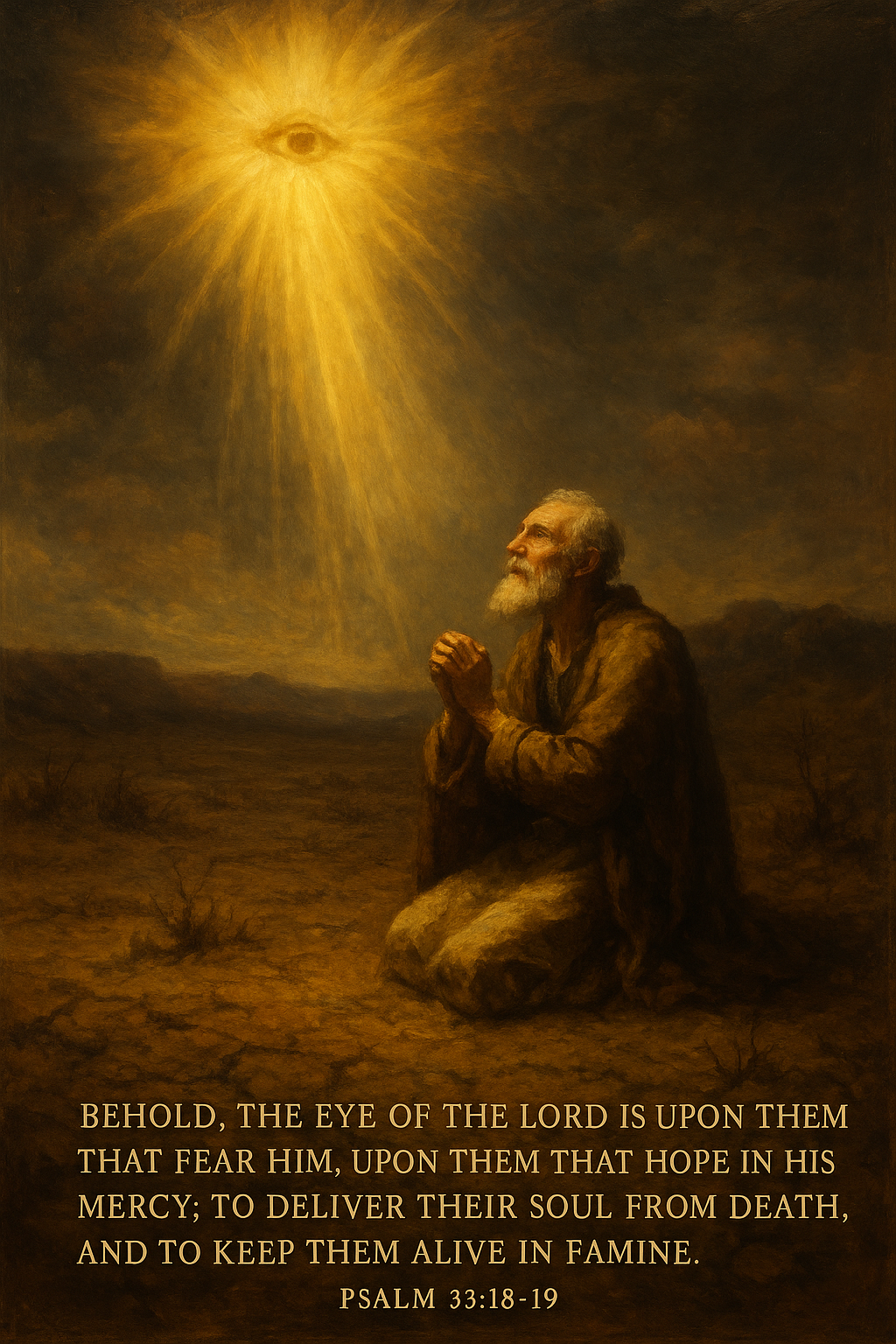
Psalm 33:18–19 (KJV):
Behold, the eye of the Lord is upon them that fear him, upon them that hope in his mercy; To deliver their soul from death, and to keep them alive in famine.
Verse Context
The author of Psalm 33 is not named, but the psalm fits within the larger structure of praise and reflection on God’s sovereignty. The phrase “the eye of the Lord” is a Hebrew idiom expressing both His omniscience and His intimate involvement with His people. It does not mean God is watching from afar, but rather that He is actively guarding and guiding those who fear Him.
The word fear here does not mean being scared; it refers to reverent awe and submission, those who honor God and walk in His ways. This is paired with those who hope in His mercy, trusting His covenant love, even when circumstances are hard. The Hebrew word translated mercy (often chesed, though not named directly here) implies steadfast, loyal love, especially God’s covenant-keeping faithfulness to His people.
In verse 19, we are reminded that this divine attention has a purpose: “To deliver their soul from death” speaks to spiritual preservation, not just physical. God protects us from destruction and judgment. And the phrase “to keep them alive in famine” reminds us that God is the ultimate provider, even when resources are scarce. Historically, Israel often faced agricultural crises due to drought or invasion, yet the faithful were sustained by God’s hand.
This passage is echoed in God’s faithfulness to Elijah during famine (First Kings 17:6: “And the ravens brought him bread and flesh in the morning…”) and in the Lord’s Prayer where Jesus teaches us to pray, “Give us this day our daily bread” (Matthew 6:11). God’s provision is not occasional, it is constant for those who trust Him.
Broader Context
Psalm 33 is a call to praise God not only for who He is, but for what He does. The earlier verses (especially 6–9) declare God as the Creator: “By the word of the LORD were the heavens made…” He is not just a distant deity, He is the active Ruler of nations (verse 10), the personal Helper of those who trust Him (verse 20), and the Deliverer of those in danger. The psalm repeatedly contrasts human effort with divine power, reminding us that kings are not saved by armies (verse 16), but by God alone.
Verse 18–19 lands as a strong affirmation that God pays close attention to the righteous, not to destroy, but to deliver. It is His nature to rescue and provide. When nations tremble and fields are dry, God’s eye remains fixed on the faithful.
Application
Appreciating God’s Greatness
This verse reveals a tender aspect of God’s majesty. He is not only King of the universe but Guardian of every soul who reveres Him. That the God who commands galaxies also sees and sustains those who tremble at His Word is a staggering reminder of both His greatness and His intimacy.
For the Believer
The promise that God “keeps us alive in famine” is not just poetic, it’s personal. When life feels dry, when bills stack up, or when fears threaten to overwhelm us, we can rest in this truth: His eye is upon us. He sees every tear, every need, every prayer, and He answers in mercy.
Call to Action: Do you live as though His eye is upon you? Today, renew your reverence for God and place your hope fully in His mercy. Thank Him for His provision, especially in the “famines” of your life, spiritual, emotional, or material. Trust Him again.
For the Unbeliever
If you do not yet fear the Lord or hope in His mercy, this verse is both warning and invitation. God’s eye is on all, but His special care is for those who love and obey Him. The path to that care is simple: turn from sin and place your faith in the Lord Jesus Christ. His mercy is ready for all who will receive it.
Final Encouragement
When the world is uncertain and resources are scarce, let Psalm 33:18–19 remind you that the Lord is not blind to your needs. He sees, He knows, and He acts. His eye is upon those who fear Him, not with judgment, but with deep covenant love. You are not forgotten. You are watched over. You are kept.
Prayer
Father, thank You for keeping Your eye upon us. In times of plenty and in times of need, You are faithful to provide and protect. Help us to live with reverent fear and abiding hope in Your mercy. Teach us to trust You, not just in our words, but in our daily decisions. Guard our hearts from fear, and fill our souls with peace, knowing that we are never outside of Your care. In Jesus’ name we pray, amen.
Closing
If you’ve found these daily verses encouraging, enlightening, or fruitful, please consider helping us spread the truth and light of God’s Word by subscribing to the blog and YouTube channels and liking and following the Facebook page. Most of all, share Believers of Biblical Truth and our links with others who may need the sermons and daily teachings just as much as we do.
You are loved—so much in fact, that we want you to know and be Believers of Biblical Truth.
Deuteronomy 2:7
For the LORD thy God hath blessed thee in all the works of thy hand: he knoweth thy walking through this great wilderness: these forty years the LORD thy God hath been with thee; thou hast lacked nothing.
Verse Context
The Book of Deuteronomy is a series of final sermons given by Moses to the people of Israel before they entered the Promised Land. In this particular chapter, Moses is recounting their journey through the wilderness—a 40-year period of wandering brought on by their unbelief and disobedience in Numbers 13–14. Yet despite their failure and delay, God’s faithfulness remained unbroken.
This verse, Deuteronomy 2:7, is spoken in a moment of reflection. The people are now standing near the border of the land God had promised, and Moses reminds them that through every year, every hardship, and every mile of wandering, God never left them. Even when they were disciplined, they were still sustained. Even when they walked through desolate lands, their shoes didn’t wear out (Deuteronomy 29:5), they received manna from heaven (Exodus 16:35), and their needs were met.
Let’s look again at the verse itself:
“For the LORD thy God hath blessed thee in all the works of thy hand:” — This is a sweeping statement. Even in the wilderness, even in hardship, God was blessing the daily labor of His people. The Hebrew word for “blessed” (not included here but behind the English text) suggests an ongoing, active favor. It wasn’t random. It was deliberate.
“He knoweth thy walking through this great wilderness:” — This isn’t merely geographical. The word “walking” here conveys the idea of a long, personal journey. God didn’t just chart the map from above—He observed, understood, and walked with them. The “great wilderness” wasn’t an accident; it was a season with divine purpose.
“These forty years the LORD thy God hath been with thee;” — The number forty in Scripture often symbolizes a period of testing, proving, or preparation. These were not wasted years. They were years where God’s presence never departed.
“Thou hast lacked nothing.” — This is a powerful declaration. Though they didn’t have luxury, they had sufficiency. Though they didn’t have cities, they had shelter. Though they didn’t feast, they were fed. What the world may call lack, God calls preparation. And His provision was perfect for what they needed in that season.
What’s especially moving about this verse is that it wasn’t spoken at the end of Israel’s entire story—but at the end of a long, difficult chapter. It was a reminder that even in discipline, even in delay, God was faithful. And if He was faithful then, He will be faithful now.
This is the tone the Holy Spirit wants us to carry as we move into the broader context and application: a pastoral encouragement to those who might still feel like they’re wandering. Because the same God who walked with them through the wilderness, walks with us still.
Broader Context
Deuteronomy is the fifth and final book of the Torah (the Pentateuch), traditionally attributed to Moses as its author. The name “Deuteronomy” means “second law,” not because it contains new commandments, but because it repeats, expounds, and reinforces the law given at Mount Sinai to a new generation of Israelites. The people who stand on the edge of the Promised Land in this book are not the same ones who stood there nearly forty years earlier in the Book of Numbers. The previous generation died in the wilderness due to their unbelief and rebellion (Numbers 14:29–35). Now, this new generation needs to hear the covenant again—fresh, personal, and binding.
Deuteronomy chapter 2 specifically covers a portion of Israel’s wilderness journey, highlighting the sovereign guidance of God as the people traveled through the territories of Edom, Moab, and Ammon. These lands belonged to distant relatives of Israel—descendants of Esau and Lot—and God commanded Israel not to provoke them or take their lands. Instead, He instructed them to buy food and water, as a demonstration of respect for boundaries and obedience to His leadership (Deuteronomy 2:4–6).
It is in this context that verse 7 appears like a quiet oasis of reflection in the middle of a historical retelling. Moses pauses to acknowledge that despite the years of wandering, despite being denied entry into these regions, and despite all the trials they endured, God was present and faithful every step of the way. This isn’t a random verse—it’s a pivot point in the chapter. From here, the narrative shifts from traveling in circles to approaching conquest. It is a reminder that their survival wasn’t accidental—it was sustained by God.
More broadly, within the entire book of Deuteronomy, chapter 2 serves to highlight one of the book’s main themes: God’s covenant faithfulness, even when His people fail. The structure of Deuteronomy is deeply covenantal. Moses, under divine inspiration, is acting like a covenant mediator, reminding the people of the stipulations of God’s law, the historical evidence of God’s faithfulness, and the blessings and curses that will come depending on their obedience (see chapters 27–30).
Deuteronomy emphasizes the importance of memory—remembering what God has done (like sustaining them through the wilderness), so that they won’t forget Him when they enter into prosperity. Moses says in Deuteronomy 8:2: “And thou shalt remember all the way which the LORD thy God led thee these forty years in the wilderness…”
In this way, Deuteronomy 2:7 is not just about God’s provision. It is a testimony of continuity: the God who was with Abraham, Isaac, and Jacob; who delivered them from Egypt with a mighty hand; who sustained them in the desert—He is the same God preparing to lead them into promise.
In the grand scheme of Scripture, Deuteronomy reminds us that God’s covenant is not based on convenience or comfort—it is based on commitment and character. He keeps His word, not because His people are flawless, but because He is faithful. This makes Deuteronomy 2:7 a timeless reminder to every generation: even when we walk through barren places, we are never abandoned. God is working, watching, providing, and shaping us for what comes next.
Application
Appreciating God’s Greatness
Deuteronomy 2:7 is not a verse that glorifies prosperity—it glorifies presence. “The LORD thy God hath been with thee; thou hast lacked nothing.” What an astonishing testimony—not because they had abundance, but because they had Him. God is not great simply because He gives; He is great because He stays. When the sandals did not wear out and the manna came down day by day, it wasn’t a display of luxury—it was the quiet miracle of sustenance. And it was enough.
God’s greatness is shown not by removing the wilderness, but by walking with us through it. Just as He led Israel by a cloud by day and fire by night, He leads His people still—with gentleness, faithfulness, and purpose—even when we can’t see the path clearly. There is no night too dark for His presence, and no desert too dry for His provision.
For the Believer
Every believer will go through their own wilderness. It may not be sand and stone, but it will be marked by pain, sorrow, loss, or confusion. And in those seasons, it’s natural to ask, “Is God still with me?” The wilderness tests more than your strength—it tests your faith.
The Israelites who wandered for forty years were not all alike. Many, tragically, chose to give up their faith. They believed the giants in the land were bigger than the God who delivered them. And because of that unbelief, they died in the wilderness. But to the ones who held fast—to Joshua, to Caleb, to the faithful remnant—God was everything He promised to be. He was enough. Their feet kept walking. Their needs were met. They lived to see the Promised Land.
The lesson is painfully clear: unbelief leads to death, but faith leads to fulfillment. It does not mean the journey will be without tears. It means that God is not a liar—and when He says He will never leave us, He means it.
So when the pain is so deep that words cannot form… When cancer steals what medicine cannot restore… When a child is taken and there are no answers… When you lose someone you love, and you didn’t get to say what you needed to say…
God has not abandoned you.
The cross is our proof that He never looks away from suffering. Jesus wept at death, groaned at injustice, and carried every grief to Calvary—not so we would never suffer, but so we would never suffer alone.
Hold on, beloved. Hold on when it hurts. Hold on when you don’t understand. Your wilderness is not proof of God’s absence—it is the place where He draws you into deeper dependence and closer intimacy. And like Israel, you will look back one day and say, “He was with me. I lacked nothing.”
Call to Action
If you are a believer walking through that wilderness right now, don’t stop walking. Don’t curse God in the desert. Don’t let the dryness make you forget the Deliverer. Cry if you must. Grieve if you must. But do not let go of your faith. Even if all you can do is whisper, “I believe—help my unbelief,” you are still moving forward.
Surround yourself with those who will remind you of His faithfulness. Stay rooted in the Word. Recall your own Ebenezer stones—moments when you know God provided. And know this: the Promised Land isn’t always found here on earth. For some, the promise is fulfilled in eternity. But it is fulfilled. It is never forgotten.
For the Unbeliever
If you do not yet know Jesus Christ—if faith is something you’ve never embraced, or perhaps something you walked away from—you need to hear this clearly:
You were never meant to walk through this life alone. Your pain, your losses, your guilt—they are not ignored by God. He sees them. But more than that, He sent His Son to walk into your brokenness and offer redemption.
The same God who walked with Israel through their wilderness wants to walk with you. But unlike them, your journey begins at the cross—the place where Jesus bore your sin, your shame, and your sorrow. It is there that the curse is lifted, and the covenant begins.
Will you surrender to Him today? Not because He promises to remove every hardship, but because He promises never to leave you in it alone. Because only through Jesus can you say, even in the desert, “I have lacked nothing.”
Final Encouragement
God never promised that following Him would mean a life without sorrow, but He did promise His presence in every step. Deuteronomy 2:7 reminds us that even after forty years of wandering, struggle, and waiting, God had never let His people go. He walked with them. He provided for them. He blessed the works of their hands. And He never let them lack what they needed to finish the journey.
If you are in a season of pain, confusion, grief, or uncertainty, let this verse be your anchor: “These forty years the LORD thy God hath been with thee; thou hast lacked nothing.” That same God walks with you today.
Your sorrow is seen. Your waiting is known. And your wilderness is not the end of the story.
Prayer
Heavenly Father, We thank You for being a God who does not abandon Your children in the wilderness. You are faithful in every season—when the way is clear, and when the way is hard. Thank You for the testimony of Israel, who walked for forty years yet lacked nothing, because You were with them.
For those among us who are hurting—those grieving deep losses, enduring illness, or wandering through confusion—we ask for Your comforting presence to meet them right where they are. Help us to cling to You, even when we cannot see the Promised Land ahead. Strengthen our faith to endure, our hearts to trust, and our eyes to see Your hand in every provision.
Remind us, Lord, that Your presence is our portion, and Your promises are true. Carry us when we cannot walk, and feed us daily with the Bread of Heaven. We trust You. We need You. And we love You.
In Jesus’ name we pray, Amen.
Closing
If you’ve found these daily verses encouraging, enlightening, or fruitful, please consider helping us spread the truth and light of God’s Word by subscribing to the blog and YouTube channels and liking and following the Facebook page. Most of all, share Believers of Biblical Truth and our links with others who may need the sermons and daily teachings just as much as we do.
You are loved—so much in fact, that we want you to know and be Believers of Biblical Truth.
Isaiah 41:10 (KJV)
“Fear thou not; for I am with thee: be not dismayed; for I am thy God: I will strengthen thee; yea, I will help thee; yea, I will uphold thee with the right hand of my righteousness.”
Verse Context
This verse comes from the prophet Isaiah’s message to the people of Israel during a time of immense political threat and personal uncertainty. Assyria had already ravaged much of the region, and Babylon loomed in the prophetic distance. Isaiah 41 is God’s direct word of reassurance to His covenant people, reminding them that they are not abandoned or alone.
The opening command, “Fear thou not,” is not a suggestion, it’s a divine directive, grounded in God’s presence: “for I am with thee.” The word “dismayed” carries the sense of gazing about in despair or being overwhelmed by what’s ahead. But God answers that dismay by identifying Himself: “for I am thy God.” He doesn’t just comfort, He declares possession, relationship, and commitment.
The verse contains three promises: I will strengthen thee, I will help thee, I will uphold thee. Each clause builds on the last, emphasizing God’s active role in sustaining His people. The image of being upheld by “the right hand of my righteousness” conveys both power and integrity. God is not only willing to help, He is morally bound to do so because of His character and His covenant.
Matthew Henry (1662–1714, Presbyterian) wrote, “This is a word in season to all that are fearful and faint-hearted.” He noted that these words are for those “in danger and doubt,” assuring them that God’s grace is sufficient. Albert Barnes (1798–1870, Presbyterian) observed that the threefold repetition of divine help was meant to overwhelm fear with reassurance, “as if every fear was to be met with a promise.”
Broader Context
Isaiah 41 sits within a larger section of prophetic comfort that begins in chapter 40, often referred to as the “Book of Consolation.” After long oracles of judgment in earlier chapters, God begins to speak tenderly to His people, offering hope of restoration, deliverance, and divine presence. He reassures Israel of their unique calling and His abiding faithfulness, even as they face the consequences of their rebellion.
God contrasts the impotence of idols (Isaiah 41:7, 24) with His sovereign power. While the nations tremble and turn to false gods, Israel is told to stand firm, not because of their strength, but because of God’s. This entire chapter declares that God alone rules history, chooses His people, and carries them through every trial.
This section would have been especially meaningful to later generations exiled in Babylon. To them, Isaiah’s words weren’t ancient poetry, they were a lifeline of hope pointing to a God who had not forgotten them.
Application
Appreciating God’s Greatness
This verse reveals a God who is deeply personal and infinitely powerful. He does not stand far off, indifferent to our fear, He steps into it. He speaks directly to it. He replaces it with strength, help, and divine support. His greatness is not just in what He can do, but in what He will do for those who belong to Him.
For the Believer
When fear threatens to unravel your peace, whether from uncertain finances, health battles, strained relationships, or spiritual warfare, Isaiah 41:10 is your anchor. God is not calling you to suppress fear through grit. He is calling you to replace it with faith in His presence and promises. You don’t have to hold yourself up; God will uphold you with His righteous right hand.
Call to Action
In moments of panic or pressure, speak this verse aloud. Let it rewire your reflexes from fear to faith. Meditate on the personal nature of God’s words, I am with thee… I am thy God… I will help thee. Write it on your mirror, your journal, your phone background. Let it become the truth that drowns out every lie fear tells you.
For the Unbeliever
If you don’t know God personally, this verse is an invitation. The promises here belong to those who belong to Him. But the door is open. You don’t have to face your fears alone. God offers His strength and help, not just for temporary relief, but for eternal rescue. Turn to Him, believe in His Son Jesus Christ, and receive the hope that fear can never shake.
Final Encouragement
Fear may come, but it doesn’t have to stay. God’s presence is not a theory, it’s a promise. His help is not symbolic, it’s real. And His strength doesn’t run out. Whatever you’re facing today, this verse is for you: Do not fear. God is with you.
Prayer
Lord God, thank You that You are not distant from our fear, but present in it. You are our strength when we feel weak, our help when we are overwhelmed, and our support when we feel like we’re falling. Remind us today that we don’t have to be dismayed because You are our God. Strengthen us. Help us. Uphold us. And let Your righteous right hand be our firm foundation. In Jesus’ name, Amen.
Closing
If you’ve found these daily verses encouraging, enlightening, or fruitful, please consider helping us spread the truth and light of God’s Word by subscribing to the blog and YouTube channels and liking and following the Facebook page. Most of all, share Believers of Biblical Truth and our links with others who may need the sermons and daily teachings just as much as we do.
You are loved—so much in fact, that we want you to know and be Believers of Biblical Truth. Shalom Shalom.




 Believers of Biblical Truth
You must be logged in to post a comment.