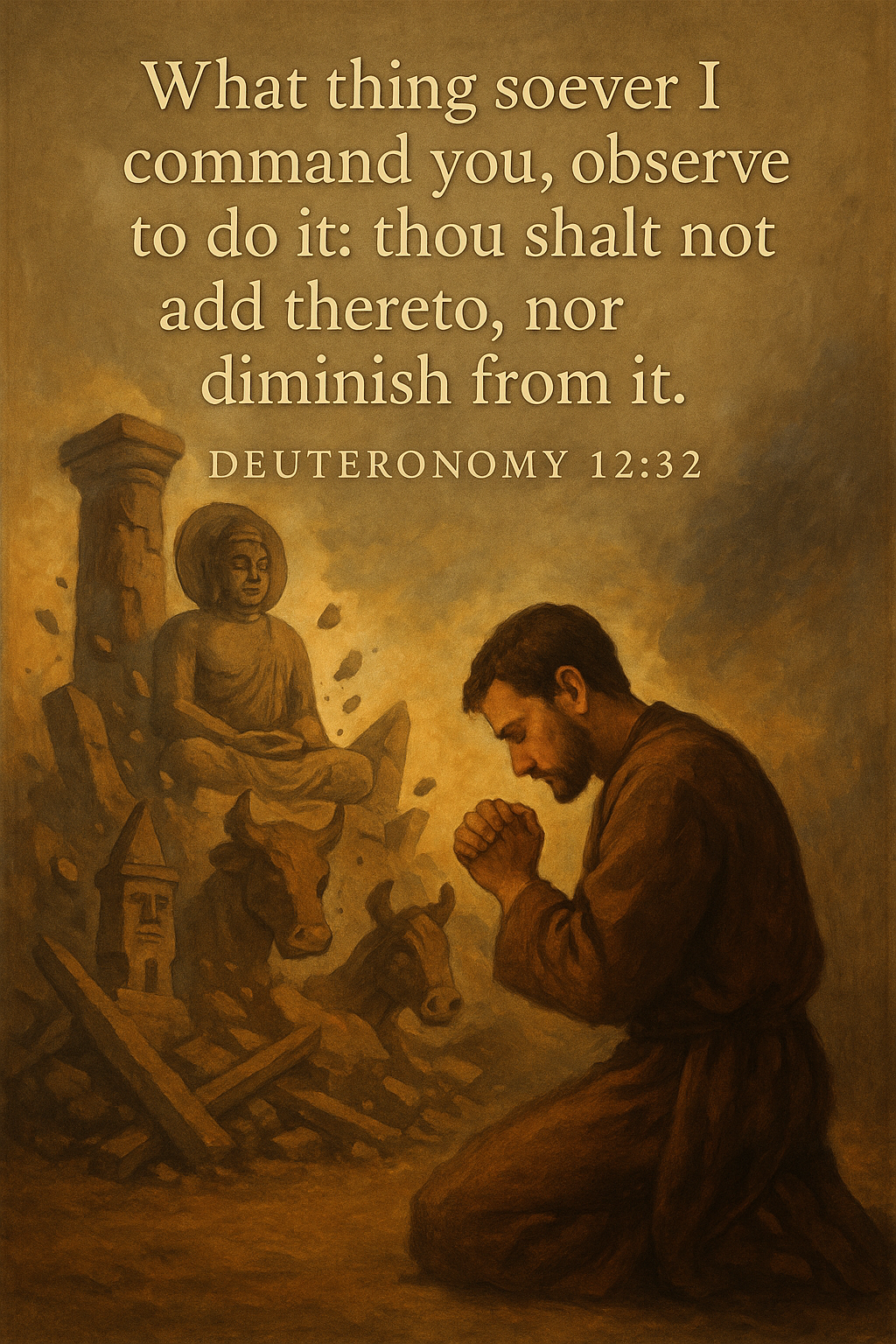
Deuteronomy chapter 12 verse 32: What thing soever I command you, observe to do it: thou shalt not add thereto, nor diminish from it.
Verse Context:
This verse comes at the end of a larger passage in which God warns His people against imitating the pagan worship practices of the nations they are to dispossess (see Deuteronomy chapter 12 verse 30). God had just commanded them to destroy the altars, groves, and images of false gods (see verse 3), and then firmly insisted that worship was to take place only in the way He prescribed, not by inventing new rituals or mixing in cultural trends.
Moses then seals this warning with a thunderous charge: “Observe to do it!” The Hebrew word here for observe is “shamar” (שָׁמַר), meaning to guard, watch closely, or keep diligently. This is no passive suggestion. It is a command to actively and carefully carry out God’s revealed instructions—nothing more and nothing less.
The second half of the verse uses legal language:
“Thou shalt not add thereto”: meaning do not create additional rules, traditions, or spiritual ideas that God did not give.
“Nor diminish from it”: meaning do not water down, ignore, or omit any part of His command.
This same command is echoed in Proverbs chapter 30 verse 6: “Add thou not unto his words, lest he reprove thee, and thou be found a liar.”
And again in Revelation chapter 22 verses 18–19, where it applies to the entire prophetic message of Scripture.
This verse ultimately teaches the supremacy and sufficiency of God’s Word. There is one God, one truth, one standard, and one way to worship, and that way is not up for revision.
Broader Context:
Author: Moses, speaking under divine inspiration as the mediator of God’s covenant with Israel. Time Period: Circa 1406 B.C., as Israel was preparing to enter the Promised Land. Audience: The second generation of Israelites after the Exodus, who had not experienced Mount Sinai firsthand. Setting: On the plains of Moab, just before crossing the Jordan River.
The Book of Deuteronomy is Moses’ final sermon series to Israel. In chapter 12, he begins the section known as the Deuteronomic Code: a covenantal restatement of how the Israelites are to live, worship, and govern themselves once they enter Canaan.
Deuteronomy chapter 12 particularly emphasizes God’s exclusive claim to worship, Destruction of idolatry, Centralized worship at the place God chooses (eventually Jerusalem). Strict obedience to His commands, without innovation or deviation
This chapter and verse is especially vital in today’s era where man-centered religion is increasingly normalized. People want to “customize” their Christianity, adding rituals, embracing ideologies God condemns, or subtracting anything that offends the flesh.
But Deuteronomy chapter 12 verse 32 lays it bare: You don’t have the authority to edit God.
Application:
Appreciating God’s Greatness:
This verse exalts God’s absolute authority. He alone sets the terms of worship, morality, and truth. He does not ask for input. He is not a consultant. He is the LORD. And it is His mercy that He gives us commands at all. Instead of leaving us blind, He gives us light. Instead of letting us destroy ourselves, He gives us a way to live that leads to blessing, peace, and eternal life. His Word is perfect, complete, and unchangeable.
For the Believer:
You must watch your life and doctrine closely (compare to First Timothy chapter 4 verse 16). Do not add to God’s commands by inventing personal convictions that He never required. And do not subtract from them just because culture finds them offensive.
Many believers today are unknowingly practicing “designer faith”: a form of Christianity edited to match personal comfort or social acceptance. This is disobedience cloaked in convenience.
Call to Action: Return to the Word. Examine your worship, your doctrine, your lifestyle. Ask:
Am I obeying God fully, or just partially?
Have I added human traditions or personal opinions to God’s commands?
Have I omitted anything God told me to do, like sharing the Gospel, honoring biblical gender roles, or speaking truth in love?
If so, repent, and recommit to full obedience.
For the Unbeliever:
You cannot create your own spiritual path and expect it to lead to Heaven. God has already revealed the only way: through faith in Jesus Christ (John chapter 14 verse 6: “I am the way, the truth, and the life: no man cometh unto the Father, but by me.”)
Any attempt to earn salvation through good works, self-made religion, or spiritual philosophies is rebellion. Salvation comes by grace through faith, but it is only given to those who receive the truth of God’s Word.
Today, submit yourself to the one true God. Stop rewriting the rules. Stop editing His commands. Believe the Gospel and obey His voice.
Final Encouragement:
The Word of God does not evolve, and truth does not bend. Our calling is not to reshape God’s commandments, but to honor them, live by them, and teach them without compromise. True freedom is not in self-rule, but in obedient worship of the one true God.
Prayer:
Heavenly Father, We bow before You today as the One True God. Forgive us for every time we’ve tried to add to or take away from Your holy Word. Keep us from self-made religion, from cultural compromise, and from the pride that whispers we know better than You. Give us hearts that tremble at Your Word, and minds that cling to Your commands. Strengthen us to walk in obedience, even when it costs us everything. Teach us to worship You in spirit and in truth. In Jesus’ name, Amen.
Closing:
If you’ve found these daily verses encouraging, enlightening, or fruitful, please consider helping us spread the truth and light of God’s Word by subscribing to the blog and YouTube channels and liking and following the Facebook page. Most of all, share Believers of Biblical Truth and our links with others who may need the sermons and daily teachings just as much as we do.
You are loved, so much in fact, that we want you to know and be Believers of Biblical Truth.
Daily Verse: Revelation 2:5:Remember therefore from whence thou art fallen, and repent, and do the first works; or else I will come unto thee quickly, and will remove thy candlestick out of his place, except thou repent.
Verse Context:
Revelation was written by the Apostle John during his exile on the island of Patmos around A.D. 95–96. It is a prophetic book containing messages from Jesus Christ to seven churches in Asia Minor (modern-day Turkey). Revelation 2:5 falls within the letter to the church at Ephesus.
The church at Ephesus was strong in doctrine, alert to false teachers, and outwardly faithful. However, Jesus Christ rebukes them for one devastating flaw: they had left their “first love.” Their outward works remained, but the passionate devotion, the heartfelt love for Christ that once burned brightly, had faded into routine.
In Revelation 2:5, Jesus commands them to remember from where they had fallen. The word remember implies a deliberate act of reflection—to honestly recognize how far they had drifted. Repent demands a complete turning away from their current coldness and a returning to the zeal, purity, and affection they had at the beginning of their walk with Christ.
The first works refer to the genuine fruits of love: passionate worship, heartfelt prayer, joyful service, and eagerness to obey Christ’s commands—not out of duty, but out of love.
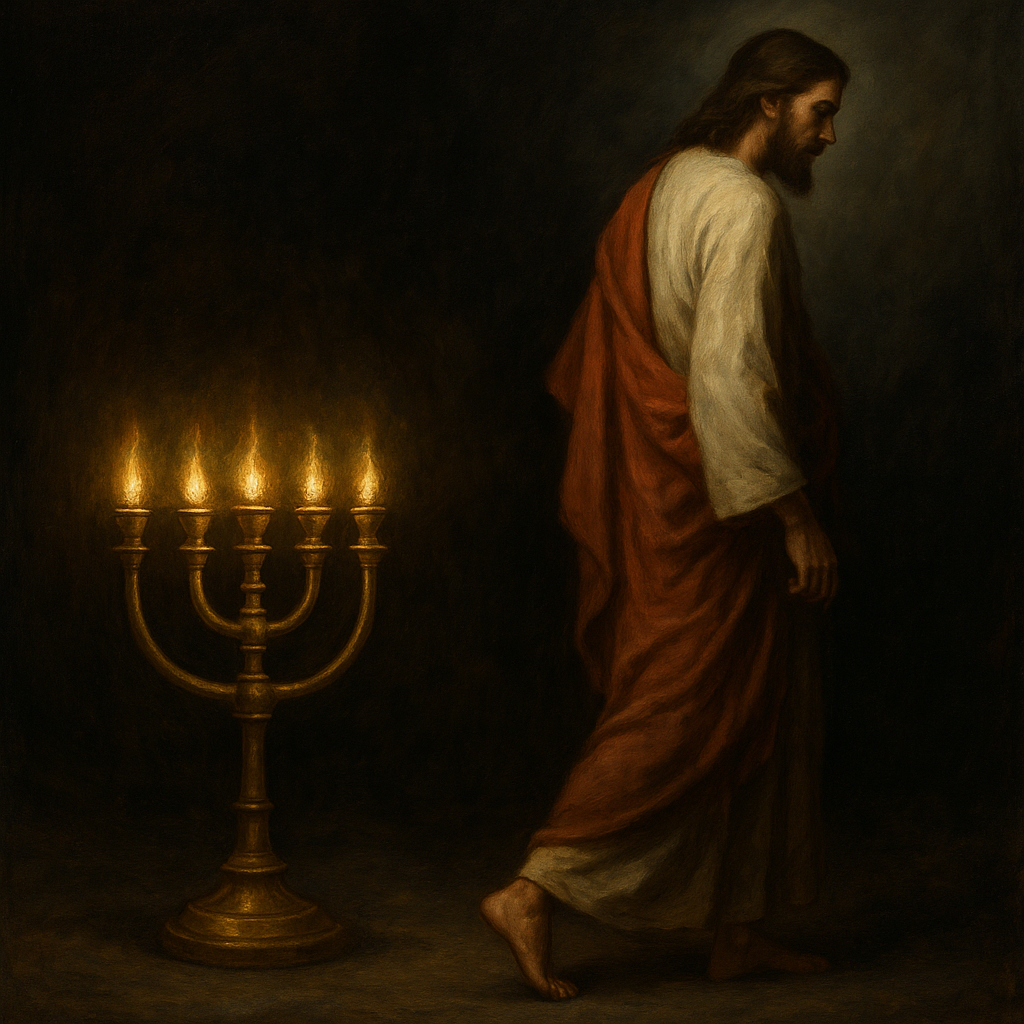
The warning is serious: or else I will come unto thee quickly, and will remove thy candlestick out of his place, except thou repent. The candlestick (Greek: luchnia, meaning lampstand) symbolizes the church’s role as a bearer of light in a dark world. To have it removed means to lose the church’s testimony and effectiveness. A church can continue to exist outwardly but be spiritually dead inside if love for Christ is lost.
Commentator Matthew Henry (1662–1714, Presbyterian) notes that the removal of the candlestick implies Christ’s judgment: when love is lost, His presence withdraws, and the church eventually collapses or becomes a mere shell. John Gill (1697–1771, Baptist) also emphasizes that the removal is not just discipline but a total rejection if repentance does not occur. This is a sobering call for any believer or congregation.
Thus, Revelation 2:5 teaches that doctrinal purity and good works cannot replace genuine, fervent love for Christ. Without love, the heart of Christianity dies.
Broader Context:
The first three chapters of Revelation contain Christ’s personal messages to the seven churches, each tailored to their specific strengths and weaknesses. Revelation 2 addresses four churches: Ephesus, Smyrna, Pergamos, and Thyatira.
The broader context of Revelation 2 is Christ’s deep concern for His church. He praises what is good but does not overlook sin. His expectation is not cold orthodoxy, but living, breathing relationship based on love, faith, and obedience.
Ephesus had many commendable qualities. Revelation 2:2–3 records Christ’s words: “I know thy works, and thy labour, and thy patience, and how thou canst not bear them which are evil…” Yet even with these admirable traits, the failure to maintain their first love put their very existence at risk.
Throughout Scripture, the first and greatest commandment remains to love God with all the heart, soul, and mind (Matthew 22:37–38). No amount of service or doctrinal accuracy can substitute for this central reality. Revelation 2:5 stands as a timeless warning to churches and individual believers: love for Christ must be kept alive and central, or spiritual death will follow.
Other Scriptures that illuminate this include:
First Corinthians 13:2:“And though I have the gift of prophecy, and understand all mysteries, and all knowledge; and though I have all faith, so that I could remove mountains, and have not charity, I am nothing.”
John 14:15:“If ye love me, keep my commandments.”
Christ demands both love and loyalty. One without the other is incomplete.
Application:
Appreciating God’s Greatness:
God’s greatness shines through His unwillingness to accept hollow religion. He loves His people too much to leave them in a state of cold ritualism. His call to repent is not condemnation but mercy. He desires real, living relationship with us, and He warns before judgment falls. This displays both His holiness and His longsuffering.
For the Believer:
For believers, Revelation 2:5 serves as a spiritual check-up. Is our walk with Christ alive, passionate, and personal? Or has it become mechanical, driven by habit rather than love? Call to Action: Today, pause and remember where you once stood with Christ. If you find that your love has cooled, repent and return to those early, heartfelt works of devotion. Rekindle your prayer life. Worship Him not out of duty, but out of joy. Love Him anew.
For the Unbeliever:
To the unbeliever, Revelation 2:5 also issues a warning: religious deeds cannot save you. Only a genuine relationship with Jesus Christ can. Cold observance of religion without heartfelt love will not stand on the day of judgment. Turn to Christ in faith and love today. Repent, believe the gospel, and begin the first works of a soul born again in Christ.
Final Encouragement:
Love for Christ is the beating heart of true Christianity. Doctrine matters. Good works matter. But neither can replace love. Today, remember your first love. Repent where needed. Do the first works again. Christ’s call is urgent, but it is also filled with hope—the light of your candlestick can shine brightly once more if you return to Him.
Prayer:
Father, thank You for loving us enough to warn us when our hearts grow cold. Help us to remember the joy of our first love for You. Stir our hearts to repentance where needed, and draw us back to sincere, vibrant faith. May our love for You be deep, pure, and growing. Keep us burning brightly as Your witnesses in a dark world. In Jesus’ name we pray, Amen.
Closing:
If you’ve found these daily verses encouraging, enlightening, or fruitful, please consider helping us spread the truth and light of God’s Word by subscribing to the blog and YouTube channels and liking and following the Facebook page. Most of all, share Believers of Biblical Truth and our links with others who may need the sermons and daily teachings just as much as we do.
You are loved—so much in fact, that we want you to know and be Believers of Biblical Truth.
Matthew chapter 4 verse 17 “From that time Jesus began to preach, and to say, Repent: for the kingdom of heaven is at hand.”
Verse Context
Matthew chapter 4 verse 17 is one of the most important pivot points in all of Scripture. Up until this moment, Jesus has been relatively quiet. Born in Bethlehem, raised in Nazareth, baptized by John in the Jordan, and tested in the wilderness by Satan, He now steps onto the public stage. And the very first word He utters in His preaching ministry is not “love” or “peace” or “blessings”—it is “Repent.” That alone should demand our attention.
Let’s break this verse down in detail, word by word, so there’s no room for confusion:
“From that time…”
This phrase marks a decisive transition in the Gospel of Matthew. Up until now, we’ve seen Jesus preparing for His ministry—through baptism, fasting, and spiritual warfare in the wilderness. But now the focus shifts. This phrase is also used in Matthew chapter 16 verse 21, where it introduces Jesus’ shift toward preparing the disciples for His death. So, whenever Matthew writes, “from that time,” he’s signaling a major turn in Jesus’ mission. Here in chapter 4, the shift is from private preparation to public proclamation. The preparation is over—now it’s time to speak.
“Jesus began to preach…”
The word “preach” here is not passive. It’s translated from a Greek word meaning “to herald,” much like a royal messenger delivering the king’s decree in public spaces. This isn’t soft-spoken teaching or philosophical musing—this is proclamation with urgency and authority. Jesus wasn’t casually offering advice. He was delivering a divine summons. In first-century culture, a herald didn’t have the option to modify or soften the king’s message—he spoke it exactly as it was given, and expected the audience to respond with obedience.
A breakdown of this word ‘Herald’ is critical to understanding this verse. The word “herald” matters because of what it represents: a clear, unaltered, authoritative proclamation from the King. That’s what Jesus did in Matthew chapter 4 verse 17. That’s what the prophets did before Him. That’s what Paul calls preachers to do in Second Timothy chapter 4 verse 2: “Preach the word; be instant in season, out of season; reprove, rebuke, exhort…”
To preach is to herald—to boldly proclaim God’s truth, even when it’s unpopular.
In the ancient world, a herald was an official public messenger, often employed by royalty or government. His job was not to debate, edit, or interpret the message—his job was to proclaim exactly what he was given. He would lift his voice in marketplaces, city gates, or streets and say, in effect, “Hear the decree of the king!” Think of the carol “Hark! The Herald Angels Sing.” That phrase points directly to the angelic announcement of Christ’s birth to the shepherds:
Luke chapter 2 verse 10: “And the angel said unto them, Fear not: for, behold, I bring you good tidings of great joy, which shall be to all people.”
In that moment, the angel is functioning exactly like a herald—bringing the good news from heaven to people who would never have known otherwise. The Christmas carol uses the word “herald” because the angels are proclaiming the arrival of the King, much like royal heralds would announce the birth of a prince.
This might surprise some people, but there is a legitimate historical link here, though it’s more secular than sacred. Newspapers with names like “The Boston Herald,” “The Miami Herald,” or “The Herald Tribune” adopted the term because they saw themselves as public announcers of critical information. The idea is that this publication will inform the public of what they need to know, and that what it reports carries a kind of weight or urgency, just like a herald in the king’s court would have. In the Old Testament, prophets acted as heralds of God’s message.
In biblical theology, we needed a herald because humanity was not naturally seeking after God (see Romans chapter 3 verses 10–11: “There is none that seeketh after God”). We weren’t going to stumble into salvation or discover divine truth by accident. We needed someone to proclaim it boldly and clearly, with authority that didn’t come from man. In the New Testament, Jesus is the ultimate herald, because He is not just delivering the Word of God—He is the Word of God (John 1:1). And when He preaches repentance, He’s not merely offering a new idea—He’s enforcing the decree of Heaven: that sinners must turn from sin and believe the gospel.
In that moment, the angel is functioning exactly like a herald—bringing the good news from heaven to people who would never have known otherwise. The Christmas carol uses the word “herald” because the angels are proclaiming the arrival of the King, much like royal heralds would announce the birth of a prince.
So in carols, “herald” is theologically appropriate and historically consistent. The angels are the divine messengers, and the news they carry is not open to interpretation—it is a royal announcement from God Himself: Christ is born in Bethlehem.
“and to say, Repent:”
This is the command that begins His public ministry: Repent. That word is almost lost in today’s feel-good religion, but Jesus made it central. To repent means to turn around, change direction, and abandon your sin. It’s not merely feeling bad or saying sorry. Biblical repentance is a full mental, moral, and spiritual about-face.
In its original context, repentance involved acknowledging guilt, confessing sin, and actively turning away from it. It carried the weight of returning to God’s covenant. For Jews in the first century, this meant more than personal remorse—it was a call to national, personal, and spiritual realignment under the rule of God.
Importantly, Jesus didn’t say “believe” here first. He said, “repent.” Why? Because you cannot receive the heavenly kingdom without first renouncing the kingdom of sin. This demolishes the modern idea that we can “believe in Jesus” while still clinging to our sin. Jesus said, “Repent”—turn from sin—FIRST.
This wasn’t just for unbelievers either. It was a call to all who heard, including the religious elite, many of whom thought they didn’t need repentance. Jesus levels the ground—everyone must repent, not just the obviously immoral.
“for the kingdom of heaven is at hand.”
Now we get the reason: “for the kingdom of heaven is at hand.” The phrase “kingdom of heaven” is used exclusively in Matthew—a reverent way of saying “kingdom of God.” This kingdom isn’t just a future heaven—it’s the rule and reign of God breaking into human history through Jesus Himself.
When Jesus says it’s “at hand,” He means it’s imminent, pressing in, close enough to touch. The King is present, so His kingdom has arrived. And the only proper response to the arrival of a holy kingdom is to repent. There’s no room for neutrality.
This also signals urgency. Jesus wasn’t giving people time to ease into faith. He was telling them: the time is now. The King is here. The kingdom is here. Your response must be immediate.
Broader Context
Matthew chapter 4 is one of the most strategic chapters in all of the New Testament. It forms the bridge between Jesus’ preparation and His public mission, which is why Matthew chapter 4 verse 17 is such a critical turning point. The chapter begins with Jesus being led by the Spirit into the wilderness to be tempted by the devil. That scene in verses 1 through 11 mirrors the wilderness testing of Israel in the Old Testament, but where Israel failed, Jesus triumphed. That’s the point: the true Son of God does not fall to temptation. Once He has victoriously withstood Satan’s threefold temptation (appetite, pride, and power), He is proven ready to begin His public ministry.
Then we see a shift in verse 12: “Now when Jesus had heard that John was cast into prison, he departed into Galilee.” John the Baptist’s arrest marks the end of the forerunner’s ministry and the start of the Messiah’s full unveiling. From this point forward, the torch is passed. The light John bore witness to (John chapter 1 verse 8) is now shining in full. Verse 17 comes right after Jesus settles in Capernaum, fulfilling Isaiah’s prophecy that Galilee of the Gentiles would see a great light (Matthew chapter 4 verses 14–16). So when Jesus says, “Repent: for the kingdom of heaven is at hand,” He’s not just making a statement—He’s fulfilling prophecy, assuming divine authority, and announcing that the Messianic age has arrived.
Let’s step back now and look at the Gospel of Matthew as a whole. This Gospel presents Jesus as the promised Messiah and rightful King, descended from David, fulfilling Jewish prophecy. Over 60 Old Testament prophecies are fulfilled in Matthew alone. The phrase “kingdom of heaven” is used 32 times in Matthew and nowhere else in the New Testament—he was specifically crafting his message for a Jewish audience who would not casually speak the divine name “God.” The message of the kingdom is central: God’s promised reign has come near in the person of Jesus Christ. But this kingdom would not be gained through birthright or temple rituals—it would be entered through repentance and faith.
That’s why Jesus’ very first sermon begins with repentance. The Jews had long expected a conquering Messiah who would free them from Rome, but Jesus came instead to free them from sin. His kingdom wasn’t of this world—it was spiritual, internal, and transformational. And it demanded a radical break from sin, not just ceremonial devotion.
This also puts pressure on the religious status quo. The scribes and Pharisees had built a system of external righteousness, but Jesus was preaching internal transformation. His message of repentance cut to the heart and threatened the power structures of Israel’s religious leaders. That’s why He would later say in Matthew chapter 5 verse 20, “Except your righteousness shall exceed the righteousness of the scribes and Pharisees, ye shall in no case enter into the kingdom of heaven.” In other words, religious performance was not enough. Repentance was required.
Now, if we zoom out even wider and examine the entire New Testament narrative, this message of repentance is echoed by every major preacher of the early church:
John the Baptist introduced it in Matthew chapter 3 verse 2: “Repent ye: for the kingdom of heaven is at hand.”
Jesus repeats it in chapter 4 verse 17. Peter proclaims it in Acts chapter 2 verse 38: “Repent, and be baptized every one of you in the name of Jesus Christ for the remission of sins.”
And Paul declares it in Acts chapter 17 verse 30: “And the times of this ignorance God winked at; but now commandeth all men every where to repent.”
This consistency destroys the modern lie that repentance is an “Old Testament idea” or that Jesus focused only on love and inclusion. The New Testament begins with repentance (Jesus in Matthew 4), continues with repentance (Acts and the Epistles), and ends with repentance (Jesus again in Revelation chapters 2 and 3).
Even in Revelation, Jesus—speaking directly to churches—repeats the same message.
To the church in Ephesus: “Repent, and do the first works” (Revelation chapter 2 verse 5).
To Laodicea: “Be zealous therefore, and repent” (Revelation chapter 3 verse 19).
So we cannot separate Jesus’ love from His call to repentance. The loving Savior is the same One who lovingly commands sinners to turn back—not to feel better, but to be made new.
DO NOT MISS THIS
Finally, we must deal with the cultural misunderstanding that love is incompatible with confrontation. Modern Christians often hesitate to talk about sin, believing it’s more “loving” to avoid offense. But Matthew chapter 4 verse 17 dismantles that idea. The most loving man who ever walked the earth began His entire ministry by confronting sin. That means the refusal to talk about sin is not compassion—it’s compromise. It’s silence in the face of spiritual death. If Jesus—who is love—preached repentance as His opening message, how can we call ourselves His followers while refusing to speak it?
Application
Appreciating God’s Greatness
The greatness of God in Matthew chapter 4 verse 17 is revealed through His willingness to confront sin for the sake of our salvation. Jesus did not come to entertain, flatter, or merely soothe the crowds. He came to do the most loving and difficult thing: call sinners to repentance so they could be delivered from the wrath to come. That shows us a Savior who is not only full of mercy—but also full of truth, holiness, and authority.
God’s greatness is also seen in the timing of His kingdom. Jesus said, “The kingdom of heaven is at hand.” That means God didn’t wait for us to be good enough. He didn’t require humanity to fix itself. Instead, He brought the kingdom to us, in the person of Jesus Christ. God entered our world, walked in our dust, and spoke words of life—and the first word was repent. That alone is a display of divine patience, wisdom, and justice. He invites us into His kingdom, but on His terms, not ours. That’s greatness: God stooping down to offer grace, but refusing to dilute His holiness.
For the Believer
This verse confronts the common idea that once we are saved, repentance is behind us. But the life of a Christian is one of ongoing repentance. We don’t just turn from sin once—we continue turning, daily, as we grow in grace. Jesus’ first command still echoes through our spiritual walk: Repent. Not because we’re under wrath, but because we are under grace, and grace gives us eyes to see the sin we used to ignore.
Believers are also called to model and preach what Jesus Himself preached. Can I get an AMEN on that? That means we must not shrink back from the topic of sin. Too often, Christians confuse kindness with silence. But Jesus showed that love means speaking the truth, ESPECIALLY when it comes to eternal consequences. If we really love the lost, we won’t leave them comfortable in sin—we’ll gently and truthfully show them their need to repent, just as we once did.
Call to Action
Examine your own life for areas where sin has crept back in, and repent with sincerity and urgency.
Let Jesus’ words shape your conversations. When witnessing, don’t avoid repentance—follow His model and present it as the doorway into the kingdom.
Ask God for courage to speak the truth in love, especially when it’s easier to stay silent.
We must not be ashamed of the very message Christ began with!
For the Unbeliever
If you are not yet a follower of Christ, this verse is Jesus speaking directly to you. His first recorded words are not threats—they are an invitation. When He says “Repent,” He is offering a new life, a new kingdom, a new heart. He’s not asking you to clean yourself up—He’s asking you to turn to Him, and He will do the cleansing.
Repentance means acknowledging that sin is not just a mistake—it’s rebellion against a holy God. It’s a breaking of His law, and the penalty is eternal separation. But Jesus came because God doesn’t want you to perish. His call to repentance is a call to be rescued, and the door is open now. But Jesus also said the kingdom is “at hand”—that means time is short. You don’t have forever to decide.
If you’ve ever thought Christianity was just about being nice, or doing good things, this verse proves otherwise. It’s about being born again, and that starts with repentance toward God and faith in Jesus Christ.
Final Encouragement
When Jesus opened His mouth to preach for the first time, He didn’t offer comfort, self-esteem, or social advice. He offered truth that saves. His first word was “Repent.” That is not a word of judgment—it is a word of rescue. It is God’s mercy clothed in urgency. It is the King of heaven calling rebels to lay down their arms, not to be punished, but to be welcomed into His kingdom.
Matthew chapter 4 verse 17 is more than history—it’s still Christ’s voice today. He is still saying to the sinner, “Turn around—come to Me.” And to the church, He is saying, “Do not compromise this message.” Repentance is not the enemy of grace—it is the evidence that grace is working.
This verse reminds us that the most loving thing we can ever do is what Jesus did: tell the truth about sin, point people to the kingdom, and call them to repentance. Let us never forget, real love warns, and real grace calls for change.
If Christ began with repentance, so must we. And if His kingdom was at hand then, it is even closer now. May we respond, and help others respond, before the door closes.
You are loved, so much in fact that we want you to know and be Believers of Biblical Truth.


 Believers of Biblical Truth
You must be logged in to post a comment.