
June 13, 2025
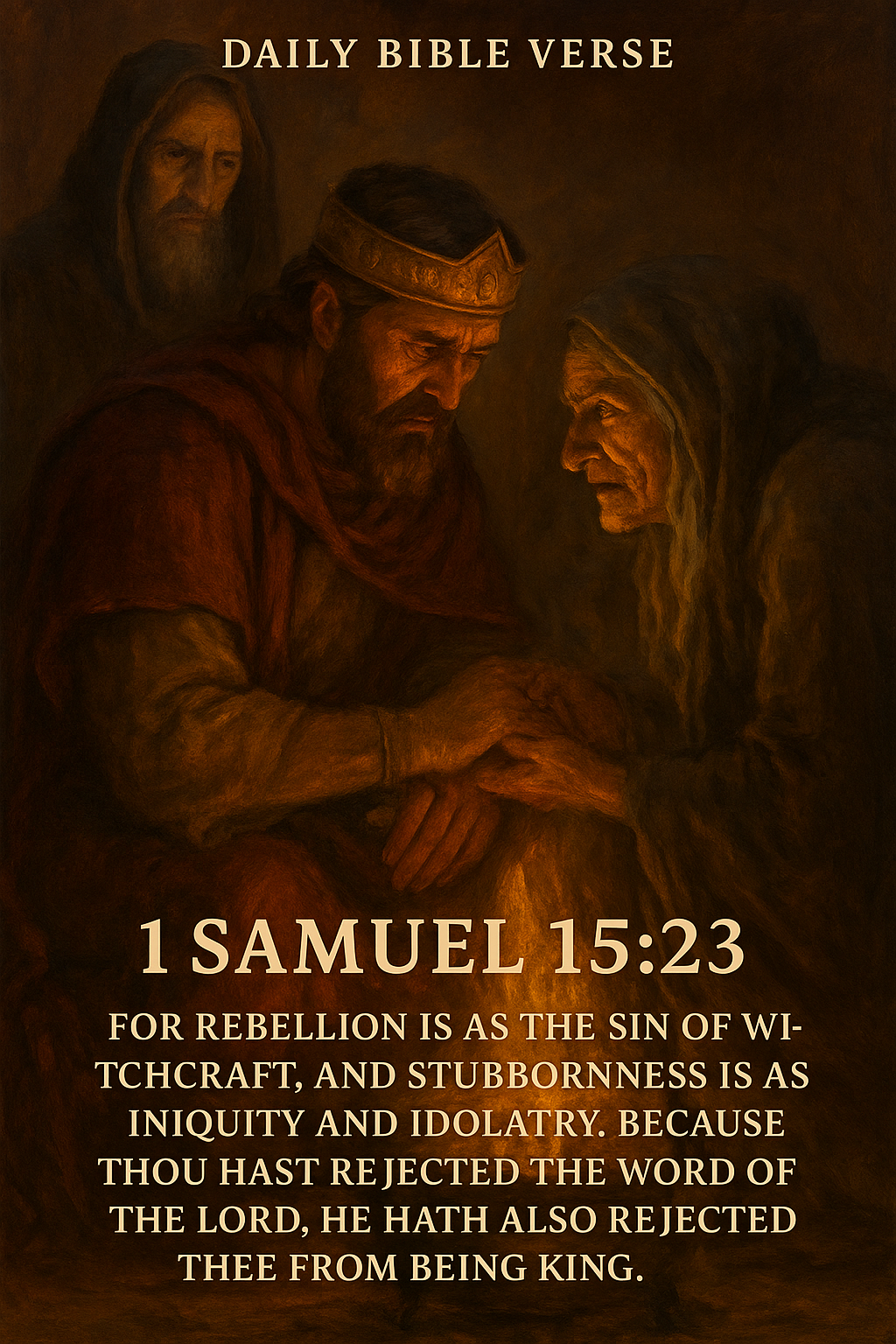
First Samuel chapter 15 verse 23:
For rebellion is as the sin of witchcraft, and stubbornness is as iniquity and idolatry. Because thou hast rejected the word of the Lord, he hath also rejected thee from being king.
Verse Context
The prophet Samuel was God’s mouthpiece to Israel during the time of King Saul, the first monarch of Israel. Saul had been divinely appointed, but that appointment came with a condition: he was to rule under God’s authority, not his own. First Samuel chapter 15 marks the turning point in Saul’s story, the moment his heart fully turned away from obedience.
God commanded Saul to destroy the Amalekites entirely, a people known for their ruthless ambush of Israel during the Exodus (see Exodus 17:8-16). This was a divine judgment, not a personal vendetta. But Saul disobeyed. He spared King Agag (pronounced AY-gag) and the best of the animals. He even built a monument to himself afterward, a prideful celebration of his victory rather than a humble act of obedience to God.
When Samuel confronted him, Saul lied and shifted blame. He claimed the people kept the animals to “sacrifice unto the LORD,” a common excuse when people disobey under the mask of religion. Samuel’s famous rebuke followed in 1 Samuel 15:22-23, culminating in today’s verse: “Because thou hast rejected the word of the Lord, he hath also rejected thee from being king.” Here, Samuel equates rebellion with witchcraft, because both reject God’s authority. Stubbornness (also translated “insolence” or “arrogance”) is likened to idolatry, because it places one’s will above God’s. And that’s where Saul’s fate is sealed.
Broader Context
Saul’s story is tragic, not just because of his fall, but because of how close he came to greatness. In First Samuel chapter 10, God gave Saul another heart and even allowed him to prophesy. He had every opportunity to walk in righteousness. But over time, fear of people, pride in himself, and a refusal to wait on the Lord led to his downfall.
Earlier, in First Samuel chapter 13, Saul grew impatient when Samuel didn’t arrive on time, and he offered a burnt offering, something only a priest should do. That moment cost him the permanence of his dynasty (see 1 Samuel 13:13-14). By chapter 15, God removed him altogether:
“The Lord hath rent the kingdom of Israel from thee this day, and hath given it to a neighbour of thine, that is better than thou” (1 Samuel 15:28).
That “neighbor” was David, a man after God’s own heart.
Saul continued as king for years after his rejection, but without God’s presence. He became tormented by an evil spirit, obsessed with control, paranoid of David, and eventually even consulted a witch (1 Samuel 28), the very sin Samuel warned about in today’s verse.
He ended his life in despair, suicide, and defeat on the battlefield. The man who was once “little in his own sight” (1 Samuel 15:17) became consumed with himself. He would not draw near to God, even in his final hours.
Application
Appreciating God’s Greatness
God doesn’t just want our sacrifices, He wants our obedience. Saul’s story reveals a holy God who demands loyalty from the heart, not just outward displays. God gave Saul opportunities to repent, but Saul chose appearance over substance, excuses over truth, pride over surrender.
For the Believer
This story warns us about what happens when we harden our hearts during trials. Saul had moments of pressure, delayed prophets, strong enemies, people demanding answers, but rather than wait on the Lord or cry out to Him, Saul took matters into his own hands. Many of us have our trials, loss, heartache, and battles that bring despair. Many of us try to handle our chaos with our own hands, usually making that tragedy even worse. We draw closer to God for His wisdom and comfort. Saul did not do that here. The result was eternal death. Saul is in hell tormented daily. Do not add to the tragedy. Reach out, call out, cry out to God in your despair. King David sinned greatly. The difference is he knew who to cry out to in his sinfulness. The Lord is righteous. When He gives us a command, we are not at liberty to alter it to fit our preferences. He is the King, not us. We are not meant to carry our burdens alone. Trials are invitations to draw closer to God. We must not be like Saul, justifying our partial obedience or using religious language to excuse our sin. When God speaks clearly, He expects to be obeyed clearly.
Call to Action
Examine your heart today. Is there an area where you’re only half-obeying God? Have you justified compromise, perhaps thinking your intentions are good enough?
Draw close to Him. Don’t wait. God’s mercy is great, but continued rebellion can lead to devastating consequences. Choose repentance. Choose surrender. Choose obedience.
For the Unbeliever
Saul’s story shows what happens when someone has a form of godliness but denies its power (see 2 Timothy 3:5). You can be chosen, blessed, even used by God, and still be lost if your heart is not right. Saul never fully surrendered.
Jesus Christ calls you not to religion, but to relationship. It’s not enough to say “I believe in God” while living in rebellion. Salvation is found only in Christ, through confession, repentance, and full surrender to His Lordship.
Final Encouragement
When we go through trials, we either turn to God, or we turn from Him. There is no middle ground. Yesterday we saw how Judas withdrew and was destroyed, while Peter wept bitterly and was restored. Today we saw how Saul disobeyed, hardened his heart, and ended in ruin.
Tomorrow is never guaranteed. If God is speaking to you today, don’t delay. Obedience is better than sacrifice. Draw close to God, and He will draw close to you.
Prayer
Heavenly Father,
Thank You for the warning in Saul’s life. Help us to see where pride, fear, or self-justification have crept into our own hearts. Cleanse us from rebellion and give us hearts that obey You fully, not partially. In every trial, remind us that the safest place to run is into Your arms. Help us not to wait, not to justify, not to pretend—but to surrender. May we be like David, not Saul. And may we be found faithful, even when life is hard. In Jesus’ name we pray, amen.
Closing
If you’ve found these daily verses encouraging, enlightening, or fruitful, please consider helping us spread the truth and light of God’s Word by subscribing to the blog and YouTube channels and liking and following the Facebook page. Most of all, share Believers of Biblical Truth and our links with others who may need the sermons and daily teachings just as much as we do.
You are loved, so much in fact, that we want you to know and be Believers of Biblical Truth.
Shalom Shalom.
 Believers of Biblical Truth
You must be logged in to post a comment.