November 12, 2026
Today’s Passage
Acts 5:29 (King James Version)"Then Peter and the other apostles answered and said, We ought to obey God rather than men."
Why This Study
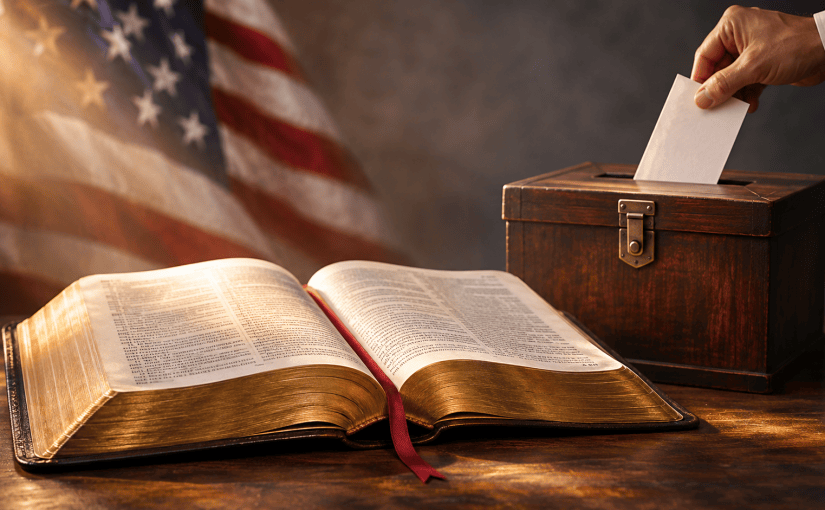
The November 2026 election cycle has come to an end. Across our nation, voters have made their choices, candidates have celebrated victories, others have conceded defeat, and political discussions continue. But for those who profess to follow Jesus Christ, there is a question far more important than which political party won or lost: How should a Christian decide whom to vote for?
Are we supposed to search for a candidate who perfectly represents Jesus Christ? Of course not. No such candidate exists. Every human being is imperfect, every person has sinned, and every candidate will have faults and shortcomings. But does recognizing human imperfection mean Christians should overlook everything? Are there certain beliefs, behaviors, and political positions that should be absolute deal breakers for someone who claims to follow Christ?
When candidates promise lower taxes, cheaper fuel, greater economic security, or protection of particular interests, those matters may be important. But they cannot settle every moral question for a Christian. The more fundamental question is what standards govern our judgment. Are we evaluating people seeking power by truthfulness, justice, respect for human dignity, and their public conduct, or are we excusing what we condemn in others because it benefits us?
This study considers what Scripture says about God’s authority, righteous leadership, human life, marriage, integrity, and the danger of making personal preferences our final standard. We will distinguish biblical commands from the further judgments involved in elections. Our purpose is not to present a party as Christian or pretend that a ballot has a perfect choice, but to ask whether our choices are examined under the authority of God’s Word.
Verse Context
These powerful words in our cornerstone passage of the day were spoken by the Apostle Peter, joined by the other apostles, as they stood before the Sanhedrin, the highest Jewish religious council in Jerusalem. They had been arrested and brought before the council because they continued publicly preaching and teaching in the name of Jesus Christ, despite having been commanded to stop. Their declaration was not born out of rebellion, arrogance, or a desire to challenge authority for its own sake. Rather, it was grounded in their absolute conviction that God’s authority was supreme and that no earthly ruler, political party, religious institution, or governing body possessed the right to command what God had forbidden or prohibit what God had commanded.
Acts 5 begins with Ananias and Sapphira, who deceived the church about the proceeds of a sale. Peter explained that the property remained within their control; the offense was their lie before God. The deaths of both and the fear that followed show the seriousness of hypocrisy within the young church. As the apostles continued to preach and signs accompanied their ministry, the high priest and the Sadducees were filled with indignation and imprisoned them (Acts 5:17–18).
An angel opened the prison during the night and gave a direct command:
Acts 5:20 (KJV)- “Go, stand and speak in the temple to the people all the words of this life.”
The apostles obeyed and resumed teaching in the temple. Brought again before the council, they heard the high priest’s accusation:
Acts 5:28 (KJV)- “Saying, Did not we straitly command you that ye should not teach in this name? and, behold, ye have filled Jerusalem with your doctrine, and intend to bring this man’s blood upon us.”
Peter and the apostles answered with the cornerstone of our study:
Acts 5:29 (KJV)- “Then Peter and the other apostles answered and said, We ought to obey God rather than men.”
The Greek word translated “ought,” dei (δεῖ, pronounced DAY), expresses necessity or obligation. The verb translated “obey,” peitharchein (πειθαρχεῖν, pronounced pay-thar-KHANE), means to obey an authority. Peter was not announcing a right to disregard every disagreeable law. He was answering a concrete conflict: God had commanded the apostles to speak, while the council had ordered them to be silent. They could not obey both commands.
Matthew Henry, commenting on Acts 5:26–32 in Commentary on the Whole Bible, stresses that the apostles had a divine command to teach in Christ’s name and could not surrender it to the council. John Calvin, in his Commentary on the Acts of the Apostles on Acts 5:29, similarly explains that human authority remains subordinate to God’s authority. John Gill’s Exposition of the Entire Bible makes the immediate conflict explicit: the angel commanded preaching, and the council forbade it. These commentators help clarify the boundary between lawful submission and obedience that would contradict God.
Peter proceeded to testify that God raised and exalted Jesus, and that the apostles were witnesses (Acts 5:30–32). As Albert Barnes notes in Notes on the New Testament on Acts 5:30, their obligation to bear witness did not disappear because authorities opposed them. The council considered killing them; Gamaliel urged caution; the apostles were beaten and commanded again to remain silent. Yet the chapter concludes:
Acts 5:41–42 (KJV)- “And they departed from the presence of the council, rejoicing that they were counted worthy to suffer shame for his name. And daily in the temple, and in every house, they ceased not to teach and preach Jesus Christ.”
Their conduct demonstrated their words. The lesson of Acts 5:29 is not that Christians may disregard authority whenever they dislike a ruler, but that no human command may require disobedience to God. We choose this passage as our cornerstone because it forces us to ask what authority shapes all our decisions. The apostles faced authorities they did not choose; citizens in representative government participate in choosing many of theirs. Applying the passage to voting requires further judgment, but it begins with this clear principle: God is not subordinate to our preferences.
Broader Context
The Book of Acts, traditionally attributed to Luke and addressed to Theophilus, continues the account begun in Luke’s Gospel. It records Christ’s ascension, the work of the Holy Ghost, and the spread of the Gospel amid opposition. Acts 5 reveals that the church’s mission was not dependent on the permission of earthly authorities. Yet the Bible also teaches respect for legitimate government:
Romans 13:1–2 (KJV)- “Let every soul be subject unto the higher powers. For there is no power but of God: the powers that be are ordained of God. Whosoever therefore resisteth the power, resisteth the ordinance of God: and they that resist shall receive to themselves damnation.”
Paul wrote under a non-Christian empire. He therefore cannot be read as requiring that all rulers be believers or that every action of a ruler receive divine approval. Romans 13 describes governing authority; Acts 5:29 identifies the limit of obedience when a command directly conflicts with God’s command. The two passages should be read together.
Scripture also describes qualities of leadership. When Jethro counseled Moses about appointing judges, he said:
Exodus 18:21 (KJV)- “Moreover thou shalt provide out of all the people able men, such as fear God, men of truth, hating covetousness; and place such over them, to be rulers of thousands, and rulers of hundreds, rulers of fifties, and rulers of tens:”
These men were to be able, truthful, God-fearing, and resistant to greed. The setting is the administration of justice in Israel, not a modern election, yet it identifies virtues worth examining in public leadership. Proverbs adds:
Proverbs 29:2 (KJV)- “When the righteous are in authority, the people rejoice: but when the wicked beareth rule, the people mourn.”
A candidate’s character affects more than private reputation. Authority can be used for fairness or favoritism, for protecting the weak or exploiting them. This makes both conduct and policy relevant to a voter’s evaluation. The Bible refuses to make popularity or personal advantage the measure of righteousness.
Before judging another person’s convictions, believers must examine their own. God’s call through Isaiah was for the wicked to forsake his way and return to the Lord; the Lord then declared:
Isaiah 55:8–9 (KJV)- “For my thoughts are not your thoughts, neither are your ways my ways, saith the LORD. For as the heavens are higher than the earth, so are my ways higher than your ways, and my thoughts than your thoughts.”
This does not mean people should abandon careful thought. It means human reasoning must not claim a higher authority than God. Paul writes:
Romans 12:2 (KJV)- “And be not conformed to this world: but be ye transformed by the renewing of your mind, that ye may prove what is that good, and acceptable, and perfect, will of God.”
The renewal of the mind is not permission to turn personal opinion into revelation. It is a summons to allow God’s truth to correct our assumptions. Paul’s teaching in Titus makes the same connection between profession and conduct.
Titus 1:16 (KJV)- “They profess that they know God; but in works they deny him, being abominable, and disobedient, and unto every good work reprobate.”
Paul is describing false teachers in Crete, not providing a test for identifying a party. The warning is nevertheless searching: a profession of knowing God can be contradicted by conduct.
Titus 2:11–12 (KJV)- “For the grace of God that bringeth salvation hath appeared to all men, Teaching us that, denying ungodliness and worldly lusts, we should live soberly, righteously, and godly, in this present world;”
Moral Questions That Cannot Be Treated Lightly
Human life is sacred because humanity bears God’s image.
Genesis 1:27 (KJV)- “So God created man in his own image, in the image of God created he him; male and female created he them.”
Genesis 9:6 was spoken to Noah following the flood:
Genesis 9:6 (KJV)- “Whoso sheddeth man’s blood, by man shall his blood be shed: for in the image of God made he man.”
The verse condemns bloodshed and recognizes grave accountability for it. It also makes a distinction between murder and the administration of punishment; the passage should not be made to say that every taking of life is identical. David speaks of God’s work in the womb:
Psalm 139:13–16 (KJV)- “For thou hast possessed my reins: thou hast covered me in my mother’s womb. I will praise thee; for I am fearfully and wonderfully made: marvellous are thy works; and that my soul knoweth right well. My substance was not hid from thee, when I was made in secret, and curiously wrought in the lowest parts of the earth. Thine eyes did see my substance, yet being unperfect; and in thy book all my members were written, which in continuance were fashioned, when as yet there was none of them.”
Jeremiah 1:5 specifically concerns God’s calling of Jeremiah as a prophet; it also describes divine knowledge before birth. Together these passages underpin the longstanding Christian conviction that unborn human life possesses dignity and should not be intentionally destroyed. Discussions about abortion must not erase the suffering of women, including victims of sexual violence, or the difficult medical decisions families face. Compassion and the protection of human dignity belong together.
Marriage also calls for serious biblical study.
Genesis 2:24 (KJV)- “Therefore shall a man leave his father and his mother, and shall cleave unto his wife: and they shall be one flesh.”
Jesus appeals to that creation account in His response about divorce:
Matthew 19:4–6 (KJV)- “And he answered and said unto them, Have ye not read, that he which made them at the beginning made them male and female, And said, For this cause shall a man leave father and mother, and shall cleave to his wife: and they twain shall be one flesh? Wherefore they are no more twain, but one flesh. What therefore God hath joined together, let not man put asunder.”
Jesus grounds His discussion in the creation of male and female and the one-flesh union. Traditional Christian teaching takes these passages as foundational to marriage between man and woman. The discussion about what civil law should recognize is a further public-policy question; believers should distinguish what the biblical text says from what they conclude about the state’s legal responsibilities.
Truthfulness and justice are not secondary virtues.
Proverbs 12:22 (KJV)- “Lying lips are abomination to the LORD: but they that deal truly are his delight.”
That standard applies to every political party. If a voter condemns deception in one leader but excuses similar behavior in another, the inconsistency needs to be examined.
Deuteronomy 16:19–20 (KJV)- “Thou shalt not wrest judgment; thou shalt not respect persons, neither take a gift: for a gift doth blind the eyes of the wise, and pervert the words of the righteous. That which is altogether just shalt thou follow, that thou mayest live, and inherit the land which the LORD thy God giveth thee.”
The direct instruction concerns judges in Israel, but its concern for impartial justice and resistance to bribery matters whenever people hold public power. Religious freedom also matters: the apostles’ refusal in Acts 4:19–20 and Acts 5:29 demonstrates the seriousness of demands that people betray obligations to God. These questions are not interchangeable; each has its own biblical and civic considerations.
Israel deserves careful treatment rather than a slogan. God’s covenant promises to Abraham and his descendants in Genesis 12:1–3 remain significant in Christian theology, but Christians differ about the relationship of those promises to the present-day State of Israel. Love of Israel’s people need not mean approval of every act of a modern government, just as concern for Palestinians need not deny the historical and religious significance of Israel. We should not claim a contemporary political position is directly commanded by a passage without explaining that connection.
Isaiah 5:20 condemns calling evil good and good evil. Romans 1:18–32 describes people exchanging truth for falsehood and worshipping created things rather than the Creator. Second Timothy 3:1–5 warns against a form of godliness without its power. These are grave warnings about idolatry, deception, and moral disorder; they do not identify a modern political party or give a calendar for the end times. They should first summon readers to examine their own thinking.
Application
Appreciating God’s Greatness
The God who created humanity does not need our approval to be God. His commands are not proposals awaiting a vote. Acts 5:29 makes the hierarchy clear: when a human command opposes a command from God, faithfulness belongs to God. That truth should inspire reverence, not self-congratulation. We are all tempted to excuse what benefits us and condemn what benefits someone else. The majesty of God challenges our attempts to place ourselves on His throne.
For the Believer
A profession of faith is not a license to reshape Scripture.
Jesus asks in Luke 6:46 (KJV)- “And why call ye me, Lord, Lord, and do not the things which I say?”
John 14:15 (KJV)- “If ye love me, keep my commandments.”
These sayings expose the contradiction between calling Christ Lord and knowingly refusing His authority. Dr. Voddie Baucham has used the expression “worship disorder” in a sermon on marriage, Gospel Healing for Hurting Marriages, to explain how a struggle with obedience can reveal misplaced worship. Applying that insight to political convictions, we must ask whether we bring our preferences before Scripture for correction or bend Scripture until it agrees with what we already want. That is a spiritual question before it is a party question.
Jesus’ warning in Matthew 7:21–23 is sober: religious words and impressive works do not replace doing the Father’s will. Revelation 3:15–16 warns the church at Laodicea against its lukewarm spiritual condition. Neither text makes one electoral choice a perfect test of salvation. Both require us to take profession, conduct, and repentance seriously.
A Christian should examine candidates and policies without pretending any individual is sinless. The phrase “lesser of two evils” describes the difficulty of choosing among flawed options; it is not permission to redefine evil as good. A voter can ask what a candidate has actually done, what powers the office carries, what consequences policies may have, and whether personal loyalty is distorting the evidence. Supporting a candidate is not necessarily affirming everything that candidate believes. It does create a responsibility to examine the choice without evasion or double standards.
A Call to Action for the Believer
Before voting, read the relevant passages in full. Examine candidates’ documented words and records rather than slogans. Consider life, marriage, family, truthfulness, protection of the vulnerable, fair judgment, religious liberty, and responsible exercise of power. Consider ordinary concerns such as taxes, prices, and retirement security too, but do not let a single personal benefit silence every other consideration. Pray for wisdom; be willing to admit when a favorite candidate acts wrongly; and refuse to treat political opponents as enemies who have ceased to bear God’s image.
Ask yourself: Is this conviction grounded in Scripture or in habit? Am I applying one standard to all candidates? Have I confused a policy disagreement with a direct command to sin? Have I excused dishonesty or cruelty because it serves my interests? Can I explain my decision without describing any political party as Christ’s own? These questions will not make every election easy. They can make our judgment more accountable.
For the Unbeliever
This study is not a claim that casting a particular ballot can save you. The Gospel is not membership in a political party, and no elected official can reconcile a sinner to God. The central question Christ places before us concerns repentance and faith in Him. Political righteousness cannot substitute for spiritual new birth. We invite you to consider who Jesus is, what His death and resurrection mean, and whether you are willing to receive His call to turn from sin and follow Him.
Final Encouragement
Do not ask God to endorse your politics. (Romans 12:2) Ask whether your politics have escaped the correction of His Word. We cannot call Jesus Lord and then declare ourselves the final authority on what we will believe or obey. (Luke 6:46; John 14:15)
When Scripture confronts our pride, appetites, fears, or political loyalties, the answer is repentance, not a clever excuse. (Acts 3:19; Romans 12:2) Christians will disagree on difficult civic judgments, but no Christian should be comfortable twisting God’s Word to protect a cherished preference. (2 Peter 3:16) God is not just love; He is life. (1 John 4:8; John 14:6) A Christian cannot serve Christ and Satan at the same time. (1 Corinthians 10:21; 2 Corinthians 6:14–15) It is one or the other. We cannot say we love Christ and support the slaughter of babies in the womb, made in the image of God. (Genesis 1:27; Psalm 139:13–16; Exodus 20:13) We cannot say we love God and call for the isolation or even total destruction of God’s chosen people, Israel. (Genesis 12:3; Romans 11:1–2; Psalm 83:4) We cannot say we love and honor God while disparaging His holy institution of marriage between a man and a woman. (Genesis 2:24; Matthew 19:4–6) We cannot call Jesus Lord while conforming to the world. (Luke 6:46; Romans 12:2)
The Bible says that if we are a friend of the world, we are an enemy of God. (James 4:4) If we love God, our behaviors should say so. (John 14:15; 1 John 2:3–6) We are not going to be perfect, but there is a difference between making mistakes and repenting of them and knowingly, willingly, purposefully, and joyfully electing people to power who bring evil to all that God has made holy. (1 John 1:8–9; Hebrews 10:26–27; 1 Timothy 5:22) If you support that, you are no longer serving God; you are serving Satan. (1 Corinthians 10:21; 1 John 3:8) The good news is that although this election is past, you have time to pray, repent, and obey Christ, who says that if you love Him, you will keep His commandments. (Acts 3:19; John 14:15) A Christian votes according to Scripture, not the desires of our wicked and spiritually dead flesh. (Romans 8:5–8; Galatians 5:16–17)
The apostles did not choose their own safety over a command from the Lord. Their testimony calls every believer to examine the same issue of allegiance: “We ought to obey God rather than men.” (Acts 5:29, KJV) Let that conviction govern our conduct before and after election day. Our hope is in Christ, not in a ballot, a party, or a president.
Our Prayer for You
Heavenly Father, our Almighty God, we come before You with humble hearts, acknowledging that Your Word is truth and Your authority is supreme. Forgive us for the times we have placed our opinions, personal desires, political loyalties, and worldly concerns above Your commandments. Forgive us when we have justified what You have condemned or remained silent when we should have stood firmly upon Your truth.
Lord, we pray that You will open the hearts and minds of everyone reading this study. Give them the wisdom to recognize righteousness, the discernment to distinguish truth from deception, and the courage to obey You even when obedience is unpopular or costly. Strengthen those who struggle with the temptation to conform to this world. Convict those who have allowed their own desires to become idols, and lead them to sincere repentance.
Father, remind us that we belong to You before we belong to any political party or nation. May our decisions, our conduct, and our treatment of others reflect our devotion to Jesus Christ. Help us to love what You love, reject what You condemn, defend the innocent, seek justice, and remain faithful to Your Word without compromise. Above all, let our lives bring glory and honor to Your holy name.
In the precious and mighty name of our Lord and Saviour, Jesus Christ, we pray. Amen.
Closing
If you’ve found these daily Bible studies encouraging, enlightening, or fruitful, please consider helping us spread the truth and light of God’s Word by subscribing to the blog and YouTube channels and liking and following the Facebook page.
Most of all, share Believers of Biblical Truth and our links with others who may need the sermons and daily teachings just as much as we do.
You are loved—so much in fact, that we want you to know and be Believers of Biblical Truth.
Shalom Shalom.

