Does it trouble you that someone can sit in a church pew hearing about the sanctity of marriage while privately enduring abuse at home?
Have you ever struggled to reconcile what you have heard about staying married to an abusive spouse with what you know about the love and compassion of Jesus Christ?
What happens when someone experiencing abuse wants help but is afraid to approach the pastor, doesn’t know whom to trust, or simply doesn’t believe the church is prepared to help?
Have you ever feared that telling someone about your abuse would mean everyone finding out—and making an already dangerous situation worse?
Have you ever feared finally asking for help, only to hear, “I’ll pray for you,” when what you desperately needed was someone prepared to help you?
These are difficult questions, but the Church cannot afford to avoid them.
As part of my graduate ministry internship, I am studying how Christian churches understand and respond to domestic violence and intimate partner abuse. The goal is to use what we learn to develop a practical, biblically grounded program that helps churches become better educated, better prepared, and safer places for people experiencing abuse.
You do not have to be a survivor to participate. If you have experienced abuse, supported someone who has, have experience in the Christian church, or simply care about how the Church responds to domestic violence, your voice matters.
Our previous Facebook post reached nearly 10,000 people and generated more than 360 link clicks—yet only nine people completed the survey.
This time, I need more than a click. I need your voice.
Please take a few minutes to complete the survey. Your answers will directly help shape a program designed to help churches confront the sin of domestic violence and abuse with biblical truth, greater understanding, compassion, and a clear plan for helping people who need it.
Please take the survey. Then please share it with everyone.copy and post this link on your blogs and on your instagram and Facebook pages.
After more than seven years working in domestic violence, I have seen firsthand how complicated these situations can become—especially when faith, marriage, safety, and the responsibilities of the church intersect.
As I complete my master’s degree at Regent University, my internship project, The Church Responds: A Ministry Study of Domestic Violence, Pastoral Preparedness, and Survivor Support, is examining how churches understand and respond to domestic violence.
The first step is this **anonymous survey**. More surveys will follow, but this one will begin giving me real data about what churches are doing, what people know, and where gaps may exist.
I would greatly appreciate a few minutes of your time to complete it. More importantly, please help me get this survey beyond my/our own circle. Share it with your Facebook friends, members of your church, and anyone you know who may have experienced domestic violence. Post the link to this blog. Please consider sending the link to your pastor or church leadership and asking them to share it as well.
First Peter chapter 5, verses 6 through 10:
6 Humble yourselves therefore under the mighty hand of God, that he may exalt you in due time: 7 Casting all your care upon him; for he careth for you. 8 Be sober, be vigilant; because your adversary the devil, as a roaring lion, walketh about, seeking whom he may devour: 9 Whom resist stedfast in the faith, knowing that the same afflictions are accomplished in your brethren that are in the world. 10 But the God of all grace, who hath called us unto his eternal glory by Christ Jesus, after that ye have suffered a while, make you perfect, stablish, strengthen, settle you.”
VERSE CONTEXT
The author of this letter is the Apostle Peter, one of Jesus Christ’s closest disciples. He writes with the authority of an elder and eyewitness to the sufferings of Christ (First Peter chapter 5 verse 1), offering both encouragement and exhortation to fellow believers who are experiencing persecution, anxiety, and the burden of living faithfully in a hostile world. The original audience included believers scattered across Asia Minor (modern-day Turkey), suffering under the weight of social rejection and looming state-sanctioned oppression during the reign of Emperor Nero. These believers were being marginalized for their faith, and Peter’s letter serves as a pastoral word of comfort and instruction.
Verse 6 begins a concluding exhortation to believers, emphasizing humility and trust in God’s sovereign timing: “Humble yourselves therefore under the mighty hand of God…” The phrase “mighty hand of God” evokes Old Testament imagery of God’s power to deliver (see Exodus chapter 13 verse 3: “By strength of hand the Lord brought you out from this place.”). Peter is reminding them that the same God who delivered Israel is the One who watches over them. Humbling oneself before God means submitting to His will, especially in times of trial, rather than attempting to escape or rebel against it.
Peter then says: “That he may exalt you in due time.” This points to the ultimate vindication of the believer—not necessarily in this life, but certainly in the life to come. It reflects the biblical principle that those who humble themselves will be lifted up by God (Luke chapter 14 verse 11: “For whosoever exalteth himself shall be abased; and he that humbleth himself shall be exalted.”).
Verse 7 continues: “Casting all your care upon him; for he careth for you.” The verb “casting” is active and deliberate, a command to transfer the full weight of our concerns onto God. The word “care” refers to our anxieties, troubles, and distractions. This echoes Psalm 55 verse 22: “Cast thy burden upon the Lord, and he shall sustain thee.” The encouragement is personal—“for he careth for you.” God is not distant or indifferent. His care is not theoretical; it is active, intimate, and ongoing. His compassion is not just corporate but deeply personal.
In verse 8, the tone shifts to a serious and personal warning: “Be sober, be vigilant…” The word “sober” here is not confined to abstaining from alcohol—it refers to a state of clear, disciplined, and spiritually alert thinking. Likewise, “vigilant” means watchful, constantly on guard against subtle threats. Why must believers be this alert? Because, as Peter writes, “your adversary the devil, as a roaring lion, walketh about, seeking whom he may devour.” The image is not gentle or abstract—it is savage and intentional. Satan is not playing games with believers. He is not roaming around to lightly annoy or inconvenience Christians, nor is he trying to “nibble away” some extra heavenly crowns or rewards. That interpretation, often put forward by the Once Saved Always Saved (OSAS) doctrine, radically downplays the gravity of Peter’s warning and misrepresents the seriousness of Satan’s intentions. The word “devour” means full consumption—total ruin. This is not about losing rewards; this is about destruction of the soul.
Peter is addressing believers here, not unbelievers. The command to be sober and vigilant is directed at those who already belong to the faith. And yet, if salvation were guaranteed without condition, regardless of how a person lives or responds to temptation, why would Peter—under divine inspiration—warn them so urgently? The answer is clear: the battle is real, personal, and eternal. Satan’s intent is to sever people from Christ, not simply diminish their heavenly prize. The phrase “your adversary” makes it unmistakably personal—each believer is being hunted. This is not metaphorical or symbolic of minor trials; this is a warning of spiritual warfare with eternal consequences.
The doctrine of OSAS claims that salvation, once received, cannot be forfeited under any circumstances. But that position must wrestle with verses like this one, which plainly describe a believer’s need to remain spiritually alert lest they be overtaken. At Believers of Biblical Truth, we hold firmly that salvation can be walked away from—not accidentally lost, as though it were a misplaced item, but willfully abandoned through deception, rebellion, neglect, or the allure of sin. When Peter says that Satan seeks to devour, we understand this as a threat to the whole person—their faith, their relationship with God, their eternal hope. This view does not diminish God’s power to save but upholds the biblical call to endure, to abide, to remain in the Vine (John chapter 15 verse 6: “If a man abide not in me, he is cast forth as a branch, and is withered…”). True salvation bears fruit and perseveres, but Scripture makes it plain that apostasy is possible, and Peter’s imagery of a prowling lion confirms the danger.
Verse 9 instructs: “Whom resist stedfast in the faith…” This resistance is not passive endurance but active spiritual warfare through unwavering trust in God and His Word. The word “stedfast” means unmovable, like a tree rooted in bedrock. It is crucial that Peter ties this resistance to “the faith”, not merely feelings or personal effort. Then Peter offers a global perspective to encourage them: “Knowing that the same afflictions are accomplished in your brethren that are in the world.” In other words, suffering for Christ is not unique to them. Believers everywhere are in the same spiritual battle. This was a comfort to them then—and to us now.
Verse 10 is the hopeful conclusion: “But the God of all grace…” This is one of the most beautiful names of God in the New Testament. The phrase “all grace” emphasizes the total sufficiency and generosity of God’s mercy and power. This God “hath called us unto his eternal glory by Christ Jesus”, reminding the readers that their hope is not merely deliverance from present trouble, but participation in eternal glory with Christ. The promise that “after that ye have suffered a while, make you perfect, stablish, strengthen, settle you,” gives depth and meaning to suffering. The word “perfect” means to restore or complete; “stablish” means to ground or root; “strengthen” means to fortify with power; and “settle” means to lay a foundation. God is not just pulling them through suffering—He is building something permanent and eternal in them through it. This entire passage holds together around the mercy and personal involvement of God. He cares. He protects. He restores. And He promises glory beyond the pain.
BROADER CONTEXT
First Peter is a letter written by the Apostle Peter likely around A.D. 64, during a time of increasing persecution against Christians under the Roman Empire—most likely during or shortly before the brutal reign of Emperor Nero. The letter was addressed to believers in “Pontus, Galatia, Cappadocia, Asia, and Bithynia” (First Peter chapter 1 verse 1)—all Roman provinces located in what is now modern-day Turkey. These Christians were living as spiritual “strangers” or exiles, not only because of their geographical dispersion but because of their identity as citizens of heaven living in a fallen world.
The theme of the entire letter is encouragement through suffering, with an emphasis on hope, holiness, and the example of Christ. Peter reminds his readers that trials are part of the Christian life, not a detour from it. He exhorts them to live in such a way that unbelievers will see their good works and glorify God (First Peter chapter 2 verse 12). He urges submission to authority, godly living in the home, and love within the Christian community. He teaches that persecution is an opportunity to share in the sufferings of Christ (First Peter chapter 4 verse 13: “But rejoice, inasmuch as ye are partakers of Christ’s sufferings…”), and he calls believers to respond not with fear or bitterness, but with humility and hope.
Chapter 5 marks Peter’s closing admonitions. He speaks first to the elders (pastors) of the church, charging them to shepherd God’s flock not for gain or with pride, but as willing examples (verses 1–4). Then he turns to the younger believers and exhorts all to mutual humility: “Yea, all of you be subject one to another, and be clothed with humility: for God resisteth the proud, and giveth grace to the humble” (verse 5). It is from this statement on humility that verses 6 through 10 flow. The progression is important:
Humble yourself before God (verse 6)
Trust His care for you by casting all anxiety upon Him (verse 7)
Stay alert, because Satan is actively working to destroy you (verse 8)
Resist him by remaining rooted in the faith (verse 9)
Remember, suffering is not random or without end—it has purpose, and God will restore you (verse 10)
What makes this section especially powerful in its broader biblical context is that Peter himself knew what it was to fall under pressure. He once tried to resist the enemy in his own strength (drawing a sword in Gethsemane), only to later deny Christ three times (Luke chapter 22 verses 54–62). So when Peter says to cast all your care on God, or to be sober and vigilant, he is speaking as a man who once failed to do these things. And when he says God will “settle you,” he is speaking from experience—Christ restored Peter after his denial and commissioned him to feed His sheep (John chapter 21 verses 15–17).
This passage also resonates with the whole New Testament theme of God’s grace being sufficient in suffering. Paul echoes this in Second Corinthians chapter 12 verse 9: “My grace is sufficient for thee: for my strength is made perfect in weakness.” The sufferings of this present world, as Paul says in Romans chapter 8 verse 18, “are not worthy to be compared with the glory which shall be revealed in us.” Peter is harmonizing with this exact truth.
Finally, it’s worth noting that Peter uses the phrase “the God of all grace,” which stands in contrast to the “adversary the devil.” The devil seeks to destroy, but the God of all grace seeks to strengthen and restore. This duality underscores the reality of the Christian walk—we live between enemy attacks and divine aid. But in Christ, the victory is assured.
APPLICATION
Appreciating God’s Greatness
This passage invites us to marvel at God’s mercy in at least three profound ways. First, He is personally involved in our lives. He is not merely a distant King issuing decrees from heaven, but a caring Father who sees every anxious thought and invites us to cast every burden on Him. That is divine tenderness—“for he careth for you” (First Peter chapter 5 verse 7). Second, He is mighty to save and just to judge. His “mighty hand” is both a place of safety and a symbol of strength. He lifts up the humble in His perfect time and brings down the proud. Third, He is faithful to restore. Even after a season of suffering, God does not merely stop the pain—He transforms it into strength. He makes the believer perfect (complete), stablishes them (firm in conviction), strengthens them (empowered for endurance), and settles them (anchored on a foundation that cannot be shaken). What kind of God does that? A God of all grace. A God worthy of all trust, worship, and submission.
For the Believer
To the believer, this passage is both a comfort and a commission. It comforts us by reminding us that we are not forgotten in our trials. We may be mistreated, isolated, or worn down by spiritual battle—but the eyes of the Lord are ever upon the righteous, and His ears are open to their cry (Psalm 34 verse 15). Yet, this passage also charges us to take our faith seriously. Be sober. Be vigilant. These are not suggestions; they are survival instructions. The devil is not after your career, your house, or your finances—he is after your soul. He seeks to isolate, wear down, and finally devour. And if we are not watchful, we risk slowly drifting into apathy, compromise, or even apostasy.
Call to Action: Stay humble before God. Make prayer your first response, not your last resort. Cast every care on Him—no burden is too small or too shameful for His shoulders. But also, resist the devil. That resistance is not passive. You must actively stand in the faith, guard your heart, renew your mind with truth, and stay in fellowship with other believers. If you’ve grown spiritually sleepy, it’s time to wake up. If you’ve allowed fear, pride, or compromise to dull your vigilance, it’s time to repent. The fight is real—but so is the victory for those who endure in Christ.
For the Unbeliever
If you are reading this and do not yet know the Lord Jesus Christ as your Savior and King, understand this: you have an adversary too, and you are not currently under God’s protection—you are under judgment. The roaring lion, Satan, has no need to devour what is already dead in sin. But that doesn’t mean you are safe. It means you are already devoured unless God intervenes. And He has intervened—through the cross of Christ. Jesus died to break Satan’s hold on you, to forgive your sin, and to bring you into the care of the only One who can lift you up and settle you forever.
This passage is a warning to the lost and a plea from a merciful God: Come to Me. Humble yourself. You don’t have to be consumed by the enemy—you can be rescued, restored, and loved by the God of all grace.
FINAL ENCOURAGEMENT
This passage from First Peter chapter 5 verses 6 through 10 is a powerful blend of mercy, warning, and promise. It reminds us that the Christian life is not without trial, but neither is it without hope. We are called to humility, not because we are weak, but because God is mighty. We are called to cast our cares on Him, not because our burdens are small, but because His shoulders are strong enough to carry them all. And we are called to vigilance, because the battle for our soul is not theoretical—it is present, personal, and eternal.
Satan’s roar is real. His desire to devour is real. But the grace of God is greater. And for those who endure in Christ—humbled under His mighty hand, alert to the enemy’s schemes, and steadfast in faith—there is a promise of restoration that the world cannot match. God Himself will make you complete. He will establish you in truth. He will strengthen your resolve. He will lay a foundation in your soul that no storm, no devil, and no failure can shake. This is not the promise of once-saved-always-safe living. This is the promise of a living, breathing, persevering faith held by a merciful and mighty God—“the God of all grace.”
ENCOURAGING PRAYER
Merciful Father, We come to You with humble hearts, thankful for Your mighty hand and tender care. Thank You for the invitation to cast our anxieties on You, knowing that You care deeply and personally for each of us. Lord, help us to stay sober and vigilant, aware of the enemy who prowls, yet confident in the protection and power of Your Spirit. Strengthen us to resist with a faith that does not waver. For every believer who is weary, restore them. For every heart that trembles in fear or discouragement, anchor them in Your truth. And for every soul who does not yet know You, draw them today by Your grace, that they too might know what it means to be settled in Your love. In the name of Jesus Christ, our risen Lord, Amen.
CLOSING
If you’ve found these daily verses encouraging, enlightening, or fruitful, please consider helping us spread the truth and light of God’s Word by subscribing to the blog and YouTube channels and liking and following the Facebook page. Most of all, share Believers of Biblical Truth and our links with others who may need the sermons and daily teachings just as much as we do.
You are loved—so much in fact, that we want you to know and be Believers of Biblical Truth.
In Luke 14:26, Jesus lays out one of the most challenging statements in the Bible: “If any man come to me, and hate not his father, and mother, and wife, and children, and brethren, and sisters, yea, and his own life also, he cannot be my disciple.”
At first glance, these words might seem shocking. How could the One who commands us to love others also tell us to “hate” our closest family members? Is this a contradiction? Of course not. The Bible is inerrant, and it never contradicts itself. What Jesus is doing here is using a hyperbole—a rhetorical tool to exaggerate for emphasis.
We use hyperbole to emphasize a point. In this case, Jesus is making it clear that our love for Him must be so great, so consuming, that every other relationship pales in comparison. This isn’t a call to neglect or despise others but to prioritize Christ above all else. After all, the same Scriptures that record this verse also command us to honor and love one another:
Exodus 20:12 reminds us to honor our parents: “Honour thy father and thy mother: that thy days may be long upon the land which the LORD thy God giveth thee.”
John 13:34-35 calls us to love each other: “A new commandment I give unto you, That ye love one another; as I have loved you, that ye also love one another. By this shall all men know that ye are my disciples, if ye have love one to another.”
Matthew 22:37-39 teaches the greatest commandments: to love God with all our hearts and to love our neighbors as ourselves.
So, how do we reconcile these teachings with Luke 14:26? Jesus is teaching us about priority. He is not urging us to despise our family, but to love Him so deeply that all other attachments become secondary. This is the cost of discipleship, and it requires total devotion.
Context and Background
Let’s set the scene for this challenging teaching. Earlier in Luke 14, Jesus had been dining with a Pharisee. The Pharisees, for those who may not know, were religious leaders who focused on rigidly following the law and their own traditions. They often missed the heart of God’s commands—love, mercy, and humility—and instead prided themselves on outward displays of piety.
At this dinner, Jesus healed a man on the Sabbath, challenging the Pharisees’ legalistic mindset. He then told several parables, including one about humility. He taught that those who exalt themselves will be humbled, and those who humble themselves will be exalted.
Later, Jesus told the parable of the great banquet. A man prepared a feast and invited many guests, but those invited made excuses. One bought a field, another oxen, and another married. Their excuses reflected misplaced priorities—work, possessions, and relationships had taken precedence over the host’s invitation. The host, angered by their rejection, invited the poor, the crippled, and the outcasts—those who recognized their need. This parable reveals a sobering truth: excuses rooted in earthly attachments can cause us to miss God’s invitation to His kingdom.
The Radical Call of Discipleship
From this parable, Jesus transitioned to addressing the crowds directly in Luke 14:25–26. He explained to the crowds that following Him was about commitment, not curiosity or convenience. To be His disciple, one must:
Love Him so deeply that all other relationships seem secondary (v. 26).
Bear one’s cross, symbolizing a willingness to endure suffering and sacrifice (v. 27).
Count the cost of following Him, as one would when building a tower or preparing for war (vv. 28-32).
Forsake all else for His sake (v. 33).
Jesus wasn’t looking for half-hearted followers. Scripture repeats the theme of radical devotion, which Jesus was calling for. Revelation 3:16 warns against being lukewarm: “So then because thou art lukewarm, and neither cold nor hot, I will spue thee out of my mouth.” Jesus desires fervent disciples, not those who waver between Him and the world.
Living Under Christ’s Headship
To follow Christ means to acknowledge His headship—His supreme authority in our lives. Colossians 1:18 says, “And he is the head of the body, the church: who is the beginning, the firstborn from the dead; that in all things he might have the preeminence.” This means Christ must have supremacy in every area of our lives: our relationships, our work, our priorities, and even our very selves.
To live under Christ’s headship, we must:
Deny ourselves and take up our cross daily (Luke 9:23-24).
Present our bodies as living sacrifices (Romans 12:1-2).
Be zealous for good works and for the Lord (Titus 2:14; Colossians 3:23).
Examples of Misplaced Priorities
Throughout the Bible, we see believers who failed to prioritize God:
Martha (Luke 10) was distracted by her tasks and missed the chance to sit at Jesus’ feet.
The rich young ruler (Matthew 19) clung to his possessions and walked away from Jesus.
Solomon allowed his foreign wives to lead him into idolatry (1 Kings 11).
Even today, we see misplaced priorities in modern churches that focus on entertainment rather than Christ, in believers who let grief or relationships overshadow their faith, and in the allure of worldly success and comfort.
Encouragement and Invitation
Despite the cost, following Christ is worth everything. As Jesus said in John 10:10, “I am come that they might have life, and that they might have it more abundantly.” The promise of eternal life far outweighs the temporary sacrifices we make.
If you’ve never surrendered your life to Christ, let me invite you to take that step today. The Romans Road shows us the way:
“For all have sinned, and come short of the glory of God” (Romans 3:23).
“For the wages of sin is death; but the gift of God is eternal life through Jesus Christ our Lord” (Romans 6:23).
“That if thou shalt confess with thy mouth the Lord Jesus, and shalt believe in thine heart that God hath raised him from the dead, thou shalt be saved” (Romans 10:9).
Will you make Christ the head of your life? Will you count the cost and follow Him above all else?
Conclusion
Jesus’ call in Luke 14:26 is not about losing relationships—it’s about redefining them under His Lordship. By placing Christ above all, we gain everything. So, let us examine our priorities, repent of lukewarmness, and pursue Him with zeal, knowing that the cost of discipleship is small compared to the reward of eternal life.
May God’s blessings be upon you and your home, may the truth of the Bible light your path, and may we all be fervent believers of biblical truth.
Sometimes I look to my front, and I see obstacles. I look to my left and right, more obstacles. I look behind me and the road I used to get me where I am is now blocked and retreat is no longer an option. I am not always sure I understand why. I just know that, because I am a believer in Jesus the Christ, the bible says that I will suffer persecution. Even though I understand this, I still find myself asking why are there so many people against me, why are so many people against doing it God’s way.
When I opened up the truth and saw the first verse of the second Psalm, I was amazed. Then I read the second verse and then the third verse; I was sitting their saying, “I ask these same questions.” Let’s refresh our memories by reading that psalm in its entirety.
Psalm 2
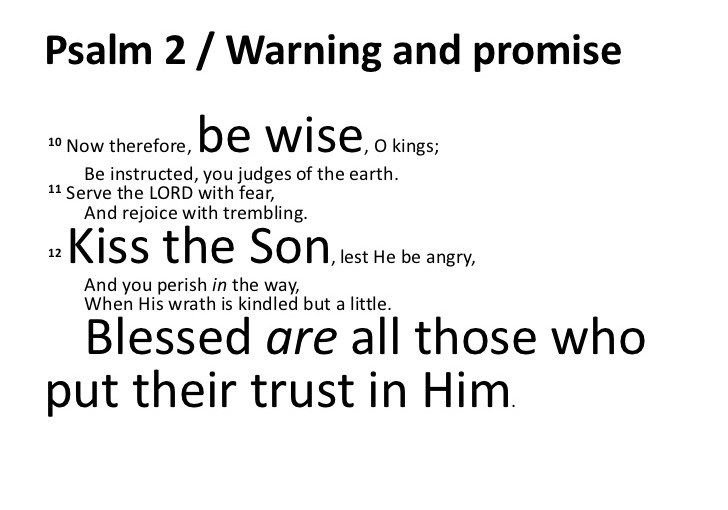
1Why do the heathen rage, and the people imagine a vain thing? 2 The kings of the earth set themselves, and the rulers take counsel together, against the Lord, and against his anointed, saying, 3 Let us break their bands asunder, and cast away their cords from us. 4 He that sitteth in the heavens shall laugh: the Lord shall have them in derision. 5 Then shall he speak unto them in his wrath, and vex them in his sore displeasure. 6 Yet have I set my king upon my holy hill of Zion. 7 I will declare the decree: the Lord hath said unto me, Thou art my Son; this day have I begotten thee. 8 Ask of me, and I shall give thee the heathen for thine inheritance, and the uttermost parts of the earth for thy possession. 9 Thou shalt break them with a rod of iron; thou shalt dash them in pieces like a potter’s vessel. 10 Be wise now therefore, O ye kings: be instructed, ye judges of the earth. 11 Serve the Lord with fear, and rejoice with trembling. 12 Kiss the Son, lest he be angry, and ye perish from the way, when his wrath is kindled but a little. Blessed are all they that put their trust in him.
No one knows for an absolute fact who wrote this psalm. However, it is widely accepted that it was written by King David. Many truly believe that because King David wrote in a theme, he wrote with a rhythm. This psalm has that rhythm. In addition, in the New Testament, in the book of Acts, chapter 4, verse 25, David is named as the writer, and the 2 psalm is quoted in that verse. While there is no proof of authorship, the word of those who were reading it in the time of writing the new testament are widely trusted to be doing so with a clear and accurate memory. I have no proof that when I was a child I owned a pet rock. But my memory knows it to be true. Do you believe me? I chose to believe the writer of Acts, Apostle Paul, and thus, believe that the king wrote this psalm.
Having said that, there is also some arguments as to whether the king was talking about himself, Jesus, or to both himself and Jesus. I have read the arguments thoroughly, and I have read the psalm over and over. I know that Kind David was a prophet, I also believe that Jesus is LORD. I believe there are parts of this psalm that can ONLY refer to Jesus. I believe that in verses 4, 5, and 6, David was talking expressly about Jesus. There is no man on earth, past-present-future, whose wrath will be greater than God. Oh we want to think ourselves some great equalizer but God is the creator of morality, and so only he can be the punisher of immorality. Additionally, King David speaks of “He who sits in heaven laughing and how the LORD will have his derision”, which means contempt or ridicule. No man, even King David should laugh at the man who is suffering the wrath of God. We should weep for the pain and suffering that we know awaits them. Charles Manson recently passed away. He went believing he was the anti-Christ, and also without much fanfare. For as much as he was in the news throughout his life, he should have been on the front page of the paper with the Headlines, “WEEP!!!! For his soul will forever be tormented in hell.” That is hard for us because we look at his behavior and say, “well he deserves it.” BREAKING NEWS…..we all deserve it. Not a single one of us is deserving of God’s mercy. So in this manner I believe these verses refer to Christ exclusively.
1 Peter 2
9 But you are a chosen race, a royal priesthood, a holy nation, a people for his own possession, that you may proclaim the excellencies of him who called you out of darkness into his marvelous light. 10 Once you were not a people, but now you are God’s people; once you had not received mercy, but now you have received mercy.
I believe King David refers to both himself and you and I in the rest. The first three verses are obviously about non-believers. That is a funny statement. When I say non-believers, I also refer to those who cry LORD LORD and yet obey him not. There are many who love him, they call on him, they are sore afraid of going to hell, so they claim his righteous name. Yet, these same people make friends with the world. They want the reward without the work. They want to be blessed by His hands, but use their own hands for their own benefit. They serve with no fear because they do not believe in His righteous wrath. Some say they believe in a God, but not the bible. Some believe that is is all about love and no obedience. They, I believe, are also non-believers.
Matthew 7
21 Not every one that saith unto me, Lord, Lord, shall enter into the kingdom of heaven; but he that doeth the will of my Father which is in heaven.
22 Many will say to me in that day, Lord, Lord, have we not prophesied in thy name? and in thy name have cast out devils? and in thy name done many wonderful works?
23 And then will I profess unto them, I never knew you: depart from me, ye that work iniquity.
In this psalm these are the kings and the leaders of the nations (heathens) surrounding Israel. They sit and conspire with each other to devise ways of disobedience. The word to use their thoughts in this psalm is “vein”. As I studied this word, I found that it could be misleading. I found this comment by Albert Barnes.
“That is, which will prove to be a vain thing, or a thing which they cannot accomplish. It cannot mean that they were engaged in forming plans which they supposed would be vain – for no persons would form such plans; but that they were engaged in designs which the result would show to be unsuccessful. The reference here is to the agitation among the nations in respect to the divine purpose to set up the Messiah as king over the world, and to the opposition which this would create among the nations of the earth.”
So how much vein thinking to do I do, meaning how much do I think of that goes against God’s plans for me, thus cannot be accomplished? That stuck with me. And in that thought, I believe that when David spoke of himself, he also spoke about you and me. Again, verse one. I have looked to my north and seen those who question me not to learn more about my faith but to watch me fail in the answer, to trap me into a corner. They wait for me to say something I cannot prove to ask for proof only to fail to understand that faith is the belief in that which is not seen. They are the world. I look to the east and west and I see friends, people who claim to love and yet they have their magnifying glasses out looking for every spot, every blemish. They point their fingers and forget about the three other digits pointing right back at them. They judge forgetting that God used some of the most broken people that have ever lived to build his church. They break my heart because I hear their words and wonder what scripture they use to support them. Their words are dressed up with support and love, yet the true intent is to break my bonds and to tear apart the cords that connect me to my God.
But then David, again, talking about his realization and giving us instruction, saves the grace of mercy until the end. In that delivery the King gives great hope, because while he talks to himself, while he instructs you and I, he talks of the salvation brought to us through the sacrifice of Christ. I am so grateful that I will forever know that my relationship with God is mine. No man, no matter how hard he tries, can interrupt my relationship with God. It is only I who can end this relationship. I am equally glad that I do not believe satan and his lies that tell me in my troubles that God forgets about his children. Blessed are all they that put their trust in Him! Do not trust man, put your trust in the LORD. He will never let you down. Man will let you down. It may not be intentional, and they may beg for forgiveness, but it will happen. The ONLY one worthy of complete Faith, unbridled obedience is God Almighty. Stand strong, and do not let the enemy keep you from answering your calling.
If you stand in the mirror what will the reflection tell you about yourself, and what are you going to do about it? May the peace of God be abundantly heaped upon you and your house, straight from the cross to the Christian!






You must be logged in to post a comment.