
Today’s Daily Bible Verse: Satan is In the Church Too

June 6, 2025

First Timothy 4:1–2
Now the Spirit speaketh expressly, that in the latter times some shall depart from the faith, giving heed to seducing spirits, and doctrines of devils; Speaking lies in hypocrisy; having their conscience seared with a hot iron;

VERSE CONTEXT

The apostle Paul, a seasoned preacher and church planter, is writing to his young spiritual son Timothy (Tih-muh-thee), who is now a pastor in the city of Ephesus (Eh-feh-sus)—a place known for idol worship, worldly pleasures, and deep spiritual confusion. Paul writes to encourage Timothy and to warn him—and the whole church—that false teachers and spiritual deceivers will absolutely come. And they won’t just be outside the church; they’ll come from within.

“Now the Spirit speaketh expressly…”

This means the Holy Spirit, the third person of the Trinity, is making something very clear, loud and direct. This isn’t a whisper or a quiet impression. It’s not just Paul’s opinion. Paul is saying, “Pay attention, God is warning us directly!”

Word Picture for a child: Imagine a firefighter shouting through a bullhorn: “Fire is coming—get out now!” That’s what “speaks expressly” means. It’s not a suggestion; it’s an urgent warning to protect you.

“…that in the latter times…”

The phrase “latter times” refers to the time period between Jesus’ resurrection and His return, so we’re in those times right now. But Paul especially means the final chapters of this age, when truth will be harder to find, and deception will become stronger. Think of this as the last part of the race, when you’re the most tired, but the danger is the greatest. That’s the “latter times.”

“…some shall depart from the faith…”

This doesn’t just mean people leaving a church building. It means turning their hearts and beliefs away from the true gospel of Jesus Christ. A key verse that demands attention by those being told that once you are saved you are always saved. That is a lie straight from the lips of satan. They once claimed to believe the truth, but they were led away from it by something more attractive, more popular, or more comfortable, their fleshly desire for sin. This is like a kid walking off the path in a dark forest because he thinks he hears music or sees a shortcut, but he’s actually walking away from the light and toward danger. The path was good. It was not always smooth and straight. It went uphill and downhill. But it was the path that he knew would lead home. Then he allowed himself to be distracted with this noise. Then he started to think about that noise and became interested and curious in the noise. So he pursued the noise. Soon, the safety of the path could not keep him and his desire for sin cost him eternal life.

“…giving heed to seducing spirits…”

To “give heed” means to pay attention to or listen closely to something.
Seducing here means enticing, charming, or tricking someone by making something dangerous sound beautiful or exciting. These aren’t human spirits. These are evil spirits, working behind the scenes to whisper lies that sound like truth.

Word Picture: Think of a fisherman dropping shiny bait into the water. The fish thinks it’s food, but there’s a hook hidden inside. That’s what a seducing spirit does; it puts a hook in a lie and hides it in something that looks good. So when someone hears, “God wouldn’t really judge people,” or “The Bible doesn’t mean that anymore,” they’re listening to the same kind of evil seducing spirit that told Eve, “Ye shall not surely die.”

“…and doctrines of devils;”

Doctrines means teachings or beliefs. And these aren’t just bad opinions; Paul says they come from devils. The word “devils” in the Bible refers to demons, the fallen angels who followed Satan when he rebelled against God. So “doctrines of devils” are demonic teachings; things demons want people to believe so that they won’t follow God’s truth. These teachings might sound loving, inclusive, or even spiritual, but they deny what God has said. They might include: “All religions lead to the same God” or “Love is love, God just wants you to be happy” or “God won’t punish anyone, it’s all grace.” These are not just wrong, they are demon-inspired lies meant to lead people to eternal death.

Word Picture: It’s like drinking from a beautiful cup filled with poison. Just because it’s shiny doesn’t mean it’s safe.

“Speaking lies in hypocrisy…”

The false teachers Paul is warning about are not just mistaken, they’re two-faced. They preach things they know aren’t true, or that they don’t even follow themselves. This is hypocrisy, pretending to be something you’re not. Example: A man might tell others to be holy, but he’s secretly living in sin. He lies, smiles, and sounds spiritual, but God sees his heart.

“…having their conscience seared with a hot iron.”

This is a very powerful image. The conscience is the part of you that knows right from wrong. But Paul says these people’s consciences are seared, like when you burn skin so badly it becomes numb, hard, and scarred.

Word Picture: Imagine touching a hot stove and getting burned. If you kept burning your hand again and again, it would eventually lose all feeling. That’s what happens to the heart when people keep rejecting God’s truth.
They can’t feel guilt anymore. They stop caring. They defend evil and mock good.

This verse is not just a warning about other people, it’s a warning to us, too. If we ever start thinking, “Maybe that part of the Bible doesn’t apply anymore…” or “Maybe God wouldn’t actually punish someone for that…”, we need to check our hearts immediately, because we might be listening to a seducing spirit.

BROADER CONTEXT

The Book of First Timothy is one of Paul’s pastoral epistles, written around A.D. 62–64 while Paul was in Macedonia. He wrote it to Timothy, a young pastor left in charge of the church at Ephesus (Eh-feh-sus). Ephesus was a city steeped in idol worship, particularly of the goddess Diana (or Artemis), a place overflowing with false religion, sexual immorality, and spiritual confusion. Paul knew that this church, planted in a dark culture, would face attacks from within and without.

In First Timothy chapter 4, Paul turns Timothy’s attention to spiritual deception, especially how false teachings will increase as the church age continues. He warns that many people, even those who once claimed to be part of the faith, will fall away because they listen to lies. These lies will sound spiritual and morally kind, but they will deny God’s truth, twist Scripture, and call evil “good.”

Paul doesn’t just warn Timothy; he charges him to stand firm, teach the truth boldly, and train others to stay grounded in sound doctrine. He reminds him to reject profane and old wives’ fables (1 Timothy 4:7) and to be an example in word, conduct, love, spirit, faith, and purity (verse 12). The whole chapter is about guarding the truth, protecting the sheep, and recognizing deception, especially when it disguises itself as righteousness.

Common False Teachings Today (Doctrines of Devils)

Paul says these false doctrines are not just mistakes, they are from devils. The following teachings are modern examples of what Paul warned about:

  1. Women as Pastors or Preachers in Authority over Men
    • First Timothy 2:12 says: “But I suffer not a woman to teach, nor to usurp authority over the man, but to be in silence.”
    • Yet today, many churches openly defy this. That’s not progressive, that’s rebellion.
    • Paul warned that such teachings are departures from the faith.
  2. Universalism (Everyone Will Be Saved)
    • This teaching claims a loving God wouldn’t send anyone to hell. But Jesus said in Matthew 7:13–14 that “broad is the way that leadeth to destruction” and many are on it.
    • To deny hell is to call Jesus a liar, and that’s demonic.
  3. Prosperity Gospel (Health and Wealth)
    • This lie teaches that if you have enough faith, God will make you rich and healthy. But Second Timothy 3:12 says: “Yea, and all that will live godly in Christ Jesus shall suffer persecution.”
    • The apostles were poor and persecuted, not flying in jets.
  4. Affirming Sinful Lifestyles
    • Churches now celebrate or excuse homosexuality, fornication, adultery, transgenderism, and more, claiming “God is love.”
    • But Romans 1:32 says: “Who knowing the judgment of God, that they which commit such things are worthy of death, not only do the same, but have pleasure in them that do them.”
  5. Faith Deconstruction and Redefining Scripture
    • “Did God really say that?” is the same satanic question the serpent asked Eve. Many now say the Bible is culturally outdated, or should evolve with society.
    • This undermines the authority of Scripture and teaches rebellion as virtue.
  6. Contemplative Mysticism and New Age Practices in Churches
    • Yoga, breath prayer, “Christian” tarot cards, and other pagan rituals are sneaking into worship. Paul warned of seducing spirits, and that’s exactly what these practices involve.
  7. Worship of Self (You Are Enough, Follow Your Heart)
    • These messages sound uplifting but are rooted in pride. Jeremiah 17:9 says: “The heart is deceitful above all things, and desperately wicked: who can know it?”
    • Any gospel that focuses on self instead of Christ is false.

Present Day False Teachers and Movements

These names and movements often blend truth with error, but still qualify as dangerous according to Paul’s warning:

  • Joyce Meyer, Beth Moore, Paula White – women who teach men with pastoral authority, directly violating 1 Timothy 2:12.
  • Joel Osteen, T.D. Jakes – prosperity gospel, refusal to preach on sin, hell, or repentance.
  • Rob Bell – teaches there is no hell; known for “Love Wins” and universalism.
  • Carl Lentz (former Hillsong NYC) – moral compromise, celebrity worship, and lukewarm doctrine.
  • The ELCA and PCUSA – mainline denominations affirming LGBT clergy and rejecting biblical authority.

Even entire movements like Progressive Christianity are rooted in doctrines of devils. They soften the gospel, downplay sin, redefine grace, and teach that Scripture is more symbolic than true. This is the seduction Paul warned about. The Holy Spirit’s warning in 1 Timothy 4:1–2 is not just about obvious heretics, it’s about anyone who causes us to doubt or disobey the Word of God. Whether it’s Eve in the garden or a preacher in a pulpit, the method is the same: “Did God really say…?” And today, Satan is still asking that question, but he’s asking it in Christian bookstores, on social media, and even in churches.

APPLICATION

Appreciating God’s Greatness

In First Timothy 4:1–2, we see that God does not leave His people in the dark. He warns us, not vaguely or softly, but expressly, directly, and with urgency. The Holy Spirit is not quiet in these verses. He’s shouting the alarm like a watchman on a city wall. This tells us something beautiful and terrifying: God sees the storm of deception coming long before it arrives. And because He loves us, He calls it out before we’re caught in it.

He doesn’t just warn us about evil; He describes how it will sound, how it will spread, and how it will be disguised. That kind of detailed love is the mark of a faithful Shepherd. Our God is great not only in power, but in wisdom, protection, and truth. We serve a God who doesn’t just give us comfort, He gives us clarity.

For the Believer

Christian, this verse is for us. It’s not just about “those bad people out there.” Paul says “some shall depart from the faith.” That means some who claimed to walk with Christ will fall into the trap of false teaching because they listened too long, questioned too much, and refused to hold fast to truth.

This passage calls us to three things:

  1. Guard your ears. What are you listening to? Podcasts, preachers, influencers, are they speaking truth, or are they mixing truth with error? Remember: seducing spirits don’t sound dangerous. They sound inspiring.
  2. Examine your heart. Do you feel uneasy when the Bible says something hard? When Scripture speaks of judgment, holiness, or submission, do you feel tempted to soften it, explain it away, or ignore it? That discomfort may be the first whisper of the same serpent who asked, “Yea, hath God said?”
  3. Stand firm in the Word. We must be like the Bereans (Acts 17:11) who searched the Scriptures daily to see whether what they were told was true. You are not called to be “open-minded”; you are called to be biblically grounded.

Call to Action

  • Turn off the voices that contradict God’s Word, even if they call themselves Christian.
  • Test every teaching against the full counsel of Scripture.
  • Teach your children and others to recognize truth from lies. Help them understand that not all “Christian” messages are of Christ.
  • Warn others in love. If you see someone being led astray, speak up. The most loving thing you can do is point them back to truth, even if it costs you popularity or comfort.

For the Unbeliever

If you’re not a follower of Christ, this passage is not just a warning, it’s a mirror. It shows what the enemy of your soul is doing behind the scenes. Every time you hear, “God is too loving to punish sin,” or “The Bible is outdated,” or “Everyone goes to heaven,” you are being lied to by devils, according to Scripture.

Satan doesn’t need you to become a witch or a criminal. He just needs you to believe a false version of Christianity that keeps you feeling spiritual while you reject the truth. His goal is not to terrify you, it’s to soothe you to sleep… right into Hell.

But the same God who speaks this warning also speaks an invitation: Come to Jesus. Now. Before your conscience is seared, before the lies feel like truth. Confess that you are a sinner. Believe that Jesus Christ died for your sins and rose from the grave. And trust Him, not your heart, not your favorite preacher, not your feelings.

John 14:6 – Jesus saith unto him, I am the way, the truth, and the life: no man cometh unto the Father, but by me.

He is the Truth, and He is calling you out of deception and into everlasting life.

FINAL ENCOURAGEMENT

First Timothy 4:1–2 is more than a warning, it’s a wake-up call. We are living in the very days Paul described. False teachers are multiplying. Doctrines of devils are paraded as truth. Seducing spirits are whispering in churches, classrooms, TV shows, podcasts, and pulpits. Feminism disguises itself as empowerment and strength, and allures women with beautiful independence which seems great to the flesh but is totally anti-scripture. And worst of all, many hearts have become so numb to conviction that they can no longer feel the sting of sin.

But you, brother, sister—you are not called to slumber. You are called to discernment, to faithfulness, to unwavering obedience. You are called to test the spirits, love the truth, and warn others with the courage of Christ. If the Word of God feels harsh, it’s because the lies of the world have dulled your ears. If the truth of Scripture feels offensive, ask yourself, “who taught you to feel that way?” If your conscience is still tender, praise God. But if it’s been seared, plead with the Lord to renew your mind and restore your fear of Him. Don’t be deceived. Don’t be led astray. Stay awake. Stay armored. Stay faithful.

PRAYER

Heavenly Father,
Thank You for speaking so clearly through Your Word. Thank You for warning us, not to shame us, but to save us. Lord, open our ears to Your voice and close them to the lies of the enemy. Give us hearts that love truth, even when it is hard, and the courage to reject what is false, even when it is popular. We pray for those who have wandered into deception. Open their eyes. Soften their hearts. Bring them back to the faith. Protect our families, our children, and our churches from doctrines of devils. Raise up bold preachers who will not bend, and give us humble hearts that will obey. Keep us alert. Keep us holy. Keep us walking in the truth of Jesus Christ, the only Way, the only Truth, and the only Life.
In Jesus name we pray,
Amen.

CLOSING

If you’ve found these daily verses encouraging, enlightening, or fruitful, please consider helping us spread the truth and light of God’s Word by subscribing to the blog and YouTube channels and liking and following the Facebook page. Most of all, share Believers of Biblical Truth and our links with others who may need the sermons and daily teachings just as much as we do.

You are loved—so much in fact, that we want you to know and be Believers of Biblical Truth.

Shalom Shalom.

Today’s Daily Bible Verse: Overcome the Flesh with the Spirit

June 5, 2025

Galatians chapter 5 verse 16: “This I say then, Walk in the Spirit, and ye shall not fulfil the lust of the flesh.”

Verse Context

The Apostle Paul is the author of the Book of Galatians, writing to the churches in the region of Galatia (modern-day central Turkey) around A.D. 48–55. The letter combats legalism and reasserts the doctrine of salvation by grace through faith, apart from the law. By chapter 5, Paul turns from theological correction to practical exhortation. He calls believers to liberty, not a liberty to sin, but to serve one another in love (Galatians 5:13). Verse 16 introduces the power source for Christian living: the Holy Spirit.

The word “walk” here is from the Greek peripateō (περιπατέω), meaning to conduct one’s life, to habitually live. It implies consistency and direction, not a one-time action.

The “lust of the flesh” refers to the sinful desires of our human nature; anger, pride, jealousy, lust, and all works of the flesh (see Galatians 5:19–21). But Paul declares that walking by the Spirit keeps us from fulfilling those desires.

Commentator John Stott (1921–2011, Anglican Evangelical) wrote, “Victory over the flesh is not attained by struggling but by surrendering, to the Spirit. The Christian life is not a battle we fight alone but a walk we share with God’s indwelling presence.”

Broader Context

Galatians chapter 5 focuses on the freedom believers have in Christ and the struggle between the flesh and the Spirit. Paul contrasts the works of the flesh (verses 19–21) with the fruit of the Spirit (verses 22–23). The key to living a life that honors God is not found in self-effort but in submission to the Spirit’s leading.

Paul is not calling for passive living but active dependence. Galatians 5:16 is the foundation of Spirit-filled victory. It doesn’t promise the absence of temptation, but it promises that temptation will not win when we walk in step with the Spirit.

This is a direct encouragement to every weary believer: God has made provision for you to win today. Not through your flesh, but through His Spirit.

ApplicationAppreciating God’s Greatness

This verse reveals God’s faithfulness to give us His very own Spirit so that we are never left to fight alone. It reminds us of His mercy, that He has not only saved us from sin’s penalty but is empowering us to defeat its power.

For the Believer

The battle with the flesh is daily, and at times exhausting. But Galatians 5:16 tells us the strategy: Walk in the Spirit. That means daily prayer, daily surrender, daily renewing of our mind through the Word. When we lean into His presence, the power of sin loses its grip.

Call to Action:

Today, before reacting to temptation, pause and pray. Say aloud, “Holy Spirit, I choose to walk with You.” Keep your heart open to His conviction and your will submitted to His direction.

For the Unbeliever

If you’re struggling with sin and wondering if real freedom is possible, Galatians 5:16 is God’s answer: Yes, it is, but not without the Spirit. True freedom begins when you place your faith in Jesus Christ, and He gives you the Spirit to dwell in you and lead you. You cannot win this war alone. But Christ already won it, come to Him.

Final Encouragement

No matter how heavy the battle has felt, no matter how often you’ve fallen, Galatians 5:16 is a fresh invitation: Walk in the Spirit. You are not a slave to your past, to your anger, or to your temptation. The Spirit of God lives in you, fights for you, and empowers you. And if you walk with Him today, you will not fulfill the lust of the flesh. That’s a promise.

Prayer

Father, thank You for giving us Your Spirit. We confess that our flesh is weak, but we also believe that Your Spirit is strong. Help us today to walk in step with You. Remind us to listen, to surrender, and to depend on You moment by moment. Strengthen those who feel weary. Help the one who’s been battling quietly to know that they are not alone. Empower us, Lord, to say no to the flesh and yes to You. In Jesus’ name we pray, Amen.

Closing

If you’ve found these daily verses encouraging, enlightening, or fruitful, please consider helping us spread the truth and light of God’s Word by subscribing to the blog and YouTube channels and liking and following the Facebook page. Most of all, share Believers of Biblical Truth and our links with others who may need the sermons and daily teachings just as much as we do.

You are loved—so much in fact, that we want you to know and be Believers of Biblical Truth.

Shalom Shalom.

Today’s Daily Bible Verse: Make Good Choices

June 3, 2025

Ephesians 6:11
“Put on the whole armour of God, that ye may be able to stand against the wiles of the devil.”

Verse Context

The Apostle Paul wrote the Book of Ephesians during his first imprisonment in Rome, around A.D. 60–62. His audience was primarily the Gentile believers in Ephesus, a prominent city in Asia Minor (modern-day Turkey) known for its wealth, commerce, and pagan practices, particularly the worship of Diana (Artemis). Paul’s letter emphasized the spiritual blessings believers have in Christ, the unity of the Church, and the call to live a life worthy of that calling.

In chapter 6, Paul is closing his letter with a final charge. He urges the believers to recognize the spiritual battle they face, not against other people, but against demonic forces (verse 12 will state this explicitly). “Put on the whole armour of God” is a metaphor drawn from Roman military gear, familiar to his readers. Each piece represents a vital aspect of the Christian’s spiritual defense.

The phrase “wiles of the devil” refers to crafty, deceitful schemes: traps, temptations, and manipulations that Satan sets to pull believers away from obedience, purity, and truth. The devil doesn’t always come with bold attacks; often, he works subtly, through compromise, distraction, pride, lust, bitterness, or doubt.

Commentator Matthew Henry (1662–1714, Presbyterian) explains, “Satan is a subtle enemy, and we must be always upon our guard against him, lest he get advantage of us.” Similarly, John MacArthur (b. 1939, Reformed Baptist) writes, “To stand firm against Satan, believers must rely on the strength of God and the armor He provides—not their own strength or wisdom.”

The Greek word for “wiles” is μεθοδείας (methodeias), from which we get the word method, meaning strategies or trickery. This implies that the devil has an organized, methodical plan to lead believers astray.

Broader Context

The Book of Ephesians as a whole lifts up the glory of the Church, not as an institution, but as the body of Christ called to reflect Him in a dark world. Chapters 1–3 lay the doctrinal foundation (what God has done for us), and chapters 4–6 are the practical application (how we should live because of that).

Chapter 6 shifts from relational roles (husbands and wives, parents and children, masters and servants) to the spiritual reality behind all relationships and responsibilities. Verses 10 through 20 introduce the armor of God: a full list of spiritual resources, truth, righteousness, faith, salvation, the Word, and prayer, all of which enable believers to resist evil, stand firm, and serve faithfully.

Ephesians 6:11 specifically introduces the purpose of that armor: to stand against temptation and deception. Without it, we are vulnerable. With it, we are empowered.

Paul’s language here echoes Isaiah 59:17:
“For he put on righteousness as a breastplate, and an helmet of salvation upon his head…”
This Old Testament connection emphasizes that the armor belongs to God, and He now gives it to us.

Application

Appreciating God’s Greatness

God is not a distant observer, He is a wise and powerful commander who equips His people for battle. He does not leave us vulnerable or ill-prepared. Just as a general would never send soldiers into combat without gear, God gives His children everything they need to stand strong. His armor is perfect, complete, and freely given.

For the Believer

Summer can be a time of distraction, vacations, parties, looser schedules. These aren’t wrong in themselves, but they often come with increased temptation to let down our guard: to indulge in sinful behavior, neglect prayer, avoid church, or prioritize entertainment over spiritual growth.

Ephesians 6:11 calls believers to daily intentionality. Putting on the armor isn’t passive, it’s a conscious act. That means:

  • Start each day in prayer and Scripture (sword of the Spirit).
  • Walk in truth and integrity (belt of truth).
  • Choose righteousness in conduct and purity (breastplate of righteousness).
  • Be ready to share the gospel (feet shod with the gospel of peace).
  • Guard your thoughts and assurance (helmet of salvation).
  • Actively trust God through trials (shield of faith).
  • Persevere in prayer (verse 18).

Call to Action:
Ask yourself each morning: Am I spiritually dressed for the day? Take time today to pray through each piece of the armor. Don’t wait until temptation hits, prepare now. The battle isn’t coming… it’s already here.

For the Unbeliever

If you are not a follower of Christ, you have no armor—no protection from sin, no defense against the schemes of the enemy, and no victory over death. But God, in His mercy, offers you salvation through Jesus Christ. Repent of your sin, believe in Jesus as Lord and Savior, and you will be forgiven, protected, and equipped to stand firm in a broken world. The armor is available, but only to those who belong to Him.

Final Encouragement

Temptation doesn’t take the summer off—and neither should your spiritual preparation. But God has not left you to fight alone or unarmed. Put on the whole armor of God, and you’ll not only stand against the devil’s lies—you’ll walk in victory. Summer doesn’t have to be a spiritual lull. It can be a time of renewed strength, deeper faith, and growing obedience.

Prayer

Heavenly Father, thank You for equipping us with everything we need to walk in victory. Help us to be spiritually alert and faithful, not distracted or deceived by the enemy’s tactics. Teach us to wear Your armor daily and rely on Your strength, not our own. For every believer feeling weak or worn down, remind them that the battle belongs to You, and You never lose. Strengthen us today, Lord. Keep us walking in truth. In Jesus’ name, amen.

Closing

If you’ve found these daily verses encouraging, enlightening, or fruitful, please consider helping us spread the truth and light of God’s Word by subscribing to the blog and YouTube channels and liking and following the Facebook page. Most of all, share Believers of Biblical Truth and our links with others who may need the sermons and daily teachings just as much as we do.

You are loved, so much in fact, that we want you to know and be Believers of Biblical Truth.

Shalom Shalom.

TODAY’S DAILY BIBLE VERSE: God is Constant

May 30, 2025

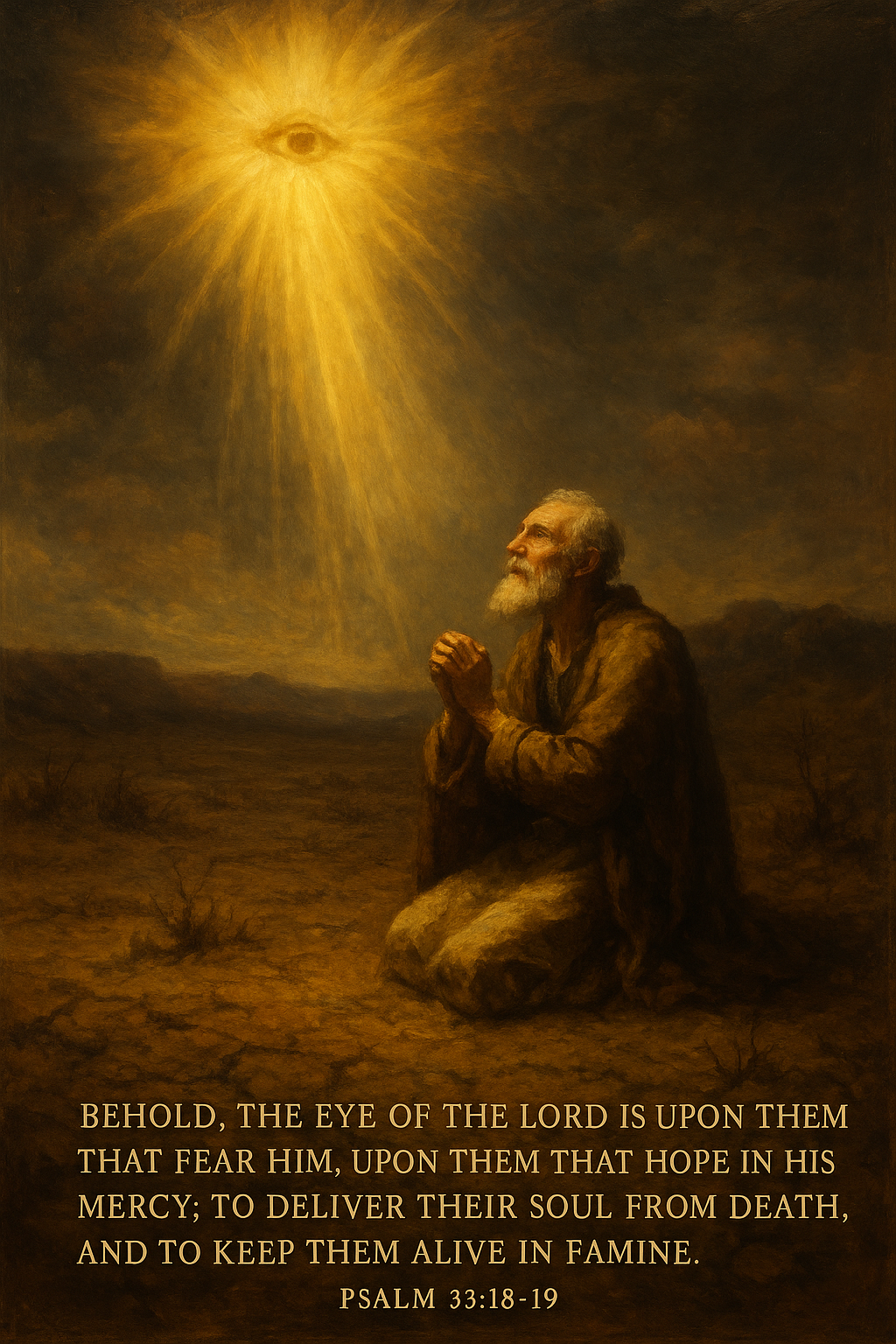
Psalm 33:18–19 (KJV):
Behold, the eye of the Lord is upon them that fear him, upon them that hope in his mercy; To deliver their soul from death, and to keep them alive in famine.

Verse Context

The author of Psalm 33 is not named, but the psalm fits within the larger structure of praise and reflection on God’s sovereignty. The phrase “the eye of the Lord” is a Hebrew idiom expressing both His omniscience and His intimate involvement with His people. It does not mean God is watching from afar, but rather that He is actively guarding and guiding those who fear Him.

The word fear here does not mean being scared; it refers to reverent awe and submission, those who honor God and walk in His ways. This is paired with those who hope in His mercy, trusting His covenant love, even when circumstances are hard. The Hebrew word translated mercy (often chesed, though not named directly here) implies steadfast, loyal love, especially God’s covenant-keeping faithfulness to His people.

In verse 19, we are reminded that this divine attention has a purpose: “To deliver their soul from death” speaks to spiritual preservation, not just physical. God protects us from destruction and judgment. And the phrase “to keep them alive in famine” reminds us that God is the ultimate provider, even when resources are scarce. Historically, Israel often faced agricultural crises due to drought or invasion, yet the faithful were sustained by God’s hand.

This passage is echoed in God’s faithfulness to Elijah during famine (First Kings 17:6: “And the ravens brought him bread and flesh in the morning…”) and in the Lord’s Prayer where Jesus teaches us to pray, “Give us this day our daily bread” (Matthew 6:11). God’s provision is not occasional, it is constant for those who trust Him.

Broader Context

Psalm 33 is a call to praise God not only for who He is, but for what He does. The earlier verses (especially 6–9) declare God as the Creator: “By the word of the LORD were the heavens made…” He is not just a distant deity, He is the active Ruler of nations (verse 10), the personal Helper of those who trust Him (verse 20), and the Deliverer of those in danger. The psalm repeatedly contrasts human effort with divine power, reminding us that kings are not saved by armies (verse 16), but by God alone.

Verse 18–19 lands as a strong affirmation that God pays close attention to the righteous, not to destroy, but to deliver. It is His nature to rescue and provide. When nations tremble and fields are dry, God’s eye remains fixed on the faithful.

Application

Appreciating God’s Greatness

This verse reveals a tender aspect of God’s majesty. He is not only King of the universe but Guardian of every soul who reveres Him. That the God who commands galaxies also sees and sustains those who tremble at His Word is a staggering reminder of both His greatness and His intimacy.

For the Believer

The promise that God “keeps us alive in famine” is not just poetic, it’s personal. When life feels dry, when bills stack up, or when fears threaten to overwhelm us, we can rest in this truth: His eye is upon us. He sees every tear, every need, every prayer, and He answers in mercy.

Call to Action:
Do you live as though His eye is upon you? Today, renew your reverence for God and place your hope fully in His mercy. Thank Him for His provision, especially in the “famines” of your life, spiritual, emotional, or material. Trust Him again.

For the Unbeliever

If you do not yet fear the Lord or hope in His mercy, this verse is both warning and invitation. God’s eye is on all, but His special care is for those who love and obey Him. The path to that care is simple: turn from sin and place your faith in the Lord Jesus Christ. His mercy is ready for all who will receive it.

Final Encouragement

When the world is uncertain and resources are scarce, let Psalm 33:18–19 remind you that the Lord is not blind to your needs. He sees, He knows, and He acts. His eye is upon those who fear Him, not with judgment, but with deep covenant love. You are not forgotten. You are watched over. You are kept.

Prayer

Father, thank You for keeping Your eye upon us. In times of plenty and in times of need, You are faithful to provide and protect. Help us to live with reverent fear and abiding hope in Your mercy. Teach us to trust You, not just in our words, but in our daily decisions. Guard our hearts from fear, and fill our souls with peace, knowing that we are never outside of Your care. In Jesus’ name we pray, amen.

Closing

If you’ve found these daily verses encouraging, enlightening, or fruitful, please consider helping us spread the truth and light of God’s Word by subscribing to the blog and YouTube channels and liking and following the Facebook page. Most of all, share Believers of Biblical Truth and our links with others who may need the sermons and daily teachings just as much as we do.

You are loved—so much in fact, that we want you to know and be Believers of Biblical Truth.

Shalom Shalom.
Daily Bible Verse: Is God Still There?

May 29, 2025

Deuteronomy 2:7
For the LORD thy God hath blessed thee in all the works of thy hand: he knoweth thy walking through this great wilderness: these forty years the LORD thy God hath been with thee; thou hast lacked nothing.

Verse Context

The Book of Deuteronomy is a series of final sermons given by Moses to the people of Israel before they entered the Promised Land. In this particular chapter, Moses is recounting their journey through the wilderness—a 40-year period of wandering brought on by their unbelief and disobedience in Numbers 13–14. Yet despite their failure and delay, God’s faithfulness remained unbroken.

This verse, Deuteronomy 2:7, is spoken in a moment of reflection. The people are now standing near the border of the land God had promised, and Moses reminds them that through every year, every hardship, and every mile of wandering, God never left them. Even when they were disciplined, they were still sustained. Even when they walked through desolate lands, their shoes didn’t wear out (Deuteronomy 29:5), they received manna from heaven (Exodus 16:35), and their needs were met.

Let’s look again at the verse itself:

“For the LORD thy God hath blessed thee in all the works of thy hand:” — This is a sweeping statement. Even in the wilderness, even in hardship, God was blessing the daily labor of His people. The Hebrew word for “blessed” (not included here but behind the English text) suggests an ongoing, active favor. It wasn’t random. It was deliberate.

“He knoweth thy walking through this great wilderness:” — This isn’t merely geographical. The word “walking” here conveys the idea of a long, personal journey. God didn’t just chart the map from above—He observed, understood, and walked with them. The “great wilderness” wasn’t an accident; it was a season with divine purpose.

“These forty years the LORD thy God hath been with thee;” — The number forty in Scripture often symbolizes a period of testing, proving, or preparation. These were not wasted years. They were years where God’s presence never departed.

“Thou hast lacked nothing.” — This is a powerful declaration. Though they didn’t have luxury, they had sufficiency. Though they didn’t have cities, they had shelter. Though they didn’t feast, they were fed. What the world may call lack, God calls preparation. And His provision was perfect for what they needed in that season.

What’s especially moving about this verse is that it wasn’t spoken at the end of Israel’s entire story—but at the end of a long, difficult chapter. It was a reminder that even in discipline, even in delay, God was faithful. And if He was faithful then, He will be faithful now.

This is the tone the Holy Spirit wants us to carry as we move into the broader context and application: a pastoral encouragement to those who might still feel like they’re wandering. Because the same God who walked with them through the wilderness, walks with us still.

Broader Context

Deuteronomy is the fifth and final book of the Torah (the Pentateuch), traditionally attributed to Moses as its author. The name “Deuteronomy” means “second law,” not because it contains new commandments, but because it repeats, expounds, and reinforces the law given at Mount Sinai to a new generation of Israelites. The people who stand on the edge of the Promised Land in this book are not the same ones who stood there nearly forty years earlier in the Book of Numbers. The previous generation died in the wilderness due to their unbelief and rebellion (Numbers 14:29–35). Now, this new generation needs to hear the covenant again—fresh, personal, and binding.

Deuteronomy chapter 2 specifically covers a portion of Israel’s wilderness journey, highlighting the sovereign guidance of God as the people traveled through the territories of Edom, Moab, and Ammon. These lands belonged to distant relatives of Israel—descendants of Esau and Lot—and God commanded Israel not to provoke them or take their lands. Instead, He instructed them to buy food and water, as a demonstration of respect for boundaries and obedience to His leadership (Deuteronomy 2:4–6).

It is in this context that verse 7 appears like a quiet oasis of reflection in the middle of a historical retelling. Moses pauses to acknowledge that despite the years of wandering, despite being denied entry into these regions, and despite all the trials they endured, God was present and faithful every step of the way. This isn’t a random verse—it’s a pivot point in the chapter. From here, the narrative shifts from traveling in circles to approaching conquest. It is a reminder that their survival wasn’t accidental—it was sustained by God.

More broadly, within the entire book of Deuteronomy, chapter 2 serves to highlight one of the book’s main themes: God’s covenant faithfulness, even when His people fail. The structure of Deuteronomy is deeply covenantal. Moses, under divine inspiration, is acting like a covenant mediator, reminding the people of the stipulations of God’s law, the historical evidence of God’s faithfulness, and the blessings and curses that will come depending on their obedience (see chapters 27–30).

Deuteronomy emphasizes the importance of memory—remembering what God has done (like sustaining them through the wilderness), so that they won’t forget Him when they enter into prosperity. Moses says in Deuteronomy 8:2:
“And thou shalt remember all the way which the LORD thy God led thee these forty years in the wilderness…”

In this way, Deuteronomy 2:7 is not just about God’s provision. It is a testimony of continuity: the God who was with Abraham, Isaac, and Jacob; who delivered them from Egypt with a mighty hand; who sustained them in the desert—He is the same God preparing to lead them into promise.

In the grand scheme of Scripture, Deuteronomy reminds us that God’s covenant is not based on convenience or comfort—it is based on commitment and character. He keeps His word, not because His people are flawless, but because He is faithful. This makes Deuteronomy 2:7 a timeless reminder to every generation: even when we walk through barren places, we are never abandoned. God is working, watching, providing, and shaping us for what comes next.

Application

Appreciating God’s Greatness

Deuteronomy 2:7 is not a verse that glorifies prosperity—it glorifies presence. “The LORD thy God hath been with thee; thou hast lacked nothing.” What an astonishing testimony—not because they had abundance, but because they had Him. God is not great simply because He gives; He is great because He stays. When the sandals did not wear out and the manna came down day by day, it wasn’t a display of luxury—it was the quiet miracle of sustenance. And it was enough.

God’s greatness is shown not by removing the wilderness, but by walking with us through it. Just as He led Israel by a cloud by day and fire by night, He leads His people still—with gentleness, faithfulness, and purpose—even when we can’t see the path clearly. There is no night too dark for His presence, and no desert too dry for His provision.

For the Believer

Every believer will go through their own wilderness. It may not be sand and stone, but it will be marked by pain, sorrow, loss, or confusion. And in those seasons, it’s natural to ask, “Is God still with me?” The wilderness tests more than your strength—it tests your faith.

The Israelites who wandered for forty years were not all alike. Many, tragically, chose to give up their faith. They believed the giants in the land were bigger than the God who delivered them. And because of that unbelief, they died in the wilderness. But to the ones who held fast—to Joshua, to Caleb, to the faithful remnant—God was everything He promised to be. He was enough. Their feet kept walking. Their needs were met. They lived to see the Promised Land.

The lesson is painfully clear: unbelief leads to death, but faith leads to fulfillment. It does not mean the journey will be without tears. It means that God is not a liar—and when He says He will never leave us, He means it.

So when the pain is so deep that words cannot form…
When cancer steals what medicine cannot restore…
When a child is taken and there are no answers…
When you lose someone you love, and you didn’t get to say what you needed to say…

God has not abandoned you.

The cross is our proof that He never looks away from suffering. Jesus wept at death, groaned at injustice, and carried every grief to Calvary—not so we would never suffer, but so we would never suffer alone.

Hold on, beloved. Hold on when it hurts. Hold on when you don’t understand. Your wilderness is not proof of God’s absence—it is the place where He draws you into deeper dependence and closer intimacy. And like Israel, you will look back one day and say, “He was with me. I lacked nothing.”

Call to Action

If you are a believer walking through that wilderness right now, don’t stop walking. Don’t curse God in the desert. Don’t let the dryness make you forget the Deliverer. Cry if you must. Grieve if you must. But do not let go of your faith. Even if all you can do is whisper, “I believe—help my unbelief,” you are still moving forward.

Surround yourself with those who will remind you of His faithfulness. Stay rooted in the Word. Recall your own Ebenezer stones—moments when you know God provided. And know this: the Promised Land isn’t always found here on earth. For some, the promise is fulfilled in eternity. But it is fulfilled. It is never forgotten.

For the Unbeliever

If you do not yet know Jesus Christ—if faith is something you’ve never embraced, or perhaps something you walked away from—you need to hear this clearly:

You were never meant to walk through this life alone. Your pain, your losses, your guilt—they are not ignored by God. He sees them. But more than that, He sent His Son to walk into your brokenness and offer redemption.

The same God who walked with Israel through their wilderness wants to walk with you. But unlike them, your journey begins at the cross—the place where Jesus bore your sin, your shame, and your sorrow. It is there that the curse is lifted, and the covenant begins.

Will you surrender to Him today? Not because He promises to remove every hardship, but because He promises never to leave you in it alone. Because only through Jesus can you say, even in the desert, “I have lacked nothing.”

Final Encouragement

God never promised that following Him would mean a life without sorrow, but He did promise His presence in every step. Deuteronomy 2:7 reminds us that even after forty years of wandering, struggle, and waiting, God had never let His people go. He walked with them. He provided for them. He blessed the works of their hands. And He never let them lack what they needed to finish the journey.

If you are in a season of pain, confusion, grief, or uncertainty, let this verse be your anchor: “These forty years the LORD thy God hath been with thee; thou hast lacked nothing.” That same God walks with you today.

Your sorrow is seen. Your waiting is known. And your wilderness is not the end of the story.

Prayer

Heavenly Father,
We thank You for being a God who does not abandon Your children in the wilderness. You are faithful in every season—when the way is clear, and when the way is hard. Thank You for the testimony of Israel, who walked for forty years yet lacked nothing, because You were with them.

For those among us who are hurting—those grieving deep losses, enduring illness, or wandering through confusion—we ask for Your comforting presence to meet them right where they are. Help us to cling to You, even when we cannot see the Promised Land ahead. Strengthen our faith to endure, our hearts to trust, and our eyes to see Your hand in every provision.

Remind us, Lord, that Your presence is our portion, and Your promises are true. Carry us when we cannot walk, and feed us daily with the Bread of Heaven. We trust You. We need You. And we love You.

In Jesus’ name we pray,
Amen.

Closing

If you’ve found these daily verses encouraging, enlightening, or fruitful, please consider helping us spread the truth and light of God’s Word by subscribing to the blog and YouTube channels and liking and following the Facebook page. Most of all, share Believers of Biblical Truth and our links with others who may need the sermons and daily teachings just as much as we do.

You are loved—so much in fact, that we want you to know and be Believers of Biblical Truth.

Shalom Shalom.