Today’s Daily Bible Verse

April 11, 2025

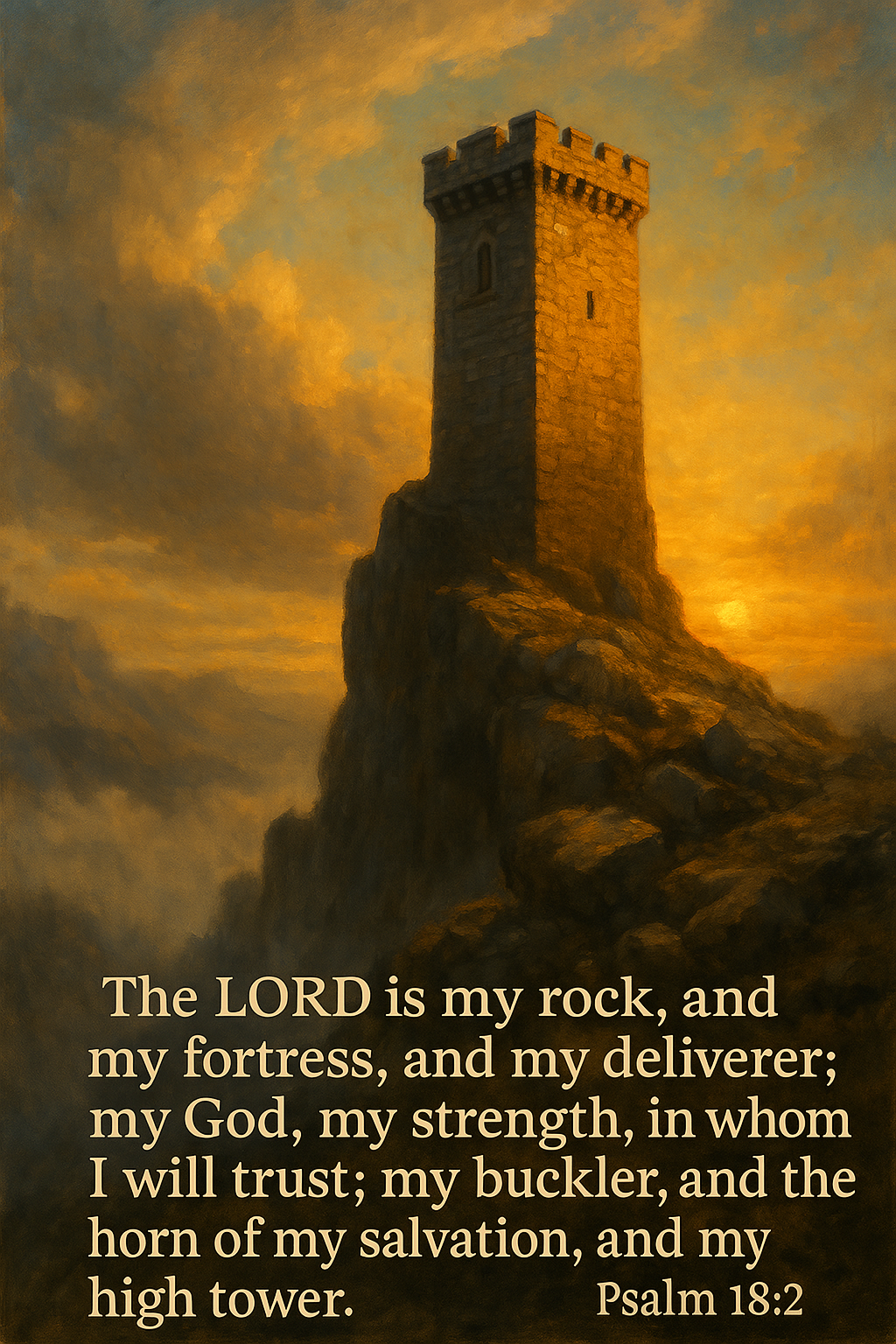
Psalm chapter 18 verse 2: “The LORD is my rock, and my fortress, and my deliverer; my God, my strength, in whom I will trust; my buckler, and the horn of my salvation, and my high tower.”

VERSE CONTEXT

This verse was written by David, the second king of Israel, who was both a warrior and a worshiper. Psalm 18, where this verse is found, is a personal song of praise that David wrote to the LORD on the day when he was delivered “from the hand of all his enemies, and from the hand of Saul” (Psalm 18, title). It’s a deeply intimate, autobiographical testimony of divine rescue and sustaining power.

David had spent years on the run from King Saul, hiding in caves, living among enemies, and narrowly escaping death more than once. The pressure of being God’s anointed while being hunted like a criminal would have been immense. Yet throughout it all, David maintained his relationship with the LORD and trusted in Him completely.

Psalm 18 is therefore not a theoretical psalm—it is born out of personal warfare, betrayal, and survival. Its core is deliverance.

The verse itself uses eight vivid metaphors to describe who God is to David:

  1. My rock – This refers to stability and a foundation. The Hebrew concept here involves something firm, unmovable, and protective—often a high rocky crag, a place of refuge in battle.
  2. My fortress – A fortress is a strong, fortified place of defense. David would have spent much of his fugitive life seeking such places in the wilderness.
  3. My deliverer – The one who rescues, who pulls out of danger. David is saying, “God is the One who gets me out when there’s no way out.”
  4. My God – This is personal. Not a god, but my God. It reflects the covenant relationship David had with the LORD.
  5. My strength – The Hebrew root here implies not just physical strength but firmness and reliability. When David was weak, he drew strength from the LORD.
  6. My buckler – An older term for a small, maneuverable shield, used in close combat. The LORD is not a distant shield, but One who defends at intimate range.
  7. The horn of my salvation – In biblical language, the horn is a symbol of power and victory. This phrase suggests God is the source of victorious salvation.
  8. My high tower – A refuge placed high above danger, where enemies cannot reach and where vision and protection are maximized.

What’s important is how deeply personal this verse is. David is not writing a theological textbook—he’s writing from the battlefield of life. The repetition of the word “my” reveals a relationship, not just knowledge. He doesn’t merely believe about God—he knows God Himself. This is his rock, his shield, his fortress.

The language of this verse is not poetic exaggeration. It is the hard-won truth of a man who had been saved time and time again by God’s direct intervention. This psalm is also duplicated nearly word-for-word in Second Samuel chapter 22, suggesting that David preserved this song as a personal anthem of praise throughout his life.

Additionally, some commentators view Psalm 18 as messianic, foreshadowing the deliverance Jesus would bring. While the psalm is rooted in David’s experience, it stretches forward prophetically to the ultimate Deliverer—Jesus Christ—who provides eternal refuge, strength, and salvation.

The psalm was likely first written for private devotion and then publicly shared for worship and instruction. As king, David was not only testifying to God’s deliverance in his own life but modeling for the people of Israel what trust in the LORD looked like during times of trial.

BROADER CONTEXT

Psalm 18 is among the longest psalms in the Book of Psalms, with 50 verses, and it is deeply autobiographical. It opens with a superscription that anchors it in a specific historical context: “A Psalm of David, the servant of the LORD, who spake unto the LORD the words of this song in the day that the LORD delivered him from the hand of all his enemies, and from the hand of Saul.” That preface gives us an undeniable clue to the emotional and historical backdrop of the chapter. This is not simply a moment of joy—it is a culmination of years of warfare, wilderness wandering, royal uncertainty, and constant peril.

This Psalm is also found almost identically in Second Samuel chapter 22, written during the final season of David’s life. That chapter acts as a retrospective song of praise—a spiritual memoir of deliverance. That helps us understand that this Psalm didn’t emerge from a single crisis, but was shaped over a lifetime of hardship. It gathers the memory of a thousand dangers and the consistency of God’s saving grace into one towering testimony.

The language of the Psalm shifts between high praise and detailed accounts of God’s acts. Verses 4–6 describe David’s distress: “The sorrows of death compassed me,” he says. In verse 7, the imagery becomes explosive as God arises in wrath to defend His servant. That section—verses 7–15—reads like a divine theophany (God appearing in dramatic form), with earthquakes, fire, and smoke. It paints God not as passive but as a warrior-king, rising to shake the heavens for the sake of His anointed.

The broader structure of the Psalm shows a movement from desperation to deliverance to exaltation:

  • Verses 1–3: Declaration of trust and praise (where verse 2 is found).
  • Verses 4–6: Cry of distress.
  • Verses 7–19: God’s dramatic response.
  • Verses 20–29: Reward for righteousness.
  • Verses 30–45: Testimony of God’s strength in battle.
  • Verses 46–50: Final praise and acknowledgment of God’s steadfast love.

Now, let’s narrow in on how verse 2 functions in that structure. It is part of the introductory declaration. David begins by saying, “I will love thee, O LORD, my strength” (verse 1), and then immediately launches into the comprehensive list of metaphors in verse 2. This is his foundational theology—everything that follows in the Psalm grows out of this understanding: God is stable, safe, rescuing, and trustworthy.

This is why verse 2 has become a lifeline for many believers, especially in seasons of anxiety, stress, and uncertainty. It does not belong to the battlefield alone—it belongs to the exhausted parent, the discouraged worker, the burdened minister, and the believer crushed by invisible burdens. That is why this verse is so powerful for a Friday. The end of the work week often represents emotional depletion. Many people are carrying burdens from the office, home, or personal life—and they may be holding on by a thread.

Psalm 18 verse 2 reminds us that God does not change. He is still a fortress. Still a rock. Still a deliverer. This is a declaration we can speak even while the battle rages—and it becomes an anchor that keeps our faith from drifting in the storm.

Matthew Henry (1662–1714), a Nonconformist minister and commentator, wrote that “those who by faith fly to God for support and shelter shall find Him a rock under their feet, a buckler over their heads, a horn of salvation on their heads, and a high tower in which they are safe.” His emphasis on God being a complete refuge—above, around, under, and within—is drawn directly from the language of this Psalm.

Charles Spurgeon (1834–1892), a Reformed Baptist preacher, echoed this idea when he said, “This verse is a perfect mosaic of precious stones gathered from the quarry of divine faithfulness.” That poetic language points us to a truth: each name David gives to God in this verse is not ornamental—it’s earned.

Whether David was hiding in the caves of Adullam, seeking refuge in the strongholds of Engedi, or walking the palace halls of Jerusalem as king, his confession remained the same: the LORD is his rock.

APPLICATION

Appreciating God’s Greatness

Psalm chapter 18 verse 2 is not a list of titles—it is a confession of experience. It magnifies the Lord by declaring what He is rather than simply what He does. David doesn’t say, “The LORD gives me strength”—he says, “The LORD is my strength.” That distinction matters. God is not a vendor of support—He is the very embodiment of it. He is the place we run to, the power we stand in, and the protection we depend on.

Each image in the verse—rock, fortress, deliverer, shield, horn, tower—gives us a multifaceted vision of God’s greatness. His strength is not one-dimensional. He is our defense in war, our safety in storms, our shelter in grief, and our victory in battle.

God’s greatness here is relational, not distant. These aren’t just majestic metaphors—they’re evidence of a living God who enters the chaos of our lives and establishes peace by His presence.

For the Believer

David’s words in this verse invite believers to rest in God’s character, not in their circumstances. Whether you’re facing battles like David or simply carrying the slow grind of daily responsibilities, the call is the same: run to the Rock.

For many, Friday brings exhaustion—not just physical, but emotional and spiritual. The workweek can leave people strained, overlooked, or spiritually dry. This verse reminds us that God is not worn out when we are. He doesn’t rest—He is the rest. He doesn’t need to be refilled to fill us. The “fortress” David speaks of is not far away or locked—it is open and ready.

That’s why this verse is especially meaningful at the end of a long week. The weekend is not just a break from work—it is an opportunity to refresh with praise and rebuild with prayer. When we slow down, we can once again see how safe we are in Him. Instead of retreating into worldly distraction, we can retreat into divine refuge. Worship becomes our weapon, and prayer becomes our high tower.

David trusted God not only in caves and palaces, but in the quiet spaces between. So should we.

Call to Action:

As the week winds down, take time this weekend to actively rest in the Lord. Don’t simply collapse into entertainment—enter into worship. Carve out moments of stillness to read this verse aloud. Personalize it: “LORD, You are my rock. My strength. My deliverer.” Let His identity settle your anxiety. Trust Him in every layer of stress, and let your weekend be shaped not by escape—but by encounter.

For the Unbeliever

If you do not yet belong to Christ, this verse still invites you in. It shows what is available to all who put their trust in the Lord. The God who was David’s refuge wants to be your refuge too.

The storms of life are no respecter of persons. They come to the rich and the poor, the faithful and the faithless. The difference is this: one stands exposed, the other is hidden in the fortress of God’s love.

The same God who protected David from spears, armies, and betrayal has extended His hand to you through Jesus Christ. Jesus is the ultimate deliverer—He didn’t just save a man from battle; He saved a world from sin.

You may have tried to be your own rock, your own strength, your own tower—but it doesn’t hold. Come to Christ. He is strong enough to carry your guilt, and gentle enough to hold your wounds. Let today be the day you call Him your rock.

FINAL ENCOURAGEMENT:

Psalm chapter 18 verse 2 is more than a declaration—it’s a shelter. It reminds us that the same God who defended David in the wilderness defends us in the chaos of our lives. Whether you’re facing battles of the heart, mind, or circumstances, the invitation is the same: trust in the Lord as your rock. You don’t have to hold yourself up. You don’t have to be your own strength. You don’t have to run without rest.

Let this weekend be a time not of collapse, but of communion. Praise the God who has sustained you all week, and find your peace not just in the absence of work—but in the presence of your Fortress. The LORD is not just a place to run—He is the only place strong enough to hold your heart.

PRAYER:

Heavenly Father,
Thank You for being our unshakable rock, our fortress in every storm, and our strength when we are weak. We come to You now with our burdens—some that we speak aloud, and others too deep for words. Let us find peace in knowing that You are our refuge, not just for today but for every tomorrow. Wrap Your presence around us this weekend. Restore our weary hearts. Help us to trust You, not just with our lips, but with our lives. And may we, like David, declare with confidence: You are my rock, my deliverer, and my high tower. In Jesus’ name we pray,
Amen.

CLOSING:

If you’ve found these daily verses encouraging, enlightening, or fruitful, please consider helping us spread the truth and light of God’s Word by subscribing to the blog and YouTube channels and liking and following the Facebook page. Most of all, share Believers of Biblical Truth and our links with others who may need the sermons and daily teachings just as much as we do.

You are loved—so much in fact, that we want you to know and be Believers of Biblical Truth.

Shalom Shalom.
Serve the Lord with fear

Sometimes I look to my front, and I see obstacles. I look to my left and right, more obstacles. I look behind me and the road I used to get me where I am is now blocked and retreat is no longer an option. I am not always sure I understand why. I just know that, because I am a believer in Jesus the Christ, the bible says that I will suffer persecution. Even though I understand this, I still find myself asking why are there so many people against me, why are so many people against doing it God’s way.

When I opened up the truth and saw the first verse of the second Psalm, I was amazed. Then I read the second verse and then the third verse; I was sitting their saying, “I ask these same questions.” Let’s refresh our memories by reading that psalm in its entirety.

Psalm 2

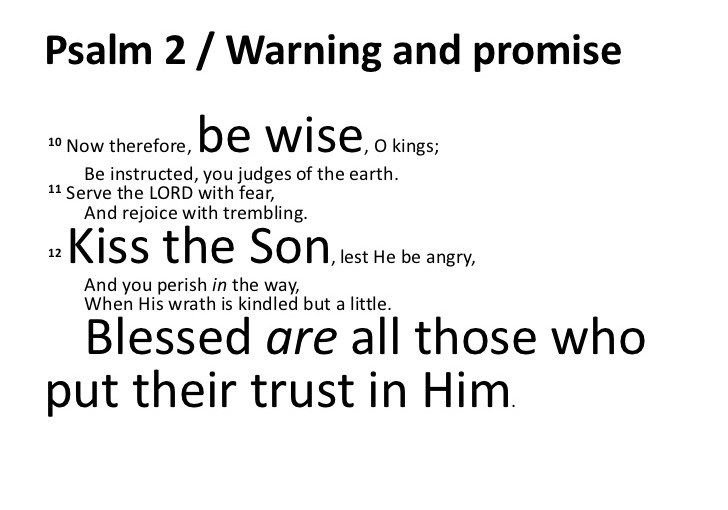
1Why do the heathen rage, and the people imagine a vain thing? The kings of the earth set themselves, and the rulers take counsel together, against the Lord, and against his anointed, saying, Let us break their bands asunder, and cast away their cords from us. He that sitteth in the heavens shall laugh: the Lord shall have them in derision. Then shall he speak unto them in his wrath, and vex them in his sore displeasure. Yet have I set my king upon my holy hill of Zion. I will declare the decree: the Lord hath said unto me, Thou art my Son; this day have I begotten thee. Ask of me, and I shall give thee the heathen for thine inheritance, and the uttermost parts of the earth for thy possession. Thou shalt break them with a rod of iron; thou shalt dash them in pieces like a potter’s vessel. 10 Be wise now therefore, O ye kings: be instructed, ye judges of the earth. 11 Serve the Lord with fear, and rejoice with trembling. 12 Kiss the Son, lest he be angry, and ye perish from the way, when his wrath is kindled but a little. Blessed are all they that put their trust in him.

No one knows for an absolute fact who wrote this psalm. However, it is widely accepted that it was written by King David. Many truly believe that because King David wrote in a theme, he wrote with a rhythm. This psalm has that rhythm. In addition, in the New Testament, in the book of Acts, chapter 4, verse 25, David is named as the writer, and the 2 psalm is quoted in that verse. While there is no proof of authorship, the word of those who were reading it in the time of writing the new testament are widely trusted to be doing so with a clear and accurate memory. I have no proof that when I was a child I owned a pet rock. But my memory knows it to be true. Do you believe me? I chose to believe the writer of Acts, Apostle Paul, and thus, believe that the king wrote this psalm.

Having said that, there is also some arguments as to whether the king was talking about himself, Jesus, or to both himself and Jesus. I have read the arguments thoroughly, and I have read the psalm over and over. I know that Kind David was a prophet, I also believe that Jesus is LORD. I believe there are parts of this psalm that can ONLY refer to Jesus. I believe that in verses 4, 5, and 6, David was talking expressly about Jesus. There is no man on earth, past-present-future, whose wrath will be greater than God. Oh we want to think ourselves some great equalizer but God is the creator of morality, and so only he can be the punisher of immorality. Additionally, King David speaks of “He who sits in heaven laughing and how the LORD will have his derision”, which means contempt or ridicule. No man, even King David should laugh at the man who is suffering the wrath of God. We should weep for the pain and suffering that we know awaits them. Charles Manson recently passed away. He went believing he was the anti-Christ, and also without much fanfare. For as much as he was in the news throughout his life, he should have been on the front page of the paper with the Headlines, “WEEP!!!! For his soul will forever be tormented in hell.” That is hard for us because we look at his behavior and say, “well he deserves it.” BREAKING NEWS…..we all deserve it. Not a single one of us is deserving of God’s mercy. So in this manner I believe these verses refer to Christ exclusively.

1 Peter 2

9 But you are a chosen race, a royal priesthood, a holy nation, a people for his own possession, that you may proclaim the excellencies of him who called you out of darkness into his marvelous light. 10 Once you were not a people, but now you are God’s people; once you had not received mercy, but now you have received mercy.

I believe King David refers to both himself and you and I in the rest. The first three verses are obviously about non-believers. That is a funny statement. When I say non-believers, I also refer to those who cry LORD LORD and yet obey him not. There are many who love him, they call on him, they are sore afraid of going to hell, so they claim his righteous name. Yet, these same people make friends with the world. They want the reward without the work. They want to be blessed by His hands, but use their own hands for their own benefit. They serve with no fear because they do not believe in His righteous wrath. Some say they believe in a God, but not the bible. Some believe that is is all about love and no obedience. They, I believe, are also non-believers.


Matthew 7
21 Not every one that saith unto me, Lord, Lord, shall enter into the kingdom of heaven; but he that doeth the will of my Father which is in heaven.
22 Many will say to me in that day, Lord, Lord, have we not prophesied in thy name? and in thy name have cast out devils? and in thy name done many wonderful works?
23 And then will I profess unto them, I never knew you: depart from me, ye that work iniquity.

In this psalm these are the kings and the leaders of the nations (heathens) surrounding Israel. They sit and conspire with each other to devise ways of disobedience. The word to use their thoughts in this psalm is “vein”. As I studied this word, I found that it could be misleading. I found this comment by Albert Barnes.

Albert Barnes on Psalm 2 verse 1

“That is, which will prove to be a vain thing, or a thing which they cannot accomplish. It cannot mean that they were engaged in forming plans which they supposed would be vain – for no persons would form such plans; but that they were engaged in designs which the result would show to be unsuccessful. The reference here is to the agitation among the nations in respect to the divine purpose to set up the Messiah as king over the world, and to the opposition which this would create among the nations of the earth.”

So how much vein thinking to do I do, meaning how much do I think of that goes against God’s plans for me, thus cannot be accomplished? That stuck with me. And in that thought, I believe that when David spoke of himself, he also spoke about you and me. Again, verse one. I have looked to my north and seen those who question me not to learn more about my faith but to watch me fail in the answer, to trap me into a corner. They wait for me to say something I cannot prove to ask for proof only to fail to understand that faith is the belief in that which is not seen. They are the world. I look to the east and west and I see friends, people who claim to love and  yet they have their magnifying glasses out looking for every spot, every blemish. They point their fingers and forget about the three other digits pointing right back at them. They judge forgetting that God used some of the most broken people that have ever lived to build his church. They break my heart because I hear their words and wonder what scripture they use to support them. Their words are dressed up with support and love, yet the true intent is to break my bonds and to tear apart the cords that connect me to my God.

But then David, again, talking about his realization and giving us instruction, saves the grace of mercy until the end. In that delivery the King gives great hope, because while he talks to himself, while he instructs you and I, he talks of the salvation brought to us through the sacrifice of Christ. I am so grateful that I will forever know that my relationship with God is mine. No man, no matter how hard he tries, can interrupt my relationship with God. It is only I who can end this relationship. I am equally glad that I do not believe satan and his lies that tell me in my troubles that God forgets about his children. Blessed are all they that put their trust in Him! Do not trust man, put your trust in the LORD. He will never let you down. Man will let you down. It may not be intentional, and they may beg for forgiveness, but it will happen. The ONLY one worthy of complete Faith, unbridled obedience is God Almighty. Stand strong, and do not let the enemy keep you from answering your calling.

If you stand in the mirror what will the reflection tell you about yourself, and what are you going to do about it? May the peace of God be abundantly heaped upon you and your house, straight from the cross to the Christian!

Inch by Inch, Little by Little

Psalm

1Blessed is the man that walketh not in the counsel of the ungodly, nor standeth in the way of sinners, nor sitteth in the seat of the scornful.

But his delight is in the law of the Lord; and in his law doth he meditate day and night.

And he shall be like a tree planted by the rivers of water, that bringeth forth his fruit in his season; his leaf also shall not wither; and whatsoever he doeth shall prosper.

The ungodly are not so: but are like the chaff which the wind driveth away.

Therefore the ungodly shall not stand in the judgment, nor sinners in the congregation of the righteous.

For the Lord knoweth the way of the righteous: but the way of the ungodly shall perish.

The first Psalm is only believed to be written by King David. It is really not known for sure, so often it is captioned authored by “Anonymous”. It describes the WAYS of the faithful, as compared to the WAYS of the faithless.

It is amazing how, while in prayer over a particular issue in life, God will send us to a spot in His word that will bring to us some understanding. This is what happened to me. I am struggling with many things, but a couple are at the top of my prayer list. I often find myself asking God, “am I right on this?”, “Am I speaking your will or my own?”, “Am I pleasing you, or am I not understanding what I am reading or have read?” I was led to this Psalm, which is certainly Holy Spirit led because rarely do I go this far back for support. I usually look for the red letters. But nevertheless, here we are.

“Blessed is the man who does not walk in the counsel of the ungodly, nor standeth in the way of the sinners, nor sitteth in the seat of the scornful”. In case you are not catching the theme I am searching for here, I am looking at the participation of Godly people in the world of the ungodly. When I say that a Godly person has no business interacting with the world, my Godly friends look at me like I am insane. How can we not interact? Easy!!! Understand that we are to witness and testify of God’s Gospel. That is what a Christian is called to do the moment we take the yoke of Christ upon us. We are instructed to do so. We are also told that the moment we are saved, the moment we accept Christ into our hearts, we are set aside. We are set aside for a greater purpose, the purpose of spreading the gospel. Because this is true, we can no longer keep doing to things that we used to. For before we served satan, and now we serve God. The world is the secular atmosphere where evil is the behavior of the day. In God’s eyes, and in His word, even those who do good deeds all day long and do not hurt a flea are ungodly and wicked if the good deeds are not spirit led and all done for the glory of God. So in other words, apart from God, there is not one of us that are good, not a single one of us. Therein lies the difference. Everything a Christian does is supposed to glorify the Father. The world glorifies itself. Only a person full of self and worshipping their own self can think that they alone have the sovereign authority to decide what is morally right and wrong.  Christians are no longer in that atmosphere.

Albert Barnes comments on the word walk- “Whose character is that he does not walk in the manner specified. Prof. Alexander renders this, “Who has not walked.” But it implies more than this; it refers to more than the past. It is the characteristic of the man, always and habitually, that he does not thus walk; it has not only been true in the past, but it is true in the present, and will be true in the future. It is that which distinguishes the man. The word “walk” is often used in the Scriptures to denote a way of life or conduct – since life is represented as a journey, and man as a traveler.”

When I talk like this, some go right to JUSTIFYING their own actions by saying, “Jesus spent time with the sinners”. Of course He did. He was a preacher. He sat with them and ate with them, and defied all Jewish law, man’s law, that said that the righteous should shun the “unclean” and all non-Jews, commonly referred to as gentiles. Jesus was a champion of civil rights before it was called civil rights, mainly because membership in the club of the saved has nothing to do with ethnicity, gender, handicap, and so on, and everything to do with Faith and Obedience. But Jesus did not live in that world, meaning He did not stay there. Every second of every day, Jesus was about His Father’s business. After talking about sin and hell with the sinners, because he more than anyone else in the bible spoke about Hell and wanted to tell the sinner why it was important to be redeemed (what we commonly refer to as the “spreading the GOSPEL”), he would leave. He usually went off to pray. Jesus was always in communion with the Father. He was always talking about how much the Father loved His children and wanted them to have faith and to obey the scriptures and to love one another. Jesus NEVER stood in the WAY of the sinners, He never SAT with the scornful, Jesus never said that disobedience was good or even non-consequential, and Jesus never said that loving someone meant that you did not have to share the gospel with them or correct them. In fact, Jesus says the Father corrects those He loves. Standing in the WAY means to do what they do, to look and act like they act, to participate in the sinful WAYS. In fact, did you know that before the word Christian was used in a positive manner to describe a follower of Christ it was used as a derogatory word to insult a follower? Before the word Christian, a person following Christ was said to be “in the WAY” of Christ. You did what he did, looked like he looked and so on. The world is the “council of the ungodly.” “Sitteth in the seat” refers to the same thing, but with a great deal more determination. We have now taken root, we have gotten comfortable. We are them. How will we know if we are in the WAY or sitting in the SEAT? If our non-saved friends don’t see us any differently than they see their unsaved friends, we are doing something wrong. If we say that we want to be friends with the unsaved because we have a lot in common with them, we are doing something wrong. The unsaved people of the world should be looking at us and either thinking that we are the strangest person they ever met, or examining us because what they see in us is different and interesting. But if we spent an abundance of quality time with the unsaved, if we invite unsaved people to be the make-up of our inner circle, and there are no conversations about the differences between us, we are doing something wrong. It is important to me to stress the importance of this because contrary thinking leads us one step at a time in the wrong direction. Does one act alone cause grave concern, maybe not? Does the totality of years of bad choices cause grave concern, absolutely yes! I usually refer to this by saying, “inch by inch” or “one small step at a time”. In researching this, I see that Spurgeon referred to it as “little by little.

Charles Spurgeon remarks, “The sum of the whole is, that the servants of God must endeavor utterly to abhor the life of ungodly men. But as it is the policy of Satan to insinuate his deceits, in a very crafty way, the prophet, in order that none may be insensibly deceived, shows how by little and little men are ordinarily induced to turn aside from the right path. They do not, at the first step, advance so far as a proud contempt of God but having once begun to give ear to evil counsel, Satan leads them, step by step, farther astray, till they rush headlong into open transgression. The prophet, therefore, begins with counsel, by which term I understand the wickedness which does not as yet show itself openly. Then he speaks of the way, which is to be understood of the customary mode or manner of living. And he places at the top of the climax the seat, by which metaphorical expression he designates the obduracy produced by the habit of a sinful life. In the same way, also, ought the three phrases, to walk, to stand, and to sit, to be understood. When a person willingly walks after the gratification of his corrupt lusts, the practice of sinning so infatuates him, that, forgetful of himself, he grows hardened in wickedness; and this the prophet terms standing in the way of sinners.”


Ephesians 5:11 And have no fellowship with the unfruitful works of darkness, but rather reprove them. (side note- look at the last four words. For those of you who think Christians should “live and let live”, or “to each is their own” or wait until you have your act together before speaking, notice the COMMAND of these four words. To reprove, elénchō –  ἐλέγχω, means to rebuke, expose, bring to the light. It is defined in Ephesians 5:13- But all things that are reproved (same word elénchō –  ἐλέγχω) are made manifest by the light: for whatsoever doth make manifest is light.)

Even for those in the WAYS of Christ, we are commanded to separate ourselves. The book of 2 Thessalonians is a letter to the church of Thessalonica. It tells them of things that have to happen before Christ returns. It was needed because people started to WALK in the WAYS of Christ differently, and some became idle. So even in the church we are told to separate ourselves from those who are not following the WAY of Christ (again, not to not witness or testify, but not to socialize or abide- which is another great word which means to hang out, to set up residence).

2 Thessalonians 3:6 Now we command you, brethren, in the name of our Lord Jesus Christ, that ye withdraw yourselves from every brother that walketh disorderly, and not after the tradition which he received of us.


2 Corinthians 6

14 Be ye not unequally yoked together with unbelievers: for what fellowship hath righteousness with unrighteousness? and what communion hath light with darkness?

15 And what concord hath Christ with Belial? or what part hath he that believeth with an infidel?

16 And what agreement hath the temple of God with idols? for ye are the temple of the living God; as God hath said, I will dwell in them, and walk in them; and I will be their God, and they shall be my people.

17 Wherefore come out from among them, and be ye separate, saith the Lord, and touch not the unclean thing; and I will receive you.

18 And will be a Father unto you, and ye shall be my sons and daughters, saith the Lord Almighty.

Often we look at these verses and consider it to refer to marriage only. I would challenge you to see that the principle here expands out to all relationships a believer has. This principle, this ruler, should be applied to our marriages, to our selection of friends to the decisions we make about where we go and what we do.

The books of Acts, Romans, 2 John, and more, state something about separating yourself from the secular world, the sinful WAYS and scornful SEATS, ran by the prince of darkness. It is getting increasingly difficult to teach this principle because we live in a sinful world where satan spreads the lies that if you keep yourself separate you are hateful, you think you’re better than others, you are a racist (a word which is incorrectly used since there is only one race to begin with), or are labelled guilty of any one or combination of more than one of the numerous –isms and –phobes. We must stand on these principles! It is not okay for us to joyfully, willingly, knowingly, and purposefully, participate in the world. There is a difference between making a mistake to which you seek God’s correction and forgiveness, and actually living in the behavior thinking it is okay. Huge difference!!

In closing, I will quote Albert Barnes, again, in summation, “So also it is in regard to the persons with whom they associate. They are, first, irreligious men in general; then, those who have so far advanced in depravity as to disregard known duty, and to violate known obligations; and then, those who become confirmed in infidelity, and who openly mock at virtue, and scoff at the claims of religion. It is unnecessary to say that, in both these respects, this is an accurate description of what actually occurs in the world. He who casually and accidentally walks with the wicked, listening to their counsel, will soon learn to place himself in their way, and to wait for them, desiring their society, and will ultimately be likely to be feared identified with open scoffers; and he who indulges in one form of depravity, or in the neglect of religion in any way, will, unless restrained and converted, be likely to run through every grade of wickedness, until he becomes a confirmed scoffer at all religion. The sentiment in this verse is, that the man who is truly blessed is a man who does none of these things.”

If you stand in the mirror what will the reflection tell you about yourself, and what are you going to do about it? May the peace of God be abundantly heaped upon you and your house, straight from the cross to the Christian!

Kick back and relax

About the photo– I have been in a lot of church houses in my life, both protestant and catholic. I have been in churches with roles that exceed 600 members. This small little church house has more love, and from what I seen and felt, more people striving to live a Godly life than any other church house I have ever been in. There is no show, no theatrics, just the Spirit and His children!

So this past week I spent a lot of time thinking about what “deny yourself” really means. I found out that the meaning is hard core. So hard core that most Christians just like me say we do it, but really we don’t. The meaning is so hard core that understanding what it really means makes some not even want to follow Christ. The meaning is very simple; it is very black and white, it is very clear. There is no watering it down, and there is no manipulation, no wiggle room. Either you deny yourself and follow Christ or you choose to follow yourself and not Christ.

Luke 9- 23 And he said to them all, If any man will come after me, let him deny himself, and take up his cross daily, and follow me.

Mark 8- 34 And when he had called the people unto him with his disciples also, he said unto them, Whosoever will come after me, let him deny himself, and take up his cross, and follow me.

Matthew 16- 24 Then said Jesus unto his disciples, If any man will come after me, let him deny himself, and take up his cross, and follow me.

Jesus himself said that in order to be a true follower of Him, we must deny ourselves. The bible offers a definition of what this means.

Galatians 2- 20 I have been crucified with Christ; it is no longer I who live, but Christ lives in me; and the life which I now live in the flesh I live by faith in the Son of God, who loved me and gave Himself for me. 21 I do not set aside the grace of God; for if righteousness comes through the law, then Christ died in vain.”

“I have been crucified” means I have died. Before Christ, I was an unrepentant sinner. Either you were too, or you still are, only you and God know which. We were doomed. We lived for ourselves and through ourselves. When Christ went to the cross, His perfect sacrifice gave us a way to repent and be redeemed for all eternity. In the act of salvation, we- the old unrepentant sinners that we were or are- is crucified, we die to our self.

“It is no longer I who live, but Christ lives in me; and the life which I now live in the flesh I live by faith in the Son of God, who loved me and gave Himself for me.” After Christ enters in, we are now alive IN CHRIST. This is the meaning of rebirth. The old man dies and a new man is reborn in an instant. We are now alive because of Christ and for Christ. This means that you and I are to take on the characteristics of Christ. If we were a drunkard before, we are to be no more. If we had hate in our heart, we are to love instead. If we were sexually immoral, in ANY way, we are to stop and cherish our body as the priceless gift that it is. If we were proud and boastful, we are to be meek and humble until our second death. If we think about the NT, Christ spoke about the Father all the time. He wanted to lead people to God the Father. Jesus was obedient to His Father. Christ not only spoke these words, but He lived them as well. He was the model of the life He requires of His followers. No, it is not an option. He has said so over and over.

John 14- 15 “If you love Me, keep My commandments. 16 And I will pray the Father, and He will give you another Helper, that He may abide with you forever— 17 the Spirit of truth, whom the world cannot receive, because it neither sees Him nor knows Him; but you know Him, for He dwells with you and will be in you.

Jesus expects those who chose to follow Him to obey Him. “If you love me, you will keep My commandments.” Notice this is written in the plural. And notice that ‘My” is capitalized. That means the commandments that are spoke of here are the LORD’s commands, not yours, not mine, and not satan’s. Many think this means love everyone and you will be okay because love is the greatest gift, or because it is the command above all commands. But that theology negates that there are more than just that one command. There are hundreds of commands in the NT that we are to live out. They are not hard, they are not complicated. They are all wrapped around Christ and His agape love for us. We are to live according to His will, not our own. When we do that, Jesus says that He will advocate on our behalf to the Father. The Father will send the spirit of truth, the Holy Spirit, to us. The world does not know the truth, because they do not have the spirit. But because we live according to Christ, we have the spirit and we know the truth.

The truth is we are a fallen man, and sometimes we hold on to the parts of us which are dead, or at least are supposed to be dead. Hate, fornication, murder, lying, idolatry and such are not behaviors of Jesus, but of the devil. If you are the center of your universe, Christ is not in you. You simply have not denied yourself. That is simple and it is the truth. I don’t need to be Christ to make that call. Christ has left the word here for all of us to know what the fruit of the spirit looks like, and that rotten fruit of idolatry, man centered anything, tells all who know the truth, and have the spirit so that we can recognize it that the  spirit is not in that man centered person. It is not hard really. In fact, it is more simple and plain than most people think. People only think these words are complicated or have more complicated meanings because they want to feel comfortable in their sin.

We must become a people who are in submission, that is, submitted completely to the mission of the Church, ‘in statu missionis.’ Thus, living fully within the mainstream of grace, under the mantle of God’s divine authority, and by uniting ourselves to the obedience of Christ on the cross, we participate in the reversal of Adam’s sin.

Michael O’Brien

For many years I refused to go to church. I had a number of bad experiences and ended up saying that Church is not for me. I used to say, all the time, “I can have a relationship with God without having to go to church.” Even after I went back to church, I used to say; “nowhere in the bible does it say you ‘HAVE’ to go to church.” Let me tell you, I was wrong and so is everyone who is saying what I used to say.

Hebrews 10- 24 And let us consider one another in order to stir up love and good works, 25 not forsaking the assembling of ourselves together, as is the manner of some, but exhorting one another, and so much the more as you see the Day approaching.

These verses indicate that not only are we to go to church, but we are to urge and encourage others to go to church. It also indicates that not going to church is not a new idea. There were people thinking what I thought long before I thought it. These verses tell me it wasn’t right then and it isn’t right now. Finally, as it states, we should be gathering even more as the end times approach. No, this is not a quatrain declaring the end date! But my eyes work, do yours?

John Gills comments, “Now to “forsake” such assembling, signifies a great infrequency in attending with the saints, a rambling from place to place, and takes in an entire apostasy. It is the duty of saints to assemble together for public worship, on the account of God, who has appointed it, who approves of it, and whose glory is concerned in it; and on the account of the saints themselves, that they may be delighted, refreshed, comforted, instructed, edified, and perfected; and on account of others, that they may be convinced, converted, and brought to the knowledge and faith of Christ; and in imitation of the primitive saints. And an assembling together ought not to be forsaken; for it is a forsaking God, and their own mercies, and such are like to be forsaken of God; nor is it known what is lost hereby; and it is the first outward visible step to apostasy, and often issues in it.”

The great King David proclaimed that we need to Praise God in His house.

Psalm 150- 1Praise the Lord! Praise God in His sanctuary; Praise Him in His mighty firmament!

Apostle Paul said we need to get together for the purpose of learning and growing.

Colossians 3- 16 Let the word of Christ dwell in you richly in all wisdom, teaching and admonishing one another in psalms and hymns and spiritual songs, singing with grace in your hearts to the Lord.

How do you teach and admonish one another if you are at home alone? This is a command that we do this. Today, people want to accuse others of judging because they don’t like what’s being said. Funny connection, the devil doesn’t like the truth too! Sometimes people are wrong, that’s why the mirror is an important piece of equipment. That’s why brothers and sisters need to be more honest with each other. On brother says another brother said I should stopped swearing. He is at home, who does he ask. If he is at church he can ask other brothers, is it true, should I stop. Everyone who loves this brother should tell him the truth. Yes, you swear too much and you need to stop. If you have numerous brothers and sisters agreeing that this something amiss in your worship, then a wise person should be convicted to check himself. People don’t go to church anymore, at least the churches that still preach the truth, because they want to remain comfortably in sin. People want to kick back and relax. They do not want to be corrected because they do not want to deny themselves. There is just too much fun in sin. Isn’t that some sad short term thinking?

Christlike communications are expressions of affection and not anger, truth and not fabrication, compassion and not contention, respect and not ridicule, counsel and not criticism, correction and not condemnation. They are spoken with clarity and not with confusion. They may be tender or they may be tough, but they must always be tempered.

Lionel Kendrick


I will conclude with the parable of the rich young ruler

Key Verses

Luke 18- 18 Now a certain ruler asked Him, saying, “Good Teacher, what shall I do to inherit eternal life?” 19 So Jesus said to him, “Why do you call Me good? No one is good but One, that is, God. 20 You know the commandments: ‘Do not commit adultery,’ ‘Do not murder,’ ‘Do not steal,’ ‘Do not bear false witness,’ ‘Honor your father and your mother.’ 21 And he said, “All these things I have kept from my youth.” 22 So when Jesus heard these things, He said to him, “You still lack one thing. Sell all that you have and distribute to the poor, and you will have treasure in heaven; and come, follow Me.” 23 But when he heard this, he became very sorrowful, for he was very rich.

And this is the truth more often than not. The idea of hell scares people, so they seek Christ. The idea of heaven is so comforting. A lot of people want Christ right up until Christ starts to infringe on one’s health, wealth, loves of entertainment and happiness, idea of fairness, and so on. God is good as long as the sinner comes first and God comes last. People, there shouldn’t even be balance. It is ALL for God, nothing for you. This ruler had power and possessions and wealth. To him, Jesus told him to deny himself because Jesus knew the ruler had a love for that stronger than his love of Christ. Christ new He was not first in this ruler’s life. But that ruler wanted it all. He wanted all he had on earth, and he wanted heaven, and he wanted it for him, not for Christ. When Jesus infringed on that, when Jesus told him to put Christ first and deny himself, that was too much to bear. He walked away sad. But he could not stay sad forever, right? So what did he do? Probably the same thing we do. We start saying there is no God, and there is no heaven and hell because I have to do something with this fear of hell. So if I negate the truth, and everything that reminds me that this is the truth, I can remain comfortably in my sin. That is why there are fake Christians in the world, and people who walk away. Everything is great until God asks us to sacrifice that which we love. Here is a plain and easy example. God tells me to love my wife like Jesus loves the church. Now, I don’t know about all husbands out there, but there are times when I do not want to love my wife. Sometimes I want to walk out that door. That would be a bad choice. Why? Because that is a choice made under extreme emotion, where I am lacking a God grip on my life. That would be Mike’s will, not God’s. God wants me to stay there and love her enough to let Christ take care of the devil who is trying to destroy my marriage. I have to love God enough to love my wife even when my flesh is screaming not to. I have to deny myself. What God may be asking you to do, or not to do, can be different than this. And knowing it is easy. Are you doing it, or do you have it for God, or for yourself. Deny yourself, die to your flesh. Life is not about you!

If you stand in the mirror, what will the reflection tell you about your relationship with God, and what are you going to do about it? May the peace of God be abundantly heaped upon you and your home, straight from the cross to the Christian!