Theophany: The Divine Presence in our Lives

Today, we stand in a world where God’s presence often feels distant—not because He has left, but because we have pushed Him to the fringes of our lives. In Scripture, God revealed Himself through divine manifestations known as theophanies, which are dramatic displays of His holiness, power, and presence. These theophanies demanded reverence from those who witnessed them. But today, as Christians, we often forget that we are walking theophanies—carrying God within us through the indwelling of the Holy Spirit. Despite this profound truth, many of us fail to live in reverence of that reality. This sermon will explore the theophanies of Scripture, our identity as bearers of God’s presence, and the reverence God deserves but often does not receive in today’s church.

Defining Theophany:

The word theophany is derived from the Greek terms theos (God) and phaino (to appear), denoting the visible and tangible appearance of God to humans. Theophanies in Scripture are not mere symbolic events or visions but are moments when God reveals His physical presence in a dramatic and real way. These encounters are awe-inspiring, often accompanied by natural phenomena like fire, clouds, thunder, or lightning, and they invoke reverence, fear, and worship.

John Gill explains that in a theophany, God makes Himself known in a way that transcends ordinary human experience. Gill often notes that these manifestations serve not just as divine revelation but as direct encounters with God’s holiness, requiring humility and awe from those who experience them.

Matthew Henry emphasizes that theophanies are meant to “strike awe and reverence into the heart of man.” He sees these events as moments when God graciously accommodates Himself to the weakness of human perception, revealing just enough of His glory to inspire worship without overwhelming the person. Henry’s insights point out that these experiences draw the witness into deeper obedience to God’s will.

Charles Spurgeon speaks of theophanies as a testimony to God’s “intense nearness.” In his sermons, Spurgeon often comments that God doesn’t just reveal Himself in spiritual terms but sometimes in ways that engage our senses, showing that He is both transcendent and immanent—beyond all and yet close to all. Theophanies, he notes, are God’s way of reminding us of His supreme authority and intimate involvement in His creation.

Theophany vs. Vision:

While both theophany and visions involve divine revelation, they occur in distinctly different ways.

Theophany:

A theophany is an actual, physical manifestation of God that can be witnessed by multiple people and takes place in real-time, physical space. Unlike visions, theophanies are not dreams or inner experiences but concrete appearances of God’s presence. For example, when Moses encounters God through the burning bush (Exodus 3:2-6), this is a direct, tangible theophany. God’s presence is evident in the fire that burns but does not consume, signaling His holiness and eternal nature.

John Calvin believed that in theophanies, God condescends to reveal Himself in a form we can perceive, underscoring His incomprehensible nature while still allowing Himself to be known. Calvin notes that the burning bush represents God’s ability to sustain His people amid trials without being consumed by them.

Albert Barnes writes that Moses removing his sandals demonstrates reverence and submission in the presence of God’s holiness. He comments that Moses knew he was standing before the God of Abraham, Isaac, and Jacob, making this a profoundly sacred moment that called for awe and respect.

Adam Clarke adds that the fire in the bush symbolizes God’s enduring, refining presence. He sees theophanies as moments of divine invitation, where God calls humanity to witness His glory and respond in obedience.

Vision:

A vision is a supernatural experience or revelation given to an individual, often in a dream-like or altered state. Visions convey divine messages or spiritual truths, but they are not physical manifestations like theophanies. For example, Isaiah’s vision of God in Isaiah 6:1-8 is not a physical encounter but a prophetic experience where Isaiah sees the Lord “high and lifted up” in a spiritual sense. This vision conveys profound theological truths, but it is different from a physical manifestation of God.

Matthew Henry sees visions as a grace from God, allowing individuals to receive spiritual insight and direction. However, Henry distinguishes visions from theophanies by highlighting that visions involve inward, prophetic experience, whereas theophany involves the real, external manifestation of God.

John Wesley interprets visions as spiritual lessons that often reveal deeper truths about God’s plans or purposes. Wesley comments on Isaiah’s vision as a moment where the prophet receives a deep understanding of God’s holiness and his own sinfulness, leading to his commission as a prophet.

Theological Reflections:

John Wesley speaks of theophanies as not just revelations of God’s presence, but of His holiness and majesty. For Wesley, theophanies often contain both a moral demand and a spiritual revelation, calling the people who experience them to greater holiness and commitment.

Charles Spurgeon often preached about the profound reverence required when encountering the presence of God, whether through a theophany or in the everyday Christian life. He encouraged believers to live as if they were continually before the face of God, reflecting the reverence that theophanies demand.

Jonathan Edwards points out that in theophanies, God’s sovereignty and glory are put on full display. Edwards saw these divine manifestations as reminders of human smallness in the presence of God’s greatness, which should inspire reverence and humility in every believer.

Theophanies in Scripture teach us to revere the holy, majestic, and transcendent nature of God. As Voddie Baucham often says, when we lose the sense of God’s majesty, we diminish our worship. Understanding theophanies should reignite a sense of awe and reverence in our hearts, for we are not dealing with a distant or indifferent deity. These powerful encounters remind us that God is holy, and His presence demands our utmost respect and reverence.

Examples:

Some examples of these revelations are:

  • God Appears to Adam and Eve in the Garden (Genesis 3:8-10)
  • God Appears to Abraham (Genesis 18:1-15)
  • The Cloud and Fire on Mount Sinai (Exodus 19:16-20)
  • The Pillar of Cloud and Fire (Exodus 13:21-22)
  • The Angel of the Lord and Balaam’s Donkey (Numbers 22:21-35)
  • God Appears to Joshua as the Commander of the Lord’s Army (Joshua 5:13-15)
  • God Appears to Solomon at the Temple Dedication (2 Chronicles 7:1-3)
  • The Appearance of God to Elijah (1 Kings 19:9-13)
  • The Transfiguration of Jesus (Matthew 17:1-8)
  • The Appearance of the Resurrected Christ to Saul (Acts 9:3-6)

There is so much that can be taken from each of these, and maybe in the future I will do a series on Theophanies, but for now there are three theophanies I want to discuss with you, LORD willing.

The Burning Bush

As we look to the story of Moses and the burning bush, we find one of the most striking moments in Scripture where God breaks into the ordinary and declares His presence in the extraordinary.

The first thing we notice is the fire. Moses saw a bush that was burning, yet it was not consumed. The Greek word used for “burn” in the Septuagint (the Greek translation of the Old Testament) is καίω (kaiō), which means to burn continually. This word is crucial because it doesn’t describe a fire that flares up and dies down; it describes a fire that burns steadily, continuously. This tells us something profound about God.

God’s fire, His presence, is not fleeting. It does not wane or diminish. Charles Spurgeon comments that this continuous fire represents the eternal nature of God’s holiness. God’s presence is a fire, but one that does not rely on anything outside of Himself for sustenance. He is self-sufficient. The fire in the bush wasn’t and it wasn’t fueled by the bush. If there was a way to know at the time, I would bet we would find out that the fire wasn’t consuming oxygen too. This wasn’t a natural fire; this was the supernatural presence of God—a fire that burned continuously and by its own power.

John Calvin expands on this idea, noting that the fire is symbolic of God’s glory and purity, which are constant and unchanging, hence the continuing flames. As I learned to cook over wood, I needed to learn the difference between dry wood and wet wood, fresh wood and old wood. Older wood was less dense and would not burn as long nor create hotter coals. During my learning curve I saw how fires would flame and die at various rates as a result of the fuel source, I.e. the wood. This is not present here. There was a consistent and enduring flame. Calvin says that the bush’s inability to be consumed by the fire points to the fact that God’s purposes, like the bush, are sustained by His will and power, not by external means. The bush was not consumed because God was in control of the fire, and the fire was self-sufficient, just as God is self-sufficient. He doesn’t need anything from us; He is complete in and of Himself. This is a picture of God’s aseity—His complete independence and self-existence.

Matthew Henry draws our attention to the fact that the fire represents God’s sustaining power, particularly toward His people. Just as the bush was not consumed, so too are God’s people sustained in the midst of trial and affliction. The fire burns around us, and we are not consumed. God was with them, burning brightly in the midst of their oppression, and yet they were not destroyed. But just like the Israelites, we focus on the trial and the pain and the suffering, and not the mighty work of God. Tragedy befalls most of us at some point. How wrong it is to try to measure and out-tragic (I just made that word up) others. It is our faith that helps us refocus. I hope when we refocus, we remember the bush and that in the midst of the fire, God was always in control and because of THAT and that alone, the bush was not consumed. The bush did nothing to protect itself, it was a bush just being a bush. It was the authority of God that protected that bush.

Now, why was Moses told to take off his sandals? Adam Clarke and Albert Barnes both point to the cultural and religious significance of this act. In the ancient Near East, removing one’s shoes was a sign of respect, humility, and submission when entering sacred spaces. But beyond cultural practice, this act is deeply symbolic. Remember the definition of Theophany. God is physically here. He is present and interacting with man. The ground was holy because God was there. His presence sanctified the ordinary earth, turning it into holy ground. It doesn’t matter where you have church, every place in which God is present is Holy! By removing his sandals, Moses was acknowledging that he was in the presence of a holy God, and that no human, in his natural state, is worthy to stand before Him.

And this is where reverence comes in. What is reverence? It’s the deep, respectful awe that comes when we truly recognize who God is and who we are in comparison. Matthew Henry comments that reverence is the only proper response to encountering the living God. God didn’t tell Moses to take off his sandals for the sake of ceremony or tradition. He did it because standing in His presence required Moses to recognize that this moment was unlike any other. It required Moses to humble himself and approach with the utmost respect.

The church today has lost much of this reverence. We don’t even call it a sanctuary. Probably because God is no where to be found. In the auditoriums in churches across the planet people bring coffee and food into the sacutary. Its too early, I need to wake up, I need my coffee. We often treat God as common, as someone we can approach on our own terms. We come into worship services without a sense of awe, without trembling in the knowledge that we are entering the presence of the Almighty. We take more time getting dressed up for the big game than they do to go to church. Its amazing what some people wear, including the pastor. The arguments these people come up with to get off the hook of showing reverence. If you go to a church where there is a coffee bar and you are allowed to eat and drink in the holy temple of God, if your pastor takes his divine calling so cavalier as to dress as if he is attending a social gathering instead of delivering the divine word of God to you, the run far and fast. Listen, none of this would be permitted in the temple of old at all, and we serve the very SAME God. God told Moses to take his sandals off, not Mike, not Randy, not Voddie, God!!! Mike, Randy, and Voddie, and all oother humble servants of God are just reminding you of who God is who we are NOT! We live our lives as though God is just another part of our routine, something we think about for an hour on Sunday and then push aside the rest of the week.

Charles Spurgeon warned of the dangers of treating God with irreverence. He spoke about the need for the church to recover its awe of God, saying that “familiarity breeds contempt,” and that we have become so familiar with the idea of God’s love and grace that we’ve forgotten His holiness. Spurgeon noted that when the church loses its sense of reverence, it loses its ability to worship rightly. When we no longer see God as holy, we begin to treat Him as something less than divine.

Voddie Baucham has spoken on this same topic, pointing out that many modern churches have traded reverence for relevance. In our desire to be accessible, to make people feel comfortable, we’ve stripped away the awe that should come when we gather to worship. Worship is not about making us feel good; it’s about recognizing the greatness of the God we serve.

Which is why I take issue with the modern day churches focus on music as “worship” and music leaders as “worship leaders”. Worship is not you being entertained, you dancing and having a good time. Worship is you humbling yourself before a mighty and righteous and all powerful God. We used give testimonies in church praise that mighty God for working so powerfully in our lives. We used to share the change His theophany has brought about in our lives. Now we sing. Oh I am not saying that some are not praising as they sing, but lets be real, it’s a mini rock concert.

And it’s not just in our churches. Many of us, as individuals, are failing to live reverently before God. We go about our lives as if God isn’t watching, as if He isn’t with us. We give Him lip service in song and prayer on Sunday and then ignore His presence throughout the week. But friends, if we truly understood that God is always with us—that His fire is always burning, always present, never consuming us but always sustaining us—how different would our lives be?

Albert Barnes says that reverence means living in a constant awareness of God’s presence, the Theophany of the holy spirit in souls. It means realizing that every action, every thought, every word is done in the sight of the Holy One. We cannot compartmentalize our lives, worshiping God on Sunday and living for ourselves the rest of the week. If we are truly reverent, we will live every moment in awe of His presence, knowing that we stand on holy ground every day of our lives.

So, what does the burning bush teach us? It teaches us that God is holy, that His presence is a consuming fire that does not depend on us for its existence. It teaches us that when we approach God, we must do so with reverence, humility, and awe. It teaches us that God sustains His people, that His fire burns in our lives, not to destroy us, but to purify us, to make us holy as He is holy.

Friends, it’s time for us to take off our sandals. It’s time for us to recognize that we are standing on holy ground, not just in church, but in every moment of our lives. God is with us—His fire is burning, and it is time we respond with the reverence He deserves.

Jesus Christ: The Ultimate Theophany

Throughout the Old Testament, theophanies were often temporary manifestations of God’s presence—moments when God revealed Himself to humanity in fire, smoke, or angelic appearances.

When Jesus Christ, the Son of God, entered the world through the Incarnation, He was the ultimate and final theophany. No longer was God revealing Himself through temporary appearances; He was now dwelling among humanity in the flesh. John 1:14 (KJV) declares, “And the Word was made flesh, and dwelt among us, (and we beheld his glory, the glory as of the only begotten of the Father,) full of grace and truth.” Jesus wasn’t just a representative of God; He was God, dwelling in human form, fully divine and fully human.

John Calvin emphasizes that the Incarnation is the pinnacle of God’s self-revelation. In Christ, we see the fullness of God. Calvin argues that all previous theophanies were mere shadows pointing to the ultimate revelation of God in Jesus Christ. When we see Christ, we see God. Matthew Henry adds that Jesus was not merely reflecting God’s glory, as Moses did when his face shone after encountering God on Mount Sinai (Exodus 34:29), but Jesus was Himself the source of that glory. In Christ, the invisible God became visible.

This is why the transfiguration of Jesus on the mount (Matthew 17:1-8) is so significant. In that moment, Jesus was transfigured before His disciples, and His face shone like the sun, and His clothes became white as light. This was a revelation of His divine glory, a brief glimpse of the true nature of Jesus as God. Charles Spurgeon calls this theophany a “window into the divine,” a moment when the veil was momentarily lifted to show the disciples that Jesus was not merely a prophet or a teacher, but God Himself in the flesh.

The Shift: From Theophany to Indwelling

But something extraordinary happened after Jesus completed His earthly ministry. After His death, resurrection, and ascension, the nature of God’s presence with His people changed forever. In the Old Testament, theophanies were temporary; God would appear, reveal His presence, and then depart. But Jesus promised something different before He ascended into heaven. He said to His disciples in John 14:16-17 (KJV), “And I will pray the Father, and he shall give you another Comforter, that he may abide with you for ever; Even the Spirit of truth; whom the world cannot receive, because it seeth him not, neither knoweth him: but ye know him; for he dwelleth with you, and shall be in you.”

The indwelling of the Holy Spirit is the final and forever manifestation of God’s presence. Much like the fire in the bush that burned continuously, the Holy Spirit is forever, never faining, always burning. No longer does God appear in fleeting moments; now, He abides in us constantly through His Spirit. John Wesley notes that this shift marks the fulfillment of God’s ultimate desire to dwell with His people, not just around them or near them, but in them. The Holy Spirit, Wesley says, is the “living witness” of God’s ongoing presence, transforming believers from within.

When Jesus ascended, He didn’t leave us to be alone. Instead, He sent the Holy Spirit to dwell in every believer. In Acts 2, during Pentecost, the Holy Spirit descended upon the disciples, filling them with His power and presence. This event marks the transition from temporary theophanies to the permanent indwelling of God in the hearts of His people, walking, living, and forever Theophanies.

Living in the Reality of the Indwelling Spirit

Here’s where the connection between the Old Testament theophanies and our current reality becomes so important. In the Old Testament, when God appeared, the people responded with reverence and awe. Moses took off his sandals. Isaiah cried out, “Woe is me!” The people trembled at Mount Sinai. The question we must ask ourselves today is: Are we living with the same reverence and awe for God’s presence that those in the Bible displayed?

Charles Spurgeon strongly warned against the modern tendency to take the indwelling of the Holy Spirit lightly. He argued that because God now dwells in us, our lives must be marked by holiness and reverence. We are not just witnesses to God’s presence; we are bearers of it. Spurgeon believed that the reality of the Holy Spirit’s indwelling should lead Christians to live with a constant awareness that we are standing on holy ground—because the holy God lives within us.

This is why the Apostle Paul writes in 1 Corinthians 6:19-20 (KJV), “What? know ye not that your body is the temple of the Holy Ghost which is in you, which ye have of God, and ye are not your own? For ye are bought with a price: therefore glorify God in your body, and in your spirit, which are God’s.” Paul’s words here are a reminder that we are now walking theophanies. Just as God appeared in the burning bush, He now dwells in us through His Spirit. And if the ground Moses stood on was holy, how much more so should our very lives be holy, since God dwells within us?

But here is where we see a major problem in the contemporary church and in our individual lives. Many Christians today treat the indwelling of the Holy Spirit with casualness or even neglect. We don’t live with the same awe that Moses, Isaiah, or the disciples showed when they encountered the living God. Voddie Baucham often preaches about the way many churches have traded reverence for entertainment. We have replaced holiness with comfort, and we’ve forgotten that God is not just our companion; He is our holy, righteous, and consuming fire.

When Jesus was on earth, people recognized His holiness and were often moved to reverence or even fear. But today, many Christians act as if God is someone we can set aside until we need Him. Albert Barnes remarks that this is a profound misunderstanding of the indwelling Spirit. We should be living every day in reverence, knowing that we are temples of the Holy Spirit.

My friends, read you Bible, don’t take my word for it. If you do not know Jesus, I invite you to come to the cross today. I invite you to bring all your burdens, your sins, your shame, and lay them at the feet of Jesus. You don’t have to carry the weight of your sin anymore. Jesus said in Matthew 11:28-30 (KJV), ‘Come unto me, all ye that labour and are heavy laden, and I will give you rest. Take my yoke upon you and learn of me; for I am meek and lowly in heart: and ye shall find rest unto your souls. For my yoke is easy, and my burden is light.’

Today, I want to invite you to exchange your heavy load for the peace and freedom that Christ offers. This is the moment when you can be reconciled to God, to receive the gift of salvation through faith in Jesus Christ.

The Bible gives us a clear path to salvation, and it is called the Romans Road. It walks us through what we need to understand about our sin, the grace of God, and how to receive salvation.

Romans 3:23 (KJV) says, ‘For all have sinned, and come short of the glory of God.’ Every one of us is a sinner, separated from God by our sin. None of us can save ourselves.

Romans 6:23 (KJV) reminds us of the consequence of that sin: ‘For the wages of sin is death; but the gift of God is eternal life through Jesus Christ our Lord.’ Sin leads to death, but God offers us the free gift of eternal life in Jesus.

Romans 5:8 (KJV) declares God’s love for us, ‘But God commendeth his love toward us, in that, while we were yet sinners, Christ died for us.’ Jesus died for you and me while we were still sinners, showing His incredible love and mercy.

Romans 10:9-10 (KJV) gives us the promise of salvation: ‘That if thou shalt confess with thy mouth the Lord Jesus, and shalt believe in thine heart that God hath raised him from the dead, thou shalt be saved. For with the heart man believeth unto righteousness; and with the mouth confession is made unto salvation.’

If you believe in your heart that Jesus is the Son of God, that He died on the cross for your sins, and that God raised Him from the dead, you can be saved. Right now, wherever you are, you can turn to Jesus. You can confess your sin and receive the gift of salvation.

If you’re ready to make that decision, I want to encourage to cry out to Jesus and pray. I know that for someone who doesn’t pray it may seem uncomfortable, talking to someone who isn’t there. But as we just discuss, the Holy Spirit is real, and is waiting to abide with you. The Holy Spirit is a part of the Trinity, He is God, He is Jesus, and he is right there with you. Talk to him like you would a friend. Confess all your burdens to him like you would your friend. Ask for forgiveness as if you offended your friend. Ask him to stay with you, like you would a friend during troubling time. If you still find it uncomfortable, I invite you to pray with me. This prayer is simply a way to express your faith in Jesus and to ask Him to forgive you of your sins and make you new. Pray these words with me:

‘Lord Jesus, I know that I am a sinner. I believe that You died for my sins, and that You rose from the dead. I turn from my sin and invite You into my heart and my life. I want to trust and follow You as my Lord and Savior. Thank You for forgiving me and giving me eternal life. Amen.’

Acts 2:38 (KJV) says, ‘Repent, and be baptized every one of you in the name of Jesus Christ for the remission of sins, and ye shall receive the gift of the Holy Ghost.’ Baptism is an outward sign of the inward change that has taken place in your life. It is a public declaration that you have died to your old self and been raised to new life in Christ.

If you do not already have one, I encourage you to find a Bible-believing church where you can grow in your faith, be baptized, and walk in fellowship with other believers. Get into God’s Word, pray daily, and surround yourself with fellow Christians who will help you in your journey. Turning away from sin is hard, you will need as much support as possible. While the angels in heaven rejoice, Satan will be hard at work to rip you away from from God. You are merely a tool as Satan tries to cause God as much pain as possible. We must stand together and be strong and endure to the end.

The Brain is The Hub and The Tongue is The Sword, Part 1

So many times I have heard how the Old Testament (OT) has no meaning in today’s life. I have heard that once Christ came on to the scene all that was, is no more. All things are made new. I even have heard people, in the same sitting, tell me that Christ changed all that, and then used the OT to validate their thought. In Jesus fulfilling the law all that is left is faith in Him. In some ways, this is absolutely true. We no longer offer the annual blood sacrifice for the covering of our sin. Christ’s blood sacrifice was the completeness of the sacrifice. There is no other sacrifice that can do anything more than that which Jesus dying on the cross has already done. But the New Testament does not negate the Old Testament. There is so much that is alive and just as effective in the application to our doctrine and daily lives. As I read the 21st Proverb, I was overcome with this feeling. Every single instruction of how to live and every example of God’s view of right and wrong are just as true today as they were when King Solomon wrote them.

Proverb 21:1 The king’s heart is in the hand of the Lord, as the rivers of water: he turneth it whithersoever he will.

The very first verse pierces my heart as it tells me that my God has every heart in His hands. First, we must understand that the word “heart” here really means the mind of man. I have said over and over, the true heart is just a muscle that pumps blood throughout the body. It does not create feelings and thoughts and words. The heart does not control our behavior. It is a vital organ, and we should care for it. But the brain is the hub of where we generate our behaviors. God controls even the King’s mind. I think of all the times that we read about how God hardened or softened a heart (mind). How much further do you have to go than the story of Joseph who was sold into slavery and ended up in the house of the Captain of the Pharaoh’s guard, Potiphar. God had Potiphar’s heart in his hand and cause him to have favor for Joseph. He made Joseph the superintendent of his house. Because he would not lay with Potiphar’s wife, she makes accusations against Joseph and he ends up in prison. God had the Warden’s heart in his hand and caused him to have favor on Joseph. He made Joseph the jail keep. There he interpreted dreams of a baker and cup bearer. The baker was reinstated and after 2 years of forgetting about Joseph, the Pharaoh was having bad dreams that no one could understand. The baker remembered Joseph and told the Pharaoh of the dreams Joseph interpreted and how he predicted rightly that the cup bearer would be executed but that the baker would be reinstated. The Pharaoh called for Joseph. After interpreting the dreams, the Pharaoh did not let Joseph go, but God had the Pharaoh’s heart in his hand, and God directed it like the waters of rivers. He directed Pharaoh to make Joseph the Vizier, the second in command of all of Egypt. The most powerful thing is that the Pharaoh was not a believer. Being a sinner is no match for my God. Let us not forget, that the most evil of all evil, falls in the end. In the hands of the evil and wicked Pharaoh, Joseph went from slave to convict to Second in charge of all of Egypt, and having great influence on the Pharaoh as well. Make no mistake, these simple words, the introductory declaration, are simple, but carry great power when you stop and ponder that the God who had the Pharaoh’s heart in his hand and cause great things to come upon Joseph is the same God who sits on the throne and can be in charge of your life if you believe that He still has man’s heart in his hand. And that sets the tone for this proverb. It is one of wicked compared to righteous. There is no gray area in obedience to the LORD. Either you are living a life serving the Master, or you are living a life serving satan. There is no third party. There is no gray area.

Every way of a man is right in his own eyes: but the Lord pondereth the hearts.

To do justice and judgment is more acceptable to the Lord than sacrifice.

Most of us, if we are being honest with ourselves, think we are right about a lot of things. Some of us are good at admitting that we are wrong about something, but only after being shown that we are wrong. Most of us start off by thinking we are right. Our faith is no different. Those who reject God think they are right. Those who accept Christ but twist the word of God to suit their own flesh think they are right. There are so many different ways to take this, all ending with the same, we really do think we are right in our behavior. The real story is in the proverbial heart, or literally the mind. That is where God does the examining.

Dr. J. Vernon McGee says, and I am paraphrasing here, Jesus is the great physician, and a heart specialist. Jesus was the first in the heart transplant business. He was the first one to take the old heart and replace it with a heart that is obedient to him.

Matthew Henry states,

“Man is right in his own eyes. The proud heart is very ingenious in putting a fair face upon a foul matter, and in making that appear right to itself which is far from being so, to stop the mouth of conscience…..  God looks at the heart, and judges of men according to that, of their actions according to their principles and intentions; and his judgment of that is as exact as ours is of that which we ponder most, and more so; he weighs it in an unerring balance.”

I do believe that the one thing that Christian behavior has gotten far away from is principle. I think today’s society has convinced even the strongest of Christian that independent and free thinking is best. Being empowered to be you is better than compliance to any norm, including the biblical living Christ calls us to embrace when we accept Him. I fear that we have gotten away from things like principled living, and things like reverence. We have diminished God to someone we can take off a shelf when we need him, and put him back on the shelf whenever we are moved to be empowered or free thinking. We can truly see this as church after church, denomination after denomination allow the unrepentant sinner to enter the pulpit, behind the sacred desk (if your church even has a pulpit or a sacred desk anymore) to lead others. Think about weddings. Most of the Christian Faith have an objection to same sex marriage. But at the same time, the church that refuses to marry a same sex couple will marry two drunks who never attend church or even make confession for Christ. Think about that for a second. The idea of justice is righteousness or holiness. What is righteous about marrying one pair of sinners, but not another. Either we observe God in the boundaries of marriage or you do not. Of course, anyone behaving like this will open the scriptures and find something they will use to justify their position because they are right in their own eyes. But read what the king wrote here. To be just is acceptable to the LORD. Meaning the LORD is watching. We can explain our sin to each other all we want. Explain it to God; give the LORD all the excuses and let’s see how he judges us in return.

An high look, and a proud heart, and the plowing of the wicked, is sin.

The thoughts of the diligent tend only to plenteousness; but of every one that is hasty only to want.

The getting of treasures by a lying tongue is a vanity tossed to and fro of them that seek death.

The robbery of the wicked shall destroy them; because they refuse to do judgment.


Charles Ellicott States,

The plowing of the wicked.—i.e., their work, all they do; for it is not done to please God but themselves; nor carried on in His strength, but in reliance upon their own, and therefore it is “sin,” not pleasing to Him.

How we live is important. In the four verses above we see pride of man being brought to light. A high look, a facial expression that has your nose high in the air, a look that says that you see me but you turn your head from me as if I am not worthy of your acknowledgment. When God looks into our mind and He sees us, He sees the sinful pride. There are many things to be proud of, to be pleased with. The way to know the difference is to compare your thoughts to God. Jesus would never look down on anyone. Jesus would never allow His joy, pleasure, or simple contentment in any accomplishment to lead to the pain of another. He came as a humble servant, not as one who thought he was better than anyone else, or that their children are better than your children, or my home is better than your home, job than your job, paycheck/bank account than your paycheck/bank account. We see that God certainly did give us brains so that we can ponder life, and temptation, and think about them righteously. Jesus was tempted. It is not a sin to be tempted. There was nothing that satan had that Jesus did not already have. This is not true for us. Sometimes the temptations look so good, they smell, taste, feel and sound so good. To have diligent thoughts is to take into consideration God’s will. To do so leads to abundance. It may not be abundance of what your flesh wants, but it is the abundance that God wants you to have. Quickly, lets examine sexual sin. I am a heterosexual man. My flesh loves beautiful women. My lust desires them. Satan offers me all the women I can have. My God has already blessed me with a beautiful and wonderful wife. I have a choice to make. To be diligent in thinking about it, if I take all the women I can have, I might think that to be a great abundance. But an abundance of what? Pain, sickness, divorce, poverty, loneliness, and a great big hole where true companionship once lived? I had an abundance of women that led to death. Yet, if I diligent consider the gift God has given me, I have a life filled with love, companionship, peace, joy, and a life after death because my behavior was pleasing to God for bringing Glory to Him. That is the abundance He wants us to have. So as His, as a follower of Jesus, it is my responsibility to align my wants with His wants. I do not want, nor need the life of abundant women. I need abundant love.

It is better to dwell in a corner of the housetop, than with a brawling woman in a wide house.

10 The soul of the wicked desireth evil: his neighbour findeth no favour in his eyes.

Albert Barnes

“The flat roof of an Eastern house was often used for retirement by day, or in summer for sleep by night. The corner of such a roof was exposed to all changes of weather, and the point of the proverb lies in the thought that all winds and storms which a man might meet with there are more endurable than the tempest within.”

Whom we chose to spend our time with in important. I believe that the command to not be unequally yoked is not just a command for marriage, but also close friendships. We should be a friend to all, and we should always be prepared to let the light of Christ shine whenever darkness knocks on our doors. But when it comes to who we allow into the sanctuaries of our homes, and in the case of marriage into our own bodies as we become one, we should be certain to be equally yoked. Having said that, a brawling man is unbecoming. But I believe that men and women were designed for two totally different purposes. I believe that men are the hunter gatherers. They were designed to be the rugged piece. The woman however is the nurturing piece. For her to act like him is highly unbecoming. The bible does not refer to the woman as the weaker vessel as a testimony of a lack of strength, but of pricelessness. Again, a biblical principle that satan has used society and very determined sinners to destroy. Here, the bible is saying that it is totally unacceptable to be with a brawling woman. Brawling meaning loud and storming voice, violent, filthy mouth, and prone to verbal arguments/fights. God is saying that it is better to be exposed to the scorching sun, violent wind and sand storms and torrential rain storms on the roof of a house, where there is no cover, than to endure this type of woman in a luxurious home, with all the amenities. This behavior is not Christ like from male and female. But again, there should never be any mistake that, while man and woman were both made in the image of God, and that in the pure spirit form all will be equal, there was a specific and real difference between man and woman. I truly wish the church would do more to preach the difference between man and woman. Especially in the home. We are truly off the mark.

When I was not walking with God, thus called wicked, I focused only on what I wanted. This came to a great expense for others, as I would violate others during my quests to satisfy myself. Christians are command to love our neighbors. We ourselves are to be good neighbors. The wicked have no such principle. It is only about their gain. No matter what the behavior, a wicked man does it for his own good, even if it seems to suit the neighbor.

If you stand in the mirror what will the reflection tell you about yourself, and what are you going to do about it? May the peace of God be abundantly heaped upon you and your house, straight from the cross to the Christian!

Serve the Lord with fear

Sometimes I look to my front, and I see obstacles. I look to my left and right, more obstacles. I look behind me and the road I used to get me where I am is now blocked and retreat is no longer an option. I am not always sure I understand why. I just know that, because I am a believer in Jesus the Christ, the bible says that I will suffer persecution. Even though I understand this, I still find myself asking why are there so many people against me, why are so many people against doing it God’s way.

When I opened up the truth and saw the first verse of the second Psalm, I was amazed. Then I read the second verse and then the third verse; I was sitting their saying, “I ask these same questions.” Let’s refresh our memories by reading that psalm in its entirety.

Psalm 2

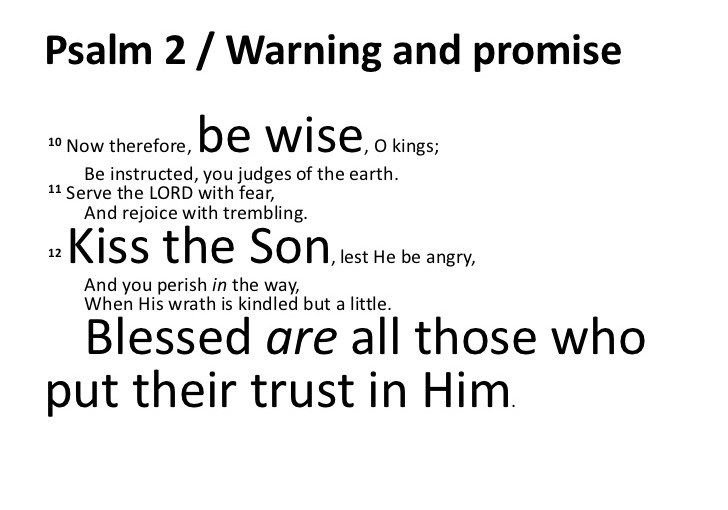
1Why do the heathen rage, and the people imagine a vain thing? The kings of the earth set themselves, and the rulers take counsel together, against the Lord, and against his anointed, saying, Let us break their bands asunder, and cast away their cords from us. He that sitteth in the heavens shall laugh: the Lord shall have them in derision. Then shall he speak unto them in his wrath, and vex them in his sore displeasure. Yet have I set my king upon my holy hill of Zion. I will declare the decree: the Lord hath said unto me, Thou art my Son; this day have I begotten thee. Ask of me, and I shall give thee the heathen for thine inheritance, and the uttermost parts of the earth for thy possession. Thou shalt break them with a rod of iron; thou shalt dash them in pieces like a potter’s vessel. 10 Be wise now therefore, O ye kings: be instructed, ye judges of the earth. 11 Serve the Lord with fear, and rejoice with trembling. 12 Kiss the Son, lest he be angry, and ye perish from the way, when his wrath is kindled but a little. Blessed are all they that put their trust in him.

No one knows for an absolute fact who wrote this psalm. However, it is widely accepted that it was written by King David. Many truly believe that because King David wrote in a theme, he wrote with a rhythm. This psalm has that rhythm. In addition, in the New Testament, in the book of Acts, chapter 4, verse 25, David is named as the writer, and the 2 psalm is quoted in that verse. While there is no proof of authorship, the word of those who were reading it in the time of writing the new testament are widely trusted to be doing so with a clear and accurate memory. I have no proof that when I was a child I owned a pet rock. But my memory knows it to be true. Do you believe me? I chose to believe the writer of Acts, Apostle Paul, and thus, believe that the king wrote this psalm.

Having said that, there is also some arguments as to whether the king was talking about himself, Jesus, or to both himself and Jesus. I have read the arguments thoroughly, and I have read the psalm over and over. I know that Kind David was a prophet, I also believe that Jesus is LORD. I believe there are parts of this psalm that can ONLY refer to Jesus. I believe that in verses 4, 5, and 6, David was talking expressly about Jesus. There is no man on earth, past-present-future, whose wrath will be greater than God. Oh we want to think ourselves some great equalizer but God is the creator of morality, and so only he can be the punisher of immorality. Additionally, King David speaks of “He who sits in heaven laughing and how the LORD will have his derision”, which means contempt or ridicule. No man, even King David should laugh at the man who is suffering the wrath of God. We should weep for the pain and suffering that we know awaits them. Charles Manson recently passed away. He went believing he was the anti-Christ, and also without much fanfare. For as much as he was in the news throughout his life, he should have been on the front page of the paper with the Headlines, “WEEP!!!! For his soul will forever be tormented in hell.” That is hard for us because we look at his behavior and say, “well he deserves it.” BREAKING NEWS…..we all deserve it. Not a single one of us is deserving of God’s mercy. So in this manner I believe these verses refer to Christ exclusively.

1 Peter 2

9 But you are a chosen race, a royal priesthood, a holy nation, a people for his own possession, that you may proclaim the excellencies of him who called you out of darkness into his marvelous light. 10 Once you were not a people, but now you are God’s people; once you had not received mercy, but now you have received mercy.

I believe King David refers to both himself and you and I in the rest. The first three verses are obviously about non-believers. That is a funny statement. When I say non-believers, I also refer to those who cry LORD LORD and yet obey him not. There are many who love him, they call on him, they are sore afraid of going to hell, so they claim his righteous name. Yet, these same people make friends with the world. They want the reward without the work. They want to be blessed by His hands, but use their own hands for their own benefit. They serve with no fear because they do not believe in His righteous wrath. Some say they believe in a God, but not the bible. Some believe that is is all about love and no obedience. They, I believe, are also non-believers.


Matthew 7
21 Not every one that saith unto me, Lord, Lord, shall enter into the kingdom of heaven; but he that doeth the will of my Father which is in heaven.
22 Many will say to me in that day, Lord, Lord, have we not prophesied in thy name? and in thy name have cast out devils? and in thy name done many wonderful works?
23 And then will I profess unto them, I never knew you: depart from me, ye that work iniquity.

In this psalm these are the kings and the leaders of the nations (heathens) surrounding Israel. They sit and conspire with each other to devise ways of disobedience. The word to use their thoughts in this psalm is “vein”. As I studied this word, I found that it could be misleading. I found this comment by Albert Barnes.

Albert Barnes on Psalm 2 verse 1

“That is, which will prove to be a vain thing, or a thing which they cannot accomplish. It cannot mean that they were engaged in forming plans which they supposed would be vain – for no persons would form such plans; but that they were engaged in designs which the result would show to be unsuccessful. The reference here is to the agitation among the nations in respect to the divine purpose to set up the Messiah as king over the world, and to the opposition which this would create among the nations of the earth.”

So how much vein thinking to do I do, meaning how much do I think of that goes against God’s plans for me, thus cannot be accomplished? That stuck with me. And in that thought, I believe that when David spoke of himself, he also spoke about you and me. Again, verse one. I have looked to my north and seen those who question me not to learn more about my faith but to watch me fail in the answer, to trap me into a corner. They wait for me to say something I cannot prove to ask for proof only to fail to understand that faith is the belief in that which is not seen. They are the world. I look to the east and west and I see friends, people who claim to love and  yet they have their magnifying glasses out looking for every spot, every blemish. They point their fingers and forget about the three other digits pointing right back at them. They judge forgetting that God used some of the most broken people that have ever lived to build his church. They break my heart because I hear their words and wonder what scripture they use to support them. Their words are dressed up with support and love, yet the true intent is to break my bonds and to tear apart the cords that connect me to my God.

But then David, again, talking about his realization and giving us instruction, saves the grace of mercy until the end. In that delivery the King gives great hope, because while he talks to himself, while he instructs you and I, he talks of the salvation brought to us through the sacrifice of Christ. I am so grateful that I will forever know that my relationship with God is mine. No man, no matter how hard he tries, can interrupt my relationship with God. It is only I who can end this relationship. I am equally glad that I do not believe satan and his lies that tell me in my troubles that God forgets about his children. Blessed are all they that put their trust in Him! Do not trust man, put your trust in the LORD. He will never let you down. Man will let you down. It may not be intentional, and they may beg for forgiveness, but it will happen. The ONLY one worthy of complete Faith, unbridled obedience is God Almighty. Stand strong, and do not let the enemy keep you from answering your calling.

If you stand in the mirror what will the reflection tell you about yourself, and what are you going to do about it? May the peace of God be abundantly heaped upon you and your house, straight from the cross to the Christian!

Leadership… a concept many believe they are great at. There are so many authors, so many experts who have made it their life’s mission to tell us all how to be a better leader. Did you know that the best self-help book to great leadership is the bible itself? I know many people think that the bible is all about sin and hell and rules and laws. But the Bible is loaded with principles. Yes, sometimes God comes right out and says, “Thou shall not kill.” Pretty self-explanatory if you ask me, right? But what about the principles in messages? Principles like character and integrity and honesty are at the core of God centered leadership.


There are many characters in the bible who God places and uses in positions of leadership. The first point of interest I would like to share is that all are human, and all but Jesus himself were sinners, and they all made mammoth mistakes. For now, I want to look at just one prophet who was an excellent leader. I want to look at the leadership qualities of Micah. Let’s put ourselves side by side with him and let’s bring in the mirror.


The first thing that is amazing to me, something that just rings loudly in my ear is that Micah was a poor man. He was considered a commoner, a peasant. He was not like Isaiah, who counseled kings; he was just a common ole country boy. I am a commoner, a peasant. I have nothing of great value, except for the Holy Spirit in me. I, in my flesh am not different than Micah. But Micah valued people. He had a love for mankind. Even though Micah spoke of the consequences for Samaria and Jerusalem, his heart broke for the people. Just understanding this little piece of background should already make you acutely aware of how God will use the small and the mighty to accomplish His mission. Isn’t also funny that most ‘great’ leaders have the love of people in common? To say the least, ‘great’ leaders at minimum understand and invest in the value of people. I think of General Patton. I think it may be a stretch to say he ‘loved’ people. However, he understood the value of well trained and well equipped soldiers. He understood moral and in the hardest of battles he was able to motivate them to give all they had. Micah loved people. He understood the disobedience and the need for God’s wrath, but his heart hurt for them.


In the first chapter we see Micah declaring God’s witness against the disobedient. We also see Micah’s mourning and grief for the people. Right now I am thinking of that old saying, “No one cares how much you know until they know how much you care.” Micah’s prophecy was not a kind one. But then he cries out for the people. As a leader, the people are the most valuable asset. I believe God looks at His children and loves them everyone. Each of us, no matter our differences, is loved by God to an unmeasurable degree. Equally and completely loved the child is to his Father.


Micah 1: 2 Hear, all ye people; hearken, O earth, and all that therein is: and let the Lord God be witness against you, the Lord from his holy temple. 3 For, behold, the Lord cometh forth out of his place, and will come down, and tread upon the high places of the earth. 4 And the mountains shall be molten under him, and the valleys shall be cleft, as wax before the fire, and as the waters that are poured down a steep place. 5 For the transgression of Jacob is all this, and for the sins of the house of Israel. What is the transgression of Jacob? is it not Samaria? and what are the high places of Judah? are they not Jerusalem? 6 Therefore I will make Samaria as an heap of the field, and as plantings of a vineyard: and I will pour down the stones thereof into the valley, and I will discover the foundations thereof.

Micah 1: 8 Therefore I will wail and howl, I will go stripped and naked: I will make a wailing like the dragons, and mourning as the owls.

In the second chapter we see characteristics of bad leadership. We see that the leaders of Micah’s time were selfish, greedy, lovers of self, and had not affection and respect for a human. They took things that were not theirs just because they could, like land and homes. A good leader cannot be selfish. At work, there is a goal. A leader must get the team to the goal, or to accomplish the goal. A leader must also grow the employee as the drive toward the goal. A leader must be a teacher, sharing wisdom and information. Dare I say there is a difference in teaching someone what they need to know so the goal is met, and teaching someone what they need to know so they have that information all their life. A student can feel and hear the teacher’s desire to grow them in a lesson just as loudly as they can hear and feel the teacher’s cold delivery of words just to get it done. At home the man is ordained as the leader. The husband is the accountable and responsible party. We should never lead selfishly, using our family to labor toward our goal. That is not leadership, its manipulation. We should lead wanting our children to be better than us. Moving them and our wife more toward God than to us. We are not the power, we are not the authority. This is God who ordains, it is God who has power and authority. We are a servant to His power. We are to grow the family towards God.


Micah 2: Woe to them that devise iniquity, and work evil upon their beds! when the morning is light, they practise it, because it is in the power of their hand. And they covet fields, and take them by violence; and houses, and take them away: so they oppress a man and his house, even a man and his heritage. Therefore thus saith the Lord; Behold, against this family do I devise an evil, from which ye shall not remove your necks; neither shall ye go haughtily: for this time is evil.


In the third chapter we see that the leaders of Micah’s time were abusive, and that God rebuked them. When they prayed to God, he did not hear them. I think the coming of Christ brought a greater understanding of God’s love, and how we are to love one another to this world, but I don’t think it changed how God’s wrath will handle sin. I don’t think God hears an abusive leader to this very day. I continue to believe that God’s wrath is no different in concentration and strength. I think sin angers God. To this day I think that many people profess to know and love Jesus, yet fail to understand that living in sin is not acceptable. We sin daily, but the spirit convicts us. We know of our errors and the wrath of God frightens us to our knees and we beg for forgiveness. I know people who claim the blood of Jesus and live no differently than those in the world thinking that the confession is all there is. Jesus loves me and I love him. Love is all there is to it. NO!!!!!! Love, when you have it right, motivates you to do the right things, to live in submission to Christ. Love does not permit you to grieve the spirit, to abuse the temple, to live in immoral conduct. We saw this here where the leaders abused the people, being evil in their daily lives, and still expecting the comforts of God.


Micah 3: And I said, Hear, I pray you, O heads of Jacob, and ye princes of the house of Israel; Is it not for you to know judgment? Who hate the good, and love the evil; who pluck off their skin from off them, and their flesh from off their bones; Who also eat the flesh of my people, and flay their skin from off them; and they break their bones, and chop them in pieces, as for the pot, and as flesh within the caldron. Then shall they cry unto the Lord, but he will not hear them: he will even hide his face from them at that time, as they have behaved themselves ill in their doings. Thus saith the Lord concerning the prophets that make my people err, that bite with their teeth, and cry, Peace; and he that putteth not into their mouths, they even prepare war against him. Therefore night shall be unto you, that ye shall not have a vision; and it shall be dark unto you, that ye shall not divine; and the sun shall go down over the prophets, and the day shall be dark over them. Then shall the seers be ashamed, and the diviners confounded: yea, they shall all cover their lips; for there is no answer of God. But truly I am full of power by the spirit of the Lord, and of judgment, and of might, to declare unto Jacob his transgression, and to Israel his sin.


Fast forward to chapter 6. I love verse 8. Understanding that we are all leaders, let us lead according to these principles so that our leadership finds favor in the sight of almighty God. Let us let at work, in the world, and in our homes looking to be just in all that we do, desiring from the depth of our minds to love one another and to be merciful with each other, and to be humble in our words and actions so to always have God at the head of all that we do.


Micah 6:He hath shewed thee, O man, what is good; and what doth the Lord require of thee, but to do justly, and to love mercy, and to walk humbly with thy God?


The final chapter of Micah, chapter 7 ends with the comfort a leader has when his leader is the LORD of all leaders. It starts with the reminders that man will fail you. Your own family will disappoint you. Your best friends will ask for gifts and seek bribes. We are instructed to have no confidence in man. Sure our daily tasks required us to have expectations in others. I think this is talking more along the lines of faith. We have expectations, me may even trust that our workers, our friends, our family will do what they need to, what they promised to but in God we put our faith of redemption in God. We pray God will protect us, and lead us. God does what no man can do because God is the divine leader who loves his people, who is the designer of morality and character, and the supplier of all mercy.


Micah 7: Trust ye not in a friend, put ye not confidence in a guide: keep the doors of thy mouth from her that lieth in thy bosom. For the son dishonoureth the father, the daughter riseth up against her mother, the daughter in law against her mother in law; a man’s enemies are the men of his own house. Therefore I will look unto the Lord; I will wait for the God of my salvation: my God will hear me. Rejoice not against me, O mine enemy: when I fall, I shall arise; when I sit in darkness, the Lord shall be a light unto me.


Micah was just in his prophecy in that he did not allow his love for people to sway his calling. But because he loved people, he was in the best position to lead by reminding the people that God will deliver Israel. God will fulfill his promises. Micah could do that because he humbly removed himself and allowed himself to be led by God.


So, as I look in my mirror, Micah teaches me to ask, am I just? Am I being fair or not? Do I fully understand all sides and am I making a well informed decision? Am I making sure that my people know I care about them, and not just about the mission? Do my people want to work for me? Are they motivated to want to be successful? Am I leading them to me, or to God? These questions are great questions for the employer, supervisor, manager, and even teammate. They are equally great questions for the husband, wife, dad, mom, older sibling, and even the youngest of them all.


If you stand in the mirror what will the reflection tell you about yourself, and what are you going to do about it? May the peace of God be abundantly heaped upon you and your house, straight from the cross to the Christian!

Release Your Grip on the Whip

The topic of our study is Forgiveness. One might think it a simple study, but I believe it is complex. First I wonder if we really understand what forgiveness is, biblically. I wonder if we meet the biblical thresh-hold of forgiveness. I wonder if we spend more time meeting the worldly definition of forgiveness. I don’t know, but I think a serious study of it is going to let us see for ourselves.

First let’s talk about some things that Forgiveness is not. It is NOT forgive and forget. I once heard a sermon by Dr. Voddie Baucham. He is one of my all-time favorite pastors to listen to. I never met him, but he has said in a number of his sermons that this idea of forgive and forget is a lie. He explained that the human brain is not designed to forget. So if the brain is forgetting it is malfunctioning. It has experienced some form of trauma, like Blunt force trauma or concussion, or disease like Alzheimer’s or dementia. It is unreasonable to expect the brain to forget a traumatic event when traumatic events are what burns a memory into the brain in the first place. Forgiveness is NOT an eraser. Forgiving does not erase the action. It does not say, “Okay, I forgive you so go ahead and go to sleep and when you wake up in the morning we will continue on like nothing happened.” NO!!! In most cases an action that has created some form of trauma has occurred. It happened!! There is no ignoring that. Because this is true, forgiveness is NOT absolution of accountability and immunity from consequence. I can forgive you, but there is still a consequence because the act really did happen. Biblically speaking, and we are going to look at some verses here soon, God is huge on accountability. If we are to be Christ like, how then can we say that there is no accountability? We cannot. There are consequences for our actions. Finally, forgiveness does not mean a relationship of any kind needs to continue. Now let’s be careful here. If you were violated, and you learned a lesson, and that lesson was that this is a dangerous person and for safety or health reasons and you are completely free of hate and animosity, it is appropriate to go our separate ways, no problem. But if you are violated, and you say you forgive and then not communicating with that person is out of anger or some form of punishment, then you have not truly forgiven. We will talk more about this, but for now let’s just say that you have to release your grip on the whip and hand that over to God as well if you are to truly forgive.

Now that we looked at some of the things forgiveness is not, let’s look at what it is. I really want to look at the biblical definition and compare it to what you think. In the bible forgiveness refers more to the act. When you forgive biblically, you are saying that you are overlooking an act. You are sending it away. The word forgive means we are overlooking the wrong, we are going to send the wrong away. But the other half of this is, “where are we sending it to?” To God!  There are many, and I mean many, verses that address forgiving others that you may be forgiven. But I love these verses in Colossians chapter 3 because it starts off by telling us a key point of forgiveness, and that is God’s wrath.

Colossians 3

For which things’ sake the wrath of God cometh on the children of disobedience:

In the which ye also walked some time, when ye lived in them.

But now ye also put off all these; anger, wrath, malice, blasphemy, filthy communication out of your mouth.

Lie not one to another, seeing that ye have put off the old man with his deeds;

10 And have put on the new man, which is renewed in knowledge after the image of him that created him:

11 Where there is neither Greek nor Jew, circumcision nor uncircumcision, Barbarian, Scythian, bond nor free: but Christ is all, and in all.

12 Put on therefore, as the elect of God, holy and beloved, bowels of mercies, kindness, humbleness of mind, meekness, longsuffering;

13 Forbearing one another, and forgiving one another, if any man have a quarrel against any: even as Christ forgave you, so also do ye.

When we forgive we are recognizing that we are not in control, and God is. So we are going to send this away and put the act and the offender into the hands of God. We are taking everything out of our hands, and putting into the hands of God. Why would we want to do that? We want this for a couple reasons.

First, we want this because, as these verses indicate, we are to put off our wrath. Put it off to where, God’s hands. Our wrath is not perfect and not righteous. When someone hurts us, our wrath is more about the fact that we hurt than the actual act. This is why we can be okay with our response but someone else is like, ‘gee wiz, being a little harsh aren’t we?’ God’s wrath is perfectly just. We need to trust that, and defer to it. After all, His instruction to us is to be peaceful and leave the wrath up to Him.

Romans 12:

17 Recompense to no man evil for evil. Provide things honest in the sight of all men.

18 If it be possible, as much as lieth in you, live peaceably with all men.

19 Dearly beloved, avenge not yourselves, but rather give place unto wrath: for it is written, Vengeance is mine; I will repay, saith the Lord.

20 Therefore if thine enemy hunger, feed him; if he thirst, give him drink: for in so doing thou shalt heap coals of fire on his head.

21 Be not overcome of evil, but overcome evil with good.

Secondly, we want this to happen because that’s what we want others to do to us. I don’t know about you, but I make mistakes. I am human and I admit that I have hurt people before, and as uncomfortable as this may sound, it is highly likely that I will hurt people again. I pray that they forgive me and send me and my offense to God for HIS deliberation. I pray for that because I know God is just. I know that God can see into my mind (most people use the word ‘heart’ a lot but I don’t. I think it confuses people. The heart is just a muscle that pumps blood to all parts of the body. Big job, important organ. But the truth is the BRAIN is the biblical heart. It is where thoughts, all the worldly wicked thoughts of man come from. It is the hub of emotions. It is also where the transformation takes place because repentance is to have a change of MIND on sin. Another deep lesson for another day.). He knows that while I did offend, I did not do it in malice and that I do genuinely seek forgiveness, and He knows that I am a forgiving person. So I want to be judged by the judge of all judges. If I want to be forgiven, then I must forgive. People don’t know the mind of man, but God does.  There are many verses about forgiving others if you want to be forgiven. I will provide just a few.

Ephesians 4:32

32 And be ye kind one to another, tenderhearted, forgiving one another, even as God for Christ’s sake hath forgiven you.

Matthew 6:15

15 But if ye forgive not men their trespasses, neither will your Father forgive your trespasses.

Matthew 18:33-35

33 Shouldest not thou also have had compassion on thy fellowservant, even as I had pity on thee?

34 And his lord was wroth, and delivered him to the tormentors, till he should pay all that was due unto him.

35 So likewise shall my heavenly Father do also unto you, if ye from your hearts forgive not everyone his brother their trespasses.

Now, I am going to step on some toes. How much more has been done to us than what this world did to Christ? I have thought that I was so violated that I was not only justified to not forgive, but to hate the offender. I was wrong. I hope that when you think of all that Jesus went through, not only in his final hours but during his years as a minister as well, you will see that your violation is small in comparison. Jesus was continuously mocked and spit on, and challenged. The man had no home; he was homeless. The savior slept on the ground and the rock was his pillow. And then yes, in the final hours he was so badly beaten and scourged that he was hardly recognizable. While on the cross, a torturous death by the way, he had a spear thrusted into his side just to see if he was still alive. And as if that was not enough, God placed the weight of all the sin in the world, all the sin that has been-is-and was yet to come, onto the body of Christ that we shall receive forgiveness. And in the course of all of this, Jesus’ prayer was that God the father forgive us because we have no clue what we were doing. This is the picture of perfect forgiveness. How much more can be done to a human being? And Christ took all the violations and put them into the hands of the father. Jesus said here, “I forgive them; I give up my right to have earthly and personal vengeance on these people. I turn them over to you. And if they can believe in you, I advocate on their behalf that you forgive them their violations against you and that you let them come home a redeemed child.”

1 Peter 2:19-21

19 For this is thankworthy, if a man for conscience toward God endure grief, suffering wrongfully.

20 For what glory is it, if, when ye be buffeted for your faults, ye shall take it patiently? but if, when ye do well, and suffer for it, ye take it patiently, this is acceptable with God.

21 For even hereunto were ye called: because Christ also suffered for us, leaving us an example, that ye should follow his steps:

Now this is important, when we are violated and we say out loud that we just cannot forgive, what we are really saying is, “I am going through more than what Christ went through, and that because this wrong is at a magnitude never seen before, God’s wrath will not be good enough. This offender must feel my wrath. This person must not have a path to redemption; there is no forgiveness for this person. I want you to forgive me, but this person, NO FORGIVENESS! I am sorry God, but I don’t trust you to handle this to my satisfaction. I want to make sure there are no mistakes here, and that this person suffers as I have suffered and then some more. I want them to feel my pain because the pain of hell is insufficient. It’s not enough.” Now you may think that I am going a little too far with this, but I challenge you to think about it. Have you ever made a mistake, handled it maturely and begged for forgiveness and while forgiven still had to suffer consequences and maybe even long term where you wondered when will I ever be done paying for this mistake? I have and because I have I can believe very easily that God’s wrath is wholly sufficient.

In closing, forgiveness is NOT a free pass. Even the saints will meet with the LORD to discuss obedience. Remember, “EVERY KNEE WILL BOW” It only seems like bad people get away with everything. Imagine Hell, filled with those ‘bad people’. Do you still think they got away with something? This earth is not our home. It is evil and wicked. This world is not fair, and welcoming. It is not our job to give up when we get knocked down. It is our job to continue to spread the gospel, to continue to let the light of Christ shine in spite of being violated. When you don’t do that, you are suffering from idolatry. Your woes are too great to put God first, which means you must come first, right? RIGHT! Think of it this way, while you are going on about the violation, the violator is enjoying life. Sometimes forgiveness frees you from the prisons of emotions. Let’s take full advantage of God. Cast upon Him your violators and their behaviors. Forgive so you can receive forgiveness. Forgive so you can be free from the bondage of bad memories and painful emotions.

If you stand in the mirror what will the reflection tell you about yourself, and what are you going to do about it? May the peace of God be abundantly heaped upon you and your house, straight from the cross to the Christian!