Proverbs chapter 10 verse 22:
The blessing of the LORD, it maketh rich, and he addeth no sorrow with it.
Verse Context
The Book of Proverbs, authored primarily by King Solomon is filled with practical wisdom for daily life, drawn from God’s eternal truth. Proverbs chapter 10 begins a series of short sayings that contrast the ways of the righteous and the wicked. In this verse, Solomon points to a specific kind of wealth, not just financial, but spiritual and emotional abundance, that can only come from the blessing of the LORD.
The Hebrew word translated “blessing” is berakah (בְּרָכָה, beh-rah-KAH), which refers to divine favor or benefit. To be blessed by God is to receive something from Him that brings peace, stability, and purpose. When Solomon says “it maketh rich,” he’s not limiting that to money. It includes a richness of life; joy, fulfillment, relationships, contentment, and eternal hope. And most importantly, He addeth no sorrow with it. Unlike worldly gain, which can bring anxiety, guilt, and destruction, God’s blessing brings peace with no hidden burden. The world may give you wealth and fame that ultimately destroys your soul, but when God gives, it uplifts and purifies.
This verse also teaches us something deeper: God’s blessings are not random acts of kindness. They are covenant-driven rewards for obedience, reverence, and relationship with Him. While the wicked may appear to prosper, their gain is often stained with sorrow. But for the righteous, every good gift is holy and sustaining.
Broader Context
Understanding what the Bible means when it talks about being “blessed” is essential. Many people believe blessings are merely material or circumstantial; health, money, a new job, a happy family. But scripture offers a much richer picture. God’s blessings are not limited to the physical. They are rooted in a relationship with Him.
Throughout scripture, God does indeed show kindness to all people. This is often referred to as common grace. In Matthew chapter 5 verse 45, Jesus teaches: “For he maketh his sun to rise on the evil and on the good, and sendeth rain on the just and on the unjust.” This means that even those who reject Him may still enjoy the warmth of the sun, the bounty of harvest, and the joy of family life. These are temporary, earthly blessings, not the spiritual, eternal blessings reserved for His people.
For those who are saved, redeemed through Christ, there is another category of blessing entirely. Ephesians chapter 1 verse 3 says: “Blessed be the God and Father of our Lord Jesus Christ, who hath blessed us with all spiritual blessings in heavenly places in Christ.” These are blessings of adoption into God’s family, the indwelling Holy Spirit, divine wisdom, eternal inheritance, and peace with God. These do not belong to the unbeliever. He may show mercy for a time, but He withholds the covenantal blessings that belong to His people.
Application
Appreciating God’s Greatness
God’s blessings are never random; they are personal, purposeful, and perfect. He knows exactly what His children need and provides it in a way that brings joy and peace without regret. That is a mark of His goodness. Even when He blesses the unbelieving world with food or beauty or comfort, it is a sign of His long-suffering love, giving them more time to repent. And when He blesses His children, He does so with eternity in view.
For the Believer
You are blessed because you are His. Whether your bank account is full or empty, whether you feel strong or weak, you are under the blessing of the Lord if you belong to Christ. Do not measure your blessing by your circumstance. Measure it by your position in Christ. The world cannot take away what God has given you. Walk in gratitude. Trust that every hardship is filtered through His hand and every joy is a whisper of His love.
Call to Action: Praise Him today for the spiritual blessings you often overlook. Salvation. Forgiveness. His Word. His Spirit. His promises. Rejoice that you are among the blessed who are heard when you pray. And never forget, He adds no sorrow to what He gives.
For the Unbeliever
If you’ve been living outside of God’s will, recognize that what you’re enjoying now, your health, your home, your success, is temporary. These are not proof that you are right with God. They are proof that He is merciful. But He desires to give you so much more. A new heart. A renewed mind. A cleansed soul. The kind of blessing that endures. But you must come to Him through repentance and faith in Jesus Christ. Until you do, your prayers are hindered, your soul remains lost, and your blessings are fleeting.
Final Encouragement
Being blessed doesn’t mean being lucky or rich or happy for a moment. It means being right with God. It means receiving from Him what the world cannot give. The blessing of the LORD truly does make us rich, and He adds no sorrow with it.
Prayer
Lord God, thank You for being the Giver of true and lasting blessings. Thank You for blessing us with things far greater than gold or comfort. Thank You for hearing our prayers, for guiding our steps, and for granting us peace. Help us to walk in obedience so we remain under the covering of Your favor. And for those who have not yet believed, open their eyes to see that You long to bless them with life, not just now, but forever. In Jesus’ name, Amen.
Closing
If you’ve found these daily verses encouraging, enlightening, or fruitful, please consider helping us spread the truth and light of God’s Word by subscribing to the blog and YouTube channels and liking and following the Facebook page. Most of all, share Believers of Biblical Truth and our links with others who may need the sermons and daily teachings just as much as we do.
You are loved, so much in fact, that we want you to know and be Believers of Biblical Truth.
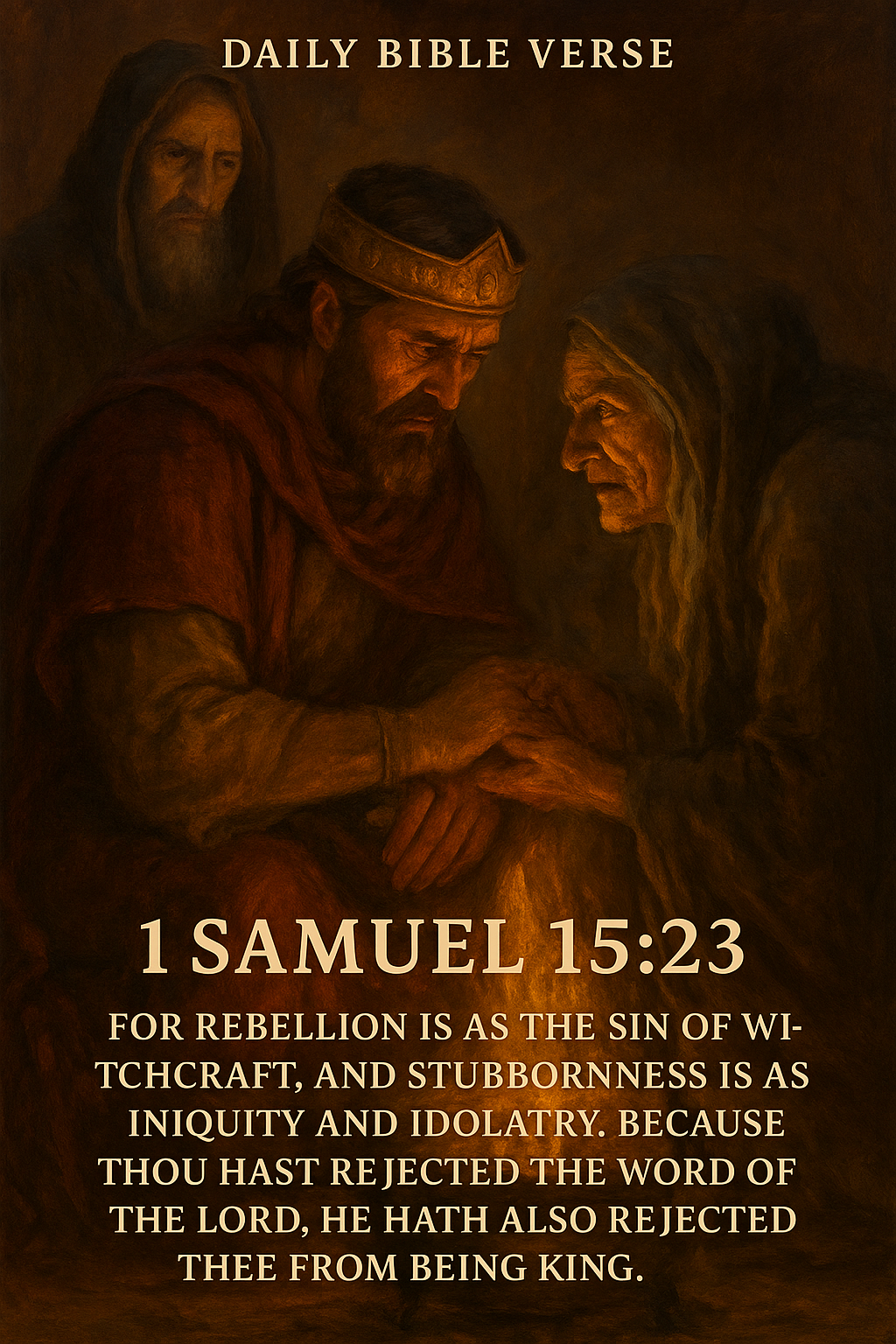
First Samuel chapter 15 verse 23:
For rebellion is as the sin of witchcraft, and stubbornness is as iniquity and idolatry. Because thou hast rejected the word of the Lord, he hath also rejected thee from being king.
Verse Context
The prophet Samuel was God’s mouthpiece to Israel during the time of King Saul, the first monarch of Israel. Saul had been divinely appointed, but that appointment came with a condition: he was to rule under God’s authority, not his own. First Samuel chapter 15 marks the turning point in Saul’s story, the moment his heart fully turned away from obedience.
God commanded Saul to destroy the Amalekites entirely, a people known for their ruthless ambush of Israel during the Exodus (see Exodus 17:8-16). This was a divine judgment, not a personal vendetta. But Saul disobeyed. He spared King Agag (pronounced AY-gag) and the best of the animals. He even built a monument to himself afterward, a prideful celebration of his victory rather than a humble act of obedience to God.
When Samuel confronted him, Saul lied and shifted blame. He claimed the people kept the animals to “sacrifice unto the LORD,” a common excuse when people disobey under the mask of religion. Samuel’s famous rebuke followed in 1 Samuel 15:22-23, culminating in today’s verse: “Because thou hast rejected the word of the Lord, he hath also rejected thee from being king.” Here, Samuel equates rebellion with witchcraft, because both reject God’s authority. Stubbornness (also translated “insolence” or “arrogance”) is likened to idolatry, because it places one’s will above God’s. And that’s where Saul’s fate is sealed.
Broader Context
Saul’s story is tragic, not just because of his fall, but because of how close he came to greatness. In First Samuel chapter 10, God gave Saul another heart and even allowed him to prophesy. He had every opportunity to walk in righteousness. But over time, fear of people, pride in himself, and a refusal to wait on the Lord led to his downfall.
Earlier, in First Samuel chapter 13, Saul grew impatient when Samuel didn’t arrive on time, and he offered a burnt offering, something only a priest should do. That moment cost him the permanence of his dynasty (see 1 Samuel 13:13-14). By chapter 15, God removed him altogether:
“The Lord hath rent the kingdom of Israel from thee this day, and hath given it to a neighbour of thine, that is better than thou” (1 Samuel 15:28).
That “neighbor” was David, a man after God’s own heart.
Saul continued as king for years after his rejection, but without God’s presence. He became tormented by an evil spirit, obsessed with control, paranoid of David, and eventually even consulted a witch (1 Samuel 28), the very sin Samuel warned about in today’s verse.
He ended his life in despair, suicide, and defeat on the battlefield. The man who was once “little in his own sight” (1 Samuel 15:17) became consumed with himself. He would not draw near to God, even in his final hours.
Application
Appreciating God’s Greatness
God doesn’t just want our sacrifices, He wants our obedience. Saul’s story reveals a holy God who demands loyalty from the heart, not just outward displays. God gave Saul opportunities to repent, but Saul chose appearance over substance, excuses over truth, pride over surrender.
For the Believer
This story warns us about what happens when we harden our hearts during trials. Saul had moments of pressure, delayed prophets, strong enemies, people demanding answers, but rather than wait on the Lord or cry out to Him, Saul took matters into his own hands. Many of us have our trials, loss, heartache, and battles that bring despair. Many of us try to handle our chaos with our own hands, usually making that tragedy even worse. We draw closer to God for His wisdom and comfort. Saul did not do that here. The result was eternal death. Saul is in hell tormented daily. Do not add to the tragedy. Reach out, call out, cry out to God in your despair. King David sinned greatly. The difference is he knew who to cry out to in his sinfulness. The Lord is righteous. When He gives us a command, we are not at liberty to alter it to fit our preferences. He is the King, not us. We are not meant to carry our burdens alone. Trials are invitations to draw closer to God. We must not be like Saul, justifying our partial obedience or using religious language to excuse our sin. When God speaks clearly, He expects to be obeyed clearly.
Call to Action
Examine your heart today. Is there an area where you’re only half-obeying God? Have you justified compromise, perhaps thinking your intentions are good enough?
Draw close to Him. Don’t wait. God’s mercy is great, but continued rebellion can lead to devastating consequences. Choose repentance. Choose surrender. Choose obedience.
For the Unbeliever
Saul’s story shows what happens when someone has a form of godliness but denies its power (see 2 Timothy 3:5). You can be chosen, blessed, even used by God, and still be lost if your heart is not right. Saul never fully surrendered.
Jesus Christ calls you not to religion, but to relationship. It’s not enough to say “I believe in God” while living in rebellion. Salvation is found only in Christ, through confession, repentance, and full surrender to His Lordship.
Final Encouragement
When we go through trials, we either turn to God, or we turn from Him. There is no middle ground. Yesterday we saw how Judas withdrew and was destroyed, while Peter wept bitterly and was restored. Today we saw how Saul disobeyed, hardened his heart, and ended in ruin.
Tomorrow is never guaranteed. If God is speaking to you today, don’t delay. Obedience is better than sacrifice. Draw close to God, and He will draw close to you.
Prayer
Heavenly Father, Thank You for the warning in Saul’s life. Help us to see where pride, fear, or self-justification have crept into our own hearts. Cleanse us from rebellion and give us hearts that obey You fully, not partially. In every trial, remind us that the safest place to run is into Your arms. Help us not to wait, not to justify, not to pretend—but to surrender. May we be like David, not Saul. And may we be found faithful, even when life is hard. In Jesus’ name we pray, amen.
Closing
If you’ve found these daily verses encouraging, enlightening, or fruitful, please consider helping us spread the truth and light of God’s Word by subscribing to the blog and YouTube channels and liking and following the Facebook page. Most of all, share Believers of Biblical Truth and our links with others who may need the sermons and daily teachings just as much as we do.
You are loved, so much in fact, that we want you to know and be Believers of Biblical Truth.
Matthew chapter 26 verse 24:
The Son of man goeth as it is written of him: but woe unto that man by whom the Son of man is betrayed! it had been good for that man if he had not been born.
VERSE CONTEXT
Judas Iscariot was not a stranger to Christ. He wasn’t a confused Pharisee or a deceived Roman. He was hand-picked by Jesus after a night of prayer (Luke 6:12–16). He was a disciple, a follower. He witnessed miracles. He sat under Jesus’ direct teaching. He was given power, along with the other apostles, to cast out devils and heal diseases (Matthew 10:1). He was even trusted with the money bag (John 12:6). In every visible way, Judas was a believer. But he wasn’t just a backslider. He was a betrayer.
That final night, at the Last Supper, Jesus looked across the table and said: “Verily I say unto you, that one of you shall betray me” (Matthew 26:21). Each disciple, with trembling, asked, “Lord, is it I?” But Judas said, “Master, is it I?” (v. 25). That word matters. The others called Him Lord. Judas called Him Master. He was close, but not submitted. He followed, but didn’t obey. And then Jesus said what should freeze every soul: “Thou hast said.”
Then came verse 24—today’s daily Bible verse:
“Woe unto that man… it had been good for that man if he had not been born.”
This is no metaphor. Jesus; the Lamb, the Savior, the Redeemer, is saying it would’ve been better for Judas to never exist than to betray the Lord and face what comes next. That is hell. That is eternal, conscious, damnation. Let no one say, “Jesus would never send anyone to hell.” He said this.
Judas didn’t stumble into apostasy. He walked into it with full knowledge. When he kissed Jesus in the garden, Jesus still gave him a chance: “Friend, wherefore art thou come?” (Matthew 26:50). But Judas was already gone, spiritually dead, even while breathing.
After the betrayal, the Bible says Judas repented himself (Matthew 27:3), but not toward God. It was guilt, not godly sorrow. There was no faith, no appeal to Christ, no tears like Peter’s. He gave the silver back to the priests and went and hanged himself.
Acts 1:18 says, “Now this man purchased a field with the reward of iniquity; and falling headlong, he burst asunder in the midst, and all his bowels gushed out.” The horror of his end mirrored the horror of his betrayal. But death was not the end. Acts 1:25 confirms where he went: “…that he might go to his own place.” That phrase has long been understood to mean hell, his appointed destination. He didn’t just fail. He quit and turned back. And that matches the warning in Hebrews chapter 10 verse 26:
“For if we sin wilfully after that we have received the knowledge of the truth, there remaineth no more sacrifice for sins.”
“For it is impossible for those who were once enlightened, and have tasted of the heavenly gift… if they shall fall away, to renew them again unto repentance…”
So why do we tell this story today? Because there are people reading this who are on the edge. You’ve been hurt. You’ve been disappointed. You feel like giving up. But today’s verse tells you why you must not quit. There is no safety outside of Christ. There is no reward for those who turn back. There is no second chance after deliberate apostasy. You must finish the race. You must endure. You must stay the course. Let Judas be the eternal reminder that knowing Christ is not enough. You must follow Him to the end.
Broader Context
When we consider the story of Judas Iscariot and the terrifying statement made by Jesus in Matthew 26:24, “It had been good for that man if he had not been born”, we are reminded that walking away from the truth after knowing it is not only possible but eternally deadly. This reality should sober every believer, especially those going through immense pain and suffering. Life can break a person in ways they never expected. But the broader testimony of Scripture answers, not always with why it happened, but with what we must do in response: endure. The pain is real, but so is the command to stay faithful.
The Bible doesn’t hide the hardship of life. In fact, it tells us plainly in Colossians chapter 3:1-2, “If ye then be risen with Christ, seek those things which are above… Set your affection on things above, not on things on the earth.” This is not optional. It is survival. The believer who places their hope in anything on this earth, health, family, career, even church leadership, will be devastated when that thing falls. And it will fall. Loved ones die. Bodies fail. Dreams are crushed. But Jesus remains, and we are commanded to keep our eyes fixed above. If our affection is set on heaven, then even in tragedy we are not destroyed. That’s what Paul meant when he said in Second Corinthians chapter 4, “Though our outward man perish, yet the inward man is renewed day by day.” His “light affliction” wasn’t light by human standards. He was beaten, shipwrecked, left for dead, betrayed, and imprisoned. But he called it light, because he measured it against eternity, not against comfort.
When Jesus said Judas would have been better off never being born, He wasn’t being dramatic. He was being honest. Hell is real, and Judas is there now, not because he sinned, but because he turned back and never returned. That is the danger we face if we allow suffering to uproot our faith. Hebrews chapter 10 verse 26 warns, “For if we sin wilfully after that we have received the knowledge of the truth, there remaineth no more sacrifice for sins.” This is not about losing salvation like a dropped coin. This is about rejecting Christ after knowing Him, knowing the gospel, sitting under the Word, seeing God’s goodness, and then walking away. There is no sacrifice left for that person, only a fearful judgment. Judas didn’t just fall into sin. He hardened his heart. That’s why Hebrews 6 says it is impossible to renew some again to repentance. The Holy Spirit doesn’t jump in and out. If you reject Him knowingly, you reject Him eternally.
But not every story ends like Judas’. There are believers who’ve endured immense suffering and stayed faithful. One such man was Horatio Spafford. He was a wealthy Christian lawyer whose real estate investments were destroyed in the Chicago fire. Shortly after, his four daughters died in a shipwreck. As he sailed over the very waters where they drowned, he wrote the hymn, “It Is Well With My Soul.” That’s not myth. That’s real. In the depth of loss, he held firm to his Savior. He didn’t let tragedy drive him away from God, he let it anchor him deeper. That’s what we must do. We must not quit. We must not let grief or confusion become our permission slip for unbelief. Jesus said in Matthew chapter 10 verse 22, “He that endureth to the end shall be saved.” Not he that starts the race, not he that shows promise, but he that finishes. That verse wasn’t written for the strong, it was written for the weary. For the woman crying in a silent house. For the man who just buried his child. For the worker who dreads waking up tomorrow. It was written for you, and for me.
The pain we feel is not proof that God has abandoned us. It is the fire that reveals where our hope truly rests. Some people will suffer and curse God. Others will suffer and cling to Him all the more. The difference is not strength, it’s faith. The faith that endures is the faith that saves. Peter failed Jesus too, but Peter wept and returned. Judas failed and walked into the night. The choice is ours every time tragedy hits: walk away in bitterness, or fall on our knees in trust. And make no mistake, God sees the choice. He does not forget it. There is no eternal reward for temporary faith. There is no crown for those who put their hand to the plough and look back. Only those who endure to the end will be saved.
APPLICATION
For the Believer
If you are walking through deep pain, grief, confusion, or weariness, this message is for you. You are not alone in wondering why God seems silent or why tragedy has struck your life. Many faithful believers have cried out in agony asking why God would allow them to lose a spouse, bury a child, endure disease, or feel abandoned in the midst of heartbreak. These are not signs of weak faith. These are the battles of real faith. Let the pain press you into Christ, not push you away. Let the storm drive you to your knees, not back into the world. If Judas teaches us anything, it is this: to be near Jesus, to know the truth, to taste grace, and then to throw it away, is a greater sin than to have never known at all. But if you stay the course, if you hold fast when everything else falls, then Jesus, the same Judge who condemned Judas, will welcome you with arms wide open and say, “Well done.” Finish well. Heaven is worth it.
The pain you carry may not be your fault, but what you do with it is your responsibility. Judas allowed his guilt and confusion to pull him away from Jesus. Instead of returning in repentance, like Peter, he walked into the darkness and never came back. He stopped believing that forgiveness was possible. He stopped trusting that Jesus was still the answer. He tried to fix it himself, and it destroyed him. The message for the believer is simple but serious: you must finish. Jesus doesn’t reward those who begin the race, He crowns those who endure to the end. Your tears are real, but they are not excuses to let go of the Savior.
You may feel crushed by grief. You may be angry. You may feel numb. But if you still call Jesus your Lord, then you cannot walk away. You must stay the course, even when it hurts. Especially when it hurts. Because the crown is not given for comfort, it’s given for faithfulness. Hold on, even if all you can do is whisper His name.
Call to Action
If you are hurting, don’t isolate. Don’t stop praying. Don’t stop reading your Bible. Don’t let pain drive you to bitterness. Surround yourself with truth, not with noise. Get around people who will point you back to Christ, not feed your doubts. Confess your sorrow to the Lord, and ask Him to keep your heart soft. Stay in the Word, stay in prayer, stay planted in a church that preaches the truth. You may not feel strong, but you don’t need to be strong, you just need to endure. Finish the race. Finish with Jesus. Don’t be like Judas. Be like Peter. Weep if you must, but return.
For the Unbeliever
If you are reading this and you have not fully surrendered your life to Jesus Christ, do not think that knowing about Him is the same as knowing Him. Judas knew Jesus. He heard His voice. He followed Him for years. But he never believed in Him as Lord. His heart was never changed. And when his world fell apart, he had no faith to fall back on. He tried to fix his guilt by returning the silver, but without repentance, there is no salvation.
This is your warning. If you’ve heard the gospel, if you know that Jesus died for your sins and rose again, and yet you continue to delay, you are playing with eternal fire. Judas delayed. Judas hardened his heart. Judas died without Christ. And Jesus Himself said it would have been better if Judas had never been born. Don’t let that be you.
There is still time. Right now, God is giving you one more chance to believe. But you do not know if you’ll get another. Do not walk away from the truth. Do not turn your back on the only One who can save you. You are not promised another hour. Repent today. Believe today. Surrender your life to Jesus Christ while the door of mercy is still open. Because the day will come when it is not.
PRAYER
Heavenly Father, We come before You today with trembling hearts and tear-stained eyes, knowing that life on this earth can shake us to the core. But Lord, even in our grief, even in our pain, help us never to walk away from You. Let the sorrow we carry drive us to our knees, not out the door. Strengthen every weary believer who is reading this today, those who feel like giving up, those who are angry, those who are overwhelmed. Remind them, Lord, that You are still with them, even when You feel distant. That Your Word is still true, even when life feels cruel. That You are still faithful, even when the storm has not passed.
Help us to endure. Help us to finish. Keep us from becoming like Judas, Lord. Give us the faith to return like Peter. Give us the endurance to follow like Paul. Give us the hope to worship like Job. Let not one soul reading these words fall away. And for those who have not yet surrendered to Christ, break through the hardness of their hearts and let this be the day they repent and believe. We ask this in the holy and righteous name of Jesus Christ, the Savior who never fails. Amen.
CLOSING
If you’ve found these daily verses encouraging, enlightening, or fruitful, please consider helping us spread the truth and light of God’s Word by subscribing to the blog and YouTube channels and liking and following the Facebook page. Most of all, share Believers of Biblical Truth and our links with others who may need the sermons and daily teachings just as much as we do.
You are loved, so much in fact, that we want you to know and be Believers of Biblical Truth.
Second Chronicles 15:7
Be ye strong therefore, and let not your hands be weak: for your work shall be rewarded.
Verse Context:
This powerful word was spoken by the prophet Azariah to King Asa of Judah during a time of national instability and spiritual reform. God had sent Azariah with a message to encourage Asa as he sought to rid Judah of idolatry and restore true worship. The prophet reminded Asa that although others had forsaken the Lord and faced hardship, those who seek Him will find Him (see 2 Chronicles 15:2). The final word of the message is this verse, a divine reassurance to stay strong, keep working, and not give up.
In this verse, we find a timeless encouragement: “Be ye strong therefore” — This is a direct call to courage and perseverance. In Hebrew, the word for “strong” here is chazaq (khah-ZAHK), which means to grow firm, to be resolute, to seize hold with confidence.
“Let not your hands be weak” — The phrase paints a picture of someone whose hands are drooping from exhaustion, whose arms are tired from labor. But God says: Do not let weariness cause you to stop. The work is not in vain.
“For your work shall be rewarded” — God promises that faithfulness, even when unseen by others, will be seen and rewarded by Him. In Hebrew, the word for “rewarded” is sakar (sah-KAHR), meaning wages, compensation, or divine repayment.
This verse is especially important for anyone in ministry, parenting, service, or spiritual battle. It declares: Your work matters. God sees it. Keep going.
Broader Context:
Second Chronicles 15 is a chapter of revival. Asa, the king of Judah, had courageously torn down idols and commanded the people to seek the Lord. His reforms faced opposition, and revival is never easy. But in the midst of this, the Lord sent Azariah to remind him that God is with those who are with Him (2 Chronicles 15:2). The chapter recounts Asa’s faithful response: he was strengthened by the prophecy, continued the work, and even entered into a covenant with the people to seek the LORD wholeheartedly.
The entire book of Second Chronicles was written for the post-exilic Jews returning from Babylon. Its purpose was to remind them—and us—that faithful obedience and wholehearted worship of the true God always brings His presence and blessing. This particular verse was meant to encourage weary hands to keep building, keep trusting, and keep walking with the Lord even when it’s hard.
Application:
Appreciating God’s Greatness:
This verse shows that God is not a passive observer but an active rewarder of those who do good in His name. He knows when you’re tired, discouraged, or tempted to quit. And He personally sends words of life; like this one, to strengthen you. It shows His grace, kindness, and intentional encouragement toward His people.
For the Believer:
Sometimes believers feel like their efforts are going unnoticed, whether it’s in ministry, family, prayer, or resisting temptation. But this verse is a heavenly reminder that God sees, and your spiritual persistence will be rewarded. The Lord doesn’t miss a single faithful step. When others forsake Him, when society chooses idols, when your hands tremble from exhaustion, you stay strong. He is watching, and He is working.
Call to Action: Keep going. Don’t let weariness convince you to quit. Strengthen your hands through prayer, worship, and the Word. Keep teaching, keep parenting, keep serving, keep obeying, keep resisting sin, keep standing for truth. You are not working in vain. You are not fighting alone. Be strong therefore… for your work shall be rewarded.
For the Unbeliever:
To those who haven’t yet turned to the Lord, this verse shows that God rewards those who seek Him. But you cannot expect His reward without first seeking His righteousness. Stop striving for the world’s rewards. They will all pass away. God is calling you to something better; eternal life, peace, purpose, and a reward that cannot fade. But it starts with surrender and repentance. Today is the day to stop laboring for things that do not last and begin serving the One who does.
Final Encouragement:
If you’re tired today, if you’re holding onto faith while feeling like no one sees; God sees. He strengthens the weary. He honors the faithful. This is not the time to let your hands hang low. This is the time to grip the plow, stand in the gap, finish the race. Be strong… for your work shall be rewarded.
Prayer:
Father God, thank You for seeing our efforts even when no one else does. Thank You for the promise that our labor is not in vain. Strengthen the hands that are tired today. Renew courage in the hearts that feel like quitting. Fill us with resolve to press on, to trust You, and to continue doing what is right in Your sight. Help us to work as unto You and not unto man, and remind us each day that You are our rewarder. In Jesus’ name we pray, Amen.
Closing:
If you’ve found these daily verses encouraging, enlightening, or fruitful, please consider helping us spread the truth and light of God’s Word by subscribing to the blog and YouTube channels and liking and following the Facebook page. Most of all, share Believers of Biblical Truth and our links with others who may need the sermons and daily teachings just as much as we do.
You are loved, so much in fact, that we want you to know and be Believers of Biblical Truth.
Second Corinthians 4:1
Therefore seeing we have this ministry, as we have received mercy, we faint not;
Verse Context
The Apostle Paul wrote Second Corinthians to defend his ministry, affirm God’s power in human weakness, and strengthen the church’s resolve amid trials. Written around AD 55–56, this letter addresses a church Paul dearly loved but had to correct. In chapter 4, Paul speaks about the nature of true ministry, it is not glamorous, easy, or self-promoting. Rather, it is grounded in God’s mercy, upheld by His Spirit, and carried out despite affliction.
The phrase “this ministry” refers to the ministry of the New Covenant (see 2 Corinthians 3), where believers serve not by the letter of the law, but by the Spirit, bringing life, not death. Paul reminds us that his endurance isn’t based on strength, charisma, or applause, but on the mercy he has received. He doesn’t quit (we faint not) because his calling came from the God who gave him mercy, not man.
As Charles Hodge (1797–1878, Presbyterian theologian) noted: “The mercy received by ministers is the constant source of their strength and the ground of their perseverance.”
Broader Context
Second Corinthians is one of Paul’s most emotionally transparent letters. It oscillates between pain and encouragement, conflict and hope. Chapter 4 contrasts the frailty of human vessels (“earthen vessels,” verse 7) with the power of God who works through them. Paul is reminding all Christians that the work of the Gospel is not accomplished through personal ability or public praise, it’s driven by mercy, sustained through grace, and displayed in perseverance even when unseen.
Verse 1 sets the tone for the entire chapter: ministry is hard, but it is also anchored in mercy. Therefore, we do not give up.
Paul later writes in Second Corinthians 4:8–9: We are troubled on every side, yet not distressed; we are perplexed, but not in despair; Persecuted, but not forsaken; cast down, but not destroyed.
These verses show the real weight Paul carried, and why “we faint not” is not a casual phrase, it’s a declaration of faith in action.
A personal note: I was recently discussing scripture with a human friend, my best friend, and felt myself getting upset. We all must be careful to allow the scripture to talk to us, and not to talk to it. What I mean is, God gave us the word to have and to follow, but also to guide us to our deeper understanding of its meaning. Sometimes we have to dig deep and sometimes we have to trust that God means simply what He says. We get into this habit of interpreting the Bible. This is a delicate exercise because we do not want to interpret it in such a way that it allows us to be wrong. That is us talking to scripture. We want to interpret what the write is saying not what we are saying. At the end, I am called by God, no matter who thinks what. I am also a sinner. God, not man, is my refuge. We cannot lose heart, we must endure.
Application
1. Appreciating God’s Greatness
God does not call us to serve Him because of our strength. He entrusts us with ministry because of His mercy. Whether you are a pastor, teacher, parent, or quiet intercessor, your labor is not in vain because He sustains it. The greatness of God is seen in the fact that He continues His work through broken vessels like us, and gives us the strength not to faint.
2. For the Believer
This verse speaks to the wearied servant, the one who has faced criticism, exhaustion, and obscurity. Today’s reminder is simple: You have this ministry. Not someone else’s. Not a hypothetical one. The one God has given you, sustained by His mercy.
Call to Action: Reflect on what God has entrusted to you, your household, your testimony, your prayer life, your ministry, your witness, and remember it is yours because of mercy. Don’t give up. God didn’t choose you based on your strength. He called you in mercy, and that mercy still holds you today.
3. For the Unbeliever
This verse reminds you that the Christian faith is not about earning or deserving a role. It’s about receiving mercy. Ministry isn’t for the perfect; it’s for the redeemed. If you are exhausted from trying to fix your life without peace or purpose, Jesus offers mercy, and through that mercy, a life of eternal purpose. Accept Him today, and you too will “faint not.”
Final Encouragement
No matter how tired, rejected, or small you feel, if God has placed you in ministry—any ministry—He will carry you by mercy. Mercy is not the beginning of ministry—it is the foundation of endurance. And because of that, you faint not.
Prayer
Father, thank You for the ministry You have given each of us. Whether public or private, visible or hidden, it is a gift of Your mercy. Strengthen us today to not give up—to press on, not in our own strength, but in the mercy that saved us. Encourage the discouraged. Renew the weary. Empower the hesitant. Let Your mercy be the fuel of our obedience. In Jesus’ name, amen.
Closing
If you’ve found these daily verses encouraging, enlightening, or fruitful, please consider helping us spread the truth and light of God’s Word by subscribing to the blog and YouTube channels and liking and following the Facebook page. Most of all, share Believers of Biblical Truth and our links with others who may need the sermons and daily teachings just as much as we do.
You are loved, so much in fact, that we want you to know and be Believers of Biblical Truth.





You must be logged in to post a comment.