
Leadership… a concept many believe they are great at. There are so many authors, so many experts who have made it their life’s mission to tell us all how to be a better leader. Did you know that the best self-help book to great leadership is the bible itself? I know many people think that the bible is all about sin and hell and rules and laws. But the Bible is loaded with principles. Yes, sometimes God comes right out and says, “Thou shall not kill.” Pretty self-explanatory if you ask me, right? But what about the principles in messages? Principles like character and integrity and honesty are at the core of God centered leadership.


There are many characters in the bible who God places and uses in positions of leadership. The first point of interest I would like to share is that all are human, and all but Jesus himself were sinners, and they all made mammoth mistakes. For now, I want to look at just one prophet who was an excellent leader. I want to look at the leadership qualities of Micah. Let’s put ourselves side by side with him and let’s bring in the mirror.


The first thing that is amazing to me, something that just rings loudly in my ear is that Micah was a poor man. He was considered a commoner, a peasant. He was not like Isaiah, who counseled kings; he was just a common ole country boy. I am a commoner, a peasant. I have nothing of great value, except for the Holy Spirit in me. I, in my flesh am not different than Micah. But Micah valued people. He had a love for mankind. Even though Micah spoke of the consequences for Samaria and Jerusalem, his heart broke for the people. Just understanding this little piece of background should already make you acutely aware of how God will use the small and the mighty to accomplish His mission. Isn’t also funny that most ‘great’ leaders have the love of people in common? To say the least, ‘great’ leaders at minimum understand and invest in the value of people. I think of General Patton. I think it may be a stretch to say he ‘loved’ people. However, he understood the value of well trained and well equipped soldiers. He understood moral and in the hardest of battles he was able to motivate them to give all they had. Micah loved people. He understood the disobedience and the need for God’s wrath, but his heart hurt for them.


In the first chapter we see Micah declaring God’s witness against the disobedient. We also see Micah’s mourning and grief for the people. Right now I am thinking of that old saying, “No one cares how much you know until they know how much you care.” Micah’s prophecy was not a kind one. But then he cries out for the people. As a leader, the people are the most valuable asset. I believe God looks at His children and loves them everyone. Each of us, no matter our differences, is loved by God to an unmeasurable degree. Equally and completely loved the child is to his Father.


Micah 1: 2 Hear, all ye people; hearken, O earth, and all that therein is: and let the Lord God be witness against you, the Lord from his holy temple. 3 For, behold, the Lord cometh forth out of his place, and will come down, and tread upon the high places of the earth. 4 And the mountains shall be molten under him, and the valleys shall be cleft, as wax before the fire, and as the waters that are poured down a steep place. 5 For the transgression of Jacob is all this, and for the sins of the house of Israel. What is the transgression of Jacob? is it not Samaria? and what are the high places of Judah? are they not Jerusalem? 6 Therefore I will make Samaria as an heap of the field, and as plantings of a vineyard: and I will pour down the stones thereof into the valley, and I will discover the foundations thereof.

Micah 1: 8 Therefore I will wail and howl, I will go stripped and naked: I will make a wailing like the dragons, and mourning as the owls.

In the second chapter we see characteristics of bad leadership. We see that the leaders of Micah’s time were selfish, greedy, lovers of self, and had not affection and respect for a human. They took things that were not theirs just because they could, like land and homes. A good leader cannot be selfish. At work, there is a goal. A leader must get the team to the goal, or to accomplish the goal. A leader must also grow the employee as the drive toward the goal. A leader must be a teacher, sharing wisdom and information. Dare I say there is a difference in teaching someone what they need to know so the goal is met, and teaching someone what they need to know so they have that information all their life. A student can feel and hear the teacher’s desire to grow them in a lesson just as loudly as they can hear and feel the teacher’s cold delivery of words just to get it done. At home the man is ordained as the leader. The husband is the accountable and responsible party. We should never lead selfishly, using our family to labor toward our goal. That is not leadership, its manipulation. We should lead wanting our children to be better than us. Moving them and our wife more toward God than to us. We are not the power, we are not the authority. This is God who ordains, it is God who has power and authority. We are a servant to His power. We are to grow the family towards God.


Micah 2: Woe to them that devise iniquity, and work evil upon their beds! when the morning is light, they practise it, because it is in the power of their hand. 2 And they covet fields, and take them by violence; and houses, and take them away: so they oppress a man and his house, even a man and his heritage. 3 Therefore thus saith the Lord; Behold, against this family do I devise an evil, from which ye shall not remove your necks; neither shall ye go haughtily: for this time is evil.


In the third chapter we see that the leaders of Micah’s time were abusive, and that God rebuked them. When they prayed to God, he did not hear them. I think the coming of Christ brought a greater understanding of God’s love, and how we are to love one another to this world, but I don’t think it changed how God’s wrath will handle sin. I don’t think God hears an abusive leader to this very day. I continue to believe that God’s wrath is no different in concentration and strength. I think sin angers God. To this day I think that many people profess to know and love Jesus, yet fail to understand that living in sin is not acceptable. We sin daily, but the spirit convicts us. We know of our errors and the wrath of God frightens us to our knees and we beg for forgiveness. I know people who claim the blood of Jesus and live no differently than those in the world thinking that the confession is all there is. Jesus loves me and I love him. Love is all there is to it. NO!!!!!! Love, when you have it right, motivates you to do the right things, to live in submission to Christ. Love does not permit you to grieve the spirit, to abuse the temple, to live in immoral conduct. We saw this here where the leaders abused the people, being evil in their daily lives, and still expecting the comforts of God.


Micah 3: And I said, Hear, I pray you, O heads of Jacob, and ye princes of the house of Israel; Is it not for you to know judgment? 2 Who hate the good, and love the evil; who pluck off their skin from off them, and their flesh from off their bones; 3 Who also eat the flesh of my people, and flay their skin from off them; and they break their bones, and chop them in pieces, as for the pot, and as flesh within the caldron. 4 Then shall they cry unto the Lord, but he will not hear them: he will even hide his face from them at that time, as they have behaved themselves ill in their doings. 5 Thus saith the Lord concerning the prophets that make my people err, that bite with their teeth, and cry, Peace; and he that putteth not into their mouths, they even prepare war against him. 6 Therefore night shall be unto you, that ye shall not have a vision; and it shall be dark unto you, that ye shall not divine; and the sun shall go down over the prophets, and the day shall be dark over them. 7 Then shall the seers be ashamed, and the diviners confounded: yea, they shall all cover their lips; for there is no answer of God. 8 But truly I am full of power by the spirit of the Lord, and of judgment, and of might, to declare unto Jacob his transgression, and to Israel his sin.


Fast forward to chapter 6. I love verse 8. Understanding that we are all leaders, let us lead according to these principles so that our leadership finds favor in the sight of almighty God. Let us let at work, in the world, and in our homes looking to be just in all that we do, desiring from the depth of our minds to love one another and to be merciful with each other, and to be humble in our words and actions so to always have God at the head of all that we do.


Micah 6:8 He hath shewed thee, O man, what is good; and what doth the Lord require of thee, but to do justly, and to love mercy, and to walk humbly with thy God?


The final chapter of Micah, chapter 7 ends with the comfort a leader has when his leader is the LORD of all leaders. It starts with the reminders that man will fail you. Your own family will disappoint you. Your best friends will ask for gifts and seek bribes. We are instructed to have no confidence in man. Sure our daily tasks required us to have expectations in others. I think this is talking more along the lines of faith. We have expectations, me may even trust that our workers, our friends, our family will do what they need to, what they promised to but in God we put our faith of redemption in God. We pray God will protect us, and lead us. God does what no man can do because God is the divine leader who loves his people, who is the designer of morality and character, and the supplier of all mercy.


Micah 7: 5 Trust ye not in a friend, put ye not confidence in a guide: keep the doors of thy mouth from her that lieth in thy bosom. 6 For the son dishonoureth the father, the daughter riseth up against her mother, the daughter in law against her mother in law; a man’s enemies are the men of his own house. 7 Therefore I will look unto the Lord; I will wait for the God of my salvation: my God will hear me. 8 Rejoice not against me, O mine enemy: when I fall, I shall arise; when I sit in darkness, the Lord shall be a light unto me.


Micah was just in his prophecy in that he did not allow his love for people to sway his calling. But because he loved people, he was in the best position to lead by reminding the people that God will deliver Israel. God will fulfill his promises. Micah could do that because he humbly removed himself and allowed himself to be led by God.


So, as I look in my mirror, Micah teaches me to ask, am I just? Am I being fair or not? Do I fully understand all sides and am I making a well informed decision? Am I making sure that my people know I care about them, and not just about the mission? Do my people want to work for me? Are they motivated to want to be successful? Am I leading them to me, or to God? These questions are great questions for the employer, supervisor, manager, and even teammate. They are equally great questions for the husband, wife, dad, mom, older sibling, and even the youngest of them all.


If you stand in the mirror what will the reflection tell you about yourself, and what are you going to do about it? May the peace of God be abundantly heaped upon you and your house, straight from the cross to the Christian!

Release Your Grip on the Whip

The topic of our study is Forgiveness. One might think it a simple study, but I believe it is complex. First I wonder if we really understand what forgiveness is, biblically. I wonder if we meet the biblical thresh-hold of forgiveness. I wonder if we spend more time meeting the worldly definition of forgiveness. I don’t know, but I think a serious study of it is going to let us see for ourselves.

First let’s talk about some things that Forgiveness is not. It is NOT forgive and forget. I once heard a sermon by Dr. Voddie Baucham. He is one of my all-time favorite pastors to listen to. I never met him, but he has said in a number of his sermons that this idea of forgive and forget is a lie. He explained that the human brain is not designed to forget. So if the brain is forgetting it is malfunctioning. It has experienced some form of trauma, like Blunt force trauma or concussion, or disease like Alzheimer’s or dementia. It is unreasonable to expect the brain to forget a traumatic event when traumatic events are what burns a memory into the brain in the first place. Forgiveness is NOT an eraser. Forgiving does not erase the action. It does not say, “Okay, I forgive you so go ahead and go to sleep and when you wake up in the morning we will continue on like nothing happened.” NO!!! In most cases an action that has created some form of trauma has occurred. It happened!! There is no ignoring that. Because this is true, forgiveness is NOT absolution of accountability and immunity from consequence. I can forgive you, but there is still a consequence because the act really did happen. Biblically speaking, and we are going to look at some verses here soon, God is huge on accountability. If we are to be Christ like, how then can we say that there is no accountability? We cannot. There are consequences for our actions. Finally, forgiveness does not mean a relationship of any kind needs to continue. Now let’s be careful here. If you were violated, and you learned a lesson, and that lesson was that this is a dangerous person and for safety or health reasons and you are completely free of hate and animosity, it is appropriate to go our separate ways, no problem. But if you are violated, and you say you forgive and then not communicating with that person is out of anger or some form of punishment, then you have not truly forgiven. We will talk more about this, but for now let’s just say that you have to release your grip on the whip and hand that over to God as well if you are to truly forgive.

Now that we looked at some of the things forgiveness is not, let’s look at what it is. I really want to look at the biblical definition and compare it to what you think. In the bible forgiveness refers more to the act. When you forgive biblically, you are saying that you are overlooking an act. You are sending it away. The word forgive means we are overlooking the wrong, we are going to send the wrong away. But the other half of this is, “where are we sending it to?” To God!  There are many, and I mean many, verses that address forgiving others that you may be forgiven. But I love these verses in Colossians chapter 3 because it starts off by telling us a key point of forgiveness, and that is God’s wrath.

Colossians 3

6 For which things’ sake the wrath of God cometh on the children of disobedience:

7 In the which ye also walked some time, when ye lived in them.

8 But now ye also put off all these; anger, wrath, malice, blasphemy, filthy communication out of your mouth.

9 Lie not one to another, seeing that ye have put off the old man with his deeds;

10 And have put on the new man, which is renewed in knowledge after the image of him that created him:

11 Where there is neither Greek nor Jew, circumcision nor uncircumcision, Barbarian, Scythian, bond nor free: but Christ is all, and in all.

12 Put on therefore, as the elect of God, holy and beloved, bowels of mercies, kindness, humbleness of mind, meekness, longsuffering;

13 Forbearing one another, and forgiving one another, if any man have a quarrel against any: even as Christ forgave you, so also do ye.

When we forgive we are recognizing that we are not in control, and God is. So we are going to send this away and put the act and the offender into the hands of God. We are taking everything out of our hands, and putting into the hands of God. Why would we want to do that? We want this for a couple reasons.

First, we want this because, as these verses indicate, we are to put off our wrath. Put it off to where, God’s hands. Our wrath is not perfect and not righteous. When someone hurts us, our wrath is more about the fact that we hurt than the actual act. This is why we can be okay with our response but someone else is like, ‘gee wiz, being a little harsh aren’t we?’ God’s wrath is perfectly just. We need to trust that, and defer to it. After all, His instruction to us is to be peaceful and leave the wrath up to Him.

Romans 12:

17 Recompense to no man evil for evil. Provide things honest in the sight of all men.

18 If it be possible, as much as lieth in you, live peaceably with all men.

19 Dearly beloved, avenge not yourselves, but rather give place unto wrath: for it is written, Vengeance is mine; I will repay, saith the Lord.

20 Therefore if thine enemy hunger, feed him; if he thirst, give him drink: for in so doing thou shalt heap coals of fire on his head.

21 Be not overcome of evil, but overcome evil with good.

Secondly, we want this to happen because that’s what we want others to do to us. I don’t know about you, but I make mistakes. I am human and I admit that I have hurt people before, and as uncomfortable as this may sound, it is highly likely that I will hurt people again. I pray that they forgive me and send me and my offense to God for HIS deliberation. I pray for that because I know God is just. I know that God can see into my mind (most people use the word ‘heart’ a lot but I don’t. I think it confuses people. The heart is just a muscle that pumps blood to all parts of the body. Big job, important organ. But the truth is the BRAIN is the biblical heart. It is where thoughts, all the worldly wicked thoughts of man come from. It is the hub of emotions. It is also where the transformation takes place because repentance is to have a change of MIND on sin. Another deep lesson for another day.). He knows that while I did offend, I did not do it in malice and that I do genuinely seek forgiveness, and He knows that I am a forgiving person. So I want to be judged by the judge of all judges. If I want to be forgiven, then I must forgive. People don’t know the mind of man, but God does.  There are many verses about forgiving others if you want to be forgiven. I will provide just a few.

Ephesians 4:32

32 And be ye kind one to another, tenderhearted, forgiving one another, even as God for Christ’s sake hath forgiven you.

Matthew 6:15

15 But if ye forgive not men their trespasses, neither will your Father forgive your trespasses.

Matthew 18:33-35

33 Shouldest not thou also have had compassion on thy fellowservant, even as I had pity on thee?

34 And his lord was wroth, and delivered him to the tormentors, till he should pay all that was due unto him.

35 So likewise shall my heavenly Father do also unto you, if ye from your hearts forgive not everyone his brother their trespasses.

Now, I am going to step on some toes. How much more has been done to us than what this world did to Christ? I have thought that I was so violated that I was not only justified to not forgive, but to hate the offender. I was wrong. I hope that when you think of all that Jesus went through, not only in his final hours but during his years as a minister as well, you will see that your violation is small in comparison. Jesus was continuously mocked and spit on, and challenged. The man had no home; he was homeless. The savior slept on the ground and the rock was his pillow. And then yes, in the final hours he was so badly beaten and scourged that he was hardly recognizable. While on the cross, a torturous death by the way, he had a spear thrusted into his side just to see if he was still alive. And as if that was not enough, God placed the weight of all the sin in the world, all the sin that has been-is-and was yet to come, onto the body of Christ that we shall receive forgiveness. And in the course of all of this, Jesus’ prayer was that God the father forgive us because we have no clue what we were doing. This is the picture of perfect forgiveness. How much more can be done to a human being? And Christ took all the violations and put them into the hands of the father. Jesus said here, “I forgive them; I give up my right to have earthly and personal vengeance on these people. I turn them over to you. And if they can believe in you, I advocate on their behalf that you forgive them their violations against you and that you let them come home a redeemed child.”

1 Peter 2:19-21

19 For this is thankworthy, if a man for conscience toward God endure grief, suffering wrongfully.

20 For what glory is it, if, when ye be buffeted for your faults, ye shall take it patiently? but if, when ye do well, and suffer for it, ye take it patiently, this is acceptable with God.

21 For even hereunto were ye called: because Christ also suffered for us, leaving us an example, that ye should follow his steps:

Now this is important, when we are violated and we say out loud that we just cannot forgive, what we are really saying is, “I am going through more than what Christ went through, and that because this wrong is at a magnitude never seen before, God’s wrath will not be good enough. This offender must feel my wrath. This person must not have a path to redemption; there is no forgiveness for this person. I want you to forgive me, but this person, NO FORGIVENESS! I am sorry God, but I don’t trust you to handle this to my satisfaction. I want to make sure there are no mistakes here, and that this person suffers as I have suffered and then some more. I want them to feel my pain because the pain of hell is insufficient. It’s not enough.” Now you may think that I am going a little too far with this, but I challenge you to think about it. Have you ever made a mistake, handled it maturely and begged for forgiveness and while forgiven still had to suffer consequences and maybe even long term where you wondered when will I ever be done paying for this mistake? I have and because I have I can believe very easily that God’s wrath is wholly sufficient.

In closing, forgiveness is NOT a free pass. Even the saints will meet with the LORD to discuss obedience. Remember, “EVERY KNEE WILL BOW” It only seems like bad people get away with everything. Imagine Hell, filled with those ‘bad people’. Do you still think they got away with something? This earth is not our home. It is evil and wicked. This world is not fair, and welcoming. It is not our job to give up when we get knocked down. It is our job to continue to spread the gospel, to continue to let the light of Christ shine in spite of being violated. When you don’t do that, you are suffering from idolatry. Your woes are too great to put God first, which means you must come first, right? RIGHT! Think of it this way, while you are going on about the violation, the violator is enjoying life. Sometimes forgiveness frees you from the prisons of emotions. Let’s take full advantage of God. Cast upon Him your violators and their behaviors. Forgive so you can receive forgiveness. Forgive so you can be free from the bondage of bad memories and painful emotions.

If you stand in the mirror what will the reflection tell you about yourself, and what are you going to do about it? May the peace of God be abundantly heaped upon you and your house, straight from the cross to the Christian!

Inch by Inch, Little by Little

Psalm 1 

1Blessed is the man that walketh not in the counsel of the ungodly, nor standeth in the way of sinners, nor sitteth in the seat of the scornful.

2 But his delight is in the law of the Lord; and in his law doth he meditate day and night.

3 And he shall be like a tree planted by the rivers of water, that bringeth forth his fruit in his season; his leaf also shall not wither; and whatsoever he doeth shall prosper.

4 The ungodly are not so: but are like the chaff which the wind driveth away.

5 Therefore the ungodly shall not stand in the judgment, nor sinners in the congregation of the righteous.

6 For the Lord knoweth the way of the righteous: but the way of the ungodly shall perish.

The first Psalm is only believed to be written by King David. It is really not known for sure, so often it is captioned authored by “Anonymous”. It describes the WAYS of the faithful, as compared to the WAYS of the faithless.

It is amazing how, while in prayer over a particular issue in life, God will send us to a spot in His word that will bring to us some understanding. This is what happened to me. I am struggling with many things, but a couple are at the top of my prayer list. I often find myself asking God, “am I right on this?”, “Am I speaking your will or my own?”, “Am I pleasing you, or am I not understanding what I am reading or have read?” I was led to this Psalm, which is certainly Holy Spirit led because rarely do I go this far back for support. I usually look for the red letters. But nevertheless, here we are.

“Blessed is the man who does not walk in the counsel of the ungodly, nor standeth in the way of the sinners, nor sitteth in the seat of the scornful”. In case you are not catching the theme I am searching for here, I am looking at the participation of Godly people in the world of the ungodly. When I say that a Godly person has no business interacting with the world, my Godly friends look at me like I am insane. How can we not interact? Easy!!! Understand that we are to witness and testify of God’s Gospel. That is what a Christian is called to do the moment we take the yoke of Christ upon us. We are instructed to do so. We are also told that the moment we are saved, the moment we accept Christ into our hearts, we are set aside. We are set aside for a greater purpose, the purpose of spreading the gospel. Because this is true, we can no longer keep doing to things that we used to. For before we served satan, and now we serve God. The world is the secular atmosphere where evil is the behavior of the day. In God’s eyes, and in His word, even those who do good deeds all day long and do not hurt a flea are ungodly and wicked if the good deeds are not spirit led and all done for the glory of God. So in other words, apart from God, there is not one of us that are good, not a single one of us. Therein lies the difference. Everything a Christian does is supposed to glorify the Father. The world glorifies itself. Only a person full of self and worshipping their own self can think that they alone have the sovereign authority to decide what is morally right and wrong.  Christians are no longer in that atmosphere.

Albert Barnes comments on the word walk- “Whose character is that he does not walk in the manner specified. Prof. Alexander renders this, “Who has not walked.” But it implies more than this; it refers to more than the past. It is the characteristic of the man, always and habitually, that he does not thus walk; it has not only been true in the past, but it is true in the present, and will be true in the future. It is that which distinguishes the man. The word “walk” is often used in the Scriptures to denote a way of life or conduct – since life is represented as a journey, and man as a traveler.”

When I talk like this, some go right to JUSTIFYING their own actions by saying, “Jesus spent time with the sinners”. Of course He did. He was a preacher. He sat with them and ate with them, and defied all Jewish law, man’s law, that said that the righteous should shun the “unclean” and all non-Jews, commonly referred to as gentiles. Jesus was a champion of civil rights before it was called civil rights, mainly because membership in the club of the saved has nothing to do with ethnicity, gender, handicap, and so on, and everything to do with Faith and Obedience. But Jesus did not live in that world, meaning He did not stay there. Every second of every day, Jesus was about His Father’s business. After talking about sin and hell with the sinners, because he more than anyone else in the bible spoke about Hell and wanted to tell the sinner why it was important to be redeemed (what we commonly refer to as the “spreading the GOSPEL”), he would leave. He usually went off to pray. Jesus was always in communion with the Father. He was always talking about how much the Father loved His children and wanted them to have faith and to obey the scriptures and to love one another. Jesus NEVER stood in the WAY of the sinners, He never SAT with the scornful, Jesus never said that disobedience was good or even non-consequential, and Jesus never said that loving someone meant that you did not have to share the gospel with them or correct them. In fact, Jesus says the Father corrects those He loves. Standing in the WAY means to do what they do, to look and act like they act, to participate in the sinful WAYS. In fact, did you know that before the word Christian was used in a positive manner to describe a follower of Christ it was used as a derogatory word to insult a follower? Before the word Christian, a person following Christ was said to be “in the WAY” of Christ. You did what he did, looked like he looked and so on. The world is the “council of the ungodly.” “Sitteth in the seat” refers to the same thing, but with a great deal more determination. We have now taken root, we have gotten comfortable. We are them. How will we know if we are in the WAY or sitting in the SEAT? If our non-saved friends don’t see us any differently than they see their unsaved friends, we are doing something wrong. If we say that we want to be friends with the unsaved because we have a lot in common with them, we are doing something wrong. The unsaved people of the world should be looking at us and either thinking that we are the strangest person they ever met, or examining us because what they see in us is different and interesting. But if we spent an abundance of quality time with the unsaved, if we invite unsaved people to be the make-up of our inner circle, and there are no conversations about the differences between us, we are doing something wrong. It is important to me to stress the importance of this because contrary thinking leads us one step at a time in the wrong direction. Does one act alone cause grave concern, maybe not? Does the totality of years of bad choices cause grave concern, absolutely yes! I usually refer to this by saying, “inch by inch” or “one small step at a time”. In researching this, I see that Spurgeon referred to it as “little by little.

Charles Spurgeon remarks, “The sum of the whole is, that the servants of God must endeavor utterly to abhor the life of ungodly men. But as it is the policy of Satan to insinuate his deceits, in a very crafty way, the prophet, in order that none may be insensibly deceived, shows how by little and little men are ordinarily induced to turn aside from the right path. They do not, at the first step, advance so far as a proud contempt of God but having once begun to give ear to evil counsel, Satan leads them, step by step, farther astray, till they rush headlong into open transgression. The prophet, therefore, begins with counsel, by which term I understand the wickedness which does not as yet show itself openly. Then he speaks of the way, which is to be understood of the customary mode or manner of living. And he places at the top of the climax the seat, by which metaphorical expression he designates the obduracy produced by the habit of a sinful life. In the same way, also, ought the three phrases, to walk, to stand, and to sit, to be understood. When a person willingly walks after the gratification of his corrupt lusts, the practice of sinning so infatuates him, that, forgetful of himself, he grows hardened in wickedness; and this the prophet terms standing in the way of sinners.”


Ephesians 5:11 And have no fellowship with the unfruitful works of darkness, but rather reprove them. (side note- look at the last four words. For those of you who think Christians should “live and let live”, or “to each is their own” or wait until you have your act together before speaking, notice the COMMAND of these four words. To reprove, elénchō –  ἐλέγχω, means to rebuke, expose, bring to the light. It is defined in Ephesians 5:13- But all things that are reproved (same word elénchō –  ἐλέγχω) are made manifest by the light: for whatsoever doth make manifest is light.)

Even for those in the WAYS of Christ, we are commanded to separate ourselves. The book of 2 Thessalonians is a letter to the church of Thessalonica. It tells them of things that have to happen before Christ returns. It was needed because people started to WALK in the WAYS of Christ differently, and some became idle. So even in the church we are told to separate ourselves from those who are not following the WAY of Christ (again, not to not witness or testify, but not to socialize or abide- which is another great word which means to hang out, to set up residence).

2 Thessalonians 3:6 Now we command you, brethren, in the name of our Lord Jesus Christ, that ye withdraw yourselves from every brother that walketh disorderly, and not after the tradition which he received of us.


2 Corinthians 6

14 Be ye not unequally yoked together with unbelievers: for what fellowship hath righteousness with unrighteousness? and what communion hath light with darkness?

15 And what concord hath Christ with Belial? or what part hath he that believeth with an infidel?

16 And what agreement hath the temple of God with idols? for ye are the temple of the living God; as God hath said, I will dwell in them, and walk in them; and I will be their God, and they shall be my people.

17 Wherefore come out from among them, and be ye separate, saith the Lord, and touch not the unclean thing; and I will receive you.

18 And will be a Father unto you, and ye shall be my sons and daughters, saith the Lord Almighty.

Often we look at these verses and consider it to refer to marriage only. I would challenge you to see that the principle here expands out to all relationships a believer has. This principle, this ruler, should be applied to our marriages, to our selection of friends to the decisions we make about where we go and what we do.

The books of Acts, Romans, 2 John, and more, state something about separating yourself from the secular world, the sinful WAYS and scornful SEATS, ran by the prince of darkness. It is getting increasingly difficult to teach this principle because we live in a sinful world where satan spreads the lies that if you keep yourself separate you are hateful, you think you’re better than others, you are a racist (a word which is incorrectly used since there is only one race to begin with), or are labelled guilty of any one or combination of more than one of the numerous –isms and –phobes. We must stand on these principles! It is not okay for us to joyfully, willingly, knowingly, and purposefully, participate in the world. There is a difference between making a mistake to which you seek God’s correction and forgiveness, and actually living in the behavior thinking it is okay. Huge difference!!

In closing, I will quote Albert Barnes, again, in summation, “So also it is in regard to the persons with whom they associate. They are, first, irreligious men in general; then, those who have so far advanced in depravity as to disregard known duty, and to violate known obligations; and then, those who become confirmed in infidelity, and who openly mock at virtue, and scoff at the claims of religion. It is unnecessary to say that, in both these respects, this is an accurate description of what actually occurs in the world. He who casually and accidentally walks with the wicked, listening to their counsel, will soon learn to place himself in their way, and to wait for them, desiring their society, and will ultimately be likely to be feared identified with open scoffers; and he who indulges in one form of depravity, or in the neglect of religion in any way, will, unless restrained and converted, be likely to run through every grade of wickedness, until he becomes a confirmed scoffer at all religion. The sentiment in this verse is, that the man who is truly blessed is a man who does none of these things.”

If you stand in the mirror what will the reflection tell you about yourself, and what are you going to do about it? May the peace of God be abundantly heaped upon you and your house, straight from the cross to the Christian!

Be Unspotted of the World

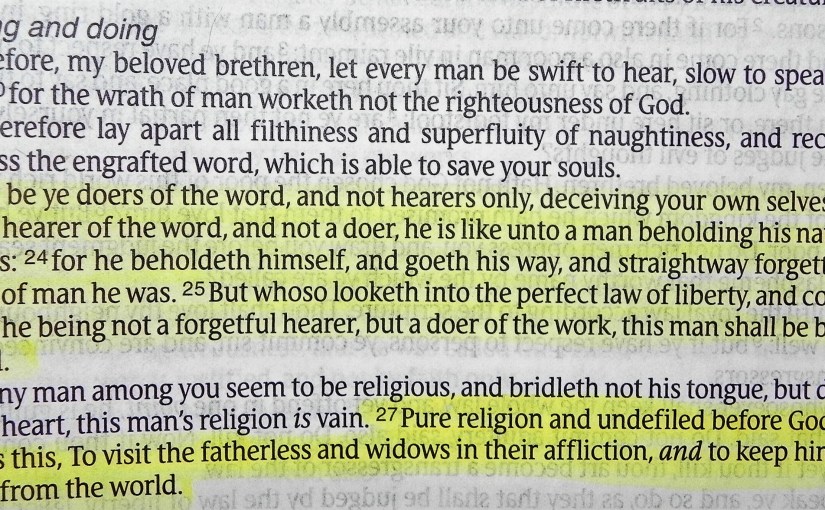
James 1

22 But be ye doers of the word, and not hearers only, deceiving your own selves.

23 For if any be a hearer of the word, and not a doer, he is like unto a man beholding his natural face in a glass:

24 For he beholdeth himself, and goeth his way, and straightway forgetteth what manner of man he was.

25 But whoso looketh into the perfect law of liberty, and continueth therein, he being not a forgetful hearer, but a doer of the work, this man shall be blessed in his deed.

26 If any man among you seem to be religious, and bridleth not his tongue, but deceiveth his own heart, this man’s religion is vain.

27 Pure religion and undefiled before God and the Father is this, To visit the fatherless and widows in their affliction, and to keep himself unspotted from the world

I post this because I see many hearers of the word and few doers. In fact, if you even try, just a little bit, to be a doer in this world you are labeled as an -ist, or a -phobe, or declared guilty of some form of -ism, and if none of these apply then you’re crazy, hateful, abusive, and so on.

I wish we would read the word of God with the intent to be doers no matter what the world says. I wish we would read God’s word, God’s written plan for our lives with the intent to follow it and not the intent to make God’s word fit into our plan. I wish we would read and study the God’s sovereign word with the intent to become more firm and fervent, and bold in our faith, not to try and use his own word against himself or to try and disprove his word. That has not worked ever since the word was penned yet we still try. I wish we would all stop thinking so highly of ourselves and realize the futility in trying to do it our own way.

Not a single one of us is so great as to be able to claim a greater sovereignty than God. Be hearers and then be doers of GOD’S WORD, NOT YOUR OWN AND BE UNSPOTTED OF THE WORLD!

There is nothing that you can do for yourself.

There is an incredible burden on my heart, one that has been even more profound these last few weeks. Daily sanctification is a journey. When we truly confess our sins, and have a genuine repenting heart, and professed that Jesus Christ is LORD, His blood cleanses the soul. After we have a soul free from the bonds of sin, then the spirit is free to dwell inside. Justification is the result of faith in and acceptance of God’s grace and mercy. Once the Spirit of the LORD dwells inside of us, we are able to have intense fellowship with God. It is a direct line to Him. We feel that correction of a loving father through the imputing of the Holy Spirit. The conviction we feel when something is wrong, or when we have offended someone comes from the Holy Spirit that dwells in us. But so does power. When we have the Holy Spirit inside of us, and we call on the Holy Spirit to take control and genuinely give up that control to the Holy Spirit we have power from God. It is important to recognize that that power is not ours. It is important to recognize and praise the source of that power. The indwelling of the Holy Spirit strengthens us as well as corrects us.

This is on my heart because of two things. The first is this. These past few weeks I have been confronted by a man. I believe he is a good man, and a hard-working man. I should know I work with. Over the past few weeks, and especially the last week, he has texted me often. He has been quoting scripture as he seeks answers for some work related issues. But this man believes that he is being wronged by administrators of our company. This man has a tendency to allow anger to overcome him. And I believe that he is using Scripture to authorize his anger and wrath. The second thing is simple. I believe I recognize this because I am guilty of the very same thing. We have been told “it takes one to know one”. Well, I believe that is true in this case. I love the word of God. I love the feeling of communication and communion with God during biblical studies, prayer, fellowship with like-minded Christians, and other situations where the presence of the Lord is genuinely felt. But in situations where things are not going well, the sinful flesh of my old self wants to take over. It is in this regard that my heart is burdened.

All of us, every self-proclaimed follower of Jesus Christ who believes that they benefit from the mercy and grace of the Almighty Father, better understand one thing. There is nothing that you can do for yourself. The Holy Scripture is meant to be our source of many things. The Scripture is our source of wisdom, of comfort, of guidance, of power, and so on. What the Bible is not, is a weapon to be used to justify our own desires. We cannot talk about putting on the full armor of God to go to battle to defend our desire of selfishness and still be in the will of God. In one of his texts, my coworker quoted the book of James. The book of James is one of my most favorite books. It should not be misconstrued as a book of works righteousness, but rather instruction on how the indwelling Holy Spirit brings about good works through you. Once again, you better understand that there is nothing that man can do for himself. My coworker specifically quoted verse 22 and 23.

James 1:22-23, “22 But be ye doers of the word, and not hearers only, deceiving your own selves. 23 For if any be a hearer of the word, and not a doer, he is like unto a man beholding his natural face in a glass:”

My coworker went on to quote a few other Scriptures. He was collecting them verse by verse from various places, trying to explain to me that the Bible says that we are to stand up and defend the faith and defend his position that he is not going to take anymore of the administrations non-sense by saying in his words, “compromising no more.” This would be a good thought if what we were talking about not compromising was faith in the word of God. My coworker is struggling with some personnel issues with administration, as well as some pay issues. In some regards I don’t think Jesus ever expected us to be pushovers. If we were to truly let all non-believers, like ISIS, just kill all of us, there would be no-one left to preach the word. But I do think that he expected us to use the spirit to help us discern between what’s right and wrong. My observation is that my coworker will take Scripture and use it to defend the execution of his wrath instead of allowing himself to be humbled by the spirit so that God’s wrath will prevail. Once again there is nothing that man can do for himself. God’s wrath will always be more righteous and more just than anything that man can come up with. I must repeat myself. I do not say this to lecture my coworker. I say this because it is a hard lesson, one that I have learned about myself over and over. I am grateful for the conviction of the spirit.

So let’s take a look at what James is saying here. It is my intention to lift up the word of God so that we can have a better understanding of what it means to be doers of the word. In order to do that, I think we have to quote more than just two versus, to keep everything in context. So let’s start and James verse 19

James 1:19-27
19 Wherefore, my beloved brethren, let every man be swift to hear, slow to speak, slow to wrath: 20 For the wrath of man worketh not the righteousness of God.
21 Wherefore lay apart all filthiness and superfluity of naughtiness, and receive with meekness the engrafted word, which is able to save your souls. 22 But be ye doers of the word, and not hearers only, deceiving your own selves. 23 For if any be a hearer of the word, and not a doer, he is like unto a man beholding his natural face in a glass: 24 For he beholdeth himself, and goeth his way, and straightway forgetteth what manner of man he was. 25 But whoso looketh into the perfect law of liberty, and continueth therein, he being not a forgetful hearer, but a doer of the work, this man shall be blessed in his deed. 26 If any man among you seem to be religious, and bridleth not his tongue, but deceiveth his own heart, this man’s religion is vain. 27 Pure religion and undefiled before God and the Father is this, To visit the fatherless and widows in their affliction, and to keep himself unspotted from the world.

My study Bible the Tyndale life application study Bible has a small paragraph providing commentary on the 27th verse. That commentary, on page 1887, reads as follows,
“to keep ourselves unpolluted (“unspotted”) from the world, we need to commit ourselves to Christ’s ethical and moral system not the world’s. We are not to adapt to the world’s value system based on money, power, and pleasure. True faith means nothing if we are contaminated with such values.

I think that it is absolutely awesome that Joseph Benson makes the following commentary about “slow to speak”. When I think of my coworker and myself I think about his words here that say,

“To deliver his opinion in matters of faith, that he does not yet well understand. Persons half instructed frequently have a high opinion of their own knowledge in religious matters, are very fond of teaching others, and zealous to bring them over to their opinions.”

We have a high opinion of our own knowledge and are very fond of teaching others in order to bring them over to our opinions. Again, I have to be honest. If you cannot look at this and say, “Yep, that is me sometimes.” the let me simply say that it is most certainly me sometimes. Unfortunately, for my co-worker, I think that is so true in these text messages. I love the book of James and am very familiar with it. And when I know what my coworker is trying to accomplish; and I see the Scriptures that he’s quoting in order to accomplish it, I see these words by Joseph Benson come to life. My coworker also texted to me that brethren in the faith, “also stand up for each other when we are being wronged” I would say that I would go to war for a friend if I believe my friend was being wronged. The problem is what he believes is wrong and what I believe are wrong are two different things. And he is willing to put our spiritual relationship on a hook if I don’t stand up for him; If I don’t go to war with him over what he believes is right. The Scripture does not say anything close to that. But I must say I have shared that opinion in the past and had the audacity to be upset with a brother for not being on my side. You want to talk about guilt. Once I realized what I was doing, there was no apology big enough. But THANK GOD FOR THE BLOOD OF CHRIST that allowed a brother to forgive another brother and for one brother to learn to pay attention to his mouth more often.

I’m going to continue with more commentary by Joseph Benson, because I believe he is spot on. Continuing to refer to the rest of the verses in James 1:19-27, he writes,

“The apostle, however, may be understood as cautioning his readers against easily yielding to provocation in any respect whatever, and especially when injuriously treated by their persecutors. For the wrath of man — Even when it appears in the garb of religious zeal, worketh not — But, on the contrary, greatly obstructs, the righteousness of God — Instead of promoting the cause of true religion in the world, it is a reproach to it, and a means of exciting the prejudices of mankind against it. Persecution, in particular, the effect of the wrath of man, if violent, may make men hypocrites, by forcing them to profess what they do not believe; but it has no influence to produce that genuine faith which God accounts to men for righteousness. Nothing but rational arguments, with the illumination of the Spirit of God, can do this.”

When I read these words I cannot help but think of myself, “On more than one occasion I have represented this hypocrisy, lack of influence to produce genuine faith, and reproach in exercising my own wrath. I am certain that people have looked at me and said, “who is this man?” One minute I was talking about God and the next minute I was acting like a lunatic. I am ashamed to admit that this still happens from time to time. My daily sanctification has me working on this issue because I believe every word that Joseph Benson is saying here is truth. I believe that this is something that I clearly see in others because I am so acutely aware of its existence inside my own body. It is something that I wanted to take time to caution everyone about. We live in a day and age where people are looking at Christians and scrutinizing us with the most critical eye. We cannot afford to dampen the light of Jesus Christ, we cannot afford to contaminate the ethical and moral system of Jesus Christ with our own wrath brought about by the violation of our own morals. This whole relationship, salvation, is not about us. I say again, there is nothing that we can do for ourselves. Everything is about Jesus the Christ!

I have had many conversations with myself, the man in the mirror, and the triune God. My question to you is, “are you having these conversations yourselves?” I know many Christians, just like my coworker and I, who have used or continue to use Scripture to validate their questionable behavior. There is righteous anger. There is anger that has compassion for change in it. But if your anger leads to sin, if it produces hate in your heart or even just a little anger in your thoughts, then perhaps this conversation in the mirror is something you should take time to have sooner rather than later.

If you stand in the mirror what will the reflection tell you about yourself, and what are you going to do about it? May the peace of God be abundantly heaped upon you and your house, straight from the cross to the Christian!